Topic

Sub 1 lb. Intellectual Exercise

  • This topic is empty.
Viewing 25 posts - 76 through 100 (of 142 total)
PostedJun 1, 2008 at 6:32 am

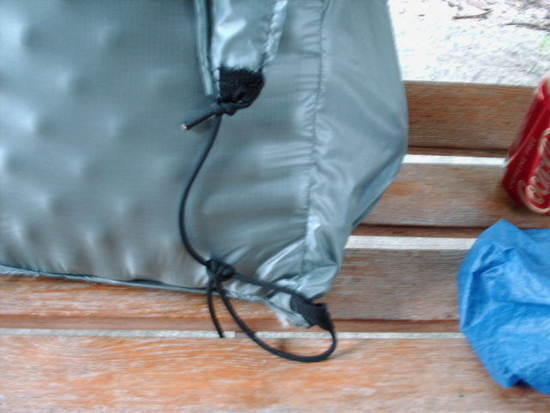
I finished up my SUL prototype bivy this morning and took a few pictures.SUL Bivy prototype
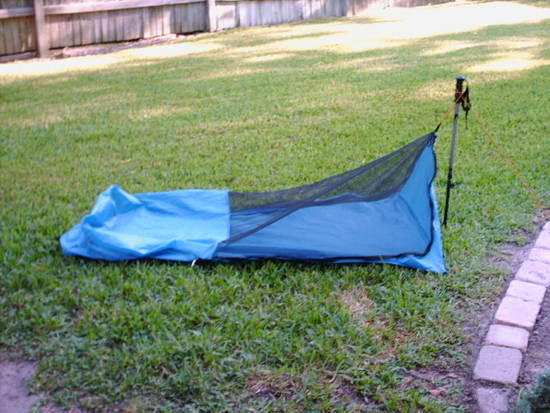
This is the prototype made from .92 oz per square yard spin cloth and .9 oz per square yard no see um netting. The Spin cloth comes up to just above the knees.

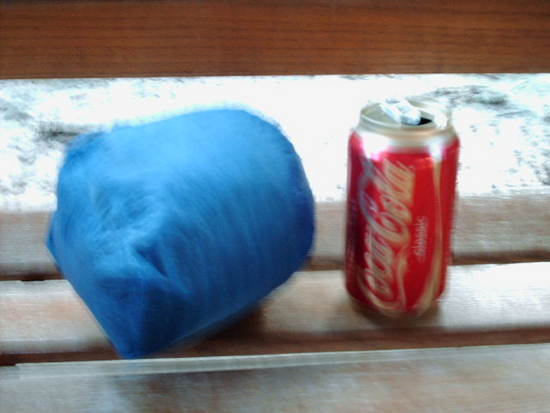
The thought is that this bivy would only require a ~half poncho for complete rain protection.close-up of nettingAbout the size of a coke can when stowed
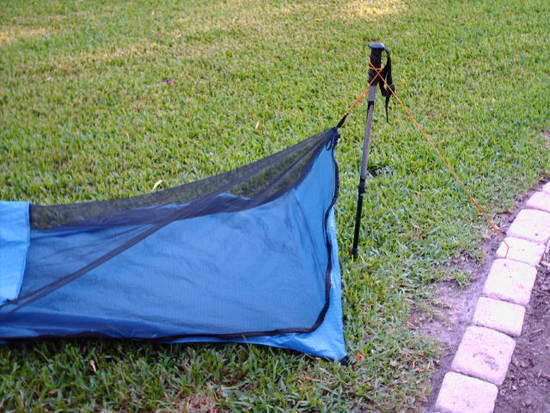
Should come in around 6 oz with the spin material but the new scale will be here sometime later in the week, accurate down to the tenth of an ounce.

This uses 3.4 square yards of Spinnaker material. 0.6 ounce per square yard Cuben would save 1.1 ounces. Nanoseeum netting would save another 1 third of an ounce for a total savings of somewhere around an ounce and a half.

I learned a lot about the pullouts needed and reinforcements, so I think I can shave another ounce off whatever the total weight is now, so a cuben/nano see um bivy like this could come in sub 4.5 oz I think.

Next is a prototype half poncho tarp out of this nice red 1.35 ounce Sil-nylong I have laying around, but a 6 x 5 poncho tarp of sil should come in around 5 oz i think.

Of .6 oz cuben I think I can go sub 3 easy, perhaps under 2.5 oz and retain some toughness to the material.

For now, given the expense of Cuben, I'm going to keep a "weight penalty" number going to keep track of the weight penalty I'm taking to save money. This number is kind of like a "Handicap" going forward to equalize the material properties.

So far, my Cuben handicap is around 1.5 ounces

PostedJun 1, 2008 at 6:55 am

Hi mark.

Its looking really good. You have put a lot of time and work in making it so I hate saying this but 6 oz?? It will be hard to justify the weight when you can wear a bivanorak.

Bill Fornshell BPL Member
PostedJun 1, 2008 at 8:34 am

Hi Mark,

I like your Bivy Prototype.

A few questions:
1. Why the heavier version of the Cuben (.6)? vs the lighter stuff?
2. Do you know the product number of the .6 Cuben? I have some .6 Cuben but it is the 4 cord version and really strong.
3. Are you using Velcro to close the Bivy (Bug Mesh?) to the other material?
4. If yes, how many feet of Velcro did you use and do you know how much the Velcro weighs?
5. When Ed Speer made my Silk Hammock he used 17 feet of velco. Full length on each side of my bug net. The Velcro weighed about as much as the Silk did. My bug net was light weigh silk mesh.

Thanks.

PostedJun 1, 2008 at 12:20 pm

Bill,

I'm not very cuben savy, but I see that most manufacturers that make Cuben stuff either use the .6 or the 1 oz per square yard stuff ….. so I was assuming that the .6 would be a bit more abrasion resistant.

I know I ordered one yard of the .6 stuff for the pack. I've got some stow bags made from the .6 cuben and I really like the feel of it.

I don't know the number … I just ordered it by the weight.

I'm using zipper to close the Bivy on one side … it adds an ounce overall to the bivy. The other side is sewn in place.

PostedJun 1, 2008 at 12:26 pm

I finished the Sil-nylon 1/2 poncho tarp prototype today and thought I'd post a few pictures.

The finished tarp is 48" x 48" with the hood attached along a slit passing from one corner to the other. I'm playing with some ways to close the hood to weather by rolling it closed and passing something over it.

The calculated weight of the tarp is 3 ounces not including the lines.

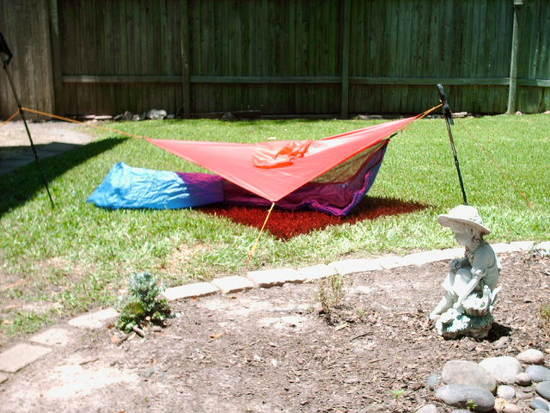
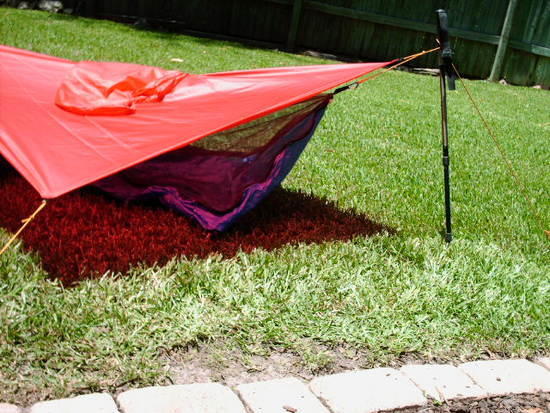
I've set it up very low in the picture to show the storm pitch.tarp and bivy in storm configuration
close up

Using the Lightweight Cuben would take this to about 1 ounce.

This takes my Cuben handicap to about 3.5 ounces.

6 ounces for the Bivy, 3 ounces for the Cape/tarp yields 9 ounces total, with cuben taking this to 5.5 ounces for the total.

A 1.5 ounce pack takes this to 10.5 for the inexpensive option and 7 ounces for the Cuben options.

As Bill pointed out … there are lighter Cuben fabrics that could takes this down one additional ounce to 6 ounces total for about the same cost.

Now for the Quilt …..

PostedJun 1, 2008 at 1:29 pm

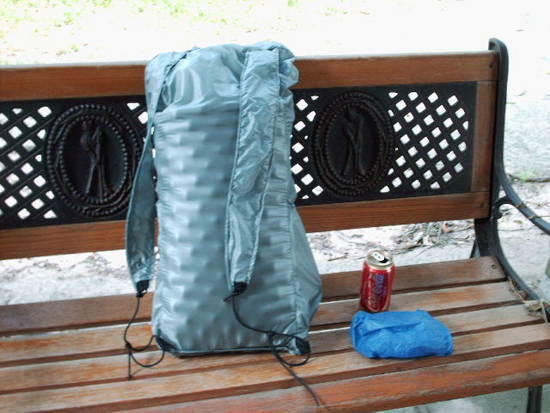
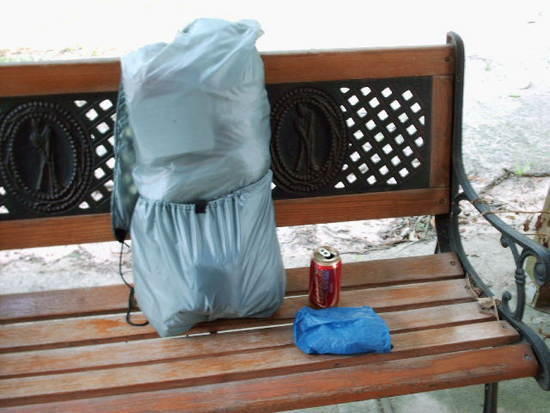
Here's some pictures of the silnylon prototype pack that I wrote about earlier.

This pack uses one square yard of material and holds about 2000 cu in with the front pocket.

I'm calculating the weight around 2 ounces … but I won't know for sure until the new scale gets here next week.pack strap design
Pack strapsPack back
The back of the packPack front with pocket design

Front with Pocket design

This takes my Cuben Handicap to about 4.5 ounces

Prototype bivy at ~6 ounces, Tarp at ~ 3 ounces, and Pack at ~2 ounces. This yields 11 ounces where Cuben would take it to about 6.5 ounces.

If I can get a Quilt/Tunic prototype to around 9 ounces I'll be at 20 ounces with the big three ….. with the cuben handicap of 4.5 ounces this yields 15.5 ounces ….

I still need to "crack the nut" on insulation without resorting to a reflecting mylar type material for the quilt.

Bill Fornshell BPL Member
PostedJun 1, 2008 at 3:20 pm

Huzefa,

You need to make a full size prototype of some of your ideas in real cheap material. Then tell us how many square yards or meters of material it took and show us what it looks like. We can then play "what if" and see how much it would weigh in Cuben or some other material.

Until then only you know what you are talking about.

jdubhikes BPL Member
PostedJun 1, 2008 at 5:36 pm

Bill, you sure know how to spur a good thread! Good to see you posting again.

I have to respectfully disagree with the practice of wearing gear and not counting it as *base weight*. Lower weight is not actually achieved by moving ones shelter from the *Base Weight* category and placing it in *Clothing and Gear* worn category and then strapping it to oneself. The net result is the same, the only difference is on paper and where the gear is located during the hike.

Yes, it is a fine line between what is actually good multi-use and what is blatant cheating to get one's base weight down. However, to be honest I think any piece of gear that is not our basic clothing, hat and shoes should be counted as *base weight*. I'm all for sub-x or whatever, but let's get there by lowering gear weights or reducing gear, not shifting stuff around and remaining at the same overall weight.

*Base Weight* includes things we hang off our necks and place in pockets and on hats. In most of the lists I've studied and hikers I've spoken with a watch is generally a freebie and exception to this *best practice* approach. More than this and we are just cheating ourselves.

To go sub-x one must actually reduce the amount of gear and/or lower the weight of gear, re-distributing gear around one's body does not count towards reducing *Base Weight*, IMHO of course.

I post this because I am passionate about accomplishing 3 season backpacking with the lightest possible gear that allows me to weather rain, freezing temps and hot sun over a period of 3-5 days between resupply. Naked with knife does not apply as in most wilderness areas one cannot construct shelters or make fires to keep warm, so we must carry what we need for all the above conditions.

If a list goes sub-x but relies on man made shelters or restaurants for meals it does not seem to be very relevant to the majority of backpacking venues.

I'd like to see a sub-1 list that meets typical three season conditions!

That said, this sort of thread is a great way to inspire both less gear and lower weight gear, and I am excited to see the result of such creative minds as those here at BPL! Let's just place be men about it and suck up the weight of our gear by placing it in the *Base Pack* category.

PostedJun 1, 2008 at 6:34 pm

Hi Bill.

Bivanorak:
http://www.hilleberg.com/2006%20Products/NewBivanorak.htm

My idea is to make it sleeveless out of propore with a zip which can close the armholes.
Advantages:
>lighter
>no overheating
>very breathable

Moonbow gearskin:
http://www.moonbowgear.com/1trailgear/1Custom%20packs/Gearskins/gearskin.html

You can see that weight of the this harness comes from all that webbing and buckles. Replace it with cord.

Trekking in India is perhaps more wild. Even in sahyadris where I hike trek pass through forests, bushes (I hate those!) and steep rocky routes where you cant always protect your pack from some abrasion. So cuben/spinn/silnylon are no-no. I think 160D cordura would be the minimum required which can also double as groundsheet.

.. Or I can double bivanorak as cover for a cuben pack. And use poly pad inside the bivanorak. Something I have to think about. Since I will be wearing it I can add patches of heavier fabric at the back with no penalty on pack weight.

PostedJun 1, 2008 at 6:42 pm

Mark, I like your pack. good thinking about using cord instead of webbing. Is it spectra? There is a possiblity of cutting some grams there.

PostedJun 1, 2008 at 7:36 pm

Thanks!

On the prototype I used Paracord and SilNylon

I have some Cuben and Spectra cord on order.

The real trick was using a Magnus hitch knot on the cord (friction hitch). It's adjustable when there is no load on the knot, but holds fast when even a few pounds of pressure is applied.

I'm not sure that the Magns hitch knot will be the right friction hitch to use with spectra cord, however …. but we'll see.

Bill Fornshell BPL Member
PostedJun 1, 2008 at 8:18 pm

Hi Jhaura,

Thanks for taking the time to comment.

I don't completely disagree with all of your comments, but —.

The "Great Kilt", for the old time Scottish clansman, was both a body garment and something to sleep under or wrap around them at night when necessary.

I don't think I have a problem saying I am going to wear a "Great Kilt" during the day and turn it into two different items at night. That one of those items happens to be a hammock and the other happens to be a tarp. Oh, and by the way the "Great Kilt" happens to be made out Cuben Fiber. I try and make everything out of Cuben Fiber so that should not surprise anyone that knows me. When I wear the "Great Kilt" I leave home my ExOfficio Shirt (286.3 grams) and Pants (376 grams), those two items in my size weigh 22.4 ounces. The total weight of the "Great Kilt" is 10 ounces. This is less than half the weight of the shirt and pants.

If I wear something all day hiking (Great Kilt) and it takes the place of a shirt and pair of pants – I am wearing it. As for the "Great Kilt", all I have on when I am wearing it is my underwear – you hope – at least most of the time.

I also count my trekking poles as "worn" since I use them all day as I hike.

I do agree about stuff that hangs off our necks, stuff in our pockets, attached to a hat and I am sure a few others. I would not count a watch as packed as most of us wear a watch all the time. If the watch did a lot of other things and was heavier than ???, I might have to think about that.

I am not sure that creating a Sub 1 pound gear list, as a "purest", as you suggest, with materials, (that we can get in todays world), is possible. We are talking about 16 ounces or ( 453.6 grams). That is less weight than two 12 ounce cans of Diet Coke. One 12 ounce can of Dirt Coke weighs 369.4 grams.

The good thing about this "Exercise" has been a lot of new ideas. I expect more good ideas to come before it has run its course.

I would like to say I am going to take a trip up to Georgia and do a hike on the AT to test the Sub 1 pound gear list. I would not fly, so it would take about $500 worth of gasoline – round trip from Home to Springer Mountain, GA and return.

Maybe BackpackingLight.com would like to sponsor the trip for a story and Podcast. I would say pictures also but I can't carry a camera and stay under 1 pound.

However, since the camera has a time feature I could call it my watch and wear it. That is a joke – Jhaura.

Bill Fornshell BPL Member
PostedJun 1, 2008 at 8:28 pm

Hi Mark,

I want to comment on you recent posts and your gear and will do that later tonight.

I am going for a walk. It is down to a sticky 76 degrees F which should about be our low for tonight.

PostedJun 1, 2008 at 9:16 pm

Bill,
If you're looking to do it on the cheap, you could probably "go greyhound" for about half that price, but that doesn't include to and from the terminals. Personally, I'd suggest spending the whole enchilada. My sanity does not involve riding a greyhound bus halfway across the country, but your mileage may vary (pardon the pun).
Best of luck.
Chris

PostedJun 1, 2008 at 9:17 pm

while thinking about spectra I got a idea for a new lighter construction of Poly air pad.

Take a poly bag with three sides sealed and one long side open. Then take pieces of spectra cord lenght of which = to the thickness of the pad you would like. Glue these at a regular intervals in manner of a grid. Seam seal the fourth side while placing a valve at one end.

Another thing -you will have to leave a margin (=half the cord lenght) when you plan your grid. Otherwise side baffles will be smaller.

Bill Fornshell BPL Member
PostedJun 1, 2008 at 11:00 pm

Huzefa,

He is some data to play with. My 2 mil. Poly Tubing is 5" – flat and weighs 3.7 grams per foot. I never opened the 3 mil so I have no idea how much it weighs.

PostedJun 1, 2008 at 11:24 pm

A 20"x30" pad (when flat) will weight 37 grams or 1.3 oz nice :) Add weight of spectra and valve – a sub 2oz luxurious torso air pad is possible.

Sam Haraldson BPL Member
PostedJun 2, 2008 at 8:07 am

I'm thoroughly enjoying seeing this type of thread again. I would like to comment briefly on the semantics debate however.

I agree with Jhaura (and others) that the re-arranging of gear from pack to items-worn is of little to no value. However, I also agree with Bill that if a piece has multi function one should not be penalized.

I suggest adopting a policy to weigh our lists 'from skin out' (with a discussion of the definition of consumables to take place as an aside) thereby leveling the playing field. All clothing and gear would be weighed and considered the gear necessary to live in such and such conditions for however many days.

$0.02

PostedJun 2, 2008 at 8:50 am

Be careful defining Skin Out ….. you may see more naked hikers than you care for!

PostedJun 2, 2008 at 8:52 am

Huzefa and/or Bill,

Are you planning on Heat sealing the Poly?

Can Cuben be heat sealed?

PostedJun 2, 2008 at 9:05 am

This is Bill's original post to this Thread …. reprinted here for clarity:

"I have printed out a bunch of the comments from the old thread. I only went back a couple of pages as the first two pages were not really relevant to a serious discussion on the topic.

I highlighted many of your suggestions on my copy and and made a consolidated list of sorts.

If you all want to do an "Intellectual Exercise" on this topic then we need a few assumption or conditions to give this some degree of merit and a good starting point.

1. I would suggest the hiking area be the southern half of the Appalachian Trail during the months from June to August. During that time the temperature range should be from 60 degrees F up to whatever. If someone thinks a low of 60 degrees is not low enough speak up.

2. How do we decide what we count toward the Sub 1 pound or 16 ounces?

3. I think we should let the weight drift up to Sub 2 pounds or 32 ounces if necessary and then pare the weight down from there.

4. I think the hike should be sustainable with a 3 to 5 day resupply over a period of several hundred miles or more.

5. Add you comments here as they related to the first 4 and or any new ones you think should be considered. I will consolidate them into one list and edit them as necessary."

1.) The AT is a great choice. And 60 degrees is fine …. I try to carry enough gear for a 20 degree drop below average nightime lows, which takes into record low territory, and a 40 degree survival minimum for this exercise is fine.

2.) I'm thinking that one pound less normal clothing worn for the temp range given is a good start. If you'd like, we can take the Ryan Jordan standard of a Photon and Whistle on a lanyard around your neck as clothing worn as well …. since as surivial equipment it really shouldn't ever be in your pack anyway. I'd even say that a Small knife and a small flint striker or an EXTRA lighter, or EXTRA matches, as survival equipment is good as well for counting as items carried. This stuff should be always carried and never in your pack anyway.

But 2 oz max on the knife and 1 oz max on the survival gear carried would be my thoughts.

Everything else, except poles, should be pack weight.

3.) Sub two is a good target … then tighten our belts down to near the 16 oz mark. That way, we don't discourage ideas that only get us to 22 oz total, for example, or compromise safety just to meet an arbitrary target. If we can only get to 27 oz safely, then that should be the limiting factor.

4.) I agree … sustainible equipment. The equipment should be capable of doing multiple trips, or an extended trip. That way, we don't start looking down the "disposable quilt" or "disposable Pack" thought processes.

PostedJun 2, 2008 at 9:49 am

yes I am planning to heat seal poly. I dont know if you can heat seal cuben.

whats on your mind? cuben air pad? :)

Cuben Fiber is a laminated fabric constructed from plasma-treated Ultra High Molecular Weight Polyethylene (UHMWPE) fibers and monofilament polyester film. Cuben fiber is sometimes confused with carbon fiber, a fiber used as a reinforcement in some Cuben Fiber sails. UHMWPE fiber products are marketed as Spectra or Dyneema; they are thermoplastics as opposed to Carbon Fiber or Aramid fibers such as Kevlar. (wikipedia)

Perhaps the monofilament polyester film is air tight. If so then with good adhesive job a cuben air pad may be possible. I think its too thin to heat seal.

Bill Fornshell BPL Member
PostedJun 2, 2008 at 1:54 pm

If you search the archives hard enough you will find my reference / link to that site. I have some of the different Cuben products like they used. Several years ago I talked to them on the phone to see what product # of Cuben they were using.

It isn't very likely that you will come up with anything that hasn't been tried for Cuben Fiber or Poly Tube material by just talking about it.

If it could have been done don't you think it would have by now?

You have to start doing more than just talking about ideas, you have to start making prototypes. I don't want to imply that everything has been discovered that will ever be discovered, but it will not happen until you start making things. You just may get lucky.

There are a lot of things I have done or tried with Poly Tubing and Cuben Fiber that I don't talk about.

Viewing 25 posts - 76 through 100 (of 142 total)
Loading...