


Introduction
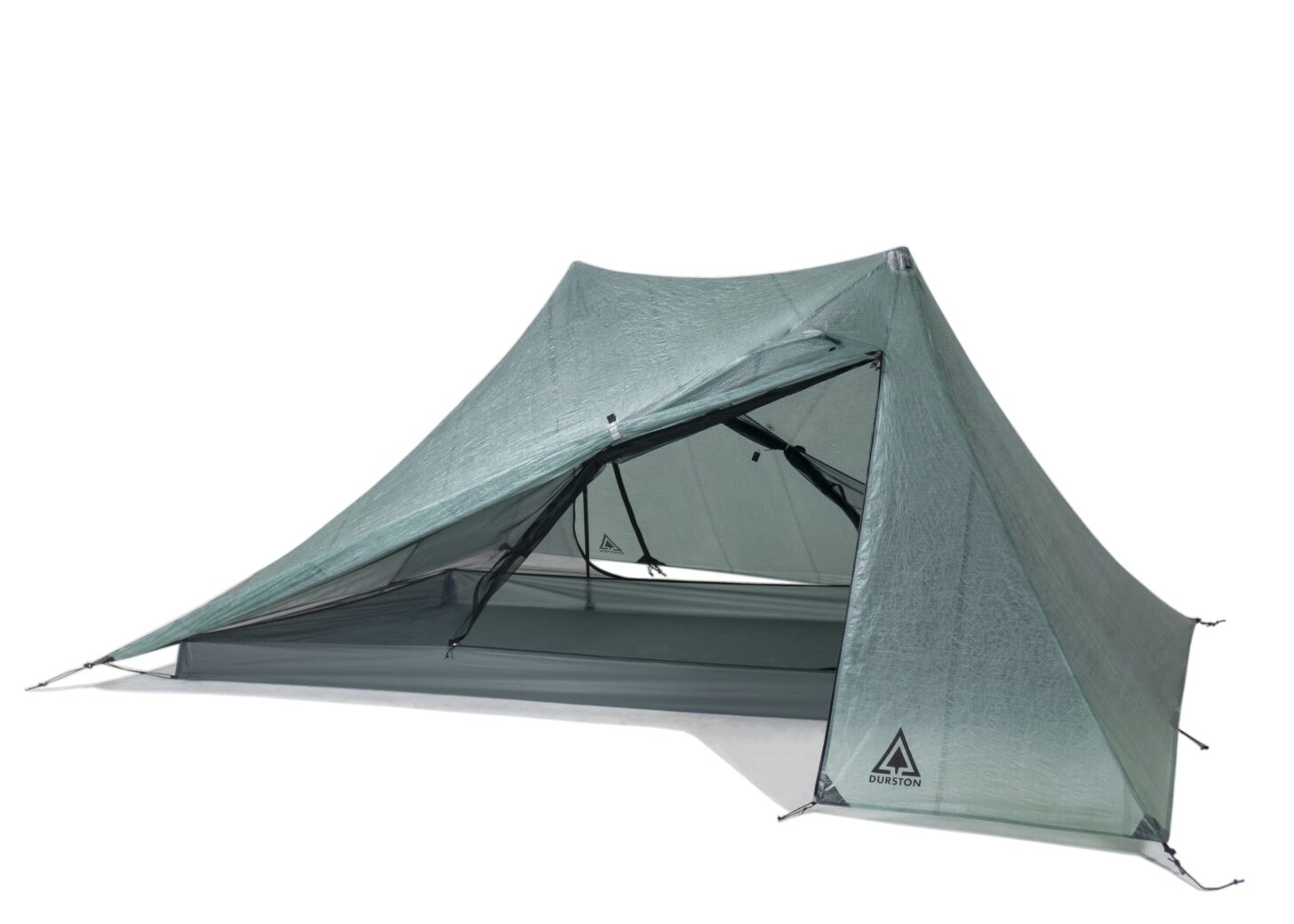
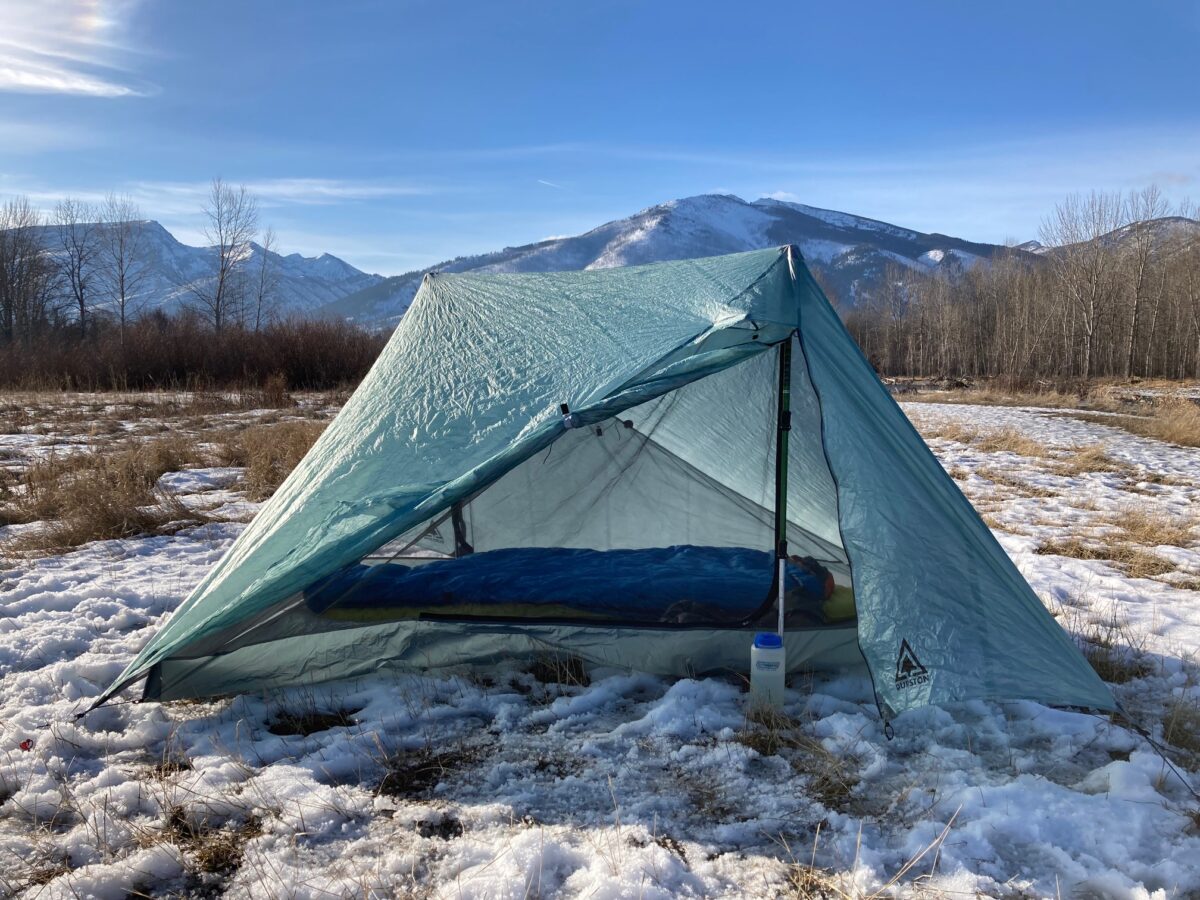
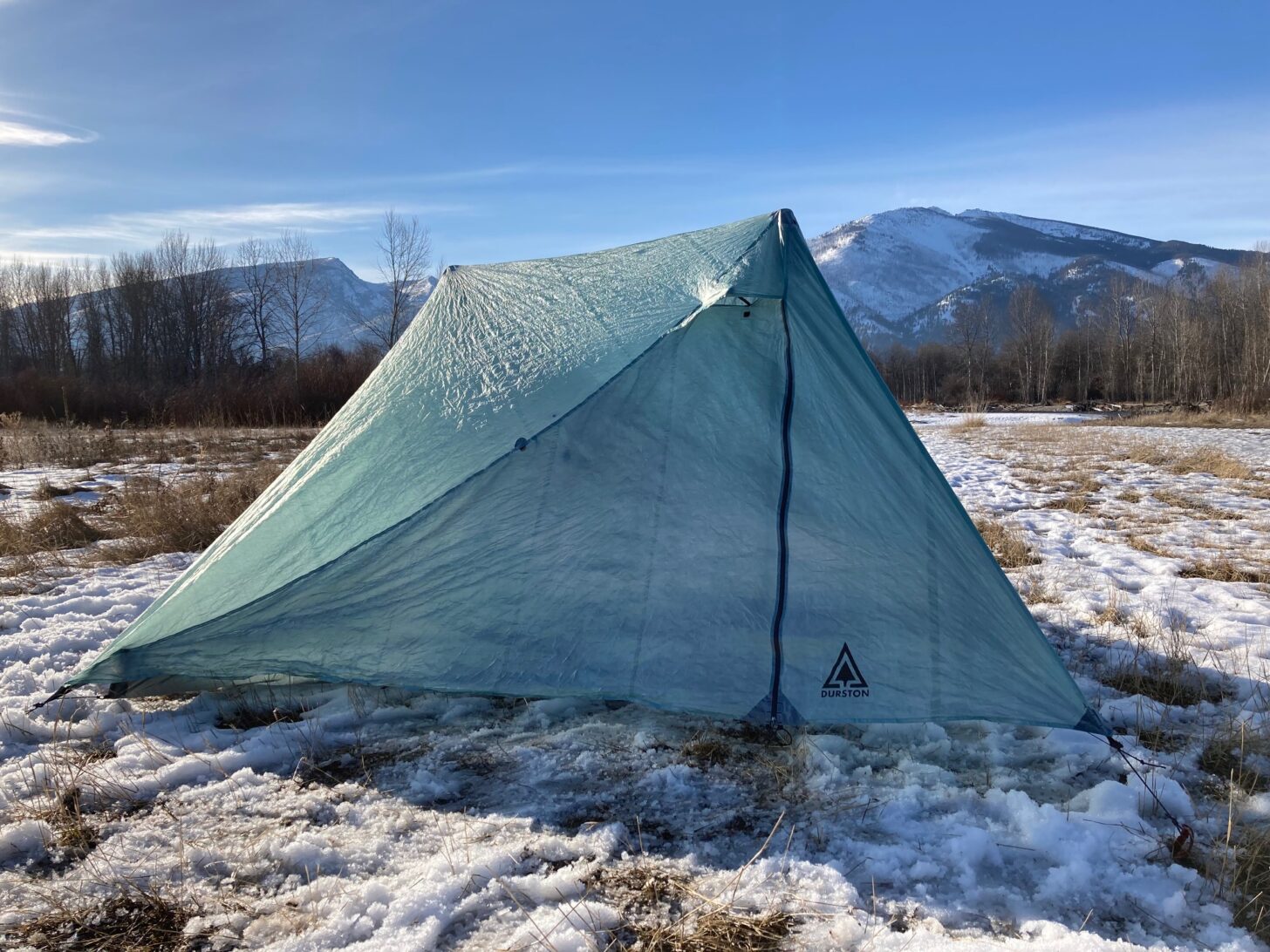
The Durston X-Mid Pro 2 tent (20.4 oz / 578 g, MSRP: $639) is an ultralight, single-wall, two-person, double-door, double-vestibule, side-entry, trekking pole-supported shelter made of Dyneema Composite Fabrics (DCF). It requires two trekking poles and a minimum of four stakes to pitch. The design combines the headroom and spaciousness of a classic double-pole single-wall shelter with the stormworthiness and simple set-up of a pyramid-style shelter.
The Durston X-Mid Pro 2 is a compelling product in the somewhat narrow category of ultralight, two-person DCF shelters. The silpoly Durston X-Mid 2 is already a popular tent and is Highly Recommended by Backpacking Light. That makes the lighter, updated DCF version particularly intriguing.
The Durston X-Mid series of tents has become a favorite among ultralight backpackers, and demand for these shelters is very high. A recent sale of the Durston X-Mid 1 sold out in three minutes. Company founder Dan Durston notes there that there will be a better supply of the X-Mid Pro 2, but it seems unlikely that they will remain in stock very long following their initial launch.
This First Looks review is based on our initial hands-on evaluation of a pre-production sample of the Durston X-Mid Pro 2 Tent.
Review Update Log:
- June 13, 2023: This review was updated with long-term performance results.
- March 25th, 2022: Backpacking Light founder Ryan Jordan and Backpacking Light canine-in-chief Sierra recently had a chance to spend some time with the Durston X-Mid Pro 2 in the field. The new photos are at the end of the review, in the Photo Essay section. Click to jump straight there.
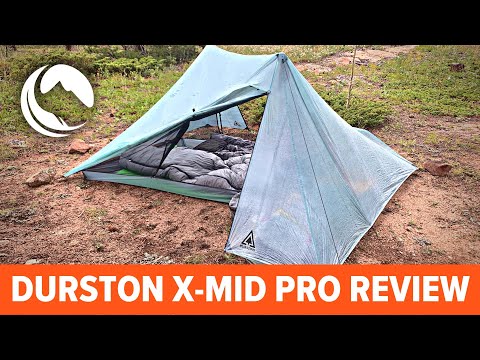
- August 22nd, 2022: We shot a video exploring the features of the Durston X-Mid Pro 2. You can find it below.
X-Mid Pro 2 Review Video
Highlights
- shelter: 20.4 oz (578 g), plus 4 stakes and two trekking poles
- height: 46 inches (117 cm)
- floor width: 48 inches (122 cm)
- floor length: 90 inches (229 cm)
- floor area: 30 sq ft (2.78 sq m)
- vestibule area: 21.5 sq ft (2 sq m)
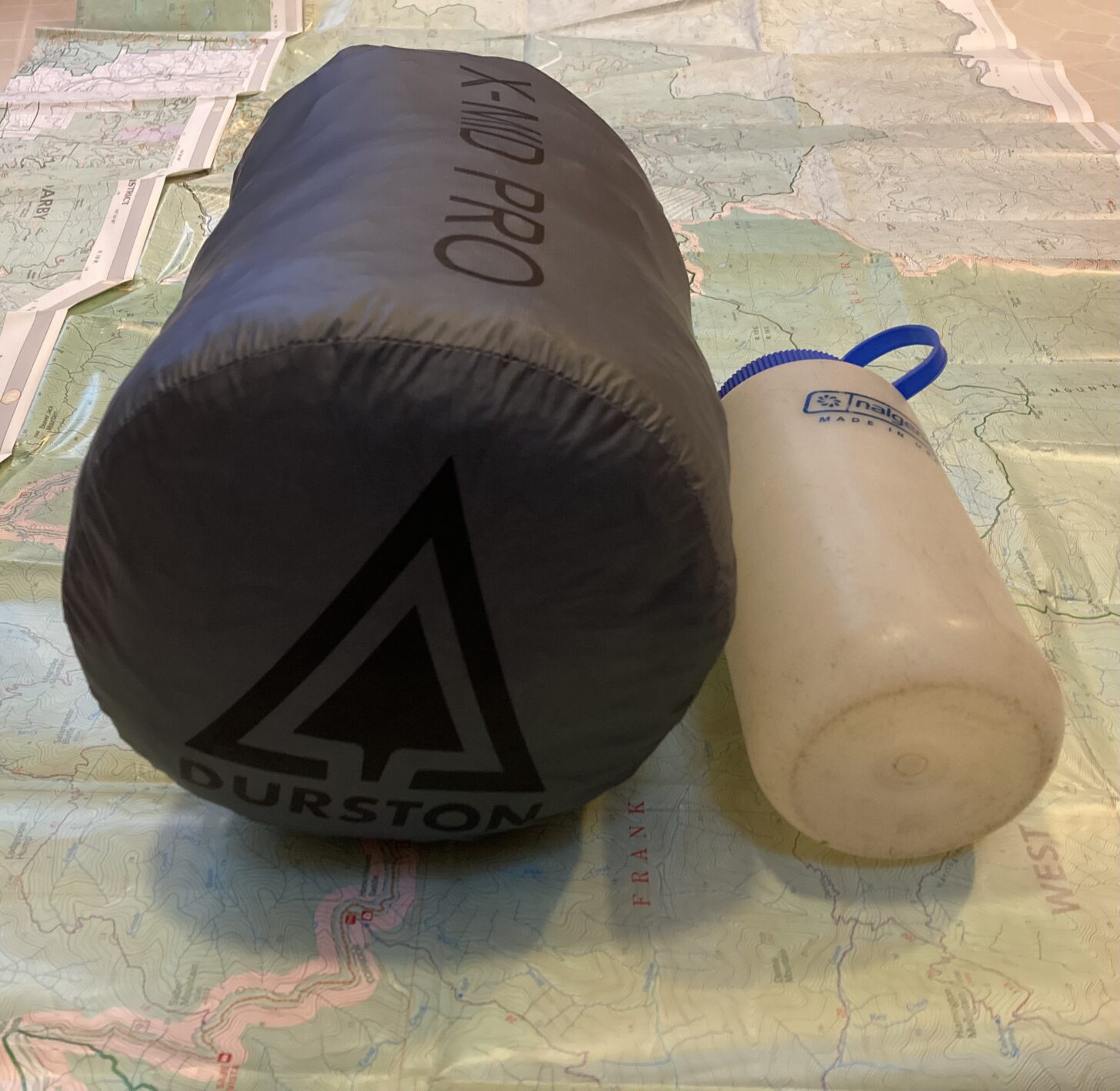
- packed size: 12 x 6 inches (30 x 15 cm)
- rectangular design allows the tent to be pitched with four stakes
- dual peak vents help manage condensation
- bonded construction instead of sewn construction
- offset pole design allows for easier entry and increased interior volume
- two doors with dual vestibules, waterproof zippers on vestibule doors
- 15 denier nylon floor doesn’t require a footprint in most conditions
- floor lays taut when pitched and tensioned properly, instead of simply hanging
- vestibules provide ample room for storing packs and other items not brought into the shelter
- door zippers are easy to operate one-handed
- magnets allow for the vestibule and/or the mesh tent door to be easily rolled up
Testing Context
This review was conducted using both pre-production prototypes and production models of the X-Mid Pro 2.
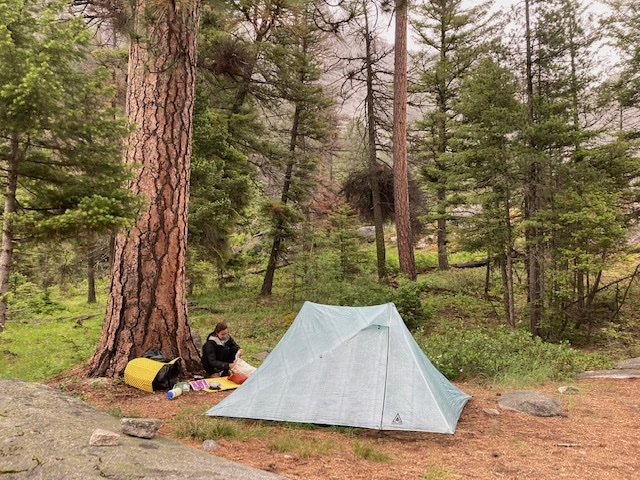
I used the Durston X-Mid Pro solely on summer and fall backpacking trips in the Northern Rockies. It was used for 27 nights. For 22 of these nights, I was the only occupant (the remaining nights were shared with a partner). This tent was tested in national forests and designated wilderness areas that did not require camping in designated sites; therefore I was able to choose locations at my discretion. Whenever possible, I chose sites that had ample room for the tent to ensure a proper pitch, soil that was easy to place stakes into, and natural features (boulders, trees, slopes) which provided additional shelter from the elements. I did not use a footprint while testing this tent and instead tried to practice good site selection and remove small rocks, pine cones, sticks, and other debris before pitching the tent.

I experienced several mild rain events while using this tent, two consecutive days of near-constant rain or drizzle while at a basecamp, three mild-to-moderate thunderstorms, and one severe thunderstorm with approximately 10-minutes of marble-sized hail and gusty winds of around 15-20 mph. I did not use this tent in snowy conditions or excessively windy conditions. Mosquitoes were present, and often in abundance, on roughly half of the nights while using this tent.
First Impressions
As with the popular X-Mid 1 and X-Mid 2, one of the most impressive attributes of the Durston X-Mid Pro 2 is its unique geometric design that incorporates offset trekking pole placements. (Compare this to most shelters that incorporate two trekking poles, which use a direct-opposite placement of the poles.) In addition, the details that caught my attention include its ease of use, livability, and potential performance in inclement weather.
We recommend you read our Durston X-Mid 2 Review to familiarize yourself with some of the design features of X-Mid tents. That review will aid in your understanding of the X-Mid Pro 2 design.
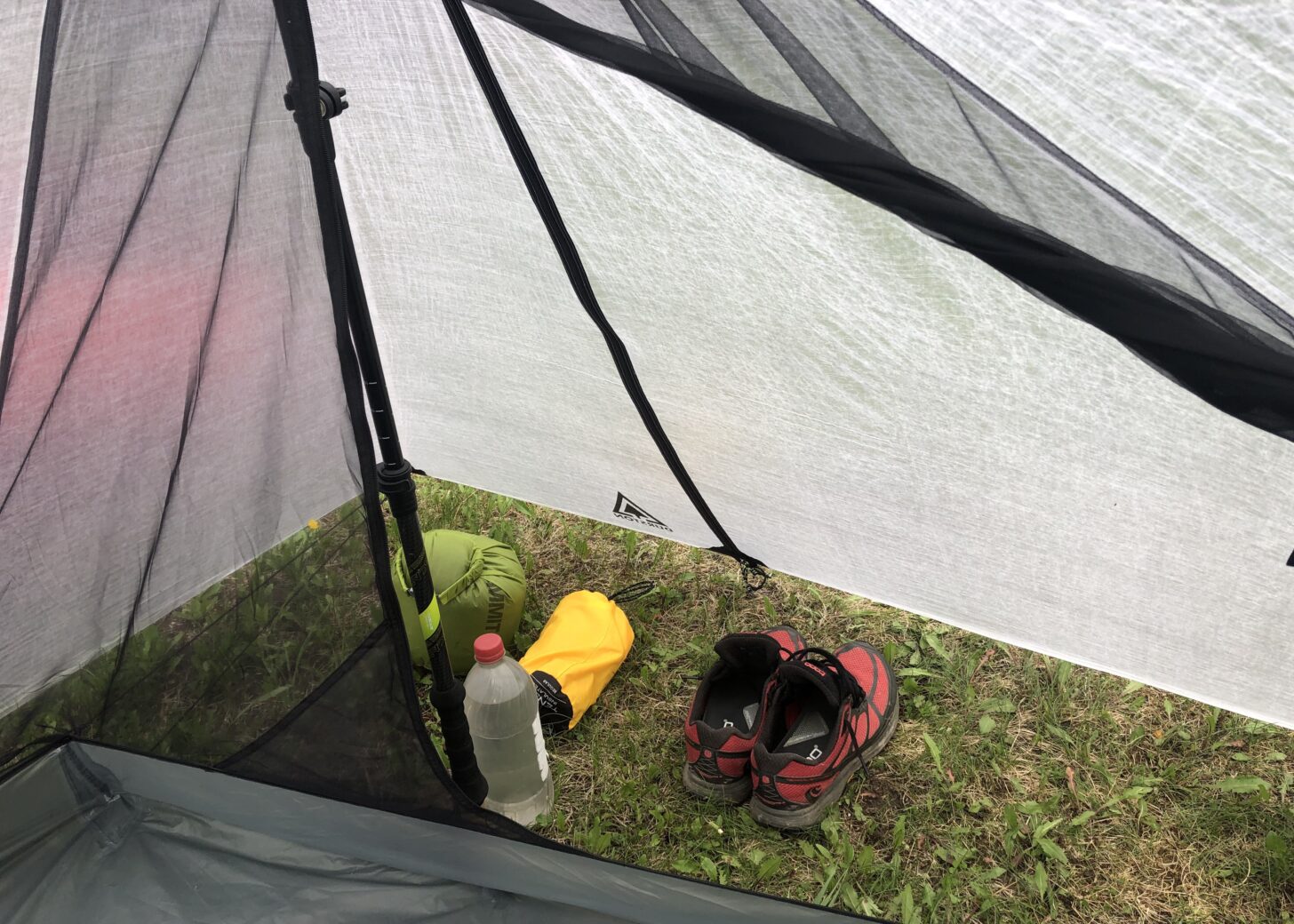
The most obvious unique design features of the X-Mid Pro 2 include:
- an intuitive (rectangular) pitch that requires a minimum of only four stakes;
- a spacious interior (a function of the offset poles and overall geometry);
- integrated fly that extends further to ostensibly provide better coverage in storms than similar tents. The area covered by the fly of the X-Mid Pro 2 is 55.5 sq ft (5.1 sq m), compared to the Zpacks Duplex whose area covered by the fly is 48.6 sq ft (4.5 sq m).
The Durston X-Mid Pro 2 Tent is designed to be pitched using two trekking poles. For hikers who don’t use trekking poles, or for bikepackers and packrafters, Durston Gear has a lightweight, folding pole kit that is compatible with the X-Mid Pro 2 (and other shelters).
“The X-mid Pro 2 can offer more space and function for the weight because it uses genuinely more efficient geometry (e.g. fewer seams, less fabric for the volume, etc.) so we can put more weight into things that matter,” said Dan Durston.
What’s the difference between the Durston X-Mid 2 and the Durston X-Mid Pro 2?
Compared to the X-Mid 2, the X-Mid Pro 2’s footprint is smaller:
- X-Mid Pro 2: 80 x 100 inches (203 x 254 cm)
- X-Mid: 90 x 102 inches (229 x 259 cm)
This allows the X-Mid Pro 2 to more easily fit into tighter campsites. The headroom is almost identical between the two shelters. The floor width of the X-Mid Pro 2 is only 2 inches (5 cm) smaller than in the X-Mid 2. The most obvious difference between the two shelters is that the X-Mid 2 is a double-wall shelter and the X-Mid Pro 2 is a single-wall shelter.
Is the Durston X-Mid 2 Pro easy to pitch?
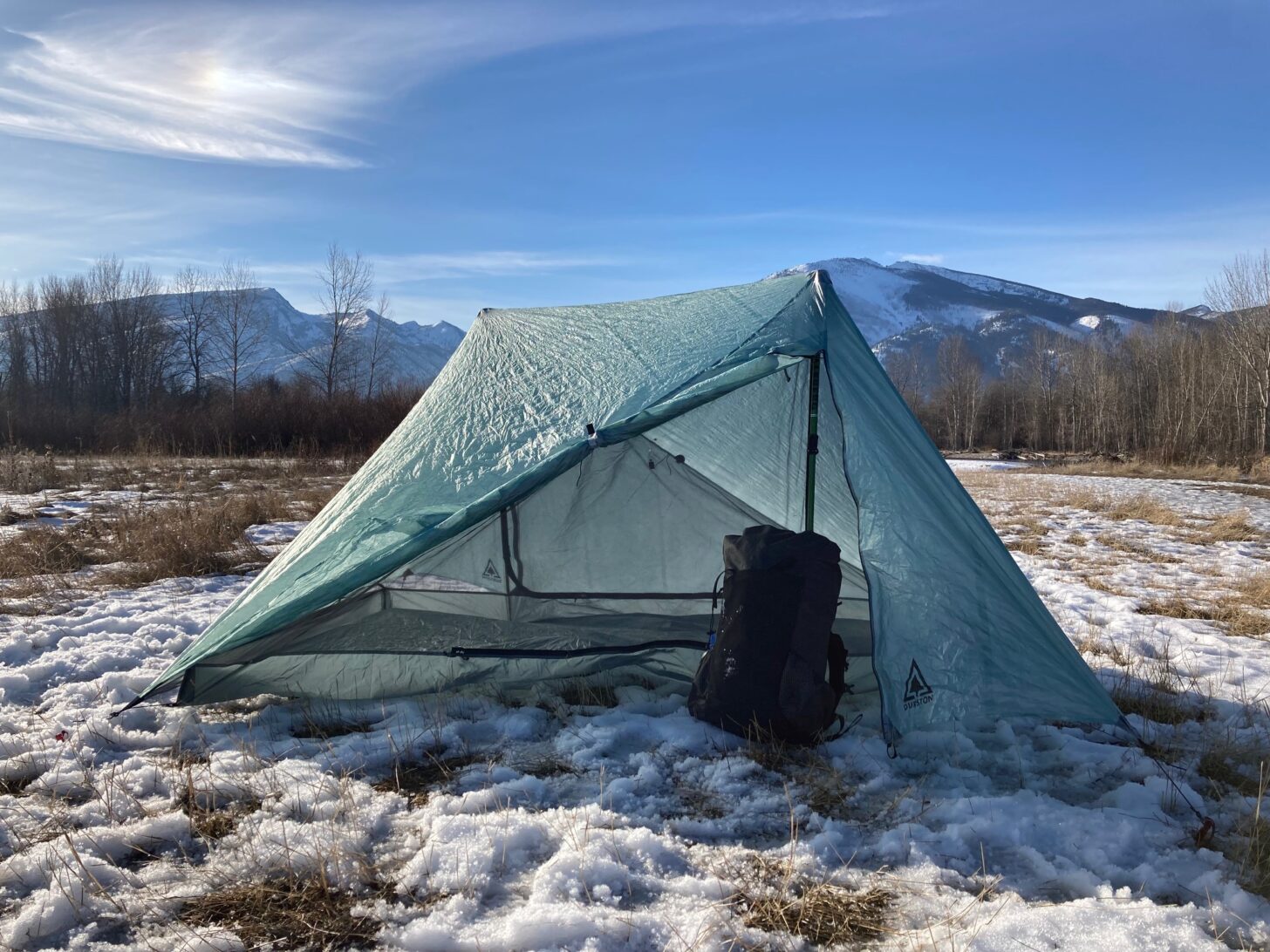
Using only four stakes and two trekking poles, I was able to have this tent pitched in just a few minutes without having to readjust anything. It almost seemed too good to be true. There was no fiddling with pole height, moving stakes around, or tensioning (and re-tensioning) guylines. These iterative steps are often required when pitching trekking pole tents. The zippers – both the waterproof fly zippers and the zippers for the body of the tent – operated smoothly.
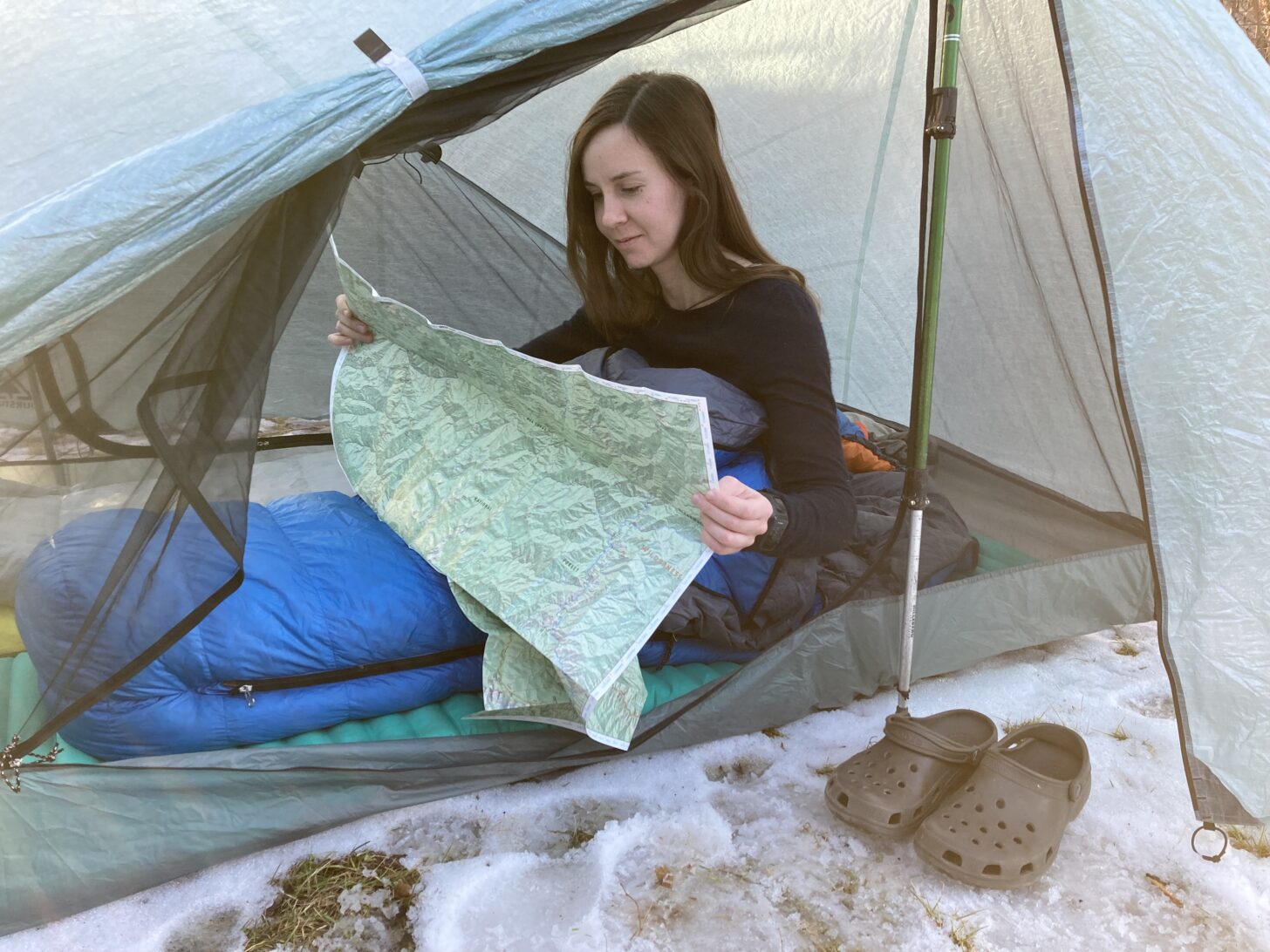
In soils where staking is more difficult than in my yard and in campsites with varying topography, pitching will obviously be a bit more challenging and perhaps require longer guylines or other adjustments to the pitch. However, given how straightforward the mechanics of erecting this tent are, it’s an easier pitch than most trekking pole shelters.
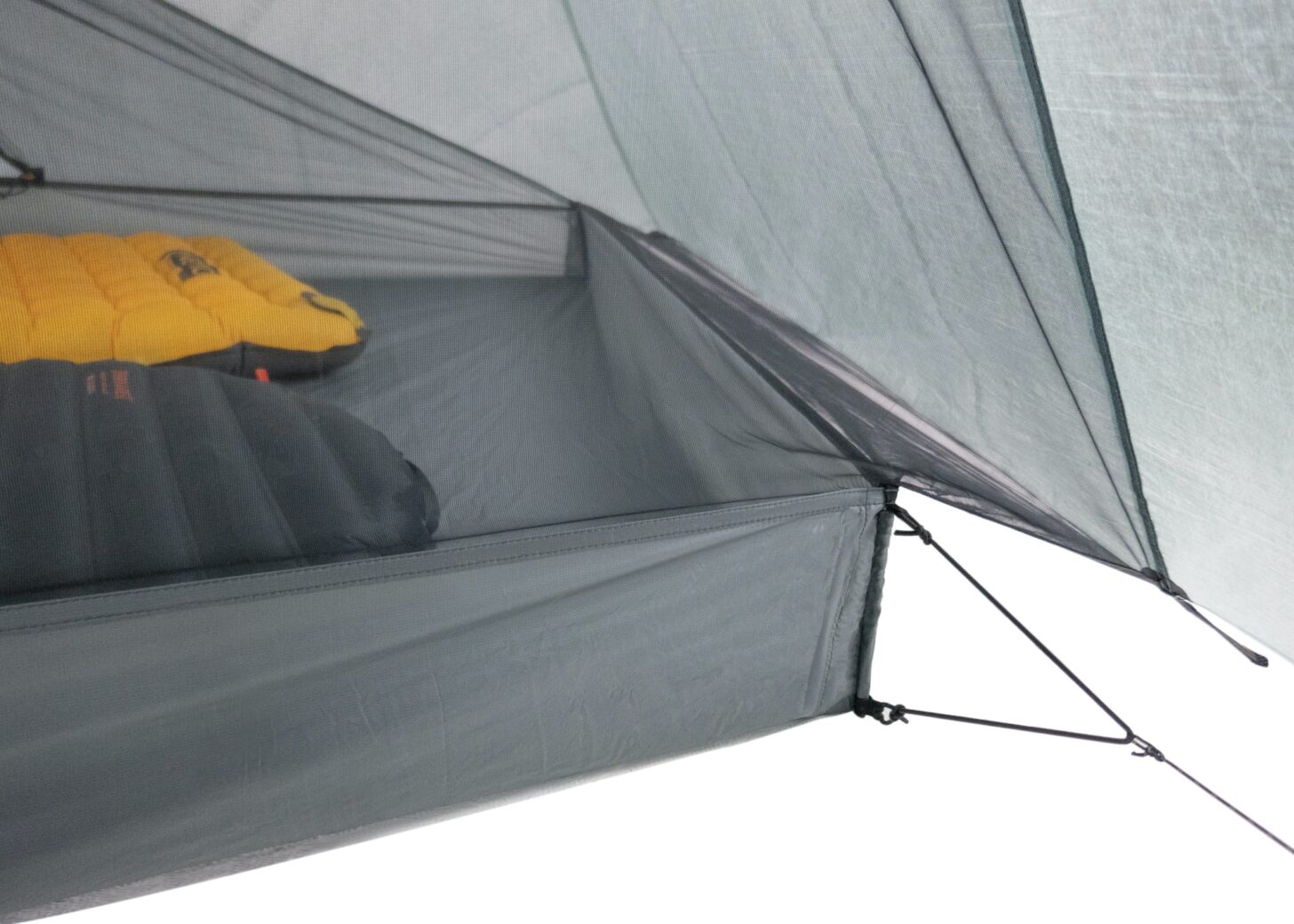
The DCF used for the body of the tent has been used extensively in many other tents by other manufacturers and will last a while for users who care for their gear with intention. One of the most common failure points of DCF shelters is sewn seams; the seams on Durston X-mid Pro 2 are entirely bonded with no sewing. (You can learn more about the advantages and disadvantages of bonded vs. sewn seams in the Dyneema Composite Fabrics episode of the Backpacking Light Podcast and the Dyneema Composite Fabrics Webinar.
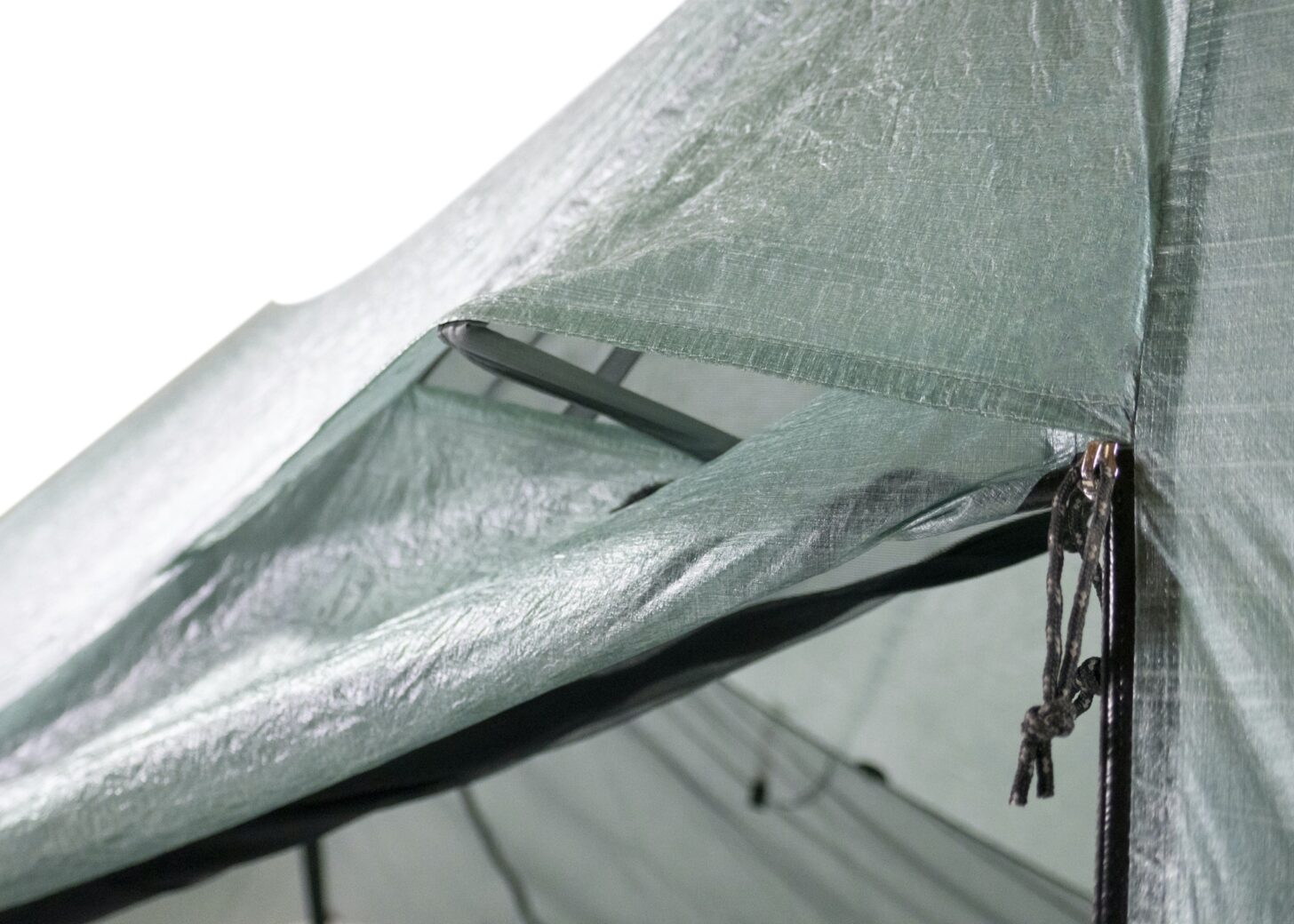
Why does the Durston X-Mid Pro 2 have a nylon floor?
A 15-denier nylon fabric was chosen for the floor with the idea that a footprint wouldn’t be necessary for most situations if reasonable precautions are taken with campsite selection. However, hikers using it in conditions where punctures would be more likely (such as rocky terrain or desert environments, with their plethora of spiky things) might want to bring a ground cloth in those specific conditions. The 15-denier floor is similar to the fabrics used in other lightweight tents, including many of those made by MSR and Big Agnes. Many hikers forego using footprints with those tents without experiencing any issues in normal use cases. When asked why the X-Mid Pro 2 uses a 15-denier floor instead of DCF, Dan cited the advantage in packability as one reason.
“We think a 15 denier woven floor is a better choice because it is a similar weight but far less bulk and debatably more abrasion resistant and waterproof in the long term,” said Dan. Using the 15 denier nylon fabric is also less costly than DCF. “Cost is another advantage, although the cost savings are largely offset by our more expensive hot bonding construction process,” said Dan. “We would have used 1.0 osy DCF if we genuinely thought it was better.” Using 15 denier nylon over 1.0 osy DCF results in a less expensive shelter that packs smaller.
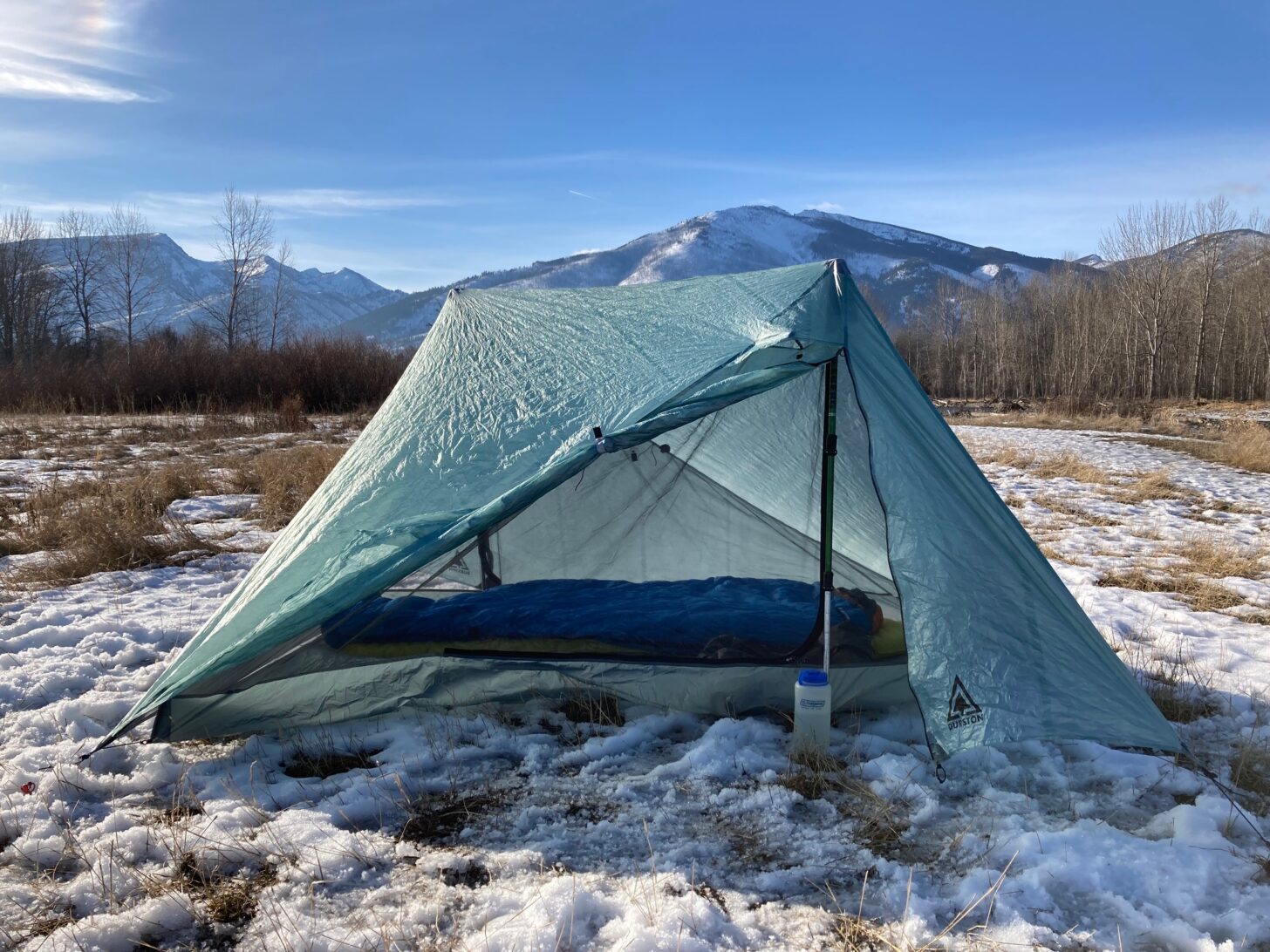
Other similar shelters, such as the Tarptent Stratospire Li, use an offset pole design. One of the advantages of the X-Mid Pro 2 is that it has such a simple pitch in addition to the benefits of having an offset pole design.
When asked how this was achieved without resulting in other trade-offs in performance, Dan said “The X-Mid uses a rectangular base to simplify the pitch (compared to a hexagonal tent) and combines that with two trekking poles (to improve headroom compared to a single pole pyramid). The classic challenge faced by other tents attempting this is locating the poles. Prior tents have positioned them around the perimeter which results in flat walls that catch the wind and mandatory guylines, or they have positioned them along the centerline where they interfere in the sleeping area and/or doorways. The X-Mid uses a new floorplan, where the poles are placed on a diagonal and then the sleeping area passes between them on the opposite diagonal. From the overhead view, these crossing diagonals form the “X” in the X-Mid name. From a functional perspective, they provide a good [larger] living space while avoiding all the common pitfalls (e.g., poles in the doorways, poles in the living area, mandatory guylines, flat walls).”
The Durston X-Mid Pro 2 Compared To…
| weight | MSRP | wall design (single-wall vs. double-wall) | floor dimensions | maximum peak height | floor material | canopy material | |
|---|---|---|---|---|---|---|---|
| Durston X-Mid Pro 2 | 20.4 ounces / 578 g | $639 | single | 48 x 90 inches (122 x 229 cm) | 46 inches (117 cm) | 15 denier nylon | 0.5 osy Dyneema Composite Fabric |
| Zpacks Duplex | 19.0 ounces / 539 g | $699 | single | 45 x 90 inches (122 x 229 cm) | 48 inches (122 cm) | 1 osy Dyneema Composite Fabric | 0.55 osy Dyneema Composite Fabric |
| Tarptent Stratospire Li | 27.5 ounces / 780 g | $699 | double | 45 x 86 inches (114 x 218 cm) | 45 inches (115 cm) | 1 osy Dyneema Composite Fabric | 0.51 osy Dyneema Composite Fabric |
| Gossamer Gear The Two | 23.5 ounces / 666 g | $375 | single | 42/48 x 84 inches (107/122 x 213) | 43 inches (109 cm) | 10 denier nylon ripstop | 10 denier nylon ripstop |
On paper, the Durston X-Mid Pro 2 bests many tents in its category (two-person, two-door, side-entry, dual-vestibule trekking-pole shelters) on a number of metrics. It is either lighter, roomier, less expensive, and in certain cases, all of those things. But how a shelter looks in a table is only part of the equation – one which we are increasingly less inclined to emphasize as shelter builders shave ounces at the expense of other important factors. Craftsmanship, quality control, user-friendliness (ease of pitching), livability, stormworthiness, and aesthetics all come into play. These are the performance metrics consider in this review.
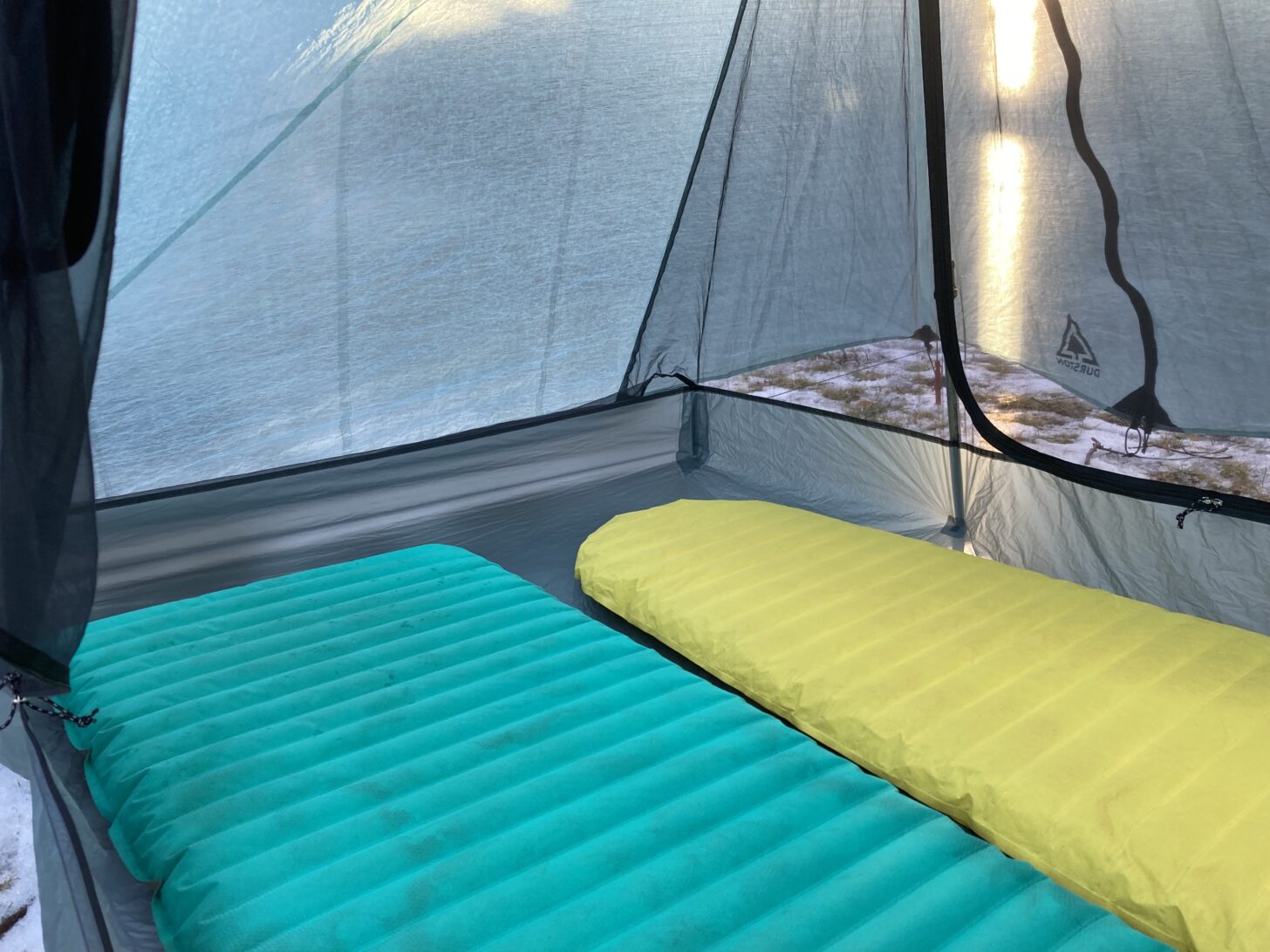
Long-Term Performance
In this section, we evaluate:
- Pitching
- Livability
- Stormworthiness
- Fabric
- Durability
- Weight
- Finish quality/aesthetics
- Price
Member Exclusive
A Premium or Unlimited Membership* is required to view the rest of this article.
* A Basic Membership is required to view Member Q&A events


Discussion
Become a member to post in the forums.
I’m not going to reread all the posts to check, but my impression was that Mr Solomon was criticising the review rather than the tent, and how it didn’t investigate possible problems with the material/design.
Ditto if you’re not interested in some people’s posts in the thread.
Thank you, William.
Cheers, Jon
“I’m not going to reread all the posts to check, but my impression was that Mr Solomon was criticising the review rather than the tent, and how it didn’t investigate possible problems with the material/design.”
Ummm, you need to re read the threads. Jon most definitely is criticizing the tent as well as the review AND BPL for publishing it. he did not criticize the reviewers dog, which he also hasn’t seen, so that’s a plus! As for investigating “possible problems”…whew! You mean, imaginary problems? Or again, do you require a long disquisition on DCF and its properties for every single tent that ever comes out in DCF? Isn’t that just a bit redundant and unnecesary?
Jon puts Durston and BPL in an impossible position by claiming that if Durston responds and corrects false assertions, he’s being unethical and so is BPL for allowing that. Frankly, NOT responding to inaccurate claims would be unethical (“covid is fake”). You’re asking to be allowed to criticize at great length a tent that you’ve never seen an d then crying foul if the maker replies and BPL allows that.
I can see someone thinking the initial review is a puff piece. Still, the notion that nothing can be said here without it being demonstrated “scientifically” with lab tests and all the rest is absurd. This review gave itself out clearly as a first impression, with an emphasis on the last. Movie and book and stage reviews do the same thing. How difficult is this to understand?
The pages of BPL are filled with contradictory recommendations on all sorts of goods, from rain shells to packs to gloves and tents. Jon apparently doesn’t like DCF (altho it’s hard to tell if he just doesn’t like it in this tent.) Fair enough. Others with real world experience of their own do like it and know all about the trade offs. That’s fair too. C’est la vie. Really, isn’t all of this so well known as to go without saying?
I bought one, if it arrives in time for some of my long trips this summer I’ll share the good and bad of the design.
It was nice to read something that was written by an experienced person that actually had their hands on it. To me it was clear it was only a brief overview with limited real world tough testing. An experienced tester can frequently spot any glaring flaws in the design by setting it up a few times and messing around with it. After that it’s real world stuff to see if it works long term.
I needed a to upgrade to a new tent, I’m 6’3″ and wanted more space, this tent appears to be a good option.
“The fact that many tens of thousands of tents have been sold over the last decade does not mean that it ain’t meaningful but rather the opposite….the community should not have to rely on what manufacturers say.”
My intent here was not to say that if a manufacturer is selling a lot, therefore you can trust them. Rather, I am suggesting that if a shelter has been selling in high volumes for a long period of time, then we can look to the real world experiences of the actual users. For example, you mention having serious concerns that DCF undergoes severe damage when a shelter relies on 4 main stake points. To inform this question, we can look to the HMG UltaMid since this is a 4 stake/rectangular shelter which has been very popular over the last decade. If relying on 4 main stakes leads to serious issues we’d expect a lot of users reporting this by now. Do we see that? I’ve never heard of such a single report, nevermind a large body of them. Thus, it seems unlikely a major issue exists. Perhaps some minor/cosmetic deformation may have gone undocumented but a major issue would be well documented by now.
“it would be worth it to point to what looks to me like a very significant difference in the way the midpanel stakepoints along the perimeter are integrated into the X-Mid 2 Pro design compared to that of other manufacturers”
I do request you spend a little time researching topics like these before speculating, because even very brief research would show this speculation to be unfounded, including looking carefully at the very photos you’re posting.
The main thing with perimeter stake points is to have the DCF oriented so the fibers are in line with the direction of pull, since pulling on the bias can lead to deformation. With a hem stake point, you want the DCF oriented square to ground so the fibers run horizontally to the adjacent stakes and vertically up to the peak. That’s what you see on the X-Mid Pro and on other similar shelters like HMG, MLD, and Locus Gear. Everyone does it the same.
The difference you suggest could be ‘very significant‘ is that other shelters have a vertical seam running up to the peak, whereas you suggest the X-Mid Pro does not. However, this is not true. These seams are not consistently or even commonly present on other shelters and do not exist for strength reasons (although they do help a bit). Rather, these seams exist because the panels are too large to construct with a single piece of DCF so there has to be a seam somewhere. Splitting the panel down the middle is one such way of doing that. In the case of Locus Gear (your photo), they do have a vertical seam running towards the peak, except that it does not run all the way to the peak since it hits a horizontal seam 3/4 of the way up. So it still hits a span without a seam – which is fine because the fibers are square to the force. In the case of the HMG UltaMid, they don’t have a vertical seam at all because they split the panel horizontally – which again is fine because the fibers are properly oriented. Similarly for MLD – many of their pyramid shelters have perimeter stake points without a vertical seam. Perimeter hem stake points without a vertical seam are commonplace.
In the case of the X-Mid Pro, it actually does have a true vertical seam right to the peak on the end walls so the truth is the opposite of what you say: Other shelters usually do not have a true vertical seam, while the X-Mid Pro does. The X-Mid Pro would be totally fine without this seam since the fibers are properly oriented (we only have the seam because we can’t use one piece) but it does make it slightly stronger and less prone to deformation than these other shelters. Instead of a defect, we again see best-in-class construction. For the X-Mid Pro sidewall guyouts, these do not have a vertical seam because the door panel can be constructed from one piece. A seam is not needed when the fibers are properly oriented (as they are) and especially not in this case because there is no fixed point (like a peak) in a direct path above the side panel guyouts. Instead, the canopy bends at the seam above the door so the material takes a longer path than a straight line to the peak, meaning that it is not pulling directly off a fixed point where you it could have a lot of force. So the sidepanel hem guyouts are properly designed, very low stress due to the lack of a direct path to a fixed point, and almost never used.
“Hopefully, a third party reviewer will discuss this issue some more”
I share your passion for an in depth series on shelter design with DCF. However, I do caution that it is a bit much to expect from a BPL review. The writers of these reviews are typically regular hikers who get a small honorarium – perhaps $50 – to gather their thoughts into an article. It is close to volunteer work, so it unlikely that one of them will elect to spend much larger amounts of their time compiling a treatise on DCF seam design. That type of depth/effort would be better suited to a masters thesis.
At this point in the discussion, I think it would be prudent for me to step back from further posts because I’ve already spent too much time addressing numerous non-issues. I think I’ve explained that there is no unique or worrisome way in which the X-Mid Pro is constructed, and that the main concerns expressed thus far (on perimeter stake points and rectangular bases) are neither unique to the X-Mid nor supported by the large body of DCF shelters in users hands today.
It’s a bit rich to criticise the BPL reviewer for making statements that were considered to be “overreach” relative to the scope of the review, and in the same post to speculate at great length about design weaknesses based on a handful of photos and broad assumptions. At least the BPL reviewer actually had the tent in his hands! And then to criticise Dan for his detailed rebuttals?! What choice did he have when someone has posted an academic treatise of “photographic research” of his tent, and alluded to marketing spin?
Given the popularity of the sil- nylon X-mids and the significant interest in the DCF version, I thought it was a service to the members to get something on the table before the pre-release date.
This is all a storm in a teacup until actual field reviews are available.
“The very photos” that I posted were accompanied by the sincere expression of both my own doubts about what information could reliably be gleaned from them and advance appreciation for Dan’s eventual answer. I specifically mentioned the possibility that there was, in fact, a vertical seam coming up from the midpanel tieout:
Dan did answer, for which I am grateful:
But then his answer takes a turn away from discussing the tent to misrepresenting what the other guy said:
The truth isn’t the opposite of what I said because what I said was a question.
Perhaps I assumed too easily that the long discussion we had had here recently on BPL about DCF problems on a separate thread in which I was an active participant was enough to establish the legitimacy of raising issues about DCF. It just seems so symptomatic of the whole DCF monopoly thing that knowledge about it is treated like some arcane esoteric secret and discussions by laypeople like myself (albeit with a lot of experience using DCF in many different tents for more than a decade and reading voraciously about it as much as possible) devolve into misrepresentation and possibly even shaming tactics when DCF’s little secret — deformation — is broached.
In terms of the film review metaphor raised by jscott, this would be like taking the advice of reviewers whose reviews are based solely on trailers instead of the whole film and then who tell us viewers to pay what some may consider an exorbitantly high admission price to buy a copy with a relatively short use life.
I mean, JCH really put things into perspective:
If anything, this is an argument for why the review was problematic. It is impossible to take seriously a recommendation for the superiority of this tent over all other choices in its class simply based on backyard experience, when those other options have all seen extensive usage in the backcountry over many many years. The timing of the review, which coincided with the release of a new product that led to a veritable consumer feeding frenzy, wasn’t a very good look, either. Does that mean that I think BPL was being unethical? No, unequivocally no. In fact, what I see is that both Dan and BPL have a real concern, demonstrated repeatedly time and again, for ethics. Which is why I sincerely think, as I said much earlier in this thread, that the overall look of this review did both parties a disservice.
I was an early adopter of both the X-Mid 1P and the 2P, getting in on the first round of pre-sale orders via Massdrop. After using the tents, I sold them both, principally because neither of them met my expectations and need for excellent wind resistance. (Edit: I also noticed, as I remember Ryan Jordan also once mentioned, that it was difficult to get a really taut pitch on uneven terrain, but that’s just a corollary to the primary issue of wind resistance for me). The review of the 2P here on BPL wasn’t very convincing in that department, as I explained in an earlier post in this thread. The backyard review of the 2P Pro leading to a superlative recommendation over and above any other tent in its class, even less so.
Something is happening when reviewers are becoming more like influencers, designers spend a huge amount of time micromanaging brand image on social media, and raising questions/issues about products is seen as an annoyance rather than a community service. That’s a topic for a different thread and, probably, for a different forum.
Maybe the point is: a lot of speculation has been raised about how various design elements of the tent may lend themselves to DCF deformation over time, but similar design elements on other DCF tents have not proven to be significant performance flaws. Heavy users have shown us the limits of DCF shelters – no one is going in blind here.
Fair enough if you thought some statements in the review were too enthusiastic, but come on – is it really necessary to liken the reviewer and designer to influencers and social media image managers? That’s uncalled for.
Is there really any value, at all, in allowing this thread to continue? It doesn’t seem like any new points are being made or new information shared, and it seems posters are starting to get frustrated with the whole thing. Perhaps time to close it down to further input? Just a suggestion.
I’m not inclined to close the thread. People may have questions or want to discuss the shelter further here.
I feel like Jon has made his points and Dan has responded. I hope we can avoid any rehashing of points already made.
[edited by MK to align with the Forum Guidelines]
Dans words speak for themselves.
And Dan is basically a backpacking god who need not explain himself, but is so nice he put together a couple pages of well thought non combative rebuttals.
Thanks Dan for engaging with the community here and on reddit as much as you do.Haters gona’ hate. Keep up the good fight!
I just read thru the Review and all the comments again.
I have to say the replies from Dan have impressed me. They are clear, polite and logical. They also show a very large amount of experience in his design and the use of DCF.
Cheers
I agree. I’m very impressed with Dan’s body of work. His involvement in this community has been thorough, forthright, honest, calm, polite, inclusive and to the point. Makes me examine some of my own interactions herein and realize I could do better.
Thanks, Dan, for providing so much information on your new product. Thanks also for your patience with a BPL crew that can be pretty critical at times. Just know that most everyone here appreciates your work in both making products as well as providing feedback.
I also totally agree. I think it’s worth noting that Dan has been active in the Backpackinglight community for a long long time. By that I mean like a decade (going from memory, might be more)–many years before he became a gear manufacturer. I’m pretty sure he used to author articles for the site, too. So I think comments that he’s an overactive poster or any suggestion he is here just to shill for his own products are off base.
Last Winter, I tested the X-Mid 2P tent on our bluff, 200 feet above the Pacific, in Northern California. I saw that a couple of storms were coming, and left the tent out for about 3 weeks.
Three days were very windy. Storm winds predicted to be in the 40 to 65 mph range. Tent stood up very well, with no visible damage. But a few our Spruce and Redwoods went down.
This may be of interest. I secured the two tent peaks with 2 guy lines, each. Which helped get a very taught pitch.
I use this preamble as a lead-in. I have ordered the X-Mid Pro 2. And plan to test it this way, also. My expectations are that it, also, will be highly storm worthy.
I have confidence in Dan’s designs. And have admired his willingness to share design details with all of us. I think he has set a high standard by responding, with patience and politeness, to many customer inquiries.
William N.
It is nice to see the conversation turning back to evidence-based claims.
William, your observations are important.
I’m curious about your guyline setup. You mention that each peak was secured with 2 guylines for a total of 4 peak guylines. I’m curious about the configuration. Usually, doubled peak guylines would be deployed in an inverted V to get the greatest strength. At least this is what I’ve always assumed and done. Just curious if you set yours up this way or a different way.
A couple of caveats: predicted winds are not the same as measured winds. The tent passed the catastrophic failure test. That is useful to know and speaks well of the design. What was it actually like inside the shelter during the wind event? All of this information could be considered pertinent and useful.
After a quick count yesterday, I realized that I’ve used at least a dozen 12 different shelters made with DCF since 2009. I think at least half of them experienced undesirable deformation that affected performance and ultimately longevity.
It would be interesting to hear more about this – perhaps in a different thread.
I have had the same DCF delamination at the corner tie outs on a Duplex as mentioned in another thread (also an early model Duplex) but I haven’t had problems that I’ve noticed with other tents.
DCF is an evolving thing. Many of the issues I’ve seen happened in early iterations. I feel the construction techniques have come around enough to take a swing. And I swung on this tent because I believe in the basic design of the X-mid series. I’ve done over 300 nights in me 1st Gen 1P. I’m totally sold on that fact that it is the best possible combination of critical features: weight, ease of setup, compact footprint, low use of stakes, weather performance, storage and vestibule, etc. That Dan has been woodshedding this DCF design for 3 years and knowing his absolute passion for doing things right, I’m in. I am also completely sure that there will be an even better V2 in a few years. That’s the thing. He’s still improving the OG design today. He never stops. He responds to people’s comments and lays out his logic plainly. And thank thankfully he got off that Drop site and started selling direct. A few hiccups on the purchase side but that will all get ironed out too. So, I see this as an evolution of what I believe is the most revolutionary design ethos in UL trekking pole tent design. Can’t wait to see where this all goes. And for the record I had zero confusion on the type of review this was.
Maybe I’m not understanding the proper definition of double-wall, but based upon the photos this version appears to be the same set up as my X-Mid 1 (with an outer fly and an inner mesh), which I thought was considered to be a double-wall tent. Can someone please confirm?
The X-Mid Pro does not have a seperate inner. It has a floor and some mesh walls that do not form a complete inner, but rather are sewn to the fly to form a bug proof space.
Double vs singlewall usually refers to how many layers of material are between you and the sky. A traditional doublewall tent has one layer as the fly, and a second layer in the form of the inner tent.
Usually those two components are separable, but plausibly they could have two full layers and yet be joined. Usually the two components are joined because the tent is a partially a singlewall where there is not a complete inner so it needs to be sewn to the fly to keep it bug proof. That’s what the X-Mid Pro 2 is like. It is doublewall on the sides (between the inner and vestibules) and singlewall (no mesh) on the ends and roof, so you could call the tent a singlewall or a hybrid since it is really is a mix of single and doublewall.
Got it—the photos don’t do it justice, I guess. Thanks for the explanation, Dan!
Great video update!
I really like what I see and hear about this tent. I’m still on the fence about buying another 2P tent to accommodate myself and two dogs, but if I do, this will most likely be my choice.
I am glad Ryan did this and other videos in the field as opposed to perfectly flat manicured lawn. All tents have a fiddle factor, this one included. 4 stakes and bam-well 4 stakes and some fine tuning, as with the Notch tent. No dig against any of tent, but people may have the idea you slam 4 stakes in and in 20 seconds it’s a picture perfect pitch.
Become a member to post in the forums.