


Introduction
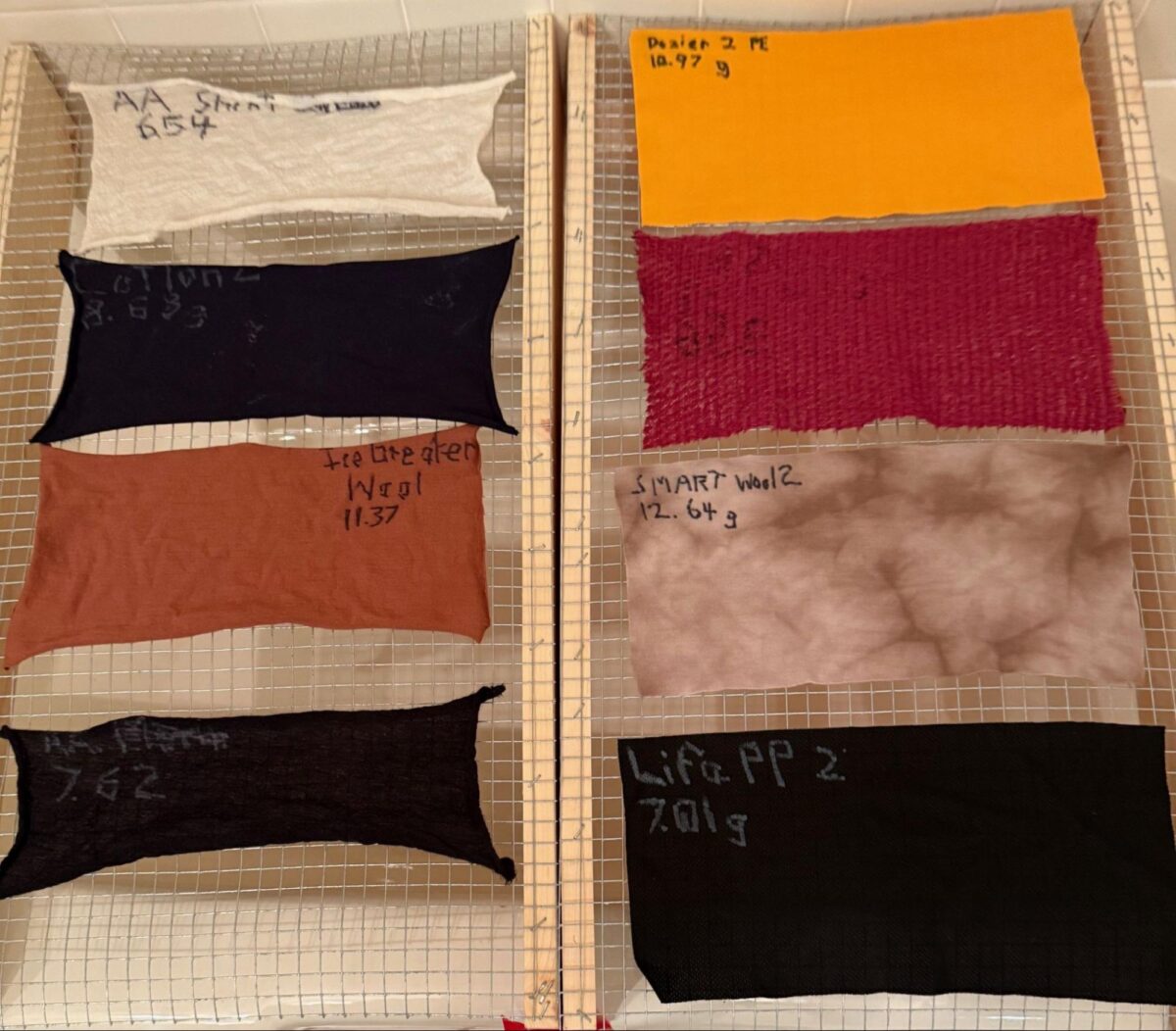
Conventional wisdom suggests that the fibers used to construct a base layer are a key factor in drying performance. Here, I examine the drying performance of eight fabric samples produced using four different fibers in fabrics that cover a range of thicknesses and complexities. The short take on these tests is that, as we shall see, conventional wisdom does not reflect reality.
Thanks to the community for asking good questions about my previous two drying articles: Why is my wicking layer soaked? and What’s the best base layer fabric? Wool vs. Alpaca vs. Polyester. These questions made me want to investigate the subject of drying further.
Here is what I found:
- It’s Not Just About the Fiber: Modern fiber, yarn, and fabric technologies have developed so that end products can be chemically treated, spun, knit, or woven to provide a wide range of drying characteristics. In this study, a 60 gram/square meter (gsm) Alpha Direct sample took 40 minutes longer to dry than a 100% merino base layer sample. Who would predict that? What is clear is that you cannot assume one garment will dry faster or slower than another based on what fiber is used in the garment.
- Water Content is Key: A fabric’s drying time is determined predominantly by the amount of water it contains when saturated. Fabric thickness is the key factor that predicts saturation water content in the eight fabrics studied. Fabric thickness accounted for 90% of the variance in drying time in this study. While fiber type also plays a role – particularly for hygroscopic fibers like wool and cotton that bind water at a molecular level – our results suggest that the dominant factor in drying speed is how much water the fabric can physically trap, which is largely determined by thickness.
- Natural vs. Synthetic: Hygroscopic fibers, like wool and cotton, can incur drying energy penalties that do not exist for synthetic fibers, resulting in slower drying times for these natural fibers. The drying penalties are relatively small for the eight test samples. I have included test results of two highly non-standard fabrics where fiber type substantially impacts water retention and drying rate. The circumstances under which fiber type plays a significant role in drying time are still to be determined. (See Appendix 1.)
- What Consumers Should Know: Fiber content can impact the drying performance of fabrics. However, The consumer will often not be able to determine when the fiber in a garment will significantly influence its drying time. The best strategy is to layer properly to avoid trapping moisture in your garments.
- What To Avoid for Faster Drying: If you want your fabrics to dry quickly, avoid fabrics with the following features: (a) thicker fabrics tend to trap more water and dry more slowly; (b) hygroscopic fibers inherently require extra energy to dry; (c) fabrics with increased fiber complexity, increased texture, or chemical treatment to increase wicking will tend to hold more moisture and take longer to dry.
Choose wisely – Giving up some of these features may cause the loss of other desirable features.
Member Exclusive
A Premium or Unlimited Membership* is required to view the rest of this article.
* A Basic Membership is required to view Member Q&A events


Discussion
Become a member to post in the forums.
Companion forum thread to: By the Numbers: Another Look at Fabric Drying Performance – How can an Alpha Direct Base Layer take Longer to Dry than a Wool Base Layer?
A deep dive into the factors that cause Alpha Direct to take longer to dry than wool.
I wonder if this is a case where the lab conditions are so different from the field that while they give insight into mechanisms at play, they don ‘t set a clear expectation of what a person will experience in the real world.
The main issue that comes to mind is that it’s extremely rare for garments to be fully saturated in the field, and when they do, movement (and maybe taking off the garment and wringing it) clears the unbound water significantly more quickly than this test demonstrated.
I have been continually surprised by how quickly AD90 dry in the field which I believe it driven by how little water is accumulated in “normal” conditions. Exposures such as short term immersion: say having to jumped in to a river to help someone during a cross I found the garment dry fairly quickly… significantly faster than say 150gsm icebreaker merino in similar situations. Likely when layered over a rather saturated base to warm up when arriving at a hut, there seemed (no measurement) to be almost no moisture uptake in the AD90.
Very interesting Stephen, thank you!
As you mention, certain factors like thickness and texture, which trap water, also trap air for insulation, so the question is which fabric structure b st balances drying time and breathability with insulation?
“significantly faster than say 150gsm icebreaker merino in similar situations”
I briefly tried Icebreaker Merino for nordic skiing but abandoned it because I’d sweat and the wool would never dry out while in use. I’m not familiar with Alpha Direct base layers so can’t comment.
My Patagonia R2 on the other hand works fine for Nordic skiing and backcountry skiing. And for backpacking if I expect temps to be cold. It’s a bit heavy for backpacking as well.
Yeah, another interesting article.
I was just beginning to figure out hydrophobic and hydrophilic, but now you’ve added hygroscopic.
One thing is you saturate each fabric – put as much water as possible into the fabric.
But maybe more like reality would be to put the same amount of water into each fabric. Depending on the situation, I’ll sweat some amount. That will go into the base layer. If a fabric could absorb more water it wouldn’t matter because I only sweated a specific amount.
I’ve been fooling around with a polypropylene base layer. Based on your results that sounds like a good prospect. But I’ve only used it a couple times, but it seems like it never gets wet. Which your results help me to understand.
it’s been a couple decades since I used polypropylene. they dried super quickly, but they also stunk to high heaven after a day of hard work, and after several uses washing them didn’t get rid of the stink. I will take a bit more water uptake for something that doesn’t offend everyone’s nose :)
I never gave up on polypropylene and still wear my over 25 year old Lifa, and now the Brynje Super Thermo
Active Wear laundry detergent completely rids it of stink, back to like new, using an overnight soak. It’s not so bad when the smell doesn’t accumulate between washes.
Thanks for the hint David. Never tried Active Wear laundry detergent. Added it, and brynje to my re-think / re-try wishlist.
Hi Mark, I also give a little wipe down end of day with a Swedish cloth then reapply from a tiny piece of deodorant. That and at the end of a trip an overnight soak & wash in this works for me.
It’ll never be as odour-proof as merino but for me the performance benefits of polypropylene are more than worth this little bit of extra TLC.
Thanks to all who are reading this. As I write this post, my next drying article is being prepared for publication. The present article is a stop on the journey to answer questions about different aspects of fabric drying. It set the parameters for the upcoming article. The objective of the next article was stated in the present article. As I hoped, using a guarded hot plate to measure the energy required to dry a fabric provided new insights that are not available through the conventional air drying methods. This makes sense. We really are not interested in what dries fastest using our body heat. Rather, we are interested in how much of our body heat will be robbed in the process. The guarded hot plate measures this very effectively. I also concluded (see a couple of the comments above) that drying from saturation obscures the issues we are trying to investigate. The real drying insights were produced by drying a variety of fabrics with equal amounts of water added. Although saturation can occur, drying smaller amounts of accumulated sweat is probably the more typical case. For me, the next article produced some surprises and I think it provides accessible demonstrations of the information that became available from this new test method. Nevertheless, please post your questions to this article and I will try to provide answers.
“The real drying insights were produced by drying a variety of fabrics with equal amounts of water added.”
That makes sense, I am awaiting your results.
I’m having a deja vu sensation that I made the same comment in a previous article
Hi Mark: I have been an enthusiastic user of Alpha Direct for years. Unfortunately, my experience is that it is not a magic bullet that avoids moisture accumulation. As always, we rely on proper layering and ventilation appropriate for our activity levels. One challenging activity (from a layering perspective as well as energetics) is skinning in the winter. I skin most frequently at a local ski area. When I reach the top and visit the summit restaurant, my Alpha Direct holds substantial sweat and quickly makes me feel cold. My best course of action is to remove it and place it near a space heater to dry. Why can’t I control this? All I am wearing is a shell on top and a Brynje beneath. I need the insulation for the run down the mountain. The shell has “pit zips” that reach the hem of the jacket. However, they provide little arm ventilation and that is where much of the water accumulates. I like the jacket and will have some arm zips installed during the summer. So, yes, Alpha Direct can hold a lot of moisture. Does it dry faster or slower than other fabrics? You will get a better demonstration of its performance in the next article. However, it conforms well to my conclusion that the quantity of water it can hold is related directly to its thickness, and this is the primary attribute at play here.
Hi Tjaard: This question will be answered more fully in the next article. However, your action in properly ventilating and layering is generally more critical than the construction of your layers. You are really better off trying to avoid getting your clothes wet than trying to go to great lengths trying to obtain the absolute fastest drying times or least drying energy.
Stephen, I’ve had some success using the short sleeve Brynje in this use case as it reduces arm and hand sweat vs. the long sleeve. It also helps the arms function more like a heat sink helping keep the core from overheating.
It has a limit. When temps get really cold, circulation to the arms reduces and the short sleeves can result in the hands getting far too cold. In those temps, the long sleeve Brynje gets used. Trial and error. I know the cut off for me but everyone will be different.
Steven: I have also seen that the thickness of the garment is the primary driver to how much water can be retained when saturated. I am looking forward to the next in the series.
For me AD is biggest win was how much heat I can vent. As you noted, most jackets don’t provide good venting options for the arms. My solution been to has been to go light on my arm insulation (wear base + vest or short sleeves under the AD. It also helps that I am mostly no longer skiing or climbing, so my arms aren’t working to hard. :)
I didn’t mean to imply that is doesn’t accumulate moisture. I was suggesting that it “picks up” less moisture when moisture isn’t forced or held by external source against the AD and that physical manipulation seems to let me clear moisture faster than many materials.
I have the lightest weight Alpha Direct fabric that I’m edge sewing to very light polyester fabric as a sleeping bag “topper for winter. The purpose is to let bocce vapor condense and freeze on those layers.
I wonder if washing the two layers in <i>NIK WAX DWR will help them dry faster or shed frost better?</i>
Hi Eric. I am not convinced that the lightest weight Alpha Direct (60 gsm) will move either the condensation point or freeze point enough to do much good. Alpha Direct 60 will give you an added R-value of about 0.4, at best. It might be slightly better if encased in polyester. On the other hand, I am not sure what the polyester adds. The polyester will undoubtedly have far lower MVTR than Alpha Direct and may well be lower than the polyester fabric on your bag. So, the polyester cover seems to me to be an impediment from vapor flowing out of your bag and into the Alpha Direct. I have conducted some experiments with this concept, but I have had difficulty establishing causation for the moisture in my over-quilt. I am sure others have experimented with this. Perhaps you should start a new thread on the subject.
I wear a Alpha Direct hoody with a thicker fabric for the chest panel than back and sleeves (I have one each: a 60 with 90 chest, and 90 with 120 with 120 chest). This helps a bit, since it’s easy to vent the front if you get hot, and your backpack keeps your back warm and sweaty.
Unrelated to dry time:
my current Shell jacket (Made apparel custom Neoshell) also has torso-hem zips, that don’t extend into the arms. Very annoying!
Become a member to post in the forums.