



Introduction
In this test report, I investigate the effectiveness of backflushing and storage protocols to evaluate the relative differences in maintaining the performance of the Platypus Quickdraw, Sawyer Squeeze, and Katadyn Befree hollow-fiber membrane filters.
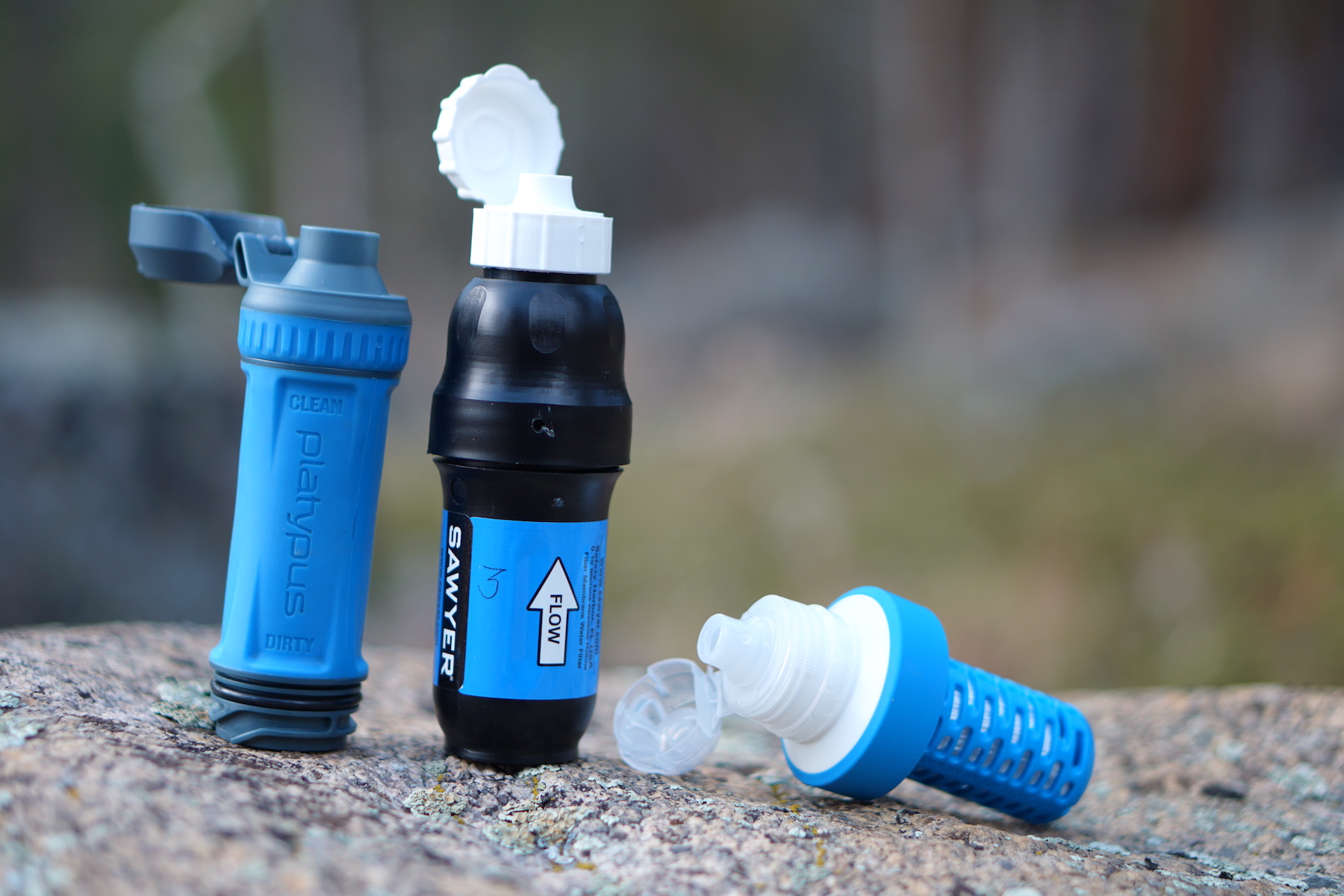
A variety of tests and protocols were performed, including filtration of dirty water with a moderate level of turbidity and backflushing efficacy. In addition, I look at how integrating a long-term storage protocol using citric acid and chlorine dioxide might affect filter lifespan. Finally, several filters were subjected to a six-month field study and evaluated at the end based on backflushing and storage protocols used to maintain their flow rates.
Because flow rate is also proportional to the transmembrane pressure of water across the hollow-fiber membrane, the rate of water flow through a squeeze filter is highly variable and depends on how hard a user squeezes the water bottle. More squeeze pressure equates to a higher flow rate. Because of this, evaluating maximum flow rates through a squeeze filter is challenging and would require a constant-pressure delivery of water that mimics the pressure exerted by a user’s hands squeezing the bottle attached to the filter. Therefore, to maintain a controllable and repeatable test, flow rates here are measured by passive flow provided by the gravitational forces of the hydrostatic head above the filter in the absence of a vacuum in the feed bottle. We use the technique presented previously by Jon Fong to determine the current state of a filter’s capacity, i.e., the effective filtration media surface area available (and not clogged), which is directly proportional to the flow rate of water through a hollow-fiber membrane filter.
Technology Overview
The water filtration technology used in the Platypus Quickdraw, Sawyer Squeeze, and Katadyn Befree is based on hollow-fiber membrane filtration. Hollow fibers are made when a molten polymer is pulled through an extruder, forming a very thin, hollow tube. The walls of the tube are porous. Contaminants are filtered from the water when dirty water is injected into the center of the tube (the hollow part of the fiber), and clean water percolates through the fiber walls to the outside of the tube (inside-out filtration) under pressure. Conversely, hollow-fiber filtration systems can be operated as outside-in systems. All filters discussed in this test report operate as outside-in systems.
Various combinations of wrapping, sealing (gluing), and fusing one end or the other of the fibers and/or interstitial voids (the spaces between the walls of the fibers) result in the mode of filtration (outside-in vs. inside-out) and govern how water flows through the filter.
In the filters tested here, a parallel bundle of individual hollow fibers is arranged in a “U”-shaped configuration and bound in a non-porous resin matrix at the outflow where the ends of the fibers terminate.
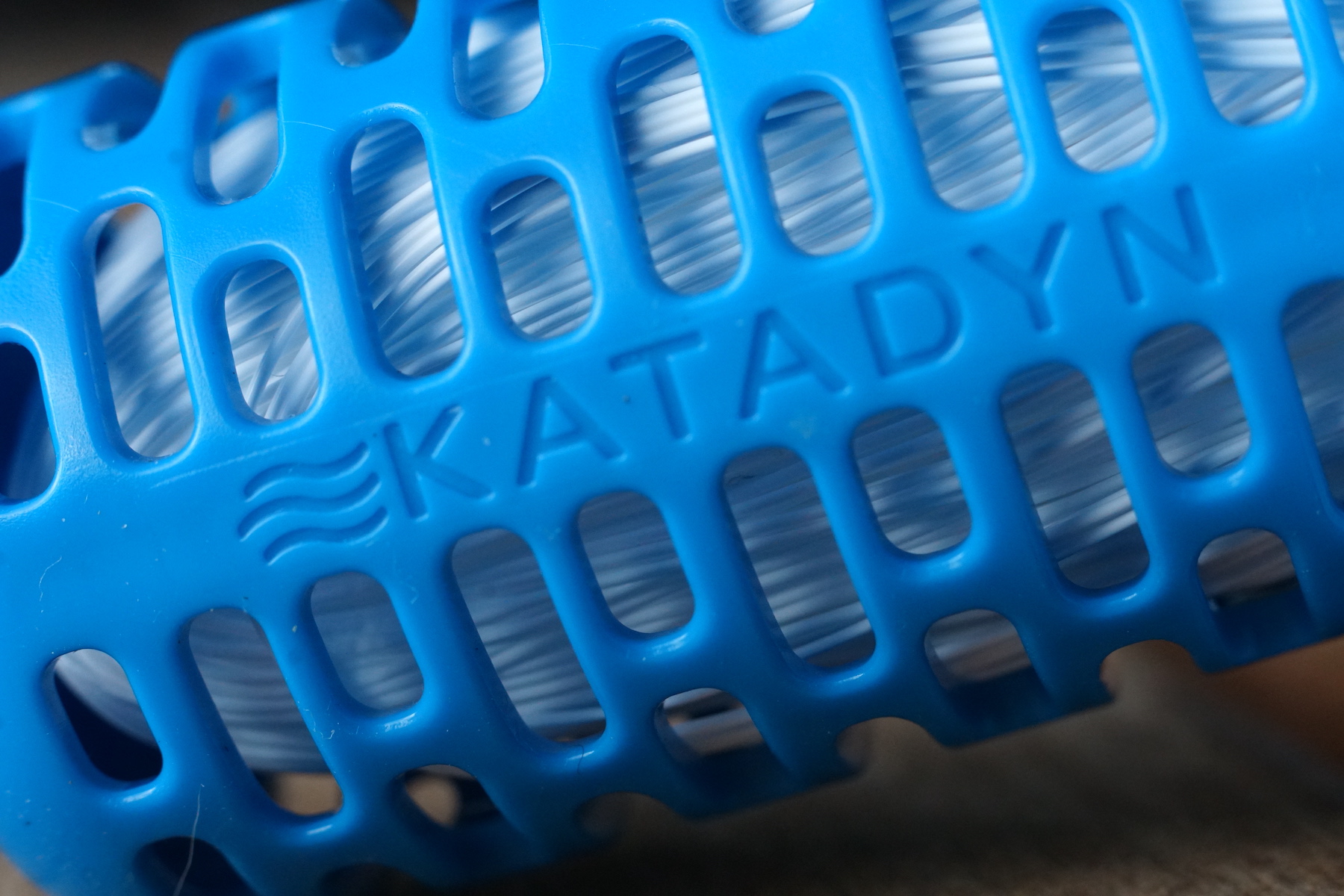
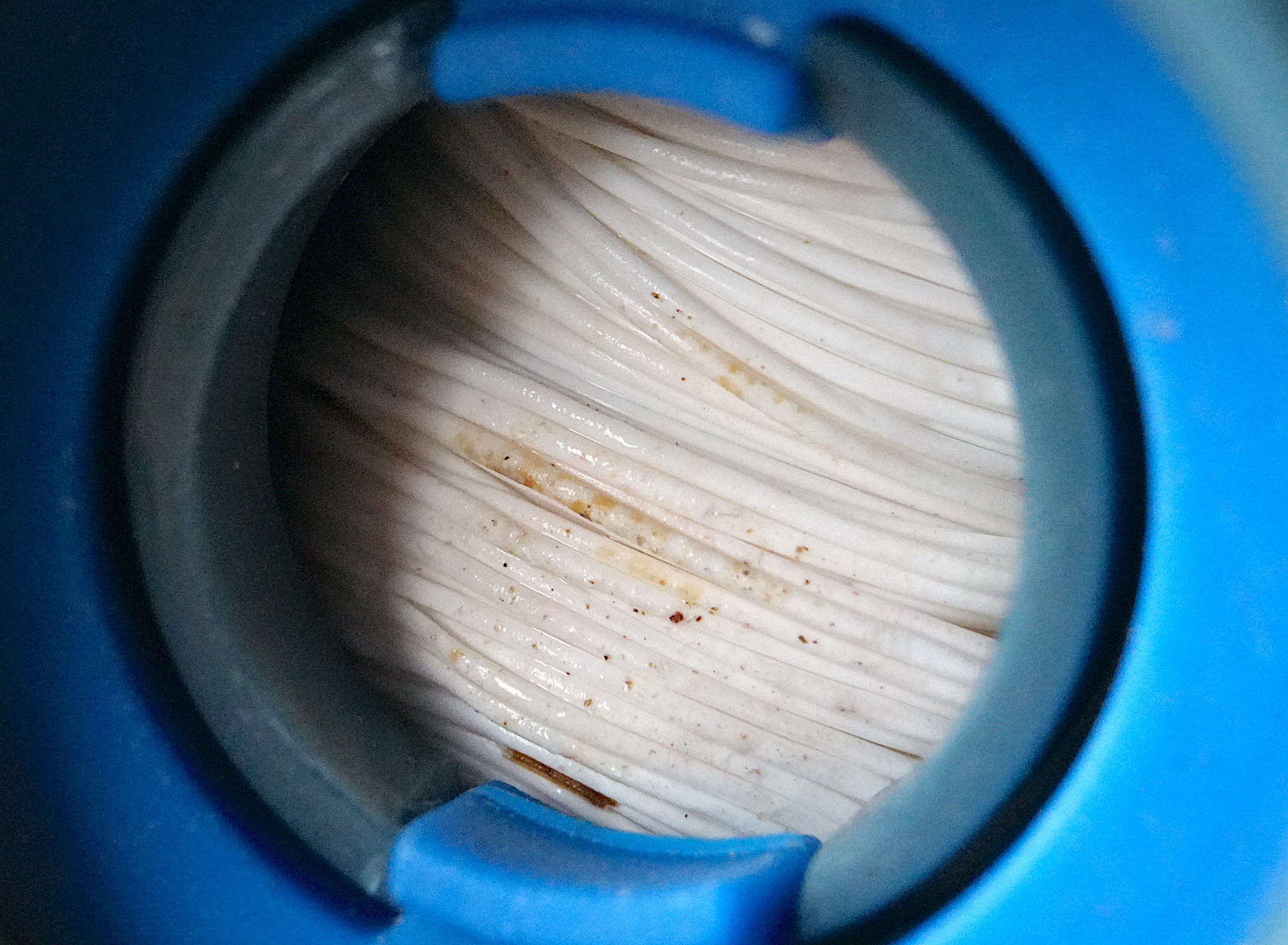
The resin is then machined at the outflow end to expose the openings of the fibers. This assembly is surrounded by the filter housing, which provides a seal between the inner wall of the housing and the resin. In these outside-in configurations, water is squeezed into the void space that exists outside the fibers, percolates through the fiber walls into the inner tube of the fibers, and exits out the tubes bound by the resin-end as clean water.

As with any water filter, undissolved solids in raw water can absorb or accumulate in the filter medium and result in slow flow rates. In hollow-fiber membranes, debris adsorbs onto the outer surfaces of the hollow fibers (since it employs an outside-in flow configuration). That makes it quite easy to clean and allows backflushing to be an effective method of restoring flow. Hollow-fiber filters that are based on inside-out flow patterns clog easily and are very difficult to clean because particles fill up the inner tubes of the fibers and are very difficult to flush out. An inside-out configuration would be totally inappropriate for backcountry use.
There are three primary mechanisms by which a filter clogs:
- sediment and other undissolved solids adsorb to the filter membrane;
- bacteria grow on the surface of the filter membrane into slimes (biofilms) that are very difficult to remove;
- dissolved solids create calcification-type deposits on the surface of the filter membrane that are resistant to dissolution after the filter medium dries.
Shaking and backflushing frequently can mitigate all three of these factors to some extent because the more sediment you can remove from a filter, the less surface area there is for bacteria to adhere to, and dissolved sediments to calcify upon.
All that to say: backflush regularly and frequently as a prophylactic measure, not just as a reactive measure.
Test Description
Three squeeze-style hollow-fiber membrane filters were selected for this study: Platypus Quickdraw, Sawyer Squeeze, and Katadyn Befree. Their specifications are outlined in the following table.
| field weight | flow rate* | cartridge life* | |
|---|---|---|---|
| Platypus Quickdraw | 2.4 oz (68 g) | 3.0 liters/minute | 1,000 liters |
| Sawyer Squeeze | 3.4 oz (96 g) | 1.7 liters/minute | 100,000 liters |
| Katadyn Befree | 1.6 oz (45 g) | 2.0 liters/minute | 1,000 liters |
Table Notes:
- Flow rate and cartridge life are specifications provided by the manufacturer and represent maximum values under ideal conditions.
- Weights denoted are “field weights” measured by the author for cartridges that have been fully wetted, and then shaken dry. Weights include the filter cartridge/housing and spout caps but no other filter accessories.
Two series of side-by-side tests were performed: a bench study and a field study. They are described below.
Bench Study
This study was performed indoors at room temperature with cold tap water unless otherwise noted. All filtration was performed passively (no squeezing). The following treatments and tests were performed in series:
- A filter was primed by filtering 4 liters of water and then submerged overnight to fully wet the filter medium.
- The flow rate of the filter (Q_new) was measured using the procedure described by Fong.
- Two liters of dirty water collected from the field were passed through the filter. The dirty water was collected from a silty stream containing a mixture of coarse inorganic sediments (generally 50 to 200 microns in diameter) and fine inorganic and organic sediments (generally 5 to 50 microns in diameter) that remained in suspension after 10 minutes of settling.
- The flow rate of the filter (Q_dirty) was measured again.
- The filter was backflushed with 2 liters of cold tap water using a soft bottle with hand-squeeze pressures as high as possible.
- The flow rate of the filter (Q_backflushed) was measured again.
In the bench study, two replicate filters were used from each brand. Reported results represent the averages of measured values. The coefficient of variation (CV) in all measurements between replicates was less than 6% unless otherwise noted.
Field Study
Six filters were tested side-by-side over 90+ use-days. Backcountry use included day hikes, overnight, and multi-day (up to 8 days) backpacking trips in the Snowy, Laramie, and Bighorn Mountains of Wyoming, and Rocky Mountain National Park in Colorado.
One replicate of each filter type was subjected to the exact same filtration conditions, backflushing protocols, and storage treatments (citric acid and chlorine dioxide, described below). In addition, additional replicate filters were subjected to the exact same filtration conditions as the others, but were only backflushed between trips, not during trips, and were stored without the citric acid and chlorine dioxide storage treatments.
Water sources included both clear and turbid natural sources (stream and lake water). I carried a calibrated turbidity meter and a pocket microscope with me and was able to categorize these water sources as follows:
1. Clear stream water above the treeline, low concentrations of primarily inorganic sediments (< 5 NTU).
2. Turbid stream water above the treeline with moderate concentrations of primarily inorganic (granitic) sediments resulting from spring snowmelt (10 to 100 NTU).
3. Clear stream water below the treeline, low to moderate concentrations of primarily organic sediments containing debris from the decay of forest litter (< 20 NTU).
4. Turbid lake water below the treeline, low to moderate concentrations of primarily organic sediments and suspended solids containing algae and debris from the decay of organic plants (20 to 50 NTU).
5. Turbid stream water below the treeline in a recent wildfire burn area, moderate to high concentrations of primarily inorganic fine sediments and suspended solids containing fine clays resulting from debris slides (200 to 500 NTU).
No prefiltering was performed, but all water sources were allowed to settle for a few minutes prior to filtering to improve the clarity of the decant and minimize the risk of fouling the filter with large-diameter sediments.
After each filtration session (defined as a single point in time where water was actively filtered, e.g., a water break at a stream during a hike or collecting water in camp for dinner), all filters were backflushed with 0.5 liters of clean (filtered) water at high (squeeze) pressures, shaken dry, and stored out of direct sunlight (to minimize heating and biofilm growth).
At the end of each trip, filters were subjected to a cleaning and storage protocol as follows:
- Filters were backflushed at a high squeeze pressure with 2 liters of cold tap water.
- Filters were forward-flushed with 0.25 liters of a 5% citric acid solution and rested for 30 minutes, then flushed with 0.5 liters of cold water. This treatment removes calcified organic deposits such as magnesium and calcium salts that may form when filtering hard waters normally found in the Mountain West.
- Filters were forward flushed with 0.25 liters of a double-concentrated solution of Aquamira, rested for two to four hours, and then flushed with 0.5 liters of cold water. This treatment is designed to disinfect bacterial biofilms which may foul the filter membranes. The cold water flushing after the Aquamira is designed to remove traces of chlorine-based oxidizers which are known to accelerate aging of polymeric filter media.
- Filters were stored in cool, dark environments and never subjected to freezing temperatures or high shock loads due to dropping, etc.
- At both the beginning and end of the field study, flow rates were measured as described in steps 1 and 2 of the Bench Study above. These flow rates are reported as Q_new and Q_used respectively. The values represent the averages of three successive flow rate measurements.
Test Results
Measured Flow Rates of New Filters
The following table reports the average passive (gravity-only) and active (maximum squeeze pressure by me) flow rates measured on a minimum of three brand new filters. The reported rates represent the averages for each filter (CV < 6% for passive flow measurements and < 10% for active flow measurements).
| Q_new | passive flow (L/min) | active flow (L/min) |
|---|---|---|
| Platypus Quickdraw | 0.82 | 2.55 |
| Sawyer Squeeze | 0.58 | 2.41 |
| Katadyn Befree | 0.94 | 3.04 |
Measured Flow Rates of Filters Used in the Field
Member Exclusive
A Premium or Unlimited Membership* is required to view the rest of this article.
* A Basic Membership is required to view Member Q&A events


Discussion
Become a member to post in the forums.
Ryan, great article. I picked up my first Sawyer because it removed the most bacteria even though it has a low flow rate like my old school First Need. Been an outdoorsman for 50 plus years and was fortunate not to get sick taking water from streams filtering through cloth only till 30 years ago when I was taking water, I noticed a herd of mountain goats up stream. Be one with nature, but come home healthy and safe.
Thanks for doing the hard work for us. Very helpful.
<p style=”text-align: right;”>I noticed that deionized water (DI water) was mentioned here a couple times for the final flush. I am curious about this as I have hard water in our tap at home and wasn’t sure if I could just buy purified or distilled water at the grocery store to use instead. Are those hard waters? Where do I get DI water, or how do I treat water I have to make it this way? I’m not a chemist of any sort, so this is a little beyond me. Thanks!</p>
distilled water would work. It has very little minerals in it that could clog a filter
Question for Ryan – I would love for you/Ryan to comment on what your “standard” (default/starting) process is/would be for cleaning a filter prior to storage after normal use (say a filter that hadn’t materially clogged yet). If you aren’t doing the cleaning/disinfection process in attempt to standardize/compare filter performance, but say your main goal was just to be proactive prior to filter layup/storage (to optimize flow rate and filter life), would you always use the Citric Acid as a step prior to disinfection? (or would you only use the weak acid/solvent if/when flow rate falls of)? Would you incorporate a warm water “soak” at the start of your “standard” layup process to dislodge material? After storage, would you incorporate a warm water “soak” when taking a filter from storage, prior to use? Thoughts on using the Chlorine Dioxide vs the Bleach?
Thanks for takin time to do all the testing/research!
This is a really great article from ~5 months ago in Nov 2021 – just what I needed! This type of deep dive adds value – thanks! I learned a ton from this article, and your/Ryan’s rigor, (and some follow up with Sawyer/Katadyne printed and support info). I learned several concepts that weren’t previously clear to me (even though I thought I had read all the instruction manuals for Sawyer/Katadyne – not!). In your testing, you came up with a good/standard process where the filter flow rates/results could logically be compared after using them. Your process had steps I hadn’t thought of (had missed previously). I’m leveraging this work, and the follow up deep dive I did into all three filter manuf’s printed cleaning/storage info, as well as some info from Sawyer’s Customer Svc group responding to my Q’s. My goal is to incorporate all these concepts optimally as I return from trips, and/or prior to heading out with a filter that has been stored (BeFree or a Sawyer Squeeze). One of my hiking partners has the QuickDraw.
I’m like many of you – I have used the Sawyer Squeeze since 2013 (~9 years), a year after they came out in 2012 (I have qty 2 of the Squeeze filters still going strong), and in 2020, after watching a million video’s and reading articles on the BeFree, I made that jump (I bought qty 3 prior to a 200 mile AT section hike in Virginia, and have only needed to use one of those qty 3 BeFree’s since then – haven’t needed to use the other two yet). I have put ~ 350 liters thru that first BeFree without any plugging or material flow rate reduction (AT & Colorado 14er climb), but hearing other’s issues, I have either carried…, or included a spare BeFree in resupply boxes on long section hikes (which haven’t been needed, yet).
The big picture fundamental concepts (which this article brought into focus) which I didn’t have “organized” logically in my mind include
1. Backflushing – OK – all of us have known how important that is was, but I hadn’t ever thought of doing that to a BeFree using a smartwater bottle with the sports cap. I didn’t have it clear how similar in technology, all three brands were.
2. Use of warm water. I see Sawyer strongly recommends starting with a warm water soak when we are attempting to maintain/restore flow (loosen crud up), and…, to get a filter back in service after it has been stored. Makes sense that the warm water might be able to loosen up crud.
3. I had never heard of the use of weak acid wash to dissolve solids/calcium/deposits (you/Ryan used Citric Acid which I now see is a great low cost safe weak acid – used for a million things including canning – which can be a solvent for the deposits in the filter). I also now see that Sawyer similarly recommends soaking a filter in white vinegar (and then backflushing) if the warm water soaking & back-flushing don’t restore flow rate. I’m betting this is a technique/step that many other people are also unaware of. It makes sense. If solids/calcium/deposits have accumulated in the filter, and back-flushing doesn’t dislodge them, and the filter dries (allowing those deposits to harden/solidify/clog the filter), I now understand how this step possibly helps to dissolve/dislodge those solids/calcium/deposits (with the weak acid solvent) where they can be flushed out (going fwd, or possible backwards via back-flushing). I’m wondering/betting that many abandoned filters could have possibly been restored via the use of warm water soaking, and/or…, use of an appropriate slightly acidic solvent (Citric Acid, White Vinegar, etc).
4. Ryan’s work helped me see that either Chlorine Dioxide (Micropur or Aquamira) or bleach is used/recommended to disinfect. All three of the filter manuf’s list/show bleach as OK. Katadyne lists bleach or Chlorine Dioxide. Also, Ryan’s work (and other comments I now understood), helped me understand the potential negatives of leaving the Chlorine in the filter.
Here is the procedure used in Ryan’s “standardized” test (to insure comparable results):
a. Filters were backflushed at a high squeeze pressure with 2 liters of cold tap water.
b. Filters were forward-flushed with 0.25 liters of a 5% citric acid solution and rested for 30 minutes, then flushed with 0.5 liters of cold water. This treatment removes calcified organic deposits such as magnesium and calcium salts that may form when filtering hard waters normally found in the Mountain West. (Note inserted: in some other BPL blogs, although not blessed by BPL, user(s) have used vinegar/acetic acid Ph ~2.4 and CLR/ lactic acid, gluconic acid are acids while the CLR’s Ph ~3.7) to dissolve deposits in backpacking water filters).
c. Filters were forward flushed with 0.25 liters of a double-concentrated solution of Aquamira (Chlorine Dioxide), rested for two to four hours, and then flushed with 0.5 liters of cold water. This treatment is designed to disinfect bacterial biofilms which may foul the filter membranes. The cold water flushing after the Aquamira (Chlorine Dioxide) is designed to remove traces of chlorine-based oxidizers which are known to accelerate aging of polymeric filter media.
Parallel (very similiar to Ryan’s standardized test procedure for cleaning filters), what follows is a great email response from Sawyer’s Cust Svc folks when I contacted them asking some Q’s:
“……For general maintenance, we recommend backwashing your filter after each outing, when your flow rate begins to diminish, before prolonged storage, and when you’re ready to start using your filter again. Backwashing your filter after storage is a great way to re-wet the filters and restore the flow rate before use.
Soak the filter in hot water (not to exceed 135 F) for ~30 min to loosen up any residual particulate built up in the filter fibers and then backflush several times with hot water as hard as possible. If the flow is slow, repeat the process for a blocked filter below.
A blocked filter can almost always be recovered by soaking the filter in hot water (not to exceed 135 F) for an hour or so, and then backflushing several times with hot water as hard as possible. The trick to a successful backwashing is to be very forceful with the process. Water will always take the path of least resistance, so in order to fully flush out the filter and restore its flow rate, make sure you are exerting as much pressure as you can, especially during the first couple of passes.
If that doesn’t work and your flow rate is still slow, your water source might be mineral rich, so we would suggest soaking it in plain, undiluted white vinegar for an hour or more, and then repeating the process with hot water backflushes in order to dissolve the minerals that have hardened on to your filter. A second or third soak of hot water and/or vinegar may be necessary. The more you do this, the more recovery you will achieve.
To sanitize the filter, we’d recommend using a weak bleach solution (one capful of bleach per Liter of water). Slosh the weak bleach solution around in your pouch and run it through the filter. After the pouch and filter have been sanitized, let the filter sit upright with sufficient ventilation to dry out before storing the filter in a cool/dry location away from direct sun exposure. Some tips:
Trying to filter water through a blocked filter will always make things worse.
Backflush, backflush, backflush,……
When storing, make sure to finish with the sanitization process above.
Our backwashing tips and tricks video can be seen here:
https://sawyer.com/videos/backwashing-tips-tricks/
Hope that helps!…”.
Question for Ryan – I would love for you/Ryan to comment on what your “standard” (default/starting) process is/would be for cleaning a filter prior to storage after normal use (say a filter that hadn’t materially clogged yet). If you aren’t doing the cleaning/disinfection process in attempt to standardize/compare filter performance, but say your main goal was just to be proactive prior to filter layup/storage (to optimize flow rate and filter life), would you always use the Citric Acid as a step prior to disinfection? (or would you only use the weak acid/solvent if/when flow rate falls of)? Would you incorporate a warm water “soak” at the start of your “standard” layup process to dislodge material? After storage, would you incorporate a warm water “soak” when taking a filter from storage, prior to use? Thoughts on using the Chlorine Dioxide vs the Bleach?
Thanks Ryan et all!
Hi, Ryan. I may be a little dense but I still can’t figure out how to backflush the BeFree based on your answer above. Could you (or anyone else) please add a picture or two to show what you’re doing, including the donut gasket?
I use a Sawyer coupling to back flush. It fits the Sawyer filters, it is very tight on the befree. I do not have a leak at the junctions, so the coupling is doing it job. Attached are a few pictures of the backflush setup.
I have used a garden hose end gripped together with the BeFree to provide very strong flushing and great recovery once at home. Be careful with max flow and pressure though, for 1 out of my 4 blew apart.
Alas, I’ve stopped buying BeFree due to short life in field. I could not obtain life of > about 5 days or 80 miles on mountain streams in CO & NM at summer consumption rate. Would end up using chemical backup before end of trip or resupply.
I loved the high initial flow and simplicity but hated the poor endurance and ineffective swishing (ha!!) backflush.
Might reconsider with Sawyer coupling and spout removal.
Alan, I have the same experience in CO and Wyoming. Few days and the BeFree is dead using what looks like extremely clear water. What is your alternative filter?
I don’t do any overnight backpacking in the summer months…just too darn hot, sweaty and tick/mosquito infested down here, so my filter sits unused for 6 months. Previously I had pretty much accepted that I might need to buy a new Squeeze filter each Fall. I am currently conducting an experiment where, after a thorough end-of-season flush which included a few drops of bleach in distilled water, I am storing it over the summer completely full of distilled water (I fashioned a water-tight plug for the input side of the Squeeze). I will report back in November :)
Arthur, I used Sawyer on AT; but I switched to HydroBlu Versa 4-5 years ago. Vs. Sawyer, it has noticeably faster flow, lasts longer between backflushes, is easier to backflush (threads both ends), has integrated watertight caps both ends; but specs have 1 less 9 in removal rating, last I checked.
Interesting…both Sawyer and Hydroblu claim a 0.1 micron pore size but Sawyer claims five 9s for bacteria:
vs
I wonder if there is anything in Sawyers claim of “0.1 micron absolute” pore size that accounts for this difference?
Also, regarding filter longevity and the ability to effectively backflush, Hydroblu explicitly states that they orient the fibers to filter from the outside in. Wondering if Sawyer filters from the inside out?
Hydroblu explicitly states that they orient the fibers to filter from the outside in.
I think that is normal. When you backflush, the pressure is on the inside, so the soft plastic tubes expand ever so slightly, loosening the trapped bugs and wogs. So the theory goes, anyhow.
It sticks in my memory that the difference between 7x 9s for bacteria and 6x 9s for the much larger protozoa may really be an artifact of the test method. To count bacteria you put the water in a culture so the bacteria grow and become more visible, which makes them easy to count. But counting protozoa is more difficult as they do not get larger and so are harder to see.
Cheers
Hmmmm. So if the tubes expand, then it stands to reason the pores also expand…ever so slightly. If so, the tubes then need to be very good at returning to their original size to avoid degradation of effectiveness.
Squeeze disassembled. You can see the hollow tubes – there are many of them, quite small diameter
When you backflush, you put pressure on the inside of the tubes so they expand, along with the pores so they’re slightly bigger to release any particles.
They test this so I think the tubes and pores keep working for a long time. They advertise a large number of cycles.
A couple other pictures:
the tubes then need to be very good at returning to their original size to avoid degradation of effectiveness.
They are. One of the ‘wonders’ of polymer chemistry.
Cheers
A drop of Dawn. Rinsed well.
I baby my filter but am seeing something strange.
Immediately on returning from every trip, I backflush with ~ 5L tap water. This gets rid of any sediment on the inlet which then is nice and white and clean looking.
I follow that up with a mild bleach solution to sterilize it following Platys recommendation. No distilled water follow up.
It then gets left in front of a fan for for a week on high speed and next to a dehumidifier 24/7. Based on weight, it dries pretty quickly.
After about 3 or 4 days in front of the fan, I see this. When it’s primed for next trip, it’s white again.
Anyone know what is happening here? I’ve seen this exact same behaviour with 2 different quickdraws now.
Wouldn’t it be unlikely to be a biofilm because its disinfected immediately and dried quickly? I also backflush in the field often and never let it sit unused and wet for longer than 24 hours
Mineral deposits most likely. A vinegar soak will eliminate most. The Platy and BeFree and similar filters have a limited lifespan of 1000 liters for a reason. No amount of cleaning can overcome that.
I wouldn’t suspect biofilm after the bleach and flush. However, I wouldn’t be surprised if sodium/calcium hypochlorite dry to sodium/calcium chloride — salt.
I’ll bet that Platypus support has seen this question before.
(EDIT: Or, yeah, as the other Bill says, other minerals from your tap water.)
I was thinking salt/deposit as well, thanks for the feedback. I’ll reach out to Platy and share if they have anything new to say. I’ve done the vinegar soak in the past, agree it can help.
It is interesting that Platypus skips the distilled water rinse (after bleach) that some other instruction include. I wonder why they skip it, and whether it would leave you with a clean-looking filter?
Platy Gravityworks recommend 2 drops bleach/L. Platy Quickdraw recommended 1/4 ts per L in ’22 but it was a typo (2.5ml<> 1/4tsp) which they corrected to 1/2 tsp in ’23. MSR (owned by the same company as Platy, Cascade Designs) Trailshot (which I also own) recommends 1/4 tsp bleach per L (but again, with the same typo, 2.5ml<>1/4 tsp) but then a final “clean water” rinse, not even distilled.
3 filters, 3 different storage recommendations, same company.
I’ve used a final distilled water rinse in the past to reduce the chance of bleach blocking the filter but I believe it leaves the opportunity to go foul if not 100% dry. Depending on Cascade’s feedback, I may go back to a final distilled rinse and just make sure its ultra dried.
I hold extra backup filters at home just in case, and carry purification tabs as back up on trips.
Yep (on all points).
I suspect the reason for such wide variation in bleach amounts (2 drops to 2.5ml) is because bleach evaporates after opening, so you never know the real concentration of home bleach. Maybe two drops of fresh bleach is enough, but 2.5ml should work even if your bleach is ancient.
Shame that you have to stock backup filters, but that’s the current state of the art: None of them last forever.
Become a member to post in the forums.