

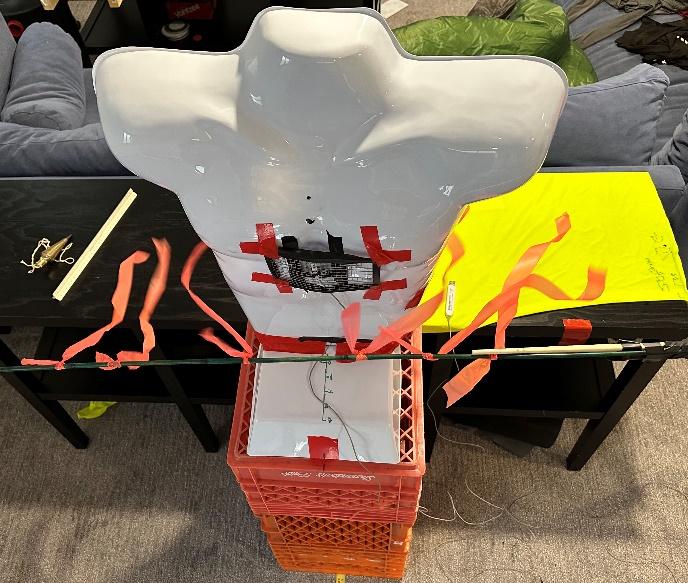
UPDATED January 11, 2023: In October, I began a project to improve the accuracy of high air permeability measurements produced by my air permeability tester. The original configuration was developed to measure up to 400 CFM/Ft2. The instrument was originally calibrated using calibration plates whose performance was measured by Frazier Precision Instrument Company, the manufacturer of the Frazier Air Permeability Tester. A year later, I increased the range of the instrument by adding an additional rotameter. This was supplemented by several statistical techniques to measure the performance of fabrics such as 60 gsm Alpha Direct. Recently, I completed the present project to improve the accuracy of the tester at high air permeability rates. As a result of this latest project, numerous changes to the instrument were implemented. The range of the instrument was extended to beyond 1000 CFM/Ft2. I hired Diversified Testing Labs to measure the air permeability of a 60 gsm Alpha Direct fabric sample. The newly configured testing instrument produced results within 2% of the lab test results. I retested the air permeability of all garments whose original air permeability exceeded 300 CFM/ft2. This resulted in the following changes to the article: the introduction table and Table 2 were revised. Figure 9 was revised. Several minor editorial changes were made to the text to reflect the new air permeability measurements. The findings and conclusions of the article are unchanged. – Stephen Seeber (Author)
Introduction
I often feel that if my outer layer had just a little more outside air passing through it, I could be cooler or dryer and, in general, more comfortable. Perhaps I’m confusing standing before a fan with the almost negligible breeze I create by hiking up or down a mountain. This article will examine how much outside air can penetrate an exterior layer while running, walking, or standing in a moderate breeze. The results of this article are based on extensive testing of a wide range of fabric air permeabilities at three windspeeds. I will not examine how air permeability impacts a fabric’s ability to remove vapor from within. Improved moisture vapor transmission from within would seem to be a likely outcome of increased air permeability and one I hope to investigate in a future article.
In my last article, I discussed, in general terms, what happens when moving air runs into a fixed object. If you are the fixed object, most of the air you encounter will move around you. The air that comes into contact with your exterior layer will have lost nearly all its forward speed, so it will have little pressure left to penetrate to your skin.
I do admit I have a bias on the issue of air permeability. The bias originated when I switched from a regular Houdini to a Houdini Air. The Houdini Air has far greater air permeability than a Houdini. (About 24 times greater, when new.) However, when I wore the Houdini Air during winter ascents below treeline (low wind), my base layer would get wet from sweat, just as it would when I wore my regular Houdini. The increased air permeability did not matter. However, once past the tree line and faced with high winds, I got cold as winter winds reached my wet base layer. This experience suggested that higher air permeability could increase ventilation in high winds. However, at a hiking pace, in low winds, the impact seemed negligible. This concept led me to create several articles evaluating the role of Moisture Vapor Transmission Rate (MVTR) and Air Permeability Rate (APR) in removing moisture vapor. Read the first article in this series if you missed it.
Member Exclusive
A Premium or Unlimited Membership* is required to view the rest of this article.
* A Basic Membership is required to view Member Q&A events


Discussion
Become a member to post in the forums.
Sorry, yes. Let me rephrase since my last post did not make sense and I edited it. A 48300 in black would absorb more sunlight but me more air permeable. A 48800 would be less air permeable but reflect sunlight. Which one would you go with and why? Thank you for answering all the questions, I am just trying to learn more and hopefully other people are also.
The conditions I face in Colorado are undoubtedly different than those you face so I don’t think I can provide more useful advice than I already have. Sorry.
Companion forum thread to: By The Numbers- How Much Wind Penetrates Your Air Permeable Outer Layer at Hiking and Running Speeds
Stephen Seeber helps us answer the question, “do air-permeable garments allow a noticeable amount of ventilation while hiking or running?”
Stephen,
For high exertion/sweaty activities (xc skiing and backpacking) in cold weather (New England), what are your thoughts on having HH Lifa 48300 between Fishnet and Alpha 60? Would that keep as much sweat away from the skin? Or is super light merino layer better between Fishnet and Alpha 60 for cold weather activities?
Hi Meta: My winter uniform is Brynje, HH Lifa or Finetrack, Alpha 60, and a wind layer, which is usually a Shakedry jacket with 20″ pit zips. I wear this for hiking, backpacking, and backcountry skiing. Of course, you will need to vary the layers according to your level of exertion and wind/temperature conditions. If it is particularly cold, I might replace the Alpha 60 with an Alpha Duo, which is two layers of Alpha 60 sewn together by Farpointeog.com. I also sometimes layer an inside-out Mountain Hardwear Airmesh over the 60 gsm Alpha Direct. When this is used without a wind layer, vapor can freeze at the ends of the exposed napped fibers of the Airmesh and then simply be brushed off. This works nicely when the cold winds are not blowing too hard. When it gets really cold, such as high winds and temps in single digits F or below, I might cover the whole ensemble with a puffy such as a Patagonia Micro Puff or, with even lower temperatures, a Patagonia Macro Puff. I don’t carry two Puffs; I decide which to carry based on the conditions I expect.
I do not use Merino layers. I think it would generally reduce the MVTR of the ensemble and trap more moisture in its fibers due to both its hydrophilic properties and typically denser knit than the garments I described above.
This is very helpful. Thank you!!
Hello Stephen,
Making sure that I am reading this correctly: “The air permeability of the 48300 is 1143. I have not measured the MVTR of the 48300. It is probably around 6800”.
HH Lifa 48300 has almost the same air permeability as Brynje fish net?
Hi Meta. That air perm number is wrong. I corrected high air perm numbers in the updated article. The revised air perm is 613.
Thanks! Have you tried this kind of layering (Brynje fish net+ HH Lifa) for the lower body?
Meta: wear the “fishnet” thingie when cycling, under my jersey
Hi,
Another great article :) I see you tested Brynje+Finetrack Elemental. I was wondering what do you think about Elemental Warm above Brynje? I see there is some loft so I’m not sure it makes a lot of sense but it would be interesting to compare to regular Elemental and also Lifa. Especially for cold weather obviously. Thanks in advance.
Hi Alexandre: Thank you for reading. I have not used Elemental Warm. It is a denser and heavier knit, but not by much. From their website, the warm is 40 grams heavier than the standard, so a little less than twice the weight. They claim it is 50% warmer than the Elemental layer. The standard elemental layer is so light, thin and perforated that 50% won’t be much. I would be concerned that Warm could hold a little more moisture, which might overcome the extra 50% warmth. I expect its air permeability and MVTR would be somewhat reduced. So, I am guessing it probably would not make much difference in perceptible comfort. That is just a guess, but I am not sure what a good use case would be from the little I know. However, I will send them a message and ask them to send me one of each for a full series of tests and, if they are willing, I will list the performance measures.
Hi Stephen,
That would be awesome! Looking forward to reading you :)
Hi again,
Actually I did a quick test. I washed it and weight it after and then every 20 minutes while drying at 20° and around 60% RH (just hanging in my home). Dry I weighted it at 117g. After wash 167g then 20’ later 142g and 20’ again 129g. This is for the long sleeve tee shirt. I was thinking to wear it above brynje and below alpha with shell above (for legs without alpha) for hiking or skiing in maritime winter weather. Where I live lifa is impossible to source.
Become a member to post in the forums.