


Introduction
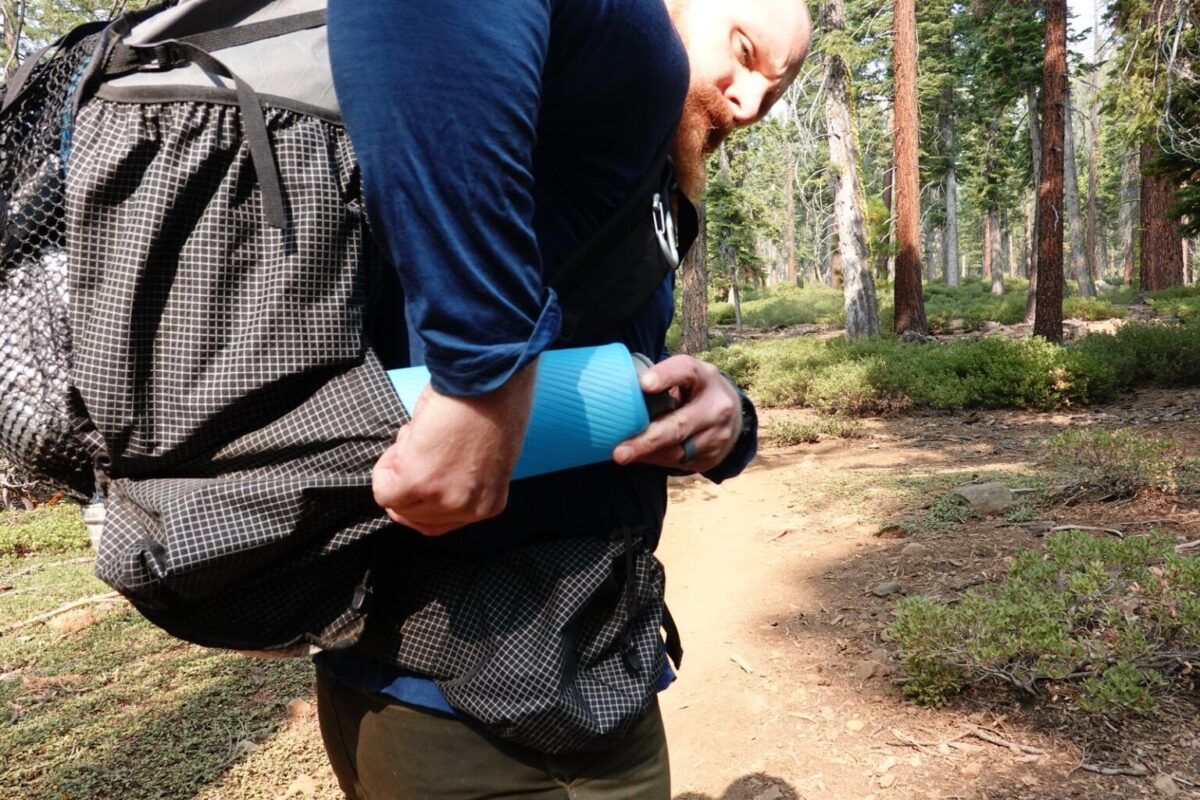
This article is about storing water in or on your pack and accessing it while hiking. Like most things in life, the easier it is to do something, the more likely you are to do it (consider taking public transit, recycling, or exercising). The easier it is to access your water while hiking, the more likely it is that you’ll stay hydrated.
There is no perfect system that applies universally to every hiker. This overview of options for accessing water stored in or on your pack while hiking will give you some ideas to determine which approach works best for you.
Why is hydration important while backpacking?
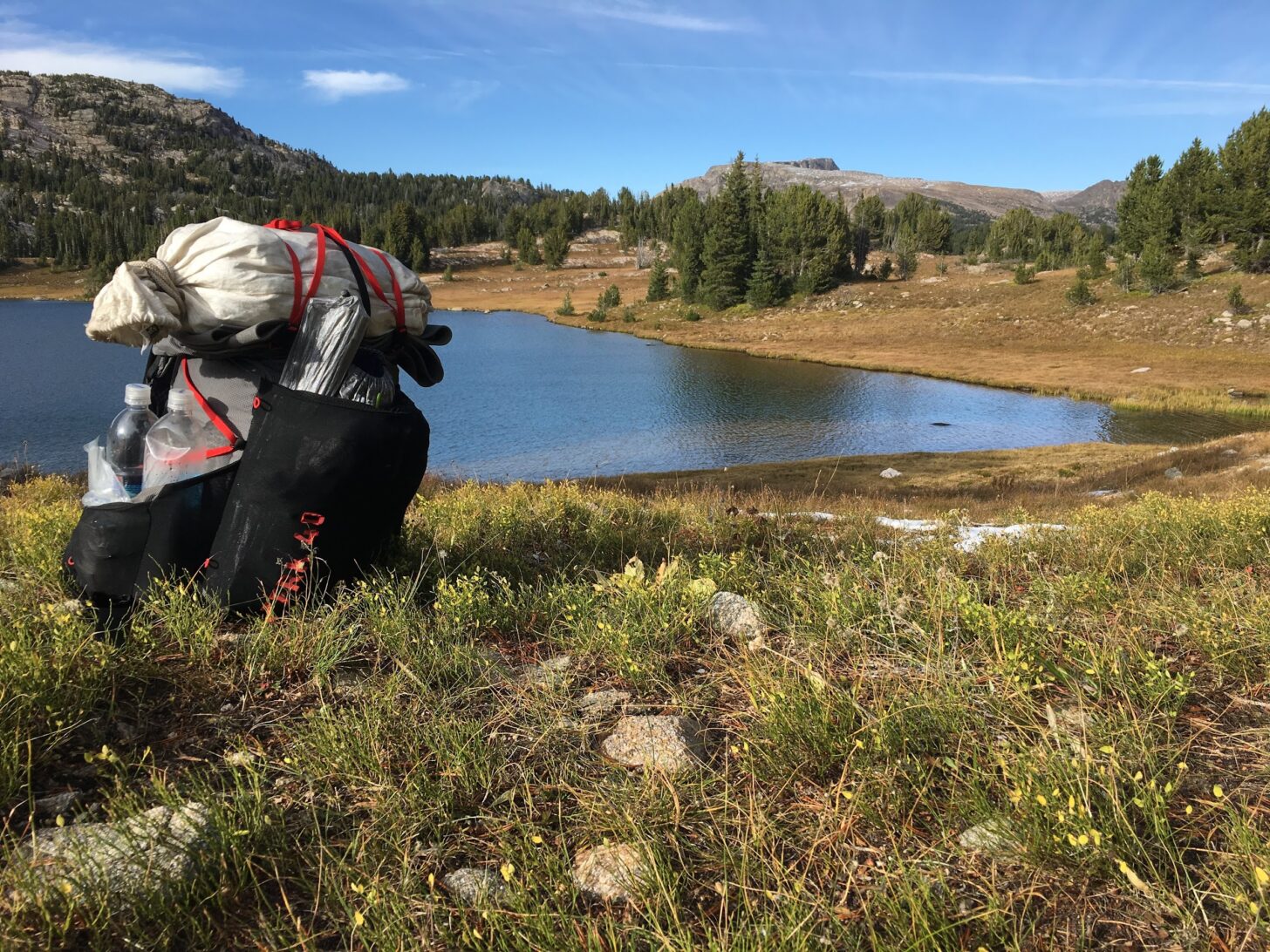
Staying hydrated is an essential skill in backpacking. It’s not as glamorous as being able to hike 25-mile days back-to-back or flawlessly executing a complicated tarp pitch in a gusty wind. Still, it has an outsized impact on your ability to enjoy yourself, recover at the end of the day, and stay healthy on the trail. I have a suspicion that an underlying cause of frustration for newer backpackers on their first few trips is that they don’t drink enough water.
Anecdotal experience from new hikers uncovers some evidence of this. I regularly discover trip reports from folks who recognize that they became dehydrated during their hike. Other times, they detail feeling poorly and cannot complete the trip they set out to do. Often, they don’t connect the dots back to their lack of water and electrolytes.
And in many tragic cases over the years, including a recent instance in California, hikers have perished from dehydration. When hiking at altitude, staying hydrated becomes even more important. A standard recommendation is to drink an additional liter of water a day when hiking and camping at higher elevations.
To what extent does hydration impact your performance?
We address hydration science, its impact on physiology and performance, and hydration strategies in more detail in the Trek Planning Masterclass.
Containers for storing water while backpacking
Hard-sided plastic bottles (like “the Nalgene”), repurposed water bottles (like the 1-liter Smartwater bottle or 750 ml Gatorade bottle), and flexible plastic water reservoirs (like those made by Platypus and Hydrapak) are the most common water containers used by backpackers. These vary in capacity, weight, price, materials, and durability. Personal preference and desire to have as light a pack as possible will play into your choice. Perhaps you’ll consider environmental concerns as well.
Some containers can handle hot or boiling water without issue (metal and hard plastics), while others can’t. Hot water stored in some types of soft plastic bottles (e.g., polycarbonate) can cause the leaching of toxic metals, microplastics, and polymers into the water.
Some containers are bulky and have the same packed size when either full or empty. Others, when empty, can be rolled up and stashed out of the way until filled again. Some bottles are compatible with squeeze-style filtration systems or are easy to pair with ultraviolet water treatment devices.
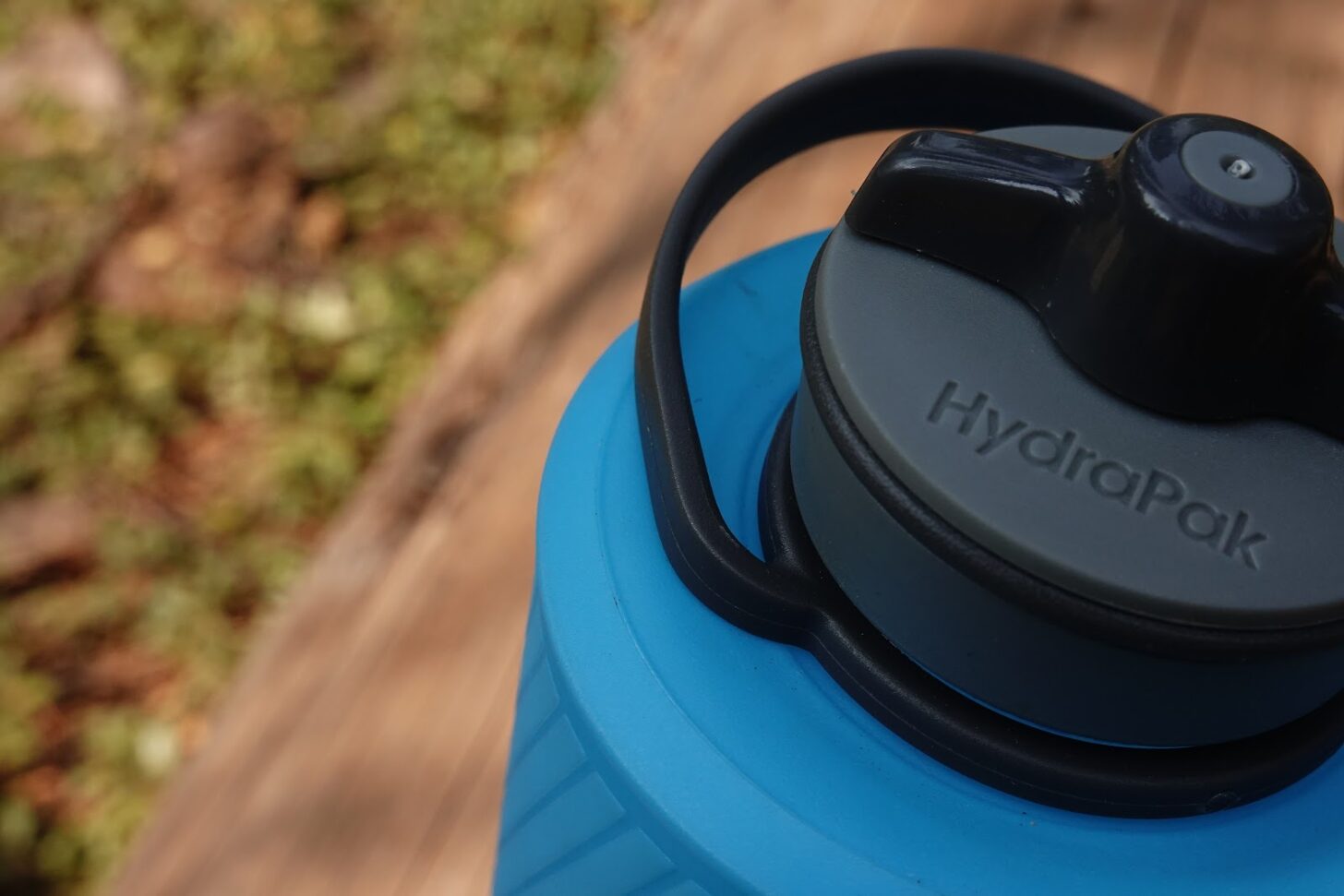
The type of water container you use can have ripple effects on the performance and ease of use of both your overall hydration system and your other backpacking gear systems. Choosing the container that best matches your needs and system will facilitate better hydration and a more efficient backpacking experience. It can take a bit of trial and error. There is no one-size-fits-all approach perfect for every hiker in every situation. But being aware of how your approach to carrying and consuming water is working (or isn’t working) for you on different trips is a worthwhile pursuit.
How much water should I carry when backpacking?
Five factors influence needed storage capacity:
Member Exclusive
A Premium or Unlimited Membership* is required to view the rest of this article.
* A Basic Membership is required to view Member Q&A events


Discussion
Become a member to post in the forums.
Companion forum thread to: Where Do I Put My Waterbottles When Backpacking?
What’s the best way to store water bottles while backpacking? You’ve got some options, but the answer depends on what you want to achieve.
UL? Two 1.5L Essentia/Smartwater bottles on either side of the pack to level out weight. Two additional Sawyer Squeeze 64oz bags for added water storage when needed on dry trails. Use bottles for all squeezing of water filter and not the bags.
I don’t think anything comes close to that in terms of weight to reliability ratio. I even carry two water filters which combined only weigh less than 2.5 ounces. I have a system that is nearly indestructible and also redundant and all-in weighs less than 6-7 ounces.
Shoulder strap pockets – “Likelihood of Failure: low” … if you don’t mind drinking a 37 C water then yes.
Not mentioned was the long-running comfort and performance controversies over hauling dense water weight high, low, or middle in a pack; on shoulder straps, hip belts, or elsewhere; and on and on.
Probably for the best. Much better to stay hydrated than to eek out the last 2% by burying water in the “optimal” location.
I have longish arms (ape index +2 inches), so cross-reaching for tall 1-liter Smartwater bottles in the side pocket “cup holders” is no big deal. Extra water rides inside 2-liter Platy bottles in the main pack compartment, laying side-to-side on top of everything else. I mostly use a BeFree filter with a few chlorine dioxide tablets as backup.
Works for me.
— Rex
Not too exciting, but I use my side pockets to house my smart water bottles. A bladder usually goes in the top of my pack (horizontally) on top of my bear can (vertically) for extra capacity. Made the switch from a hydration system a few years back and so far, the simplicity of the smart water bottle is nice. I like the accessibility of the side pocket, although one arm reaches back better than the other, but I don’t like it when I bend down and my bottles go flying, resulting in broken caps and sadness. The Evernew bladder with hourglass shape stays put better.
Johan, what filter weighs 1.25 ounces?
Smart water bottle in a Zpack shoulder strap carry pouch. Works great for me.
Two considerations I would add.
I noticed on a long multi-day hike that one of my shoulders was more sore than the other. Turns out that is the shoulder on which I was carrying my shoulder-strap water bottle. If you are sensitive to pack weight transferred to your shoulders, be careful of carrying water there.
And, another big disadvantage of hydration bladders / reservoirs is the difficulty in knowing how much water you have left. Unless you pull the bladder out of your pack, there is no way to reliably tell. And who doesn’t love trying to shove a giant water weenie back into a well-compressed backpack sleeve?
Assorted size and brand of water bottles as needed.
The shape of a Coke bottle can make it easier to slip into some shoulder strap pockets.
I’ll use Sawyer bag for storage until it fails, but I try to never squeeze it. I can at least get some use out of them rather than throwing them away.
I don’t have a problem reaching water bottle pockets on packs. I can reach around the pack and grab a water bottle from the opposite side with either hand. I can also remove and replace items from the front pocket of the pack. I try to do this as often as possible while hiking to stay flexible.
I now use a common 1,5L water bottle in my side pocket, combined with a hose from a bladder system. I have used a small 0,33L bottle in a shoulder pouch, but even then I found I didn’t drink enough on long treks, resulting in headaches and fatigue. With the hose attached to the water bottle I can easily take small sips regularly. This way I stay hydrated and I’m still feeling fine after a long day of hiking. Using a bottle instead of bladder makes refilling much easier, since I don’t have to empty half of my pack to get the bladder out. A bottle is also much easier to replace then a bladder in case of failure. And with the hose attached to the bottle, it won’t drop out of the side pocket, because the hose is held secure by the straps on the side. On long hikes, I can easily take two or more of these bottles if I waterpoints are few and far between. Just switch caps and keep going. It’s easy to adapt a water bottle to a hose. Just drill a hole in the cap slightly smaller than the hose and squeeze the hose in and drill a very, very small hole (or use a hot needle) in the cap to let air in to prevent a vacuum. For me, this combines the strength of bladders and bottles.
Does anyone make a water bottle holder that can attach to a backpack hip belt? I got one about 25 years ago from a street vendor in Austin, TX. It was sized to hold a Nalgene quart bottle. It was made of ripstop nylon and had an ensolite-like insulation inside. It also had a strap that could either be stuffed inside when attached to a backpack hip belt or worn over the shoulder. The over the shoulder strap was very useful when I had to drop my pack and search for a campsite. The only problem with it is that it is significantly heavier than something like the 16 gram Zpacks water bottle sleeve. I would love to find a lightweight sleeve to attach to my hip belt that is sized for a Smartwater .7L bottle. I could do without the insulation. The shoulder carry strap would be very nice, but not a requirement. It is my preferred place to carry a water bottle.
Water bottles on shoulder straps is way too bouncy for me. But I have an uneven gait.
Here on the west coast, it’s not often that I have to carry water at all. I carry a steripen in a super lightweight belly pack along with lunch (nuts and a power bar). Then just stop by a water source, filter, drink up and go on my way. The empty (or perhaps half empty) water bottle goes in a side pocket of the pack. I can reach it without taking off my pack if I want.
I use the pockets on the side of my pack. If a water bottle doesn’t hold at least 28 oz (just under a liter – it’s not much use). I use either Klean Kanteen stainless steel, or I’ll buy a Smart Water Bottle to use for a week or so. (Any wear or crinkles to me means I’m drinking plastic bits.) I’ve found too often that if a pack has pockets, the water bottle often just flops out (my 65L Osprey) – there’s no excuse for this. None. Two years ago I wanted to spend money on a really nice day-bag, but none of the expensive ones had water bottle pockets. WTF?? Who designs this overpriced junk? I once had to do a $500 repair on a MacBook Pro because a $100 computer backpack had no bottle pockets on the outside. There is no excuse. None. So instead of buying that slick looking, but stupid $250 Patagonia day-bag, I bought a $14 one on Amazon. And the bottles didn’t flop out. This is not rocket science.
@janpaul That is a great idea. I also use 2 smartwater bottles. They are fairly easy to access in the side pocket of my Mariposa, but sometimes a hose would be nice too. Easy and doesnt weigh much.
Dana Designs made a “Wet Rib” front pouch that clipped into the loser shoulder strap nylon webbing. I now use a (discontinued) Seek Outside silnylon version. bottle pouch and zippered “possibles pouch” right in front at my belt line, where it’s easy to access.
The bottle is ONLY for my electrolyte drink. Water is always in my CamelBak hydration pouch inside my backpack.
I nearly always carry a 2L bladder at the top of my pack horizontally. Then, depending upon the trip, I’ll add a 0.5L or 0.7L or 1L Smart Water Bottle to each of my Mountain Laurel shoulder strap water bottle pockets. I don’t use the side pockets on my packs for carrying water bottles due to the risk of loss as mentioned in the article and the difficulty in reaching them and replacing them as I’m moving. If I secured them in the side pockets so they couldn’t accidentally come out, I’d have to take the pack off to get them and replace them.
In the article environmental conditions were mentioned, but I didn’t see anything about wind. Wind can not only cool one faster but can also dehydrate one faster as well by drying skin.
Also, considering the on-going discussion about hydrophobic and hydrophilic materials, I wonder if I should consider the material my layers are made of in light of our concern for adequate hydration?
I always enjoy the articles and the following conversations! Good job everyone!
I have been dehydrated on a hike more than once. I carry a 2-liter Platy bladder in my pack, with the hose coming out the shoulder. I fill it with Gatorade powder and electrolytes. I carry 2 collapsed bottles in the side pockets for water supply while I’m camped. I have found it impossible to refill a collapsible bag in a lake, so I also carry a pump filter. An adequate, clean water supply is critical.
Oh, and AquaPur treatment gives me indigestion.
Good points. On longer multiday hikes my stainless steel is for coffee, and I have the largest Platypus bag (3l?) in my backpack. I’ve also been dehydrated, once without even being aware that’s what was wrong ( I was in the city, didn’t even think about drinking anything.) Very serious. You get weak and can only walk or do anything for a few minutes. Absolutely right about filling the bags, or anything. In my experience water sources are just outside arm’s reach from the shore (just annoying), or too shallow (100mL scooped up at a time takes forever!) I used to use an MSR pump, but when I used it two years later I got really sick – the filter had failed – no way to tell. I could never find a straight answer about why – only that promo nonsense all the companies do. I’ve yet to see a review or ‘spec’ that would make me risk my life with one of these filters. I now think of them as temporary, and use Aquamira drops. My backpacking system is now two Platypus bags one clean the other ‘dirty’ for collecting. I also use the Sawyer filter (but I haven’t really tested it) This way I can carry 6 liters of water if I ever need to. 3l clean (filtered) and 3l ‘dirty’ to filter later. I like the Platypus bags – they let light in which is a critical factor in keeping mold and bacteria growth down. I had to buy some connectors to make my whole system work.
Lennox, you could make your own bottle sleeve with (or without) insulation, from heavy gauge cuben fiber cloth that would be custom made for your particular bottle. A year ago I made a bunch of these for Christmas gifts to friends. The problem I had was that it took three hours to make each one! But they’re bomb-proof, and also quite unique.
Thanks. I have never sewn anything in my life. But I may try this.
I currently use a Smart Water bottle with a hose through the cap. It works well but I’m getting the itch to improve. I like not having my water container(s) buried in the main pack compartment, and I like being able to take quick sips while on the move, but I don’t like getting bottles in and out of my pack’s side pockets. I also prefer having a hard sided bottle around camp.
I’m considering two new (to me) methods for water carrying this year:
1. Going back to a bladder that will be suspended in the void created by my Arc Haul frame. Seems like a great place to carry a bladder as it puts the weight in a good place and it is visible/refillable without removing it from the pack.
2. adding water bottle sleeves directly to hip belt, essentially adjacent to the pack’s side pockets but lower and further forward. Need to figure out a good way to attach them though.
Lennox, I use a Dynafit bottle holder. Yes, it is insulated, but I doubt that adds much weight. It has a shock cord loop to keep the bottle in place when bouncing/dropping the pack.
https://skyrun.skimo.co/dynafit-alpine-bottle-holder
Thanks, Tjaard. I do not mind some insulation. The photos only show the front of the holder. Is there a fabric loop on the back to run the pack hip belt through? I want to get my water bottle off my shoulder strap and into my hip belt. Thanks again.
A Source bladder gives 2.5 litres, easy to stay continuously hydrated. In the pack to keep out of the sun or sharp sticks. I carry a Camelbak AllClear as my ‘hard’ water bottle in the side pocket, with the UV steriliser good for about 50 litres per recharge. That is not as light as a Steripen but infinitely easier to use. No taste alteration, unlike tablets. Kills all the nasties, Giardia etc.
If the walk is dry I can drink/refill the Camelbak 750mls at water stops, keeping the reservoir for between stops. The lid has a hard loop for a backpack strap to go through and prevent it falling out if you lean over too far.
Long walks or if I’m not gram-counting, a 500ml MontBell thermos of black tea/ herbal tea to drink at a rest stop, or occasionally just the spare hot water from the previous JetBoil, to save reheating it. Can also fill with cold water on a hot day and it stays cool for longer.
I add 1L Platypus +/- 2L Source bottles for some walks with no water/ unreliable water. The PlatyPreserve bottle can also carry wine for the indulgent trip then be refilled – turns out 16 yr old Tasmanian whisky leaves a residual taste for several refills!
The other useful water aid is a 5L Sea to Summit silnylon bucket. Folds to matchbox size. Ideal for carrying water if the source is a few hundred metres from the campsite. On one occasion when the Lodden River was flooded with unstable banks, I lowered the bucket on 2mm cord from a bridge – water obtained without falling in. In camp, the bucket hangs from a tree until sterilising needed.
I think pretty much every member of my family has had heat exhaustion at some stage, I always carry at least 2 water containers, just in case one leaks or gets lost.
This seems to be a well considered set-up. In general I think the people who’ve thought about this have put together better systems then the packages that are sold. One problem – collecting source water. Often a source is very shallow. This is very similar to bailing out my sea kayak. Only three things have worked for this. 1.a sponge (I don’t want to sponge up my drinking water). 2. A flat horizontal bailing cup for boats (West Marine) cracks after a few months in daylight and 3. A cut off plastic bottle (like a Clorox bottle). Light weight and free. Another issue, the Steripen, the filters, etc..I’ve yet to see anything legitimately scientific on any of this stuff. Some young hiker filtering muddy water and drinking it sure looks legit, but how much muddy water can be filtered before the filter clogs up or fails? (My ROS at home was at 350-450 ppm, water source something like 550 ppm – so it wasn’t actually working very well. I had no way of knowing except the residue in my tea kettle. I then bought the cheap tester and got numbers. I replaced all my filters and it was like 18ppm. But ppm and unsafe water are probably two different things. When my MSR filter failed I was in the UK. After I hiked out I went to Salisbury, checked into a BnB, went out for a big meal – the bacteria declared a holiday and I was basically a moaning open drain for two full days. This is Salisbury one month after the Novachuk nerve agent poisoning of the Skirpals (two blocks from that BnB!) The only surprising thing is that the SAS in hazmat suits didn’t raid the place and take me away in a biohazard bag, while I shouted, “It’s not the Russians, it was the sheep!”
most of my backpacking is done with limited water sources so i am typically carrying 2 liters . I put a 1L platypus hoser in each external side pocket of my ULA Catalyst. I use a standard drink tube on one bladder so i can hydrate without taking off my pack since I have restricted mobility and can’t reach back. I used to stick a 2L hydration bladder inside but too much of a hassle for me to remove when I needed to add water. might try smartwaterbottles since I think the threads match the platypus drink tube cap (i know it fits Fuji bottles) and it is easier to filter into the rigid bottle vs the Hoser.
Become a member to post in the forums.