

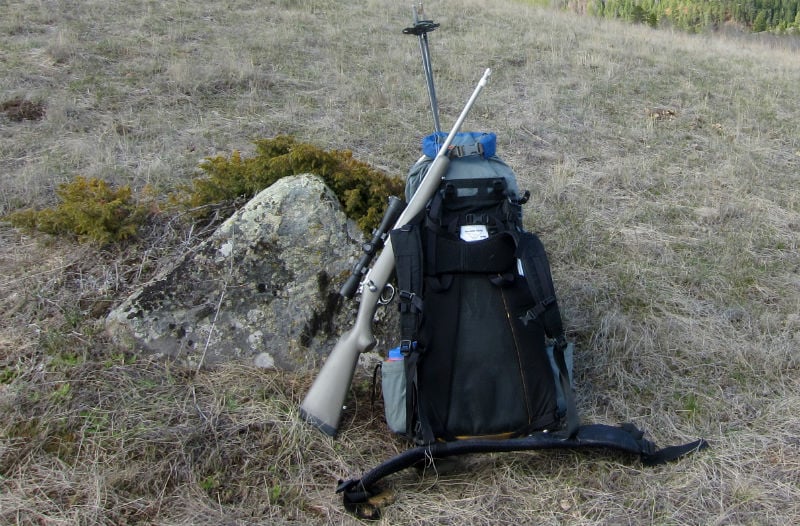
…there’s several thing to be taken into consideration before trying to go on a 5-7 day hunt with 27-35 lbs. I would personally say DON’T TRY IT, as the people posting these weights have either 1) never actually tried doing it and are guessing 2) are very experienced and have their kit dialed in 3) only do ONE backpack hunt a year and can get away with taking very little food 4) haven’t had s**t hit the fan yet and leave a lot of gear home that could help keep them on the mountain.–Aron Snyder
Introduction: That Other Ultralight
Backcountry hunting is a categorically different pursuit than backpacking and its variations. I’ve tried to make this point a stark one with the epigraphical quotation, a forum post from Kifaru rep, Rokslide.com co-founder, and famous internet hunter Aron Snyder. Backcountry hunters obsess about and discuss pack weight just as fervently as backpackers, but as the above figures reveal, the foundational assumptions used by the two camps are very different. In this article I will attempt two tasks: first to describe the conceptual gulf between backpackers and backcountry hunters and how it explains the difference in ultralight pack weights between the two, and second to make an initial foray towards establishing a numerical standard for an ultralight backcountry hunting base weight.
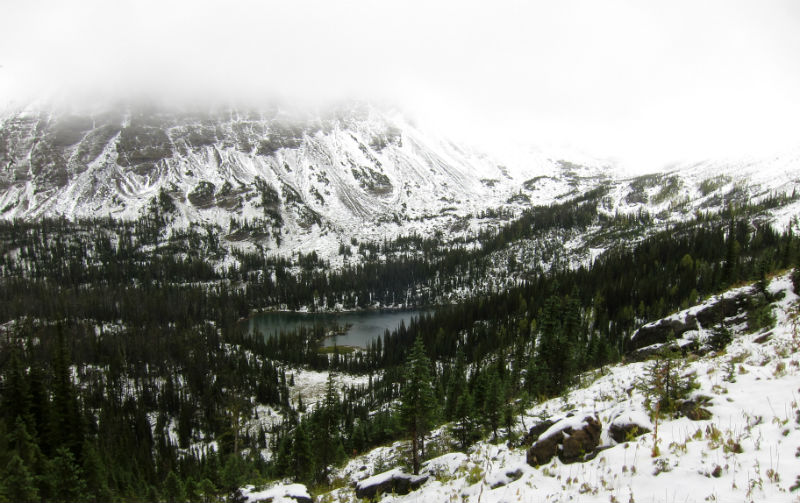
When it comes to the evolution of gear, technique, and mindset, the ultralight standard of less than 10 pounds base pack weight (i.e. everything but consumables) has been around for an eternity. More than long enough for the term to become co-opted for every imaginable marketing angle, for cottage companies and garage tinkerers to push gear well past the ultralight threshold, and for mainstream companies to at last make gear which easily fits into an ultralight gear ensemble. I still don’t put much credence in Ron Moak’s infamous 2012 pronouncement that prior to the early “oughts” an ultralight baseweight required “black arts,” but his larger point from the Ultralight: State of the Revolution series of blog entries is inarguable: advancements in technology have stripped much of the relevance out of the accepted ultralight standard of 10 pounds. It is much easier than it once was, if not just outright easy, to build an ultralight kit and use for just about any trip you might conjure up in (for example) the temperate latitudes of the northern hemisphere between April 1st and November 15th.
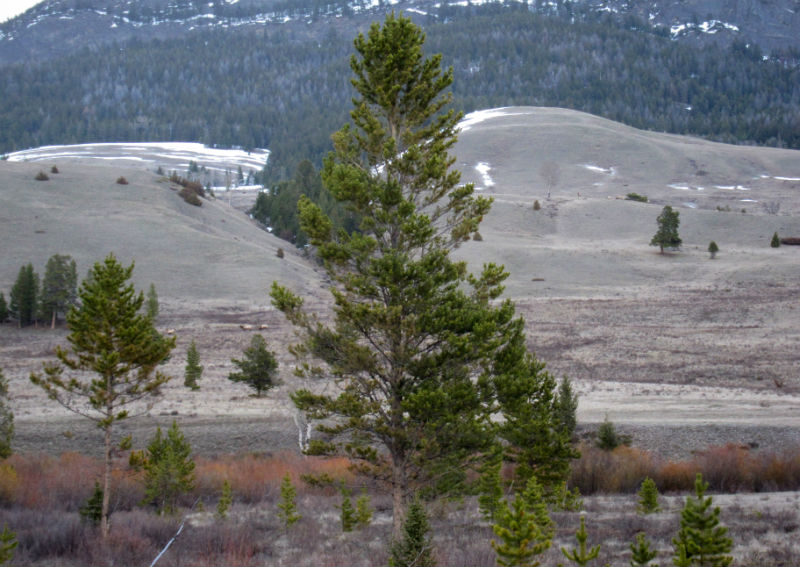
A hard metric for ultralight backpacking baseweight is useful for the same reason it is useful in anything, we humans love to ask for exceptions. Be it a higher baseweight figure for those over a certain height, or an extra SUL pound if you exceed a certain mean elevation, however compelling the excuse, the e-word remains nothing more than an attempt to get away with something rather than embrace the extra challenge of meeting an objective standard. There’s no inherent value in pack of a certain weight, the value can only be found in the trip such a hiker can only now do, as well as the extra consideration and learning meeting a rigorous weight standard can bring about. As Ryan Jordan wrote in 2013, “For me, SUL as a mindset has motivated me not only to be very intentional about what I take on the trail, but also to be very intentional about how I count the costs of all sacrifices that I make with time, finances, material possessions, and relationships.” Establishing a rigorous comparative standard with no wiggle-room helps you learn more. As will be discussed below, when it comes to hunting such things are highly relevant.
Backpacking is the prime mover of overnight ski touring, wilderness packrafting, and to a large extent alpine rock climbing and mountaineering. One does these things to travel through a given landscape in a certain fashion and see what is to be seen along the way. Even climbing is most often dedicated to experience in the landscape more than reaching a summit, witness the profusion of excellent routes which end when the good climbing does. Hunting is different. While pursuing animals in the backcountry is a good way to talk yourself into visiting and looking closely at some obscure, rough, gorgeous country, in the ends it’s like Fight Club. The first three rules of hunting are that to succeed you must kill something. If you spend five days in the mountains you went hunting, and probably succeeded in executing a fantastic backpacking and nature-watching trip, but you did not have a successful hunting trip, however satisfying the overall. I say this not as a value-based statement, but to highlight the principle around which any standard for an ultralight backcountry hunting baseweight must be built. If it will help you kill your prey, it makes the cut, no matter how heavy. As will be seen below, this is a hugely important distinction, because the backpacking pieces of an ultralight hunting pack will be among the lightest items on board.
Building an Ultralight Hunt
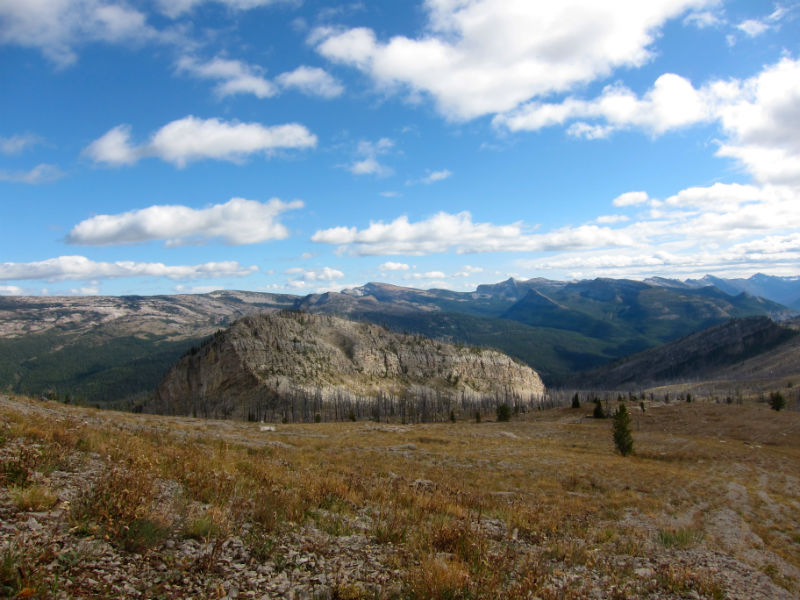
Because hunting has different motivations than backpacking, it often goes into very different places, and does so in different ways. Late September in the Northern Rockies of the United States provides a good example of this distinction. Mixed precipitation is common, as is standing snow in the higher elevations, though daily and nightly lows are usually relatively mild (read: below 20 F is uncommon). A common ultralight backpacking strategy for these conditions is to modify summer gear only a little, perhaps with warmer socks, and if particularly cold and wet conditions are present maintain warm feet via a brisk and steady pace, with perhaps a fire at camp. If the day’s high pass is exceptionally cold, a still stronger pace and an hour of minor suffering is usually all that is required. Hunting the same areas and conditions demands a different approach. Deer, elk, or sheep are likely bedded in invisible locations through the height of the afternoon squall, and descending to find dry wood is likely to spook whatever animals are nearby. Not only does the hunter need to move slowly and quietly through the area to find a high spot with good visibility for when the weather lifts, but he or she must be prepared to stay stationary during and after the storm to glass for and then locate suitable quarry. The ensuing stalk may be fast paced and help warm up cold feet, but might be interrupted at any moment by a forced wait behind a boulder midway across a talus slope, all while exposed to both the wind and the keen eyes of alpine ungulates.
The ultralight backpacker deals with challenging conditions like these with a judiciously selected kit, and adapts to the conditions by varying the pace and manner of travel. The ultralight hunter must adapt to the way the animals respond to ambient conditions, and have the equipment to do so.
All of which is to say that the ultralight hunter will have a much heavier pack, and for good reason. But how much heavier? Ultralight has in hunting, just as in other outdoor pursuits, become a potent marketing buzzword, with whole companies producing products lines devoted to “ultralight hunting.” A baseweight standard should be rigorous enough to push end-users towards defying dogma when choosing their gear. It should also provide consumers with a tool which can help hold gear-makers feet to the fire, and help foster innovation in content rather than marketing.
The following chart is a suggested list tailored to generic autumn conditions; early October in the US Rockies, early September in the Alaska Range, or mid-April in New Zealand’s southern Alps. As can be seen, the weight gets up there in a hurry. The maximum suggested hypotheticals I have here assembled come to a baseweight (worn clothing, food, and fuel not included) right around 36 pounds.
| Category | Item | Example(s) | Example Weight (oz) | Upper limit weight (oz) | Category limit total (lb/oz) |
|---|---|---|---|---|---|
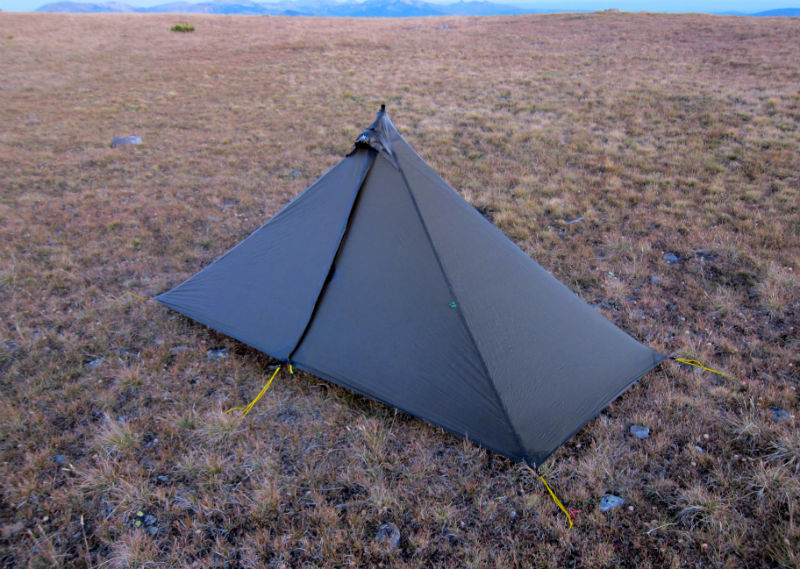
| Camp | 3+ season shelter for two | Seek Outside BT2, with pole and 10 stakes | 36 | 40 | 4 pounds 9 ounces |
| 20 degree sleeping bag | Zpacks regular/long | 18 | 24 | ||
| sleeping pad | Thermarest Prolite XS | 8 | 10 | ||
| Packing | 80+ pound capable ~4000 cubic inch pack | Paradox Unaweep, Stone Glacier Solo | 52 | 64 | 5 pounds 12 ounces |
| Game bags | 3x medium TAG bags | 10 | 20 | ||
| Drybags for gear, contractor bags for meat | Sea to Summit Ultrasil, Hefty | 8 | 10 | ||
| Cooking | stove and ~1 liter pot | MSR Windpro, Cat can alcohol w/ Evernew pot | 15 | 20 | 2-3 pounds |
| fuel | fuel | 1.5 oz/day/person | |||
| Misc | 100+ lumen headlamp, skinning knife, rope, tags, first aid, repair gear, PLB, hygiene, water bottle etc | Havalon Piranta, Petzl Tikka XP, McMudro Fastfind, satellite phone, etc | 48 | 48 | 3 pounds |
| Clothing (carried) | Durable raingear | Arc'teryx Alpha FL jacket, Rab Xion pants | 21 | 24 | 4 pounds 6 ounces |
| fleece midlayer | Rab Micro pull-on | 8 | 8 | ||
| Insulated jacket | First Lite Uncompahgre | 20 | 20 | ||
| Windshirt | Black Diamond Alpine Start | 7 | 8 | ||
| Light, snug gloves | Black Diamond Mont Blanc | 2 | 2 | ||
| Rain mittens | Outdoor Resarch Revel | 3.5 | 3.5 | ||
| Insulated hat | Original buff | 1.5 | 1.5 | ||
| Spare socks | Smartwool PhD Nordic medium | 2 | 2 | ||
| Clothing (worn) | Midweight pants | Patagonia Simple Guide | 15 | 16 | 6 pounds 10 ounces |
| Baselayer top | Patagonia Merino 1 longsleeve crew | 5 | 7 | ||
| Orange vest | poly mesh construction vest | 3 | 3 | ||
| Boxer briefs | Patagonia silkweight capilene | 2.5 | 4 | ||
| Ball cap | Arc'teryx Neutro visor | 1.5 | 2 | ||
| Socks | Smartwool PhD Nordic medium | 2 | 2 | ||
| Light boots | Zamberland Crosser Mid GTX | 36 | 40 | ||
| Gaiters | Kuiu Yukon | 12 | 14 | ||
| Trekking poles | BD Alpine Carbon Cork | 16 | 20 | ||
| Food | High calorie, palatable foods | Bars, Mountain House, etc | 22/day | 28/day | 28 ounces/day |
| Shooting | .25-.338 caliber centerfire rifle with scope, compound or tradition bow, .45-.50 caliber muzzleloader with scope | Kimber Montana in .308, Leupold 6x36, appropriate rings/bases | 92 | 112 | 8 pounds 8 ounces |
| 12 rounds of ammo, 6-8 arrows | 12x 165 grain Federal Fusion | 10 | 16 | ||
| Scope cover, sling, gunbearer, release, etc | Neoprene scope cover, nylon webbing sling | 4 | 8 | ||
| Optics | 6-10x bioculars with strap or chest rig | 6.5x32 Meopta Meopros with cord harness | 23 | 26 | 8 pounds 4 ounces |
| spotting scope | Vanguard Endeavor HD 65S | 51 | 64 | ||
| tripod/head | Vortex Summit SS | 30 | 32 | ||
| binocular mount for tripod | Outdoorsmans | 2 | 2 | ||
| rangefinder | Vortex Ranger 1000 | 8 | 8 |
This list, and thus I would suggest any ultralight hunting gear standard, must be tailored to account for not only the added weight of weapons, optics, and meat processing equipment, but for a pack which can haul very heavy loads, a shelter which can be pitched in places optimized for game spotting, and clothing which will allow for the aforementioned hanging around and bushwacking in bad weather. Many aspects of the above list will be subject to change depending on location and the species pursued. You’ll need more game bags on a moose hunt than on a deer hunt, for example, and a spotting scope and tripod may not be necessary for hunts in thicker country or for larger, less elusive species like elk and caribou. Later season hunts will demand a warmer sleeping bag and more clothing, while early-fall hunts or hunts in warmer locales might allow for less. Traditional bowhunters will shave pounds off their weapon weight compared to rifle or compound bow hunters. It was my intention however to make this list as close to the median as possible, and to make the individual selections rigorous, but not esoteric. Thus, I propose that the cutoff for ultralight backcountry hunting be a baseweight below 35 pounds (knocking a pound off the total to make for an even figure and account for a certain degree of laziness on my part).
35 pounds: The debate begins
There is, intentionally, a lot to argue about with this list and the 35 pound cutoff for ultralight hunting. I’ll address a few of the point-by-point particulars below.
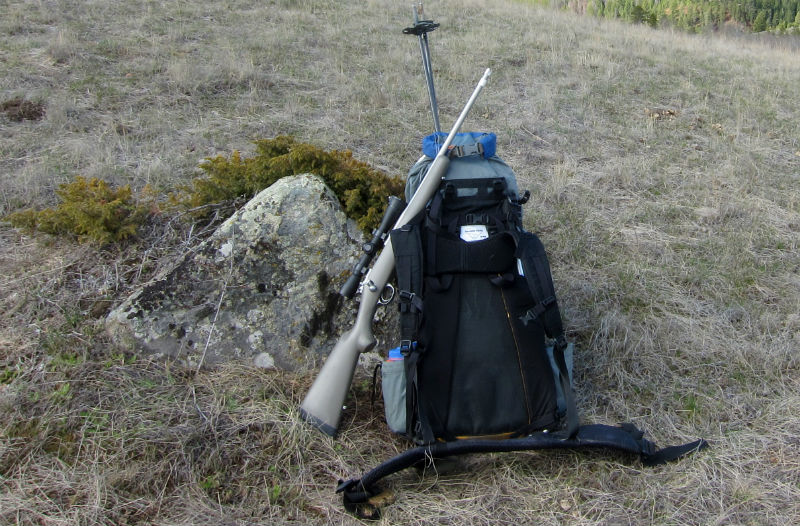
Having a rifle which comes in below 7 pounds is fairly simple with a non-magnum mountain rifle and a smaller fixed or variable scope. In the US such a combination can be had for little more than $1500. Hunters who cultivate the ability to make shots over 300 yards, and prefer the larger variables and magnum calibers which often go along with such an approach, can still have a sub-7 rifle, but will need to invest a lot more money and be prepared to cope with a hard-kicking gun. Skimping on ammo is also a good way to fail in seeing the big picture. In theory you’ll only need one round, but you never know when you’ll miss once or twice, have to check scope zero after a bad fall, or have to help dissuade a bear from coming in to your camp to check out the meat hanging in a tree. Ultralight will always come with sacrifices, but they should be the right ones.
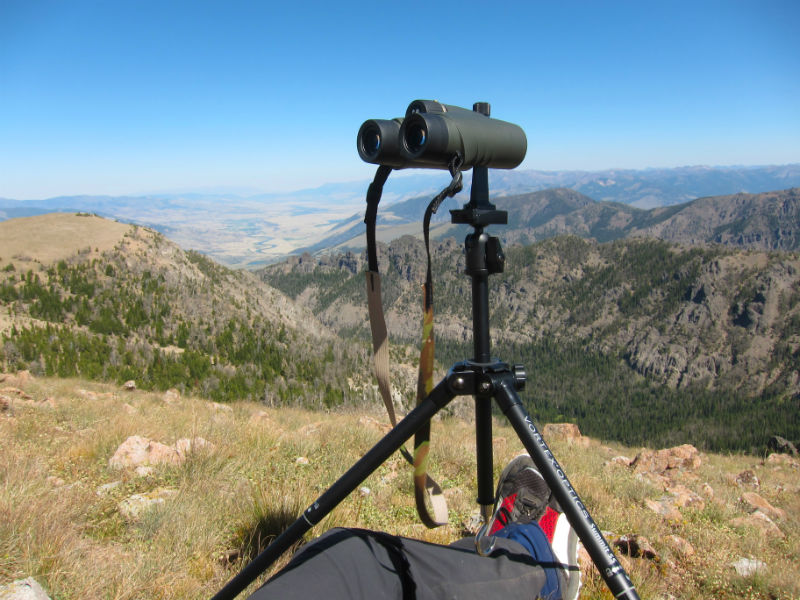
Some of the questions concerning the necessity of 8+ pounds of optics have been hinted at above, but insofar as hunting can be described as finding the best way to see the deer (or elk, bear, etc.) optics are essential, and skimping here is an almost surefire way to reduce your odds of success. Compact binoculars are a recipe for headaches and eyestrain, and the value of good binoculars mounted on a tripod can almost never be overstated. New England hunters stalking whitetails in softwood swamps may only need binoculars, but most hunters most of the time will find a tripod handy at one point or another. Again, ultralight hunting is all about making wise sacrifices, always keeping the overarching goal of a dead animal in mind.
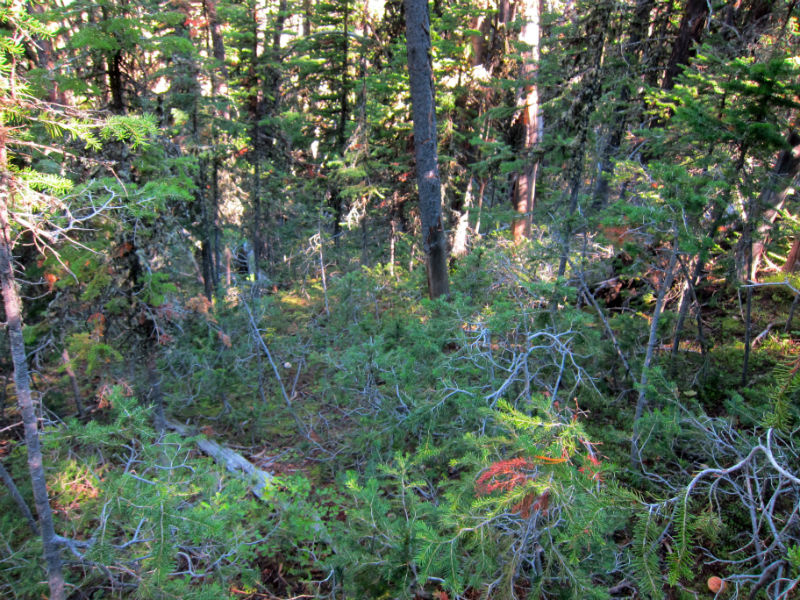
Heavier clothing than the typical ultralight backpacking load is also inevitable for backcountry hunting. Even in big wilderness, the charismatic megavertebrates most hunters pursue tend to treat trails like roads, and try to live their lives that one drainage or basin further from the stream of human traffic, however occasional that stream may be. A big part of the reason hunting the true backcountry has become more popular recently is not because it’s easier. The deer in such places, for example, may well be less wary of humans, but there are also far fewer of them per square mile. Hunting the backcountry, and especially hunting wilderness-dependent species such as sheep, is satisfying because it is as close as hunting gets to being absent from larger human influences. This end will be all the better pursued, and success all the more likely, if you get as far into the thick and nasty and untraveled as is possible. Simply put, this requires clothing which can stand up to such use. 2.5 layer PU raingear and Quantum GL-shelled puffy coats will not get the job done here, at least not for long. The options suggested in the chart are the lightest choice currently available which my experience suggests would hold up to a few seasons of non-pro use (say 20-30 days each year).
Footwear is also something where the approach for the ultralight hunter must be very different from the ultralight backpacker. I hardly ever backpack with waterproof footwear, but for fall hunting I’ve found it to be essential. Getting your feet soaked cruising through a snowfield is fine if you can keep rolling at 3.5 mph afterwards. If you need to hunker down to glass instead, dry feet are the only way to have warm feet. Footwear also needs to have enhanced grip and durability for off-trail use, and have enough support and sole stiffness to get that 80 pound load of meat and your camp back to the trailhead. I don’t think the conventional hunting boots, most of which are 2+ pounds a foot and stiff enough to be crampon compatible are necessary or desirable, but something beyond a zero-drop sneaker is probably in order.
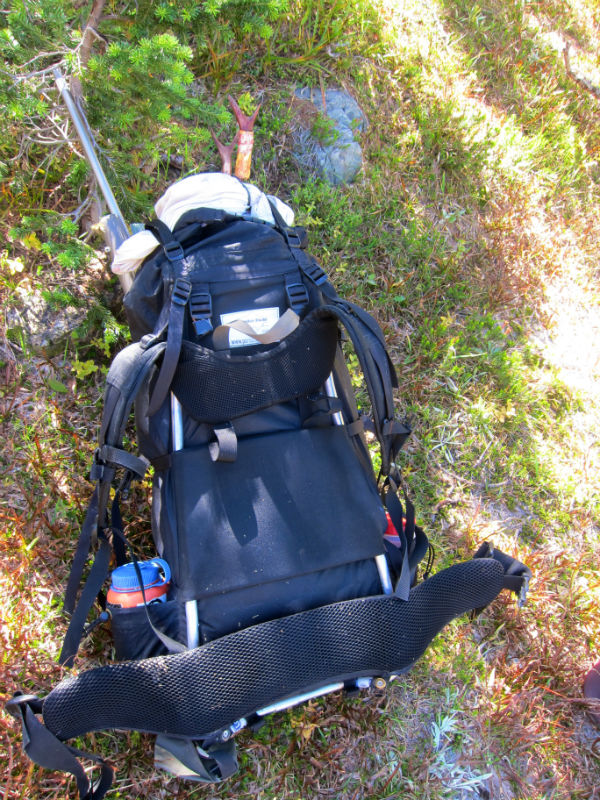
Packs for the backcountry hunter must also have different capabilities, while still being as light as possible. Thankfully, hunting packs have undergone tremendous growth in recent years, and there is no longer any need to go above the 4 pound mark in order to obtain a pack which is large enough for an ultralight load and meat, has functional features and compression, and carries weight as well as your legs are capable. A number of makers not mentioned in the chart make solid and well-regarded hunting packs, but the 4 pound barrier is an interesting one because it neatly divides those who have adapted the core design of their suspension systems to be lighter versus those who have merely come out with lighter components for the same old system. The sort of innovation Stone Glacier and Paradox Packs have brought to market in the last two years is the sort of thing which will need to become commonplace if the 35 pound mark is to become as routine for hunters as 10 pounds is for backpackers.
Conclusion: What’s next
Two things are in the future for backcountry hunting. The first is continued gear innovation, increasingly within the hunting industry itself, which will make lighter baseweights ever easier to achieve. Hunting clothing, which as discussed above is both quite heavy and has many demands placed upon it, is one area where it is easy to imagine major improvement. Quite a few hunting-specific clothing companies have come in being, and seemingly done well, since Sitka went into business in 2006. The overwhelming majority of these offerings are still far too heavy, both because of excessive features and the use of heavy fabrics. If the last 15 years of ultralight backpacking has done nothing else, it has proven that functional durability does not need to be sacrificed to obtain lighter gear, often much lighter than anyone initially thinks possible. In the next two years I expect companies like First Lite and Kuiu to knock 3 pounds off the 10+ that is the worn and carried total, with no loss of function or durability. Any backpacker knows that a 40+ pound pack is darn heavy, and no matter how fit you are it will slow you down. On a hunt, slower means less time in good glassing spots, more time needed to close the distance when game is spotted, and more energy expended overall. The harder the hunt, the more I want my pack lighter.
The second is that the backcountry hunting movement will continue to redefine what hunting is and how is it portrayed in the broader culture. Backpack hunting the wilderness shares many skills with front country whitetail hunting, but in many respects the two have as much to do with each other as backpacking does with golf. I don’t think that bow hunting whitetails out of a treestand over a food plot is unethical, especially given the overpopulations problems virtually all of the midwest and south will face so long as whole states remain deer buffets with few natural predators. But the general public is right to see frontcountry, often road-based hunting as something of a peculiar exercise, shot through with contradiction. Backcountry hunting is more of a holistic experience; experiencing where the game lives, humanely killing the animal, carrying the animal back to your home, before finally butchering it and eating it. The whole process fosters an intimacy with the wild which backpacking and its derivations cannot begin to match. In a world increasingly safe and sterile, where the raw math of how we as individuals stay alive is ever more abstract, backcountry hunting is a perfect antidote, and ultralight backpacking and hunting are ideal bedmates.
(Disclaimer: The author has a non-remunerative position as a product tester and design consultant with Seek Outside/Paradox Packs.)


Discussion
Become a member to post in the forums.
I grilled up both tenderloins this evening. Very simply; rubbed with olive oil sprinkled with coarse sea salt and pepper, grilled on high heat until slightly charred, but rare. Excellent!
We only ate the one tonight. The other one we’ll serve sliced thin (and cold) on crusty bread with a horse radish sauce :)
I’ve tried backpacking hunts a few times in Alaska but they never quite worked as planned.
Twice I’ve “backpacked” with overnight gear and shot my caribou before I could find my first camping spot. Then I just had more stuff to carry out! But I’ll take my wins.
A better strategy was to paddle a canoe through a lake chain and the day hike from a basecamp. I packed light so the portages were easier. The canoe made getting the meat out a lot easier.
I keep thinking about a Kimber but a Ruger American is light enough and cheaper. I got one in 358 Winchester and trimmed it down to 6.5 pounds with a scope. Now I need to work up some reloads so it more the a 250 yard gun. It hammers caribou and bears though.
Well it’s 2022 :) I haven’t been hunting yet for myself, but got to play “sherpa” on two different trips.
Tom’s father-in-law drew a Cabinet Wilderness sheep tag after 40 years of putting in! It was archery season still for sheep (it’s now open for rifle) so we knew it was probably more of a scouting mission, but you never know. We hunted for three days, scouted several nice looking basins and turned up some younger rams, but nothing worth pursuing. Great trip in some fantastic country nonetheless. I told Tom his fall is booked until his FIL fills that tag :)
Just two days after I got back from the Cabinets, I had to clean and repack my gear for a four day mule deer hunt that my buddy Josh drew in the Mission Mountains. It was another rather arduous hunt in more steep country. Josh passed on a nice buck; he’s holding out for even nicer buck. Also another great trip!
Amazing country Mike. Looking forward to it!
should be a good trip :)
Another trip into the Missions with my buddy (still has his tag)
Went antelope hunting last weekend in the Southeast corner of the state; was being very picky as I have two elk tags and passed over four pretty nice bucks. My buddy shot a decent buck, replete with a new antelope pack out for me- 4 miles.
I set up a day hunting rig- Seek Outside Revolution breakaway frame w/ a Merlin daypack- worked great! Also tried out a new custom knife (2 years of waiting!), it’s going to be a gem :)
https://youtu.be/ba-0SkBtIOQ
I took my wife, stepson and nephew on a “lightish” backpack trip hunting for 40 Mile caribou. No caribou but the boys got Ptarmigan with my little. 22. Good times.
We did better on a day hike for a black bear. I’ve been eating that guy for lunch for the last couple weeks.
https://youtu.be/2eVdkI05Bas
Congrats to Gabi- fine looking bear and well earned! :)
I thought you’d like that Mike.
We also tried a hike in moose hunt. I called in two bulls but they were not of a legal size. I think we’ll do more of that mountain bear hunting. It’s a lot of excitement and the logistics are easier. Caribou are so migratory its a roll of the dice where they’ll be each year. We seem to have bears figured out a bit more.
We don’t qualify as ultralight, but cuben fiber gear, small titanium wood stoves, and lovingly customized items like carbon arrow electric fences etc make getting deeper into the backcountry possible, increasing our success rate.
Phillip- great video and congrats on your guys success! Never thought about elk hunting in AK before :) Those ribs look really good!
I talked to a guy this year that had the same tag as Dave C for backcountry bison; they used an electric fence w/ success as well. If I ever draw that tag, I’ll do the same. Hanging all those bags of meat was a lot of work and he we had a couple of bags fail adding to the work. Electric fence definitely sounds like the way to go!
Well Montana went from Indian summer straight to Winter, skipped Fall altogether (sadly). It really changed up my elk hunting strategies. After three weeks of hunting my usual haunts (in 1-2′ of snow, even snowshoed a couple of the days- highly not recommended!), I finally wizened up and changed locations much closer to their wintering grounds. Started bumping into a lot more sign and started bumping some elk too. On day three of a three day hunt, connected with a cow (the largest cow I’ve ever harvested!) utilizing my B elk tag which I drew.
Still have my bull tag in my pocket and going to give it a couple more days of hunting and see what happens. Regardless, the near empty freezer will be filled up again :)
You need to do a trip report Mike. How is that little Kimber working?
Kimber is working great. I have it down to under 6 lbs all in (w/ a 2-7X Leupold and Talley mounts). Guys pick it up and want to trade for the day :)
On our hunt a few weeks ago (trip report coming), I briefly handled Mike’s Kimber mentioned above…struck me as crazy light! About 1.5# lighter than what I was carrying. I especially liked the look/feel of the shortened barrel. I think we had rifles in hand nonstop for what, ~30 miles of XC hiking, including plenty of climbing, descending, rough stuff, etc? (At one point we borderline cliffed out and a rope would’ve been handy!) Given where/how the weight is so often carried (in hand), strikes me that the benefits of the savings add up quickly vs. something in the pack.
I worked a Ruger American 358 down to 6.5 pounds scoped and it’s great. A Kimber is tempting though as more of a good thing. One lesson learned from our moose hunt. Don’t skimp on scopes. We had a bull circle us for 20 minutes right at dark. We caught glimpses of him and eventually decided he was probably not legal. I really wished I’d had a tad more magnification and more expensive glass. My son was acting as spotter with Binoculars. If I’d been solo it would have been harder. So I’ll probably get a bigger scope. It will add weight but if that buys me a full freezer I’ll take it.
I’m using an American in .308 with a Vortex 3-9 x 40. No sling. Currently 7 pounds, 4 ounces with an empty magazine. What did you do to lighten yours Luke?
Mine was a 358 Predator model and was about 6 lbs 7oz if I recall. I cut the barrel to 16.5 inches. Then I swapped out the Predator stock for a compact youth stock. I cut the forend of the stock off an saved about 1.5-2oz (I attached the round end back on, smoothed the edges with epoxy and painted over it). I finished by adding an iron front site (maybe 0.5oz?). There is a quick detach peep sight in case I ever take the scope off. The scope is only 8.5 oz. So the actual rifle is probably 5.75 lbs roughly. With the scope and rings it’s about 6.5.
It’s not a long range gun at all. My plan was a short gun that I could packraft with. I was going to hike into the mountains, shoot a black bear and float it out. I ended up moving to another part of Alaska and that trip never happened. But I did raft with it once. No real issues.
In your case a lighter scope would save a few oz. Trimming the barrel probably won’t be worth it unless you want to go real short. I believe you use copper bullets in CA. Those require more velocity to work well so a short barrel is probably a bad idea.
That’s a cool small build. Yeah, I was curious if you had any tricks but I think the scope is indeed the only place to get real weight savings. I think mine is ~14oz. I do use copper, even on my recent Montana trip that didn’t require it. I figure it’s simpler and cheaper to find a hunting round and just stick with it.
Honestly not worth it to me to spend the $$$ to reconfigure this rifle. I did fine with it on our recent hunt, the weight is hardly unmanageable. Just geeking out on UL stuff ;) I’ll build something lighter next time around.
Driving the long, lonely highway, hours rolling by. I’m always drawn to bluegrass and country on solo distance drives, it always seems fitting for endless hills and the asphalt peeling away beneath the wheels. Tyler Childers’ “Charleston Girl” was the #1 find on this drive from California to Montana. I was a bit dizzy and road weary, but eventually greeted with elk chili, a beer, and a warm spare bed, a welcome change from two days of gas station food, Starbucks, and a night sleeping in the back of my car in sub-freezing temperatures.
And we’re immediately off again well before it’s light, truck headlamps bouncing up a dirt road, sipping coffee, soon to be followed by the day’s physical warmup of shoveling snow and chaining up after getting briefly stuck in a drift. Packs are soon shouldered and wonderful silence sets in after the truck’s doors are shut; just wind, breath, and the crunching of ice and snow beneath our feet. We’re hunting right out of the gate and don’t speak too much beyond whispers for the next few days.
A few miles roll by. From a glassing knob Mike spots movement across a canyon, three or four spooked mule deer bolting across an open ridge and taking cover in the treeline. I catch a large rump or two protruding from the trees and they disappear from sight. Something other than us has them on the run. Too far, we write them off for the time being, assuming they’ll be long gone by the time we make that side of the mountain.
Climbing the same ridge a few hours later we approached the spot they disappeared, not thinking much of it, but I suddenly spot movement in the treeline. “Deer!” I gasp as loud as one can while still in a whisper. We fall back, drop prone, and a solid 3×3 emerges from the trees. “I’d take that deer…” I tell Mike. Before I can finish saying it, an even larger 4×4 steps out behind it. “That’s a good deer!” Mike says, excitement palpable while trying to stay hushed. The rangefinder says ~240 yards and there’s a brisk wind whipping through the canyon between us. Not the easiest shot for me, but doable. We stay low, making for the cover of a tree, preparing to drop a pack for a rifle rest. But the deer don’t stop moving, headed into the snow and timber traveling uphill across the canyon.
300 yards.
320 yards.
350 yards.
Binoculars glued, I give up on the prospect of a shot. They simply never stop moving, the wind is still howling, and there’s just too much cover between us. As they make the ridge they bolt, dark shapes disappearing fast through the trees, likely over the other side. These deer were spooky, definitely onto us, but also seemingly jumpy from something before we even found them.
That we were still on the morning of day one and I had ranged two of the largest deer I’ve hunted (by parched Southern California standards), things were looking good!
We spent the remainder of the day climbing and descending, occasionally postholing with heavy packs, deer sign everywhere, eventually descending into a canyon to find water, an endeavor that we nearly cliffed out on several times. Scrambling, sliding, we make the bottom spent and settle in for lunch on a grass bank, golden light filtering through the trees of an idyllic little streamside camp. Salami and cheese for me, a welcome rest, body sinking into the ground, a reminder of how hard we’ve been going. We make our way back into the higher country, into an elevation band where most of the sign was, and make camp for the night. On an evening scout a few does bolt across a meadow in front of us but no buck follows. Again, coming from the relatively game-poor areas I hunt at home, it’s been quite a good hunt already. In some places, simply seeing a deer is a victory.
Day two we hunt hard all day, covering some serious mileage and elevation cross country. The sign is there, the territory is right, but there are no deer to be found. The day culminates with us glassing the country below from a high point, endless mountains spread before us, evening light stretching across the land. I love the silence and stillness of hunting, of being in someone’s company but not having to talk too much, just watching, listening, and appreciating the land together.
On day three we change locations, heading to lower country with less snow, making the travel a bit easier. Backpacking in shoulder season/winter conditions is gear intensive enough, requiring systems that are well dialed. Hunting is fairly specialized as well. Combining the two certainly requires an intelligent approach or one’s pack would be completely unmanageable. While certainly not shouldering ultralight loads, a lightweight base system strikes me as integral in offsetting all the other gear one must carry. In my case this is an MLD Solomid, WM Antelope bag, Thermarest Neoair Xlite, Z Rest (for extra insulation and glassing), and a Seek Outside Unaweep. Being <10 pounds for the Big 3 in cold conditions with potential weather while maintaining the ability to carry a bulky and heavy load is an excellent benchmark in my estimation. My gear, clothing, and footwear systems worked flawlessly, the latter being quite welcome when hiking in ankle deep slush followed by snow, then sitting and getting wind-whipped in a glassing spot. All a good sign that I’m getting this gear thing pretty dialed over the years.
We spend the day largely still hunting through deadfall, creeping along quietly through the forest. I spotted a decent buck running the canyon bottom not far below us, instantly putting us into high alert. More hiking, more miles, Mike is soon slowly leading us across the canyon bottom and up a nearby ridge. He crests it a minute ahead of me. As I arrive, he’s low, motioning for me to get down. He whispers that three bucks are just up the ridge above us and urges me to stalk in slowly. I quietly chamber a round and begin creeping through the junipers…
The three bucks materialize, but the two largest have likely already winded me. I catch a faint glimpse of them heading uphill at a quicker pace. We haven’t totally bumped them, but they’re close. The youngest, a decent sized 2×2, is hanging back a bit. I’m creeping ever closer, staying as quiet as I can. I make the edge of a large juniper and slowly peek out. He’s standing there, full broadside, nose in the air sniffing, ears twitching and alert, looking down the hill. Despite being younger, the body was bigger than all of the much older bucks I see here at home.
I swear he locks eyes with me but can’t figure me out as I’m low and in the brush. He’s about 50-60 yards out. I very slowly slide prone and realize I have to make a snap decision: I have a perfect shot on a good looking deer but he’s on edge enough that he’s going to bolt in two or three more seconds.
I’m new to big game hunting. I’ve been out for a handful of seasons, both rifle and archery, and have had some exciting hunts. I take my responsibility seriously, having passed on a few possible rifle shots, an archery shot that was easy but had me concerned I’d lose the deer down a canyon too steep for me, as well as an archery clean miss at about 40 yards in which I misread the distance on a steep hill and the deer jumped my arrow. I’ve been on a few successful hunts with friends, including an epic bison hunt in Montana in 2018, but this deer would be my first.
So I anchored the crosshairs, exhaled, and squeezed the trigger.
I think my greatest fear thus far has been getting myself involved in a failed tracking epic on a wounded animal; this fear has been strong enough to stop me from taking a shot on a few occasions, situations that if I could replay today, I’d likely take the shot (I’m a more confident shooter with both rifle and bow now). But this is the learning curve, and likely the right way to play it. I have no regrets.
To my relief the shot was perfect and the deer dropped exactly where it stood.
I was calm through the entire process, but now that it was over, I slapped Mike a high five and traded a hug with my knees and hands shaking. Disbelief, sadness, elation, adrenaline, the sheer intensity of being a predator dialed in on its prey; hunting is a complex mix of feelings, intensified and stewed in hours upon hours of waiting and working in silence. When the emotions eventually calmed, we went to work. I must have been riding a high, because despite a steep ridge climb, I don’t remember any fatigue on the packout…
I’ve got to thank Mike for his generosity out there, for being such a great guide and teacher, and a selfless one at that. It didn’t go without notice that he deferred every opportunity to me, despite having a rifle in his hand for every mile of our trip. We’ve had some great adventures together over the years, from the Grand Canyon R2R2R, the bison hunt with Dave C., to desert hikes and Sierra XC rambles, but I’m particularly thankful for this one. Here’s to more to come!
I butchered everything myself, ground the burger and sausage (I bought a grinder after the bison hunt), and have been treating family and friends to deer throughout this holiday week. I’ve been striking out so far this season freediving for lobster, but the goal is to have a true paleo-North American feast of lobster, fish, and venison for the holidays.
Great write-up, great trip, great memories. We definitely need to work another one in! :)
Wow Craig, I hadn’t realized you got one on that hunt. Great work. The first kill in the backcountry is a special experience.
My August Dall hunt is still a go- airline tickets purchased (commercial to Fairbanks and then a float to Chandalar Lake); lodging secured for two nights in Fairbanks (night before the hunt, one after) and purchased licenses
I hemmed and hawed on grizzly and caribou tags, but realistically this is probably my one and only AK hunt, so went all in :)
Mike I look forward to your trip report. I assume its a guided trip?
^ Yup- Tyrrell Trails, Chandalar Lake in the Brooks Range.
It was booked almost three years ago. After watching a Randy Newberg episode where he hunted Dall sheep (in the Brooks as well), I told my wife just once I’d like to hunt sheep (having been putting in here in Montana for over 25 years w/ no luck). She said well just do it- in two days I had the hunt booked :)
Become a member to post in the forums.