

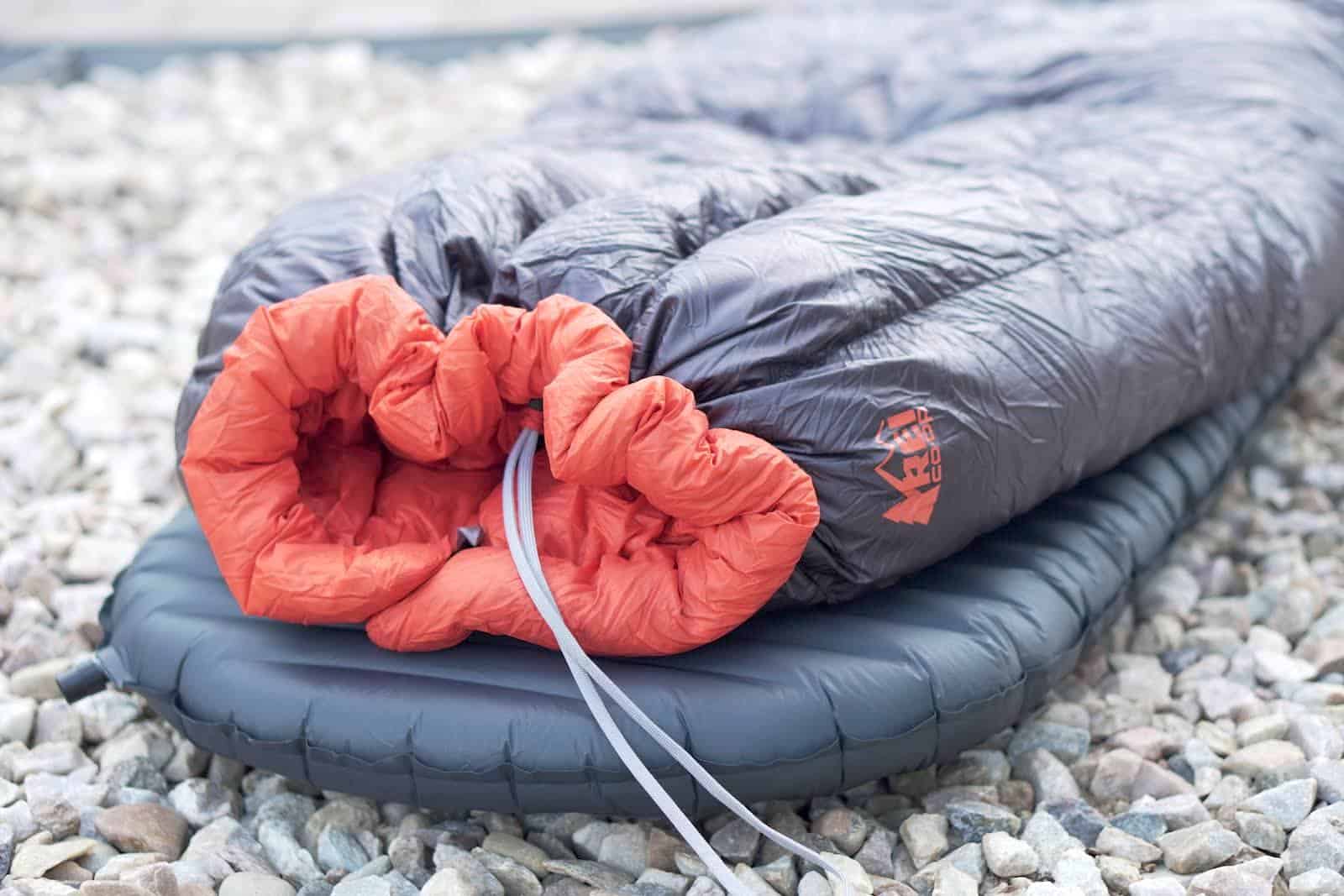

Overview
Lightweight backpackers have long complained about how hard it is to compare the warmth of different sleeping pads. Recently, three pad makers and retailers announced that they would use a new standard for measuring sleeping pad insulation. And in 2020, REI and MEC will require all their suppliers to report those values. At first glance, this looks great. But the devil is in the details.
For many years, pad makers like Nemo and Big Agnes have advertised temperature ranges without describing how they came up with those numbers. Others promoted R-values using different protocols. This made it almost impossible to reliably compare sleeping pads between manufacturers.
Then late last year, MEC, REI, and Therm-a-Rest announced that they would use a new sleeping pad R-value standard to measure their own products. And starting in 2020, REI and MEC will only sell pads furnished with standard R-values. Many people were glad that they could soon compare sleeping pads across manufacturers, like the EN/ISO 13537 temperature ratings for sleeping bags. But knowing the R-values of sleeping pads raises new questions.
What’s an R-value and how is it measured?
An R-value measures resistance to heat transfer through an insulating layer. An R 3 sleeping pad provides three times more insulation than an R 1 pad. But as one part of a sleeping system, you won’t sleep three times warmer.
R-values started as a way to measure building insulation. In this post, I’m using United States R-values; the rest of the world uses metric units sometimes called RSI. To convert from the metric values found in many scientific papers to US R-values, multiply by 5.68.
| US R-Value | Metric RSI (K·m2/W) |
| 1 | 0.18 |
| 2 | 0.35 |
| 3 | 0.53 |
| 4 | 0.70 |
| 5 | 0.88 |
While the new R-value standard is behind a paywall, Outside described the basic testing setup: two plates at constant temperatures of 95 F (35 C) and 41 F (5 C) squeeze a pad to simulate human weight. Many other factors are under control, including pad inflation, ambient temperature, wind, and humidity. At the time of their announcement, only MEC, REI, and Therm-a-Rest owned the $50,000 machines required to measure sleeping pads using the new standard.
Sleeping pad tests in a well-controlled lab only go so far. Roger Caffin covers many of the pitfalls of pad testing for BPL in Apparatus for Testing Thermal Insulation Properties. Roger and Will Rietveld also go into more detail on the real-world performance of sleeping pads in Lightweight Inflatable Sleeping Airmats – State of the Market 2011 Part 1 and Part 2.
Many BPL readers understand R-values to some extent, but most consumers don’t. And they certainly won’t know what R-value of sleeping pad they need.
What R-value should I look for in a new sleeping pad?
If you know the R-value of your existing sleeping pad, soon you can decide if your next pad should be warmer, cooler, or about the same across many brands. But you’ll need more information if you don’t know the R-value of your current pad or you’re new to shopping for sleeping pads.
Unfortunately, the guidance from pad makers, retailers, and gear reviewers is inconsistent and prone to misinterpretation. For example, see:
1. The Therm-a-Rest blog What Is R-Value?
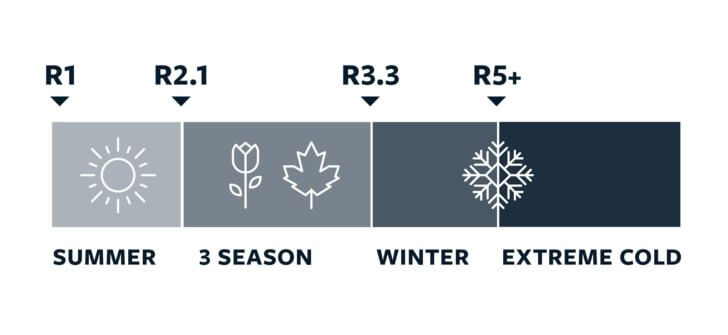
2. Therm-a-Rest Ultralight Adventure pad finder:
- R 2 to 3.3 – Three Season
- R 3.4 and higher – Winter
- R 5.7 and higher – Extreme Cold
3. REI Expert Advice How to Choose Sleeping Pads
“Thicker pads generally offer higher R-values and the average summer camping pad should be around 3 or higher. Campers who sleep cold, often women, may want to choose a pad with an R-value of at least 4.”
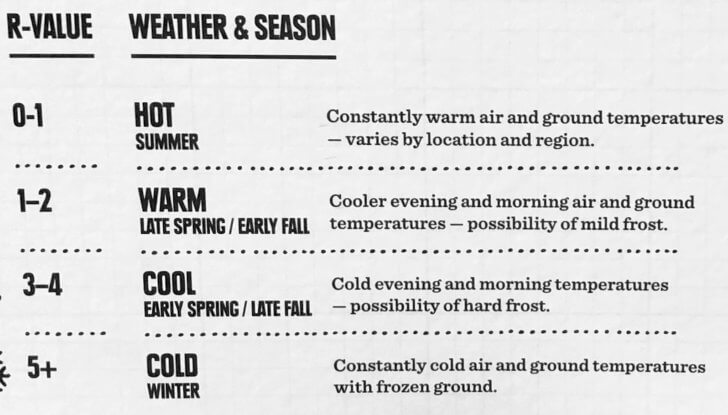
4. REI in-store sign next to sleeping pads:
5. Philip Werner’s Section Hiker blog Sleeping Pad R Values
- “For winter backpacking and camping, an R-value of 5, or higher, is recommended.
- For three-season backpacking and camping, an R-value of 2, or higher, is recommended.
- An additional R value of 1 is usually a good hedge for women and other cold sleepers.”
6. Outdoor Gear Lab How to Choose a Backpacking Sleeping Pad
“We have found that pads with R-values between 2.0 and 3.0 generally work well for three-season use but should be supplemented with a foam pad for use in the winter where an R-value of around 5 or above is ideal. Pads with R-values lower than 2.0 are great for summer, but you may want to supplement them with a closed cell foam pad on colder nights in the spring and fall.”
All this advice shares two serious shortcomings:
- Seasons in coastal Hawaii are very different from northern Minnesota, so “winter” low temperatures could be anywhere from +40 F (4 C) to -40 F (-40 C).
- Poorly-defined seasons don’t match up with sleeping bag EN ratings by temperature, which is where most people start their shopping.
But in one important way, all this guidance is wrong.
How do sleeping bag temperature ratings relate to R-values?
Most people want their entire sleep system – clothing, sleeping bag, sleeping pad, and shelter – to keep them reasonably warm at night. And many consumers focus on sleeping bag temperature ratings. For example, a warm sleeper might decide that for a trip with forecast low temperatures in the 40-50 F (4-10 C) range, a sleeping bag with an EN/ISO lower limit rating of 40 F (4 C) should work well. The EN/ISO testing protocol requires a zipped up sleeping bag with the hood cinched along with several other requirements including using an R 4.8 sleeping pad.
If your sleeping pad is substantially less than R 4.8, you’ll lose more heat to the ground, and you might not be warm enough in an EN 40 F (4 C) sleeping bag on a 45 F (7 C) night. I wrote “might not” because how warm you sleep on any given night depends on many other variables. One paper claims (PDF) that using an R 1.3 or lower pad could cut 10 F (6 C) from the effective rating of a sleeping bag.
Relying on EN/ISO sleeping bag temperature ratings argues for always using an approximately R 5 pad. This is more-or-less the approach taken by Zenbivy, who states: “only mattresses with R value 5 or greater will deliver full temperature rating performance from EN rated sleeping bags.”
Conclusion
R-values alone are not enough for many consumers choosing new sleeping pads, and much of the current guidance is inconsistent. Manufacturers and retailers who suggest lower R value pads for a wide range of temperatures could be seriously misleading buyers.
You can’t look at a sleeping pad’s R-value in a bubble. Consider your pad part of an integrated system that includes the clothing you wear to bed, your sleeping bag or quilt, the type of shelter you’re in, the nature of the ground surface (snow, moisture, etc.), ambient temperatures, and of course, your own physiology. Photo: Ryan Jordan


Discussion
Become a member to post in the forums.
The R value as reported does appear to be very low for foam pads – or should I rather say, the temperature rating of foam pads implied by R values appear low compared to inflatables. Any experiences here?
I’ve camped out in the snowy mountains in the snow many times with a 10mm and finally an 11mm foam pad ($10 at a hardware store) – no issues, and did not feel the cold coming through. Hard to say how cold it was, -5 to -10? In the snow a foam pad is also very comfortable as you can mould the shape of the floor.
With more age I am now looking at inflatables for non-snow applications for more comfort, and also for stealth – having a foam pad makes it obvious what my intentions are and now living in Europe there is a grey area the legality of doing wild camping.
in Europe there is a grey area the legality of doing wild camping.
Not to the best of my knowledge, at least in France.
‘Camping’ is taken to mean caravans and big tents and BBQs, and has to be done in proper camping parks.
But pitching a little tent up in the mountains for a single night is called bivouacing, and it is quite legal. We have done that many times over the years.
Cheers
Good to know. In Germany “biwakieren” is tolerated above the tree line “in an emergency”. But otherwise illegal.
It is therefore important (to me) not to advertise to avoid questions and crowds in the mountains.
Roger, what is your take on the warmth of foam vs inflatables?
what is your take on the warmth of foam vs inflatables?
Well, that is a bit complicated. Air mats are much softer, so you get a better sleep, but they can compress down so there may be cold spots where the thickness is much reduced. But, of course, if you are fast asleep you may not notice.
The other problem with airmats is that you can get leaks, so you end up with nothing. I have had that once or twice over a lifetime of camping.
We (wife & I) each use an Exped Synmat UL7 over 1/8″ of CCF. The CCF is as much to protect the airmat when on rough ground as anything else. We have slept on that combination down to -7 C. But there was thick snowgrass under the tent.
Cheers
To expand on warmth of foam vs inflatables:
It depends. Some inflatables are literally little more than air mattresses, which are comfy but excel at sucking the heat right out of you.
That’s where standardized R-value testing comes in. In theory you can say foam pad X is warmer or cooler than inflatable pad Y. In practice, the test misses some confounding factors. As do almost all lab tests.
Decades ago I also spent many nights sleeping comfortably on snow using a 1/2-inch (12 mm) foam pad of unknown R-value. Melted my way deeper on a couple of nights. Snow can be an insulator at lower temperatures. But for several reasons, I wouldn’t even try that now.
Some people sleep fine on cold nights using thin foam pads by carefully choosing well-protected and naturally-insulated campsites. And using the right sleeping bag or quilt, and shelter.
So it’s pretty hard to generalize.
But if you aren’t skilled at choosing warm campsites, or don’t have a choice, take an R 5 or warmer sleeping pad. Many people stack foam and inflatables to get there.
— Rex
I appreciated the mention of seasons when selecting a properly insulated pad. A 40deg F night in the summer is not the same as a 40deg F night in the “winter” (I speak of winter on California’s central coast). The ground, in my experience, was much colder on the winter night than the summer night, hence why I got cold in the winter and not in the summer, even though I used the same sleep system.
Adding to what was said above…
I tried an Exped Ultra 5R inflatable last night in the backyard and felt a definite chill through the pad. The Colorado ground was frozen, and the overnight low was ~20ºF. Adding a Nemo Switchback on top helped, and the whole thing was darn comfy. But it still wasn’t as warm as the REI Kindercone + Switchback combo I’ve used elsewhere this winter under similar or colder conditions.
Something about the construction of these pads alters the R-value, for sure. Either the Exped’s 4.8 is over-rated, or the Kindercone’s 4.5 is under-rated, or both.
I wonder if you could make a hybrid of the inflatable, reflective mylar style pads, and the self-inflating open cell foam pads, increasing the R-value, softening the noise and lowering the height, all in one…
The R value on pads is measured statically. As a person moves around on the pad at night, the stratified air in the pad moves around and mixes warmed air near the sleeper with cold air near the ground. Only insulation can minimize the air movement. 3-4 inch thick pad tubes, even w insulation, allow more opportunity for air movement. I love my comfy Exped, but if the ground is frozen adding a Thinlight pad makes a sleepable difference. Exactly why I keep my old Xtherm around for low 20s temps and lower. Not as much cush for the tush, but being warm leads to good nights sleep!
Interesting discussion. I’m developing an UL cot partly because of the issue of non reliability of air mats.
Said UL cot is comprised of bamboo poles reinforced on the outside with S glass and high strength epoxy, and spray foam on the inside. The poles are connected to/fitted into high density, thick EVA foam blocks (Yoga exercise blocks that I cut up). Then polypropylene webbing goes the length and width connected to the bamboo poles with a strap cinch on one end and a sewn loop on the other. I plan to use CC-foam on top of the straps. Maybe also a down under quilt underneath it if it is especially cold (I’ll only be about an inch off the ground). I’m hoping that since the foam will be on top of suspended straps/webbing, it might make it comfortable enough to sleep on. It’s been awhile since I could sleep comfortably on CCF on the hard ground.
I’m not fully done with the project, but judging from the weight of the materials so far, I expect the cot to be around 2 lbs. I would still use an air mat for regular backpacking trips. This UL cot is for specialized, severe cold type expedition type trip where I need something extremely reliable.
Hi Justin
I looked at this myself a long time ago. There were possibilities, but they all ran up against the extreme pressure under the cot legs on top of the groundsheet.
How are you dealing with this?
EDIT: I have a steel & canvas ex-army (I think) cot which has steel rods down the sides and 3 steel legs underneath, going from side to side. A heavy beast, but so very comfortable! But the legs touch the ground over very small areas.
Cheers
Hi Roger, there are no typical legs to speak of. Instead, there are thick high density EVA foam blocks that I used a hole saw to drill out holes about the diameter of the bamboo poles. The reinforced bamboo poles slot/fit inside the EVA foam blocks. There are 8 EVA foam blocks. The corner ones are longer than the middle side ones as to fit the head and feet poles along with the side ones better (more volume area to hold the poles). There are 8 22″ poles that make up the rectangle frame (1 horizontal one at the head, 1 horizontal one at the foot, and then 3 vertical ones on each side).
My concern is that the EVA foam, though high density and thick, will eventually compress too much. If that happens (and I suspect it will over time), I might replace them with waterproofed balsa or basswood wood blocks instead. There will be a weight increase, but it will handle the compressive forces much better.
I’m fairly close to finishing. I just have to sew the loops on the polypropylene webbing (1″ wide webbing that is rated for 300 lbs continuous tensile strength and 900 lbs temporary/sudden. There will be 2 length wise straps and 6 width wise straps, but I will experiment with the latter and see if I get away with less width wise ones). I’ll be uploading pics etc to the MYOG section when I am finished.
Hi Justin
You can get EVA foam in densities ranging from EVA30 (30kg/m3) to EVA400 (400 kg/m3). That is a huge range. My off-the-cuff GUESS is that you could start with EVA100 and go from there. The stuff is not $$.
What you really need is to find a mfr within range. I did, and the mgr was very helpful, and willing to sell small bits for MYOG.
OK, the foam will be bulky, but I would mainly worry about weight.
Photos: these are an absolute MUST! We drool in anticipation.
Cheers
Hi Roger, have you ever seen those foam blocks/bricks made and sold for yoga use? That is what I’m using for the foam blocks. I bought two of those (7 dollars US for each) and cut them up into smaller cubes/blocks. Very light, but somewhat bulky.
Yoga use? Sorry, not seen.
Web crawl . . .
EVA foam, and cork ones as well. The cork is very light and a bit more solid.
Cheers
The place I got it from didn’t have cork ones. If the EVA foam doesn’t work out, I will probably switch to balsa wood. It is around 40% less dense than cork, and has better abrasion and impact resistance/durability than cork (at least this form of cork i.e pressed particle stuff, which makes it more crumbly). In any case, either one would need to be waterproofed for such an application, unlike the EVA foam.
Photos!
Cheers
I would like to see Roger doing Yoga :)
Roger doing 1/2 yoga:
I had black hair back then.
That was in Spain on the GR11.
Jerry wrote, “I would like to see Roger doing Yoga :) ”
Budding Bro’mance or just morbid curiosity…?
I jest, I jest.
Chaff, all is Chaff.
Become a member to post in the forums.