


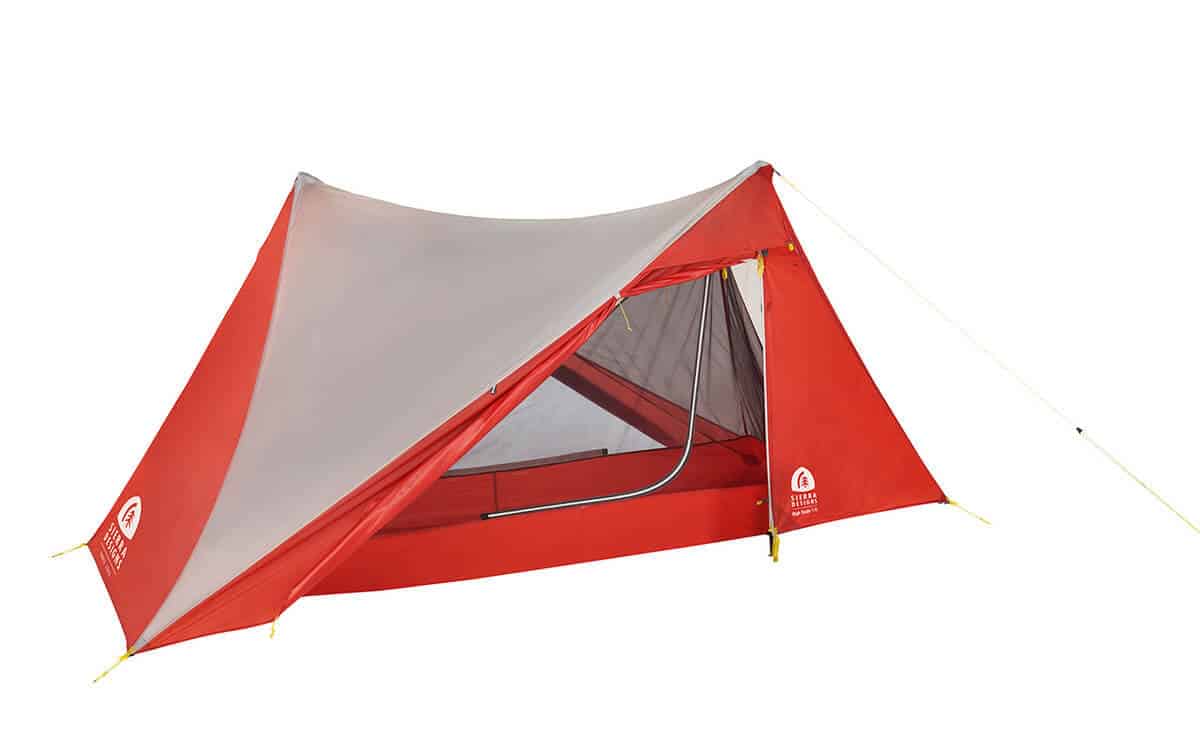
The Sierra Designs High Route 1P Tent is a spacious three-season tent designed for withstanding variable conditions while remaining (sort of) light. The High Route is versatile in relation to weather, usability, and functionality. It was designed to the specifications of Andrew Skurka, long-distance backpacker and a National Geographic “Adventurer of the Year” recipient.
Features and Specifications
Features
- Three season tent with some usability in mild winter conditions
- Pyramid-inspired design
- Pole-reinforced vertical doors
- Steep walls (added space)
- Both side doors are able to be guyed out for ventilation
- 5-inch awning vents
- The bug nest and tarp can set up separately
- Pole placement is offset
- The stuff sack is oversized to make re-packing easier
- Large enough to accommodate two people in a pinch
Specifications
- Minimum weight: 2 lbs 5 oz (1.05 kg)
- Packaged weight: 2 lbs 12 oz (1.25 kg)
- Number of doors: 2
- Gear storage area (tarp area + nest area): 17.3 ft2 (1.61 m2)
- Interior area (tarp): 36 ft2 (3.34 m2)
- Interior area (bug nest and floor): 18.8 ft2 (1.75 m2)
- Internal peak height (tarp): 48 in (122 cm)
- Internal peak height (nest): 43 in (109 cm)
- Awning height: 38.5 in (98 cm)
- Length (tarp): 108 in (274 cm)
- Length (nest): 90 in (229 cm)
- Width (tarp): 48 in (122 cm)
- Width (nest): 30 in (76 cm)
Description of Field Testing
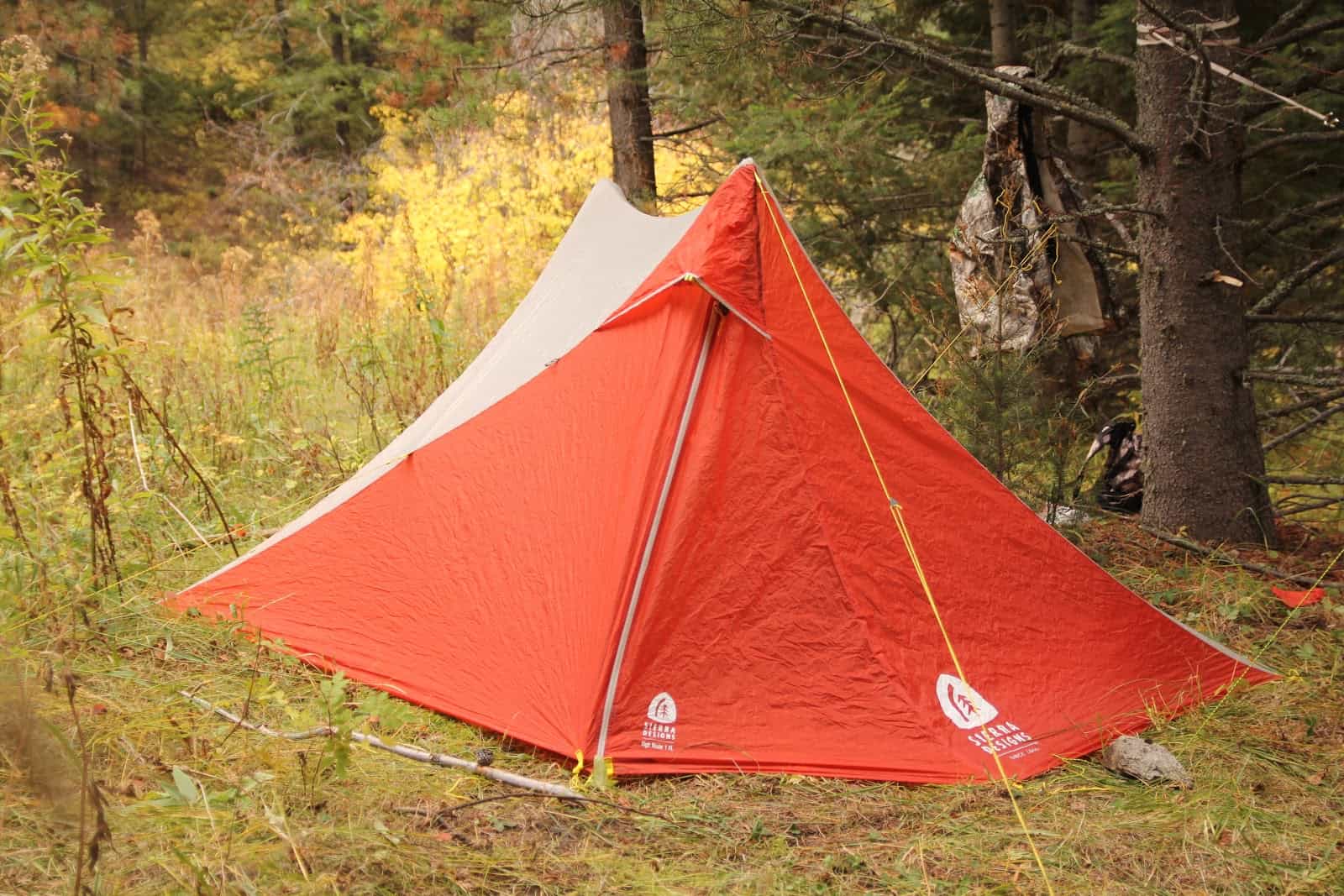
The field testing consisted of a multiple-day trip in the Belt range of Montana during the last week of September. We set up our camp at six thousand feet and day hiked from there. The weather was typical for the area and season: nights in the twenties and a few snow flurries. We were camped down in a sheltered ravine and so did not encounter a large amount of wind.
My performance assessment of the Sierra Designs High Route One Person Tent will consist of the following items:
- Features
- Design
- Usability
Features
The Sierra Designs High Route sets up with trekking poles. The side doors can stake out into spacious porches, making entering and exiting the tent easy and also allowing for a good amount of ventilation on a humid night. The steep walls add considerably more space compared to many other one-person shelters. The five-inch awning vents help keep condensation to a minimum—I woke up dry every morning.
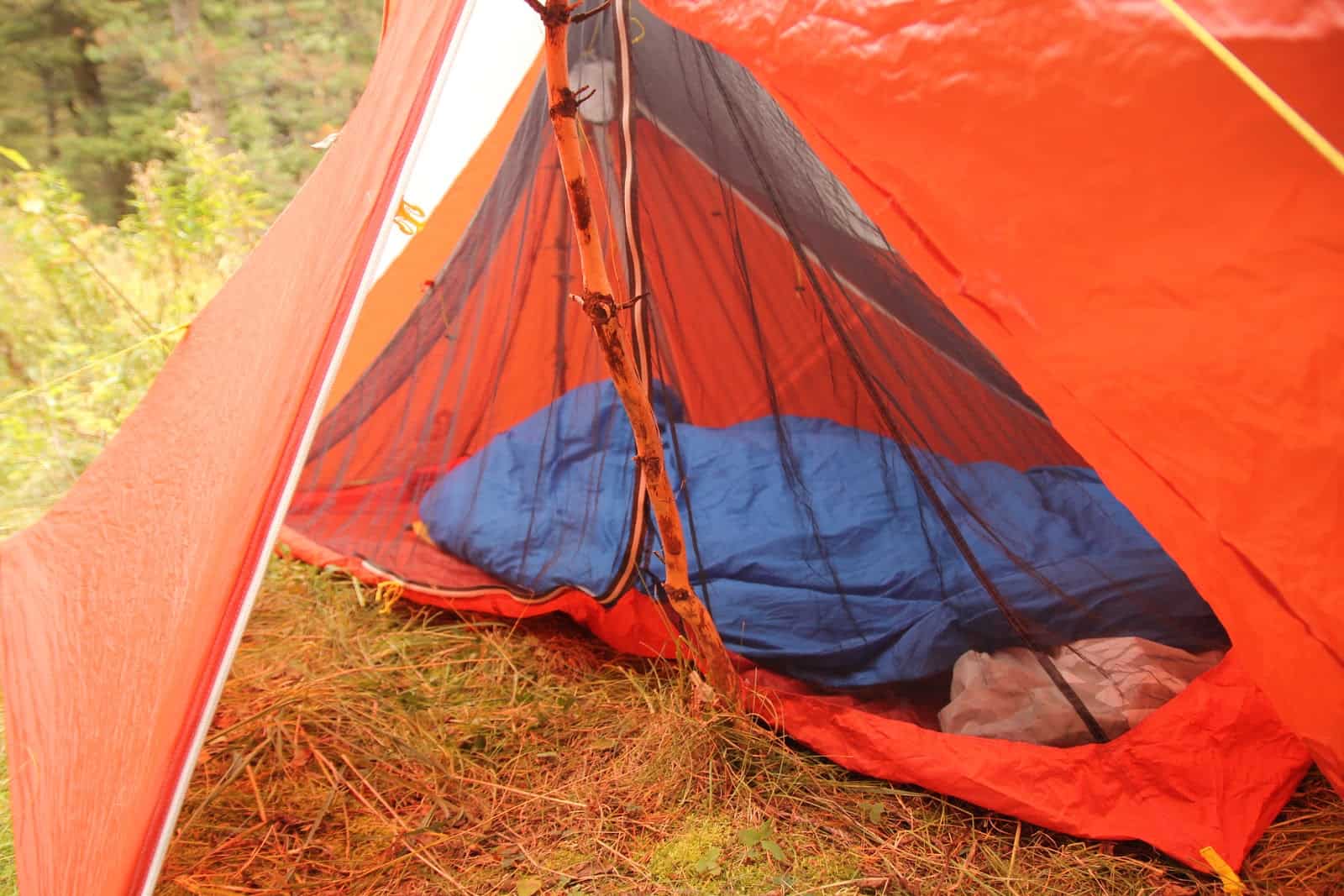
The tarp and the bug nest can be set up separately. Although this is technically a one-person shelter, using the tarp by itself could accommodate two sleepers and would lighten the weight of the shelter system. Even with the interior bug nest set up inside the tarp, the tent is large enough to accommodate two people in a pinch.
The pole placement is offset so as to not block entrances or encroach on the sleeping area.
The Night Glow feature is a small translucent compartment that dangles from the top of the tent interior. Placing your headlamp inside this compartment turns the harsh LED beam into a diffused glow. It only weighs .7 oz (20 g) but is easy to remove should you choose not to carry it.
Design
The High Route’s design is simple. It is roughly pyramidal in shape, adding stability in wind and inclement weather. The design requires that the corners of the tent be staked out at ninety-degree angles (perfectly square) with forty-five-degree pull angles on the stakes in order to achieve a good pitch.
The tent is set up by staking out the corners and inserting the trekking poles tip down into a grommet at the bottom of the lower zipper. You can then raise the tent by popping the trekking poles up from the inside, keeping the interior of the tent dry during bad weather. Velcro cuffs on the inside of the side door material keep the trekking poles in a supportive position even in high winds.
The porch-able side doors create extra living space and ventilation when needed. A side release buckle halfway down the side doors lets you porch the doors mid-way without creating tension on the zipper. Similar side release buckles at the bottom of the doors make zipping hassle free.
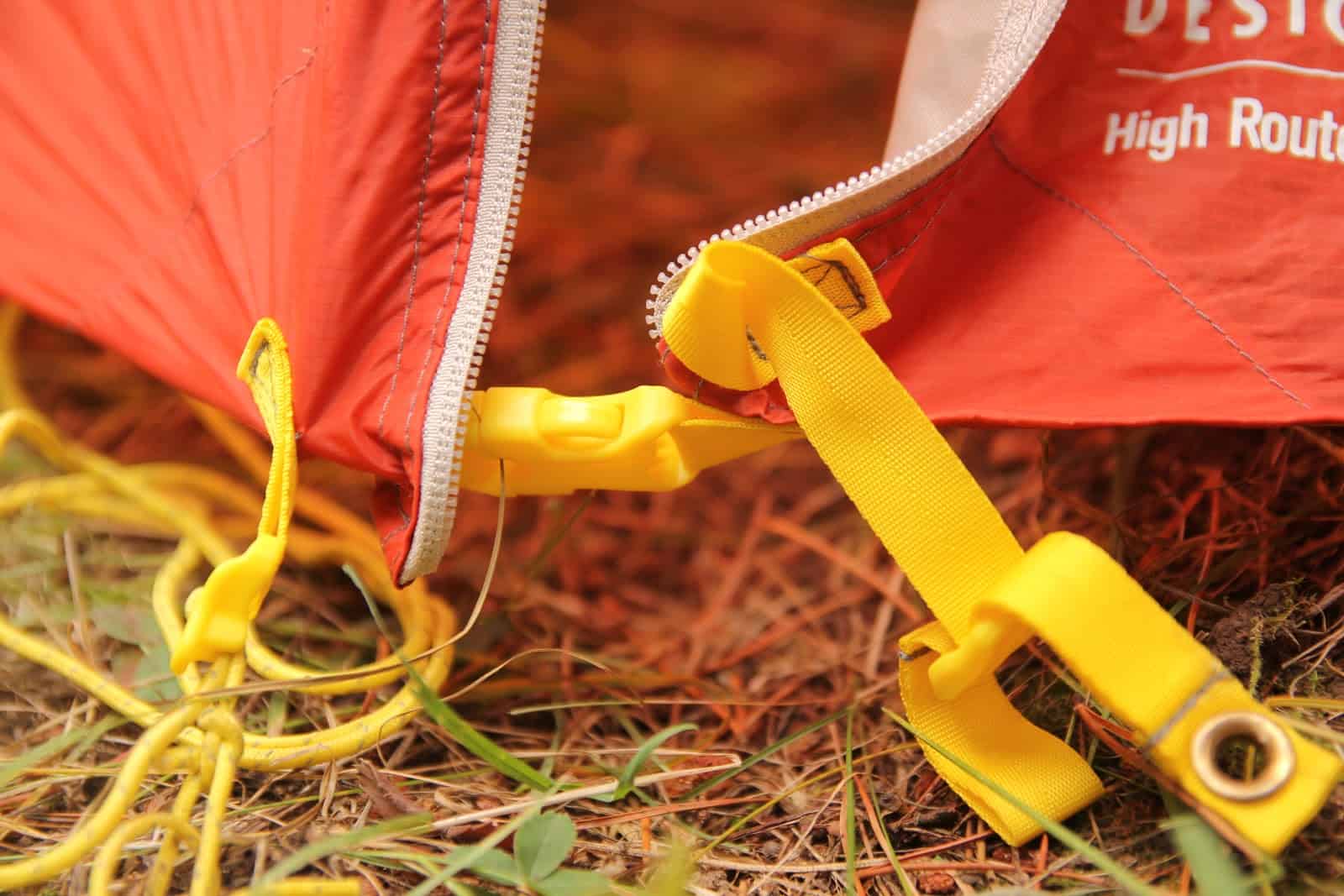
The Fly Fabric consists of Silicone coated 20D Ripstop Nylon and the floor consists of 30D Ripstop Nylon, so both elements should hold up to use and abrasion.
Usability
This is a heavy one-person tent. That being said, it is sturdy, spacious, and easy to use. Set up is simple after a little practice. The expansive headroom in conjunction with the steep walls simplifies changing clothes and other inside-the-tent chores. The extra space is especially nice when hanging out in the tent after dark but before bed. This roomy design requires a larger amount of fabric, hence the added weight.
The interior bug net and floor set up with a five-point clip system that allows for a large degree of flexibility. One upshot is it gives you the option to create one large vestibule or two smaller vestibules on each side. This was a benefit to us during testing as our camping spot was extremely unlevel.
Commentary
I love the stability and versatility of this tent. It is roomy and has well-designed extra features like the zipper buckles and the “Night Glow”. However, the Sierra Designs High Route is a little heavy compared to other ultralight one-person shelters.
Editor’s Note: According to his blog, Andrew Skurka chose not to renew his contract with Sierra Designs in January of 2018. Before parting ways with the company, he developed a plan to overhaul this tent. The new version will arrive in the spring of 2019, its name will not change, and this current design will be phased out. According to Skurka it will be ten ounces lighter than the current version and considerably less roomy. The price will remain the same.
Where to Buy
- You can purchase the Sierra Designs High Route 1P from Sierra Designs and Moosejaw.
Related Content
- The Tarptent Notch Li is another roomy tent that sets up with two trekking poles.
- Here is an interesting BPL community discussion on tent design for 4-seasons / bad weather.
Product Review Disclosure
Updated September 15, 2018
- How we acquired these products: Product(s) discussed in this review were either acquired by the author from a retailer or otherwise provided by the manufacturer at a discount/donation with no obligation to provide media coverage or a product review to the manufacturer(s).
- We do not accept money or in-kind compensation for guaranteed media coverage: Backpacking Light does not accept compensation or donated product in exchange for guaranteed media placement or product review coverage.
- Affiliate links: Some (but not all) of the links in this review may be “affiliate” links, which means if you click on a link to one of our affiliate partners (usually a retailer site), and subsequently make a purchase with that retailer, we receive a small commission. This helps us fund our editorial projects, podcasts, instructional webinars, and more, and we appreciate it a lot! Thank you for supporting Backpacking Light!


Discussion
Become a member to post in the forums.
Companion forum thread to: Sierra Designs High Route 1FL Tent Review
The Sierra Designs High Route 1P Tent is a three-season tent designed for withstanding variable conditions while remaining (sort of) light.
https://andrewskurka.com/2018/preview-sierra-designs-high-route-tent-updated/
Being redesigned for 2019 so if you like the “Revision 1” model get it while it’s still available .
looks very similar, but much heavier to the “Dan Durkin 1P” tent, which i believe is only sold on Massdrop: https://www.massdrop.com/buy/massdrop-x-dan-durston-x-mid-1p-tent#specs
– 28oz
– 17 sqft floor area (46.5 sqft total under the rainfly)
The Dan Durston tent is an awesome looking tent. But it’s not going to be for everyone, particularly since you HAVE to purchase it during a few limited time windows when Massdrop makes it available, and you have to be willing to wait MONTHS for Massdrop to finish production and deliver it.
I recently picked up the FL1 on discount at Backcountryedge.com. I guess we’ll start seeing that more as retailers try to move the old model in preparation for the 2019 version. For $225 at discount I think it’s a great deal. I’ve camped a couple of nights in it so far and found the sturdy build plus roominess are hard to beat at that price. It seems roomier than BA freestanding 1-man tents but lighter. I’m not really a gram counter, so I chose the room over some of the other lighter trekking pole tents. I’m also kind of cheap, so the price was right!
I like everything about this tent except the weight. SD must have tried really hard to get a tent without poles to weigh 48 ounces!
You’ll be able to buy when they become available. Massdrop is going to bring in a s**tload of these from China, just like they did with the Revelation and GG backpacks. I’m waiting until people have been able to review it before pulling the trigger.
That would be great. I’m just not financially ready to pull the trigger on one right now, but I really like the design.
I agree it would be better if it could be the same size but 10 oz lighter. But on my scale it’s 37 oz with everything – 34 oz when you drop a few extraneous items (2 stakes and some extra guylines). Exactly 32 oz without stakes and stuffsacks if you wanted to add your own lighter versions, although the burrito stuffsack is pretty cool. I also added an oz by using msr groundhog stakes for the 2 pole guylines – those things are under a lot of stress! It’s pretty much the same weight as the TT Stratosphire 1 and both have 30d floors which let’s me go without a groundcloth fairly confidently. The stratosphere has those nice big vestibules and a little more floor space I think, but I didn’t really want the extra overall footprint. The fussy pitch on the strato as reported by some was also a turn off. The FL1 is super easy to pitch without too much fiddling. I do wish it were green, but SD does like the bright colors.
“but SD does like the bright colors.“
Say it loud.
Timing on the reviews lately seem a bit late. Three year old tents and flashlights.
Stratospire is really not fussy to pitch.
If you understand the variables, it is easy on all sorts of ground.
Usually all up in around 3 minutes.
And no more problems with sag than any other tent I’ve ever owned (backpacking regularly since 1983).
We’ve been using a Strat 2 for 3 seasons now.
6 X 2 week trips ( Scotland and Pyrenees) as well as weekends more locally.
Like anything, there are a couple minor niggles, but ease of pitch is not one of them.
“The fussy pitch on the strato as reported by some was also a turn off”.
When I want to learn how to do something, I copy those who can.
note that there are no cuts or tricks, just me setting it up from start to finish.
They lost me instantly with the colors. SD and MSR need to get off this Red/White kick.
Isn’t this a good thing? Can we assume the review was for a product that has been through three years of frequent use?
I didn’t read the review because I don’t need a new shelter.
Isn’t this a good thing? Can we assume the review was for a product that has been through three years of frequent use?
Well, not when this particular model is being replaced for an updated design for 2019. For an article that was published on October 31, the information contained in it will quickly become obsolete.
Nick,
”The field testing consisted of a multiple-day trip in the Belt range of Montana during the last week of September. We set up our camp at six thousand feet and day hiked from there. The weather was typical for the area and season: nights in the twenties and a few snow flurries. We were camped down in a sheltered ravine and so did not encounter a large amount of wind.”
Ah…. I see.
10 years ago we would have gotten an “initial impression” article when the product was new to the market. Then maybe a year of two later, a long term product review with pros and cons, comparisons to similiar poducts, and a recommendation rating that would be somewhere along the scale of “not recommend” up to “highly recommended.” Then if a “new and improved” model was released, a product comparison between old and new. However, these kinds of articles take a lot of time and effort to create. How BPL has changed. Lots of articles that can be put together quickly seem to be the norm.
Maybe I should renew my Backpacker Magazine subscription that I cancelled almost 40 years ago due to a lack of thoroughness and objectivity in product reviews, among other things.
So I just finished reading the article. The two product links (Sierra Designs and Moose Jaw) are affiliate links and BPL will receive a commission if you purchase via the link, unlike those comprehensive and valuable reviews 10 years ago.
“You’ll be able to buy [the X-Mid] when they become available. Massdrop is going to bring in a s**tload of these from China”
Unfortunately this is unlikely to be the case any time soon – and the tents are built in Vietnam (same factory as MSR), not China.
I thought there would be some available in stock in the spring (April/May) because Massdrop ordered 1000 tents which I thought was a lot. But almost 700 of these are now pre-sold through two “drops” and I expect Massdrop will do a third “drop” soon that sells out the remainder. Massdrop may expand the production run to 1300 if material availability allows, but regardless these tents are likely to be sold out long before they arrive, and any possible second batch will have another long wait unfortunately.
Eventually I’d like to take over the X-Mid production myself and offer them in stock, but that’s years away.
Dan,
That’s an impressive number of shelters, especially given the wait time in our want-it-now society. Good for you!
Become a member to post in the forums.