


Overview
I needed a new shell and could not find authoritative information anywhere to help me make my choice. I knew from experience that breathability was important to me, so I chose the best candidates I could find, and sent them to the lab for testing. I then took them into the field to see how they performed. This is my report.
Different shells have different specialties. Some are ultralight in weight and pack size, which is ideal for carrying in varied conditions. Wind shells can be more comfortable than rain shells, so there are times for each. Some lightweight shells may not breathe as well as slightly heavier shells (due to differences in membrane or laminate technology), leading to trade-offs. In cooler weather, I may choose a heavier winter shell (about a pound / 450 g) for better pockets, features, comfort, and durability.
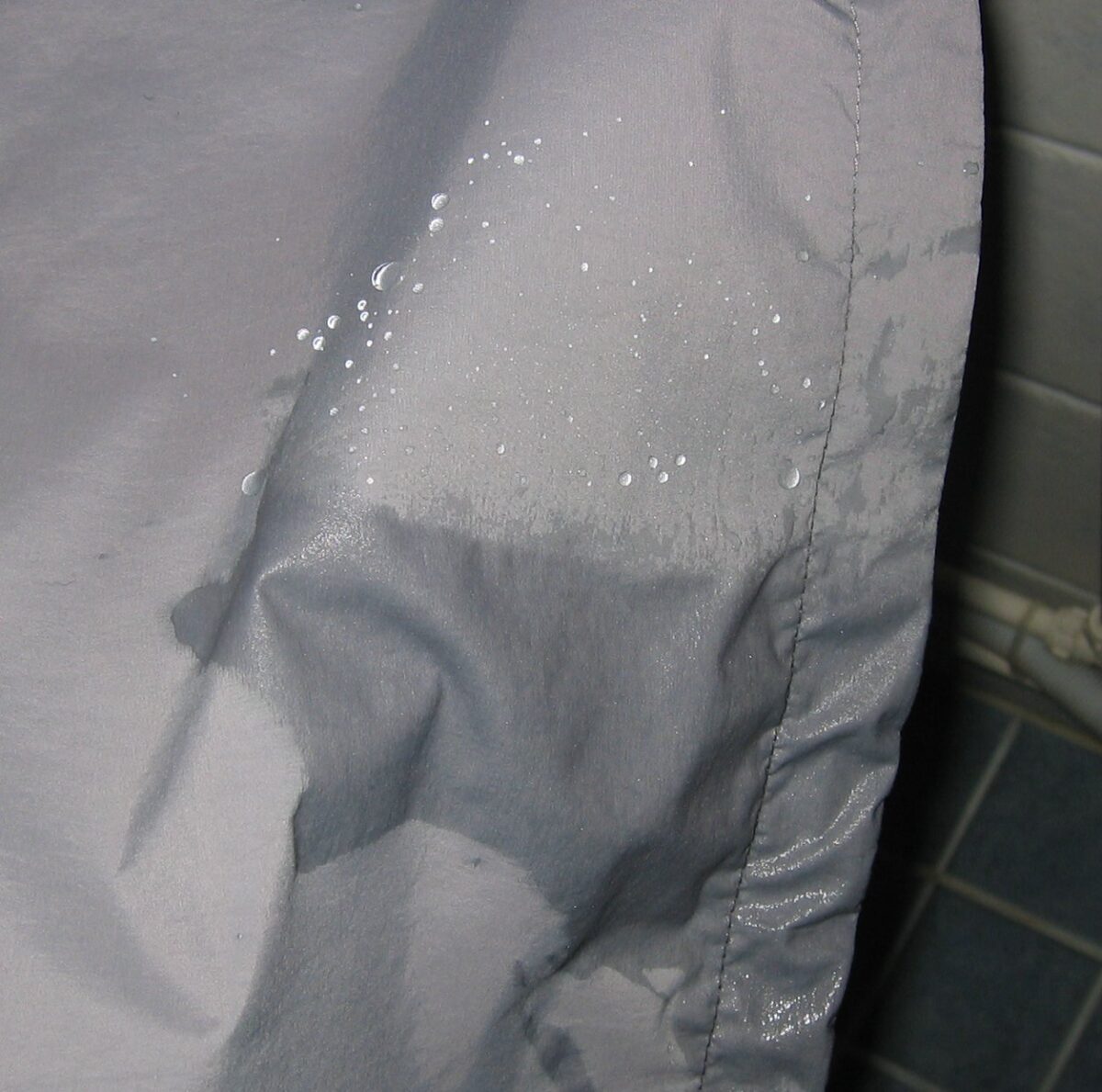
This report includes test results, debunks DWR myths, examines rain resistance in wind shells, and presents my experience with some top-performing wind and rain shells. All the shells in this report are made with high MVTR (moisture vapor transmission rate) fabrics. Differences in comfort vary more due to features and fit than to differences in laboratory measurements.
Laboratory Testing
Previous Backpacking Light articles tell us that two components of breathability are moisture vapor transmission rate (MVTR) (the best way to measure moisture movement out of our clothing system), and air permeability rate (APR) which measures how much (or how little) resistance a layer has to air movement (e.g., wind). Few manufacturers list this information, and those that do produce widely varying numbers which make comparisons more frustrating than enlightening. To overcome this, I sent them to a single facility – Stephen Seeber’s independent laboratory in Colorado – to ensure uniformity in evaluation criteria.
As Stephen Seeber recently pointed out, APR often gives us a ballpark idea of MVTR (in garments without membranes), but it doesn’t always correlate. The most interesting wind shell fabrics are the outliers: Those with high MVTR and moderate APR. Furthermore, field testing has more varied results because of other factors such as ventilation features and fit.
Member Exclusive
A Premium or Unlimited Membership* is required to view the rest of this article.
* A Basic Membership is required to view Member Q&A events


Discussion
Become a member to post in the forums.
Oh, another thing he said was that the inner lining on WPB was for comfort against the skin.
What I’ve read, which Bill mentioned, was that the lining is to protect the membrane from body oils
Now I feel bad criticizing the video : ) I like his test setup with humidity and so forth. And I agree with his basic explanation of how and when the WPB works.
i agree that the guy in the video makes a good and interesting point about the limits of Gore-tex, and by implication ANY material, to “breath” or dump moisture from the inside of a jacket into the outer environment when it’s raining.
However: when temps are cold–say, near freezing–and rain/sleet/wet snow is coming down…that’s one of the most dangerous situations. In my experience, I don’t sweat in those conditions, even when climbing a steep pass. And so, the interior of my jacket doesn’t build up moisture that needs to be breathed out–evacuated.
And in those conditions, Gore tex and Event actually DO provide good protection from the near freezing elements.
My old Rab Demand saved my butt in exactly those conditions more than one time. It was a three ply Event pull over, discontinued of course because that’s always the way of life.
In warmer temps, I have to admit that I’m coming around to the idea of a poncho or Packa. Fully waterproof, cheap, and highly breathable.
Eh, ponchos work quite well in the snow too.

France, Mont Blanc region, ascending to Col du Croix de Bonhomme. Silnylon poncho.
Cheers
Hi,
I noticed a few errors:
Comment about the Squamish in the table:
I think you swapped both.
In “Rain Shell Fabrics: WPB Fabrics with High MVTR” about “Outdoor Research Motive AscentShell Jacket”:
But in the table it says 400g.
Become a member to post in the forums.