


Overview
I needed a new shell and could not find authoritative information anywhere to help me make my choice. I knew from experience that breathability was important to me, so I chose the best candidates I could find, and sent them to the lab for testing. I then took them into the field to see how they performed. This is my report.
Different shells have different specialties. Some are ultralight in weight and pack size, which is ideal for carrying in varied conditions. Wind shells can be more comfortable than rain shells, so there are times for each. Some lightweight shells may not breathe as well as slightly heavier shells (due to differences in membrane or laminate technology), leading to trade-offs. In cooler weather, I may choose a heavier winter shell (about a pound / 450 g) for better pockets, features, comfort, and durability.
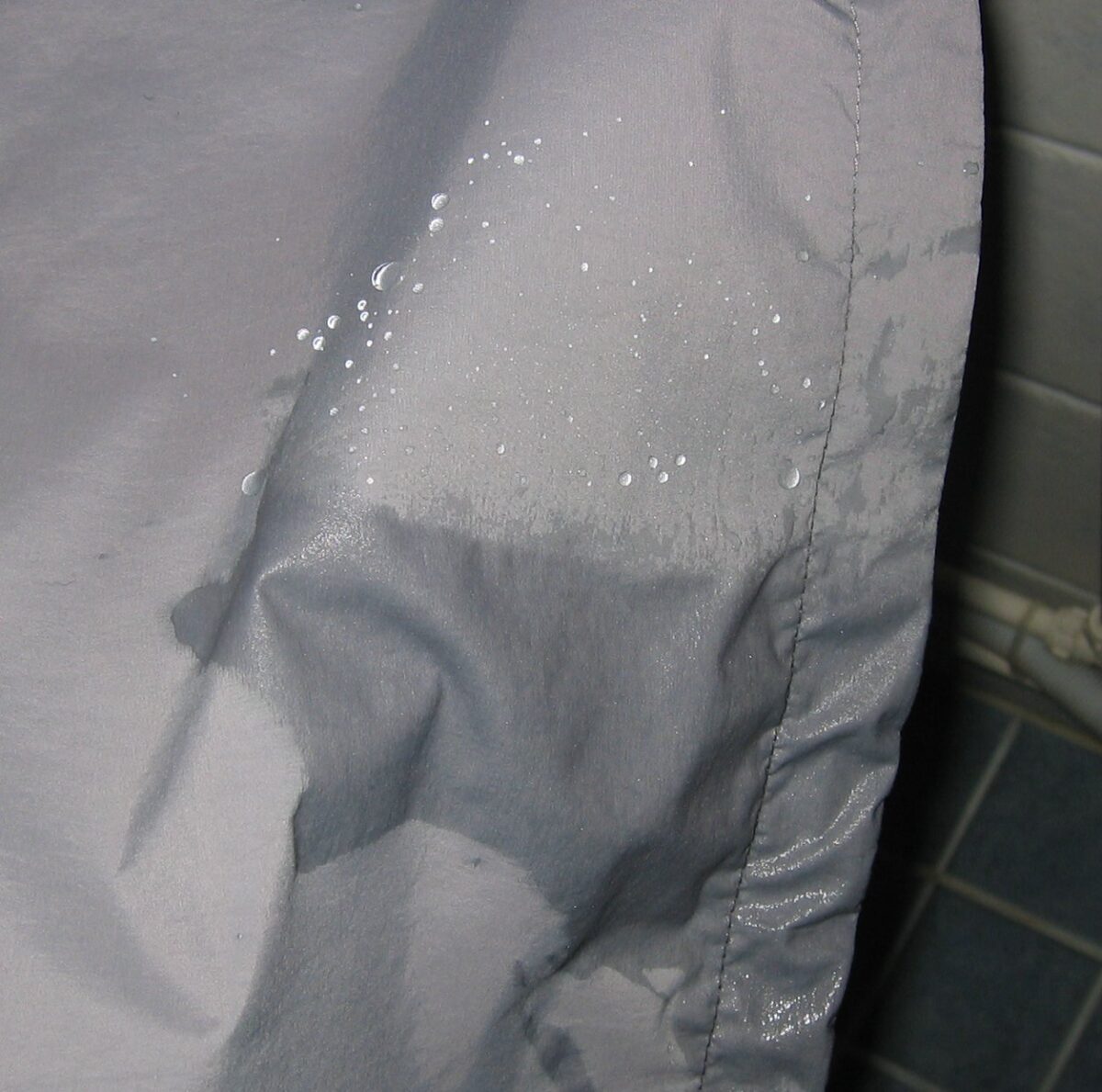
This report includes test results, debunks DWR myths, examines rain resistance in wind shells, and presents my experience with some top-performing wind and rain shells. All the shells in this report are made with high MVTR (moisture vapor transmission rate) fabrics. Differences in comfort vary more due to features and fit than to differences in laboratory measurements.
Laboratory Testing
Previous Backpacking Light articles tell us that two components of breathability are moisture vapor transmission rate (MVTR) (the best way to measure moisture movement out of our clothing system), and air permeability rate (APR) which measures how much (or how little) resistance a layer has to air movement (e.g., wind). Few manufacturers list this information, and those that do produce widely varying numbers which make comparisons more frustrating than enlightening. To overcome this, I sent them to a single facility – Stephen Seeber’s independent laboratory in Colorado – to ensure uniformity in evaluation criteria.
As Stephen Seeber recently pointed out, APR often gives us a ballpark idea of MVTR (in garments without membranes), but it doesn’t always correlate. The most interesting wind shell fabrics are the outliers: Those with high MVTR and moderate APR. Furthermore, field testing has more varied results because of other factors such as ventilation features and fit.
Member Exclusive
A Premium or Unlimited Membership* is required to view the rest of this article.
* A Basic Membership is required to view Member Q&A events


Discussion
Become a member to post in the forums.
Hey Bill,
Thanks for the great article, what year is your Arcteryx Squamish? People seem to have numbers all over the place for the CFM for that one, seems year/batch dependent.
Bill, here is an example of a commercially available, waterproof breathable jacket with mesh backed chest pockets AND forearm vents. This is a cycling specific garment made with Pertex Shield.
https://www.groundeffect.co.nz/collections/waterproof-shells/products/anti-cyclone-performance-cycling-jacket
Cheers, Scott
I’d lower the pockets and cut out the mesh. If I’m not wearing gloves, I want to warm my hands up. Mesh isn’t very warm. There’s no insulation. Anything that I put in the pockets of a raincoat gets “lost” when I take the coat off unless I remember to transfer it. I want to reach through my pockets to where I’m usually wearing a hoodie underneath. If it’s too warm for a hoodie, if it’s warm rain, I’ll take my shirt off to keep it dry and just get wet.
Severin: I’m glad you asked. The Squamish was not mine — I included it because it is a classic and one of the reviewers really likes his when working hard. In checking the data, it turns out that the numbers I listed (3420 MVTR, 29 CFM) were for a 2017 jacket. The 2019 version scored 2580 and 11 — substantially different. The newer model might do a better job of slowing wind, but has substantially lower MVTR than the older model. I did not test a recent Squamish because other windshirts were closer to the high MVTR/moderate CFM sweet spot that I sought. On the other hand, if you already own one and like it, then there is no reason to change. Also, the Squamish has more ventilation features than most lightweight windshirts. Reportedly snug fit.
Scott: That’s a cool jacket, thanks for linking. It’s great that it rolls into a lumbar pack. My favorite rain jacket when I cycled a lot did that. It’s great on a road bike that may not have a lot of luggage space — If I rode hard enough, all I needed was that jacket and a water bottle for shorter rides, down to below freezing. As you know, ventilation requirements are different for cycling than for walking, and this jacket looks great for cycling. It had better be for that price. :)
Terran: I can see that mesh or pass-through “pockets” are an individual choice. I agree that I generally prefer pass-through “pockets” rather than no pockets at all (in a shell) (although I’m personally fine with mesh-backed pockets).
I put my pockets inside. Same location as that ground effect jacket, over the chest.
To get to my pockets, I have to unzip my jacket. Then, the pockets are totally dry.
With outside pockets, even if the zipper is waterproof, when you open the pockets to get inside, water dribbles in.
“Scott: That’s a cool jacket, thanks for linking. It’s great that it rolls into a lumbar pack. My favorite rain jacket when I cycled a lot did that. It’s great on a road bike that may not have a lot of luggage space — If I rode hard enough, all I needed was that jacket and a water bottle for shorter rides, down to below freezing. As you know, ventilation requirements are different for cycling than for walking, and this jacket looks great for cycling. It had better be for that price. :)”
Yes the “bumbag” is an important feature in our range. We have been making mountain biking specific garments for 30 years this year.
Re the price it IS expensive but I suggest you are looking at it with US dollars eyes. It works out at $283 USD (NZ prices include tax, unlike MSRP prices in the US) so comparable with the Outdoor Research Micro Gravity Ascentshell jacket.
Anyhoo, cheers, Scott
Of course I can only speak of my experience. If I unzip my jacket, water comes in. With lower pockets, my core doesn’t get wet. The cycling jacket looks nice, but looks like it’s made for cycling. I guess it’s case specific. I do have a lighter Pertex Shield jacket with no pockets.
@Bill:
when you say “runs 1 (or 2) sizes small”, are you talking only about girth (to vent and fit over layers), or about overall garment size, ie both girth and length?
If it’s the former, I’m very interested!
Which jacket? Most are easily returnable if they don’t fit. When it comes to fit, trying it is the best way to be sure.
I have a Lightheart Gear rain jacket and a Zpacks Vertice rain jacket. Expensive lightweight rain gear, and one is so, so, so much better than the other. By the price tag, you can probably guess. I’ve worn each of these jackets while hiking in downpours, extended hours of steady rain, and light drizzles. In the Lightheart Gear jacket, I’m sweaty and wet on the inside in a matter of minutes, even at 50F, even with pit zips and main zipper opened up. The thing just makes me really hot and sweaty, no matter what. Honestly it just doesn’t cut it. I’m not sure what I’ll do with it.
The Zpacks jacket OTOH has been excellent. It will get hot and sweaty inside if everything is zipped up, but with the ventilation, I’ve stayed mostly dry hiking in Ireland on top of a “mountain,” for many hours. I recently hiked in Denali and stayed totally dry in that jacket. I used it in Montana along the CDT and it kept me mostly dry. Higher humidity and I get damp of course, everything does, but not sopping wet. Was it worth the insane price? If it lasts a good while, I’d say yes.
Thanks for that report, AK. I’m OK with a waterproof poncho that goes over the pack, but I have never understood how people can stand to have waterproof fabric pressed against back and chest by a pack and shoulder straps. Somehow their mileage varies from mine.
I like my Visp, which I assume is similar to your Vertice.
In Poncho News (and a small update to the article):
1) I finally bought a Packa. It is even better than anticipated — a truly well-evolved mountain poncho that you can purchase. The cuffs are wide and cinchable (a better design than elastic or velcro — open for ventilation, snug for protection). The pit zips are long — I can put my arms through them and wear the Packa like a giant vest. Combined with the front zipper, the pit zips allow flow-through ventilation that is hard to achieve with most regular ponchos. The cut is “just right” — with room for air movement underneath, but doesn’t flop around in the wind. It attaches to the pack like a pack cover or can be pulled off if you want to drop the pack while keeping the Packa on — doing so is awkward, but possible. The hood is multi-adjustable and works well. Materials and finish are excellent.
2) Liteway introduced a new front-zippered Poncho Pyraomm. It appears to be a similar concept to SMD’s Gatewood Cape, both of which convert to small, strong, shelters. The Poncho Pyraomm is listed as being about 8″ longer and wider than the Gatewood Cape, which may work better as a shelter for some people. Poncho Pyraomm is slightly heavier and more expensive — tradeoffs.
Last Saturday I really noticed the venting of cuffs. It was about 60 F, moderate rain and we were riding bikes at a slow speed and fairly low effort (end of a 100 mile day).
I could feel the cold air moving up my sleeves. Of course, on the gravel bike, arms are aimed forward, and speeds are higher than hiking, so it really blew up the sleeves.
In fact, before our break, I had only my rain jacket over my bike jersey , as it had been warm (~80 F and sunny) before, and I was cold, so I closed the cuffs as well as other vents.
During the break for the worst of the storm, I dug out my PT Alpha hoody, and layered that under the jacket. Near the end of the ride, the rain eased, the grade turned to uphill and I got a bit warm, so I pieced the up, along with torso zips and top and bottom of main zip.
@Bill,
you wrote:
”
Notably too-slim fits:
Outdoor Vitals Nebo Windbreaker – two sizes small
Dooy Sun Shirt – two sizes small
MontBell Versalite – one size small (probably Tachyon, too.)
Gore Wear Gore-Tex ShakeDry R7 Trail Hooded Jacket – one size small”
When you say something runs X sizes small, do you mean it runs X sizes too tight (what you say at the start), or that it runs X sizes small overal (ie too tight AND too short).
Yes, I love loose cuffs for ventilation. I would like to see very loose sleeves, like “wizard sleeves”.
I use “size” the same way the manufacturers use it: Primarily chest size, with other measurements proportional.
Length (tall sizes) are a different measurement. I have a long torso and short arms, so nothing is ever the right length for me. :)
I make my own jacket so I can make the sleeves and body loose for better ventilation. Another reason for making your own.
What about Buffalo Systems or Paramo? I once had a Patagonia Infurno jacket with a silicone impregnated shell that never wetted out and a pile liner that always kept a warm dry layer next to my skin if I was moving. It was the most functional rain gear I’ve ever had even though it wasn’t marketed as such.
I didn’t test Buffalo or Paramo because their pseudo-“scientific” marketing mumbo-jumbo didn’t justify the high price and weight. I remain curious but also skeptical. I couldn’t find any reviews that felt “authoritative” on the subject. Mostly I found fans who seemed to want to justify the price that they paid, but hard information is hard to come by. It’s an expensive experiment with essentially zero facts supporting it (seemingly low probability of success).
Also, the system appears to depend on DWR to function. As discussed in the article, I haven’t found any DWR that survives thirty minutes of heavy rain.
I seem to recall Buffalo having lighter-weight shirts (although still heavy compared to the rest of the tested jackets), but they don’t have a full zipper. I’ve never been a fan of anoraks, although I know that some people like them.
I have, however, enjoyed a good wind breaker over an absorbent shirt many times in light rain, as you suggest. If the rain becomes more serious, then I add a poncho over the top.
So the concept may work in some weather, although I’m not persuaded that Paramo’s and Buffalo’s products are the optimal way to get there.
Disclaimer: The above is an opinion based on lack of factual information. It is subject to change if solid information becomes available.
EDIT: One idea that I have not tried is two layers of windbreakers. The hypothesis is that the outer layer breaks the speed (and pressure) of the rain drop, and reduces the speed of water ingress, which may allow the inner DWR-treated windshirt to delay wet-out. This idea, of course, is not appropriate for warm weather due to the extra layer. Of course, the same can be said of Buffalo and Paramo.
I briefly tried friends’ Buffalo and Paramo but never owned them. The people I know who had these items loved them, and it think it was more than sunk cost. I first learned about them from MichaelO writeup from the days of the backpackinglight yahoo group.
I typically run hot and found that a separate shell and mid worked better for me. I did own a Rab’s Vapour Rise shells which worked pretty well when highly active in cold weather.
The best system I ever used for regular rain with high abrasion was a grid fleece or heavy base + EPIC shell. These days I would do alpha direct + EPIC. Was warm enough, and mostly dry.
my notes about soft shells.
it seems like a fleece jacket with a lightweight outer jacket would be like buffalo or paramo, same physics
Jerry: Yep.
Mark: Yes, the separate shell+fleece seems to approximate Paramo/Buffalo with more flexibility.
You mentioned EPIC — is it available anymore? I seem to have missed it. I do have a Patagonia L4 that may be silicone-encapsulated, although Stephen thought that it looked different than EPIC under his microscope. In any case, the L4 is good in the rain, but isn’t very breathable. Outdry works better for me, and is much more waterproof as well (maybe ShakeDry, too, if it were more available).
I had an epic jacket which worked for a while, but then it started getting wetted out.
I wear Wool socks with breathable nylon gaiters. That sort of works like paramo also. The socks don’t get wet. Until I walk through a stream
Bill: I haven’t tracked down who is making epic jackets these days. I have heard that L4 isn’t as breathable as the earlier EPIC used by Patagonia in the 2oox . Most of my trips these days don’t have serious abrasive conditions, so I can get away with using a shakedry shell which is the best option in my experience.
Mark, I also first learned about UL backpacking from his site back in 2002ish when I had to buy some gear for an REI Alaska multisport trip. That brings back memories.
Updates, Spring 2025
Outdoor Research Shadow Wind Hoodie. The fabric looks, feels, weighs, and Vader-tests (for air permeability) like the Mountain Hardwear Kor Airshell reviewed in the article above. Fit and features are similar, except that the Shadow has three fully functional pockets (while the Kor Airshell’s third pocket is only for stuffing the jacket).
The Packa. I now own one. The boxy shape fits over my pack and me like an oversized jacket. It comes in different sizes so that there is little excess fabric to flop in the wind, while retaining the over-the-pack airflow that makes ponchos so much more comfortable than jackets with a pack. This is easily the most refined poncho I have seen. The fit and finish are top-notch, and it has many small refinements that are exactly the way I like, such as:
Frogg Toggs Emergency Poncho (Amazon, Walmart). This is even lighter than the Frogg Toggs Ultralight 2 mentioned in the article. It weighs 3.5 oz and I don’t mind cutting them up for experiments. I like to cut open the front like a jacket, then use sewing clips plus cord to make loose closures. This encourages flow-through ventilation.
I was just watching that video.
I think his main idea was that Goretex doesn’t work and is a scam.
I have a Polartec Neoshell jacket (I assume that’s in the same category as goretex being called a scam). That has kept me dry in steady rain for hours. I also have a goretex jacket from the 20th century that has kept me dry in steady rain, but it’s too heavy so I seldom use it.
I don’t think that just calling my observation confirmation bias is accurate. I wore another WPB jacket in steady rain and it got wet inside just like he observed, but with the neoshell jacket it didn’t get wet. I would have needed to repeat the experiment several times to be more scientific, but I think some WPB jackets work.
Even the WPB that didn’t work so well, from RSBTR, was useful even though it had the same characteristic as in the video, wetted out in steady rain and got wet inside (I assume from sweat). In that case, the outer surface of the mid layer got wet on my hood and shoulders, but it didn’t get in further than that. The vast majority of the water, the rain, stayed outside. Then, as soon as it quit raining, everything dried out. It was never a problem. And it works well if it’s not raining (as they said in that video). I use this jacket if I don’t expect a lot of rain because it weighs less. The rsbtr jacket weighs 8 ounces, the neoshell weighs 13 ounces.
So, I disagree that goretex (WPB) is a scam. Some WPB works quite well, and the WPB that doesn’t is still useful as it keeps the rain out, and any accumulated sweat will dry out when it stops raining.
Become a member to post in the forums.