


Introduction
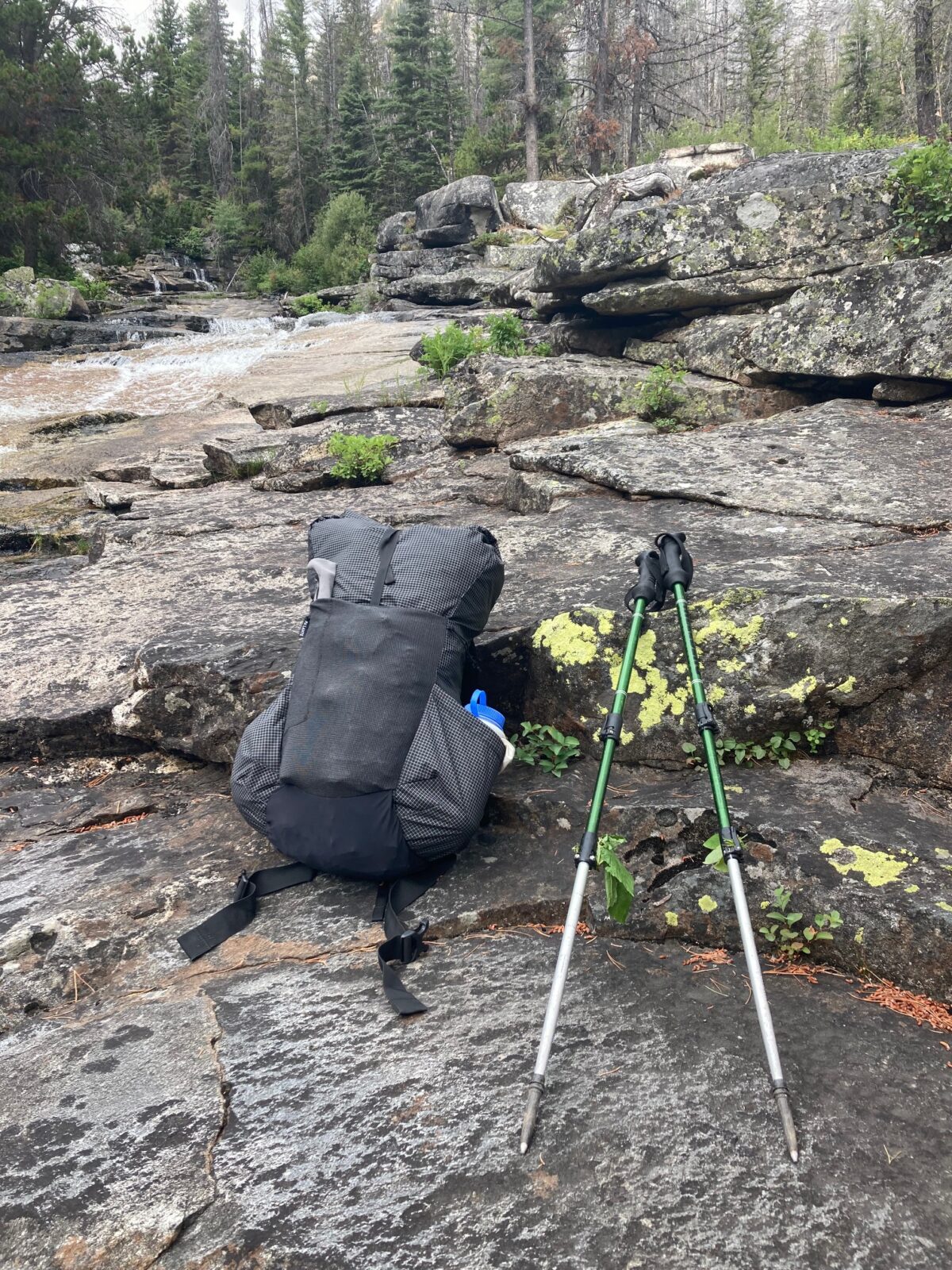
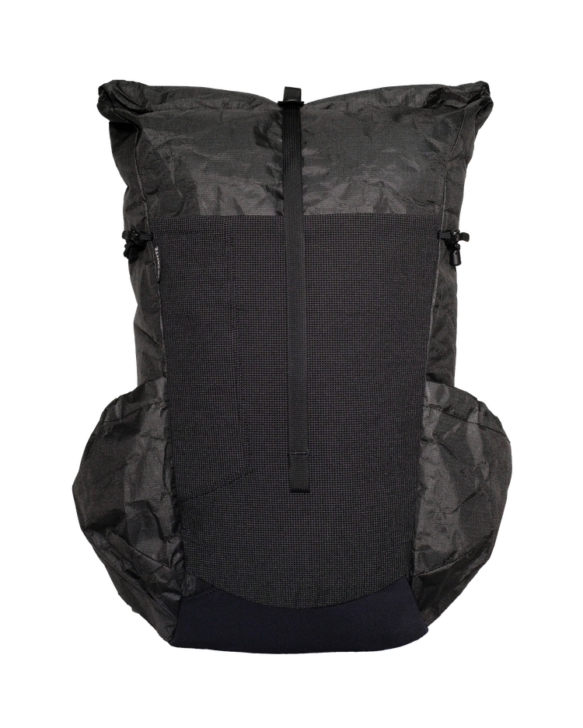
The Pa’lante V2 is a lightweight, frameless backpack (16.8 to 17.5 ounces / 476 to 495 g, MSRP $240) for low to moderate weight loads and compact equipment. It is a minimalist backpack, but several novel design elements add to its functionality and set it apart from other packs in this category. Those design elements include pockets that are accessible while hiking, a funnel-shaped main packbag for easier packing, durable fabrics, comfortable shoulder straps, and a clean design.
Highlights
- lightweight at 17.5 ounces (495 g) for a 2,258 cubic inch (37 L) pack that fits a 19 inch (48 cm) torso length
- bottom pouch for stowing trash and snacks
- stowable hipbelt
- integrated stretchy pockets on shoulder straps
- funnel-shaped top opening makes it easier to pack and unpack compared to narrower openings
- large side pockets allow efficient storing of items typically needed while hiking
- priced similarly to other packs in its category (MSRP $240)
Review Rating: Highly Recommended
The Pa’lante V2 earns a Highly Recommended rating from Backpacking Light. This rating is conferred because of a collection of standout features that, by themselves, are benefits that aren’t unique to this pack, but as a collective whole, make this backpack a uniquely positioned product in the otherwise crowded market of frameless backpacks. Those features include a clean, aesthetically-beautiful design; shoulder, side, and bottom pockets that are accessible while wearing the pack; durable fabrics; robust and comfortable shoulder straps; stash-away hip belt; and a funnel-shaped top opening.
Where to Buy
Pa’lante backpacks are sold in small batches and not continuously stocked. Those batches go on sale intermittently and sell out quickly. Monitor the company’s Instagram feed for information about new batch inventory.
- Purchase the Pa’lante V2 directly from the manufacturer here.
Review Context
I’ve been using a Gregory Z55 for most 3-season trips up to about a week in length. I use a larger pack (Gregory Z75) for winter trips and a smaller, frameless pack (Arc’teryx Cierzo 35) for fast-and-light trips and biking to trailheads. But as the wear and tear of a decade of trips finally began to catch up with the Z55, I realized that perhaps part of loving a pack is letting it go.
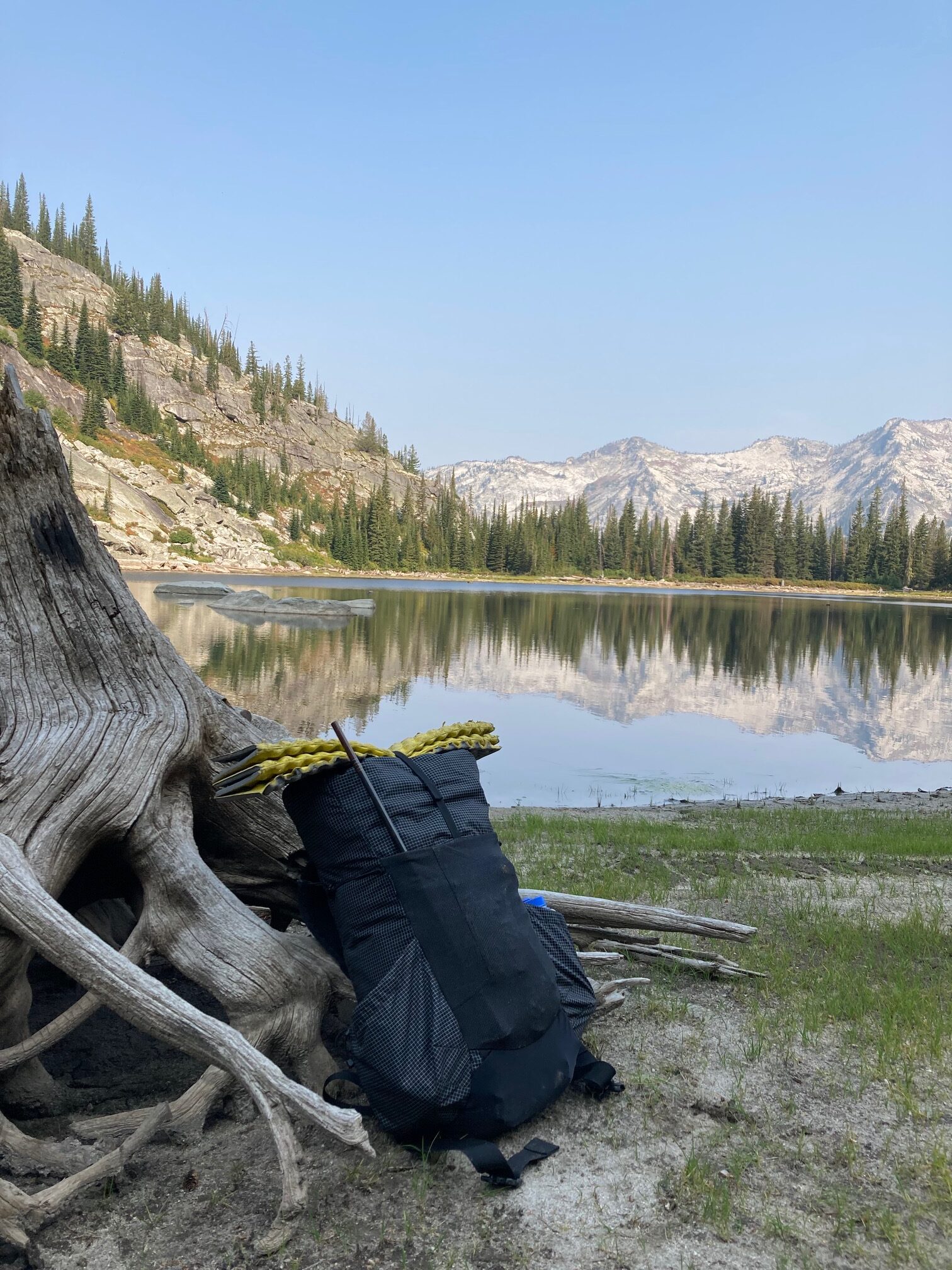
Testing the Pa’lante V2 allowed me to move on from grieving the end of my relationship with the Gregory Z55. I was genuinely looking forward to using a more streamlined, minimalist pack that would require me to make more deliberate choices about what to bring and what to leave at home. I had an abundant selection of lightweight, low-volume gear in my gear room, but I often passed over the tarps and torso-length sleeping pads for the bulkier and more familiar pieces that fit easily in my Gregory pack. The V2 would be a catalyst for embracing a different backpacking style, and I was looking forward to the change.
Features
- side pockets, shoulder strap pockets, rear pocket, bottom pocket
- loops for storing ice axe
- side straps allow trekking poles to be stored securely in pockets
- stowable webbing hip belt
- roll-top closure
- durable materials/construction
- manufactured in Ogden, UT
- MSRP $240
Specifications
- 200D ultra weave (UHMWPE/polyester blend laminated to a 0.5 mL film) – black or white
- 210D HDPE nylon gridstop – black only
- weight: 16.8 to 17.6 ounces (476 to 499 g) – depends on torso size and fabric options
- capacity: 1,892 to 2,258 cubic inches (31 to 37 L) – depends on torso size
- torso sizes: 16 or 19 inches (41 or 48 cm)
- 3/8 inch thick Evazote foam shoulder straps
- roll-top closure
- UHMWPE grid mesh and nylon-spandex mesh pockets
- 15 mm nylon webbing
- aluminum adjustable tension hook
- 1.5-inch nylon webbing hipbelt with plastic buckle
Product Category Overview
The Pa’lante V2 pack is part of the increasingly crowded field of frameless, minimalist backpacks. Popular amongst thru-hikers and catered to by numerous cottage industry manufacturers, these packs are often scarcely more than a pound (454 g) in weight. They appeal to thru-hikers cranking out long days and using lightweight, low-volume gear. These are not packs to use if you’re bringing a camp chair, a hammock, a book, a two-person tent, bulky fleece and winter parkas, or large hydration bladders and gravity filters. These packs efficiently help you get from Point A to Point B carrying a minimalist equipment kit. They are designed to be as comfortable as possible when loaded at or below their load-carrying capacity (usually around 20 pounds / 9 kg).
Given the popularity of this style, several packs in this category have been the focus of reviews at Backpacking Light. Recently, Ben Kilbourne reviewed the Yar.gear Mountain Drifter and Andrew Marshall reviewed the Mountainsmith Zerk 40. In his review, Ben mentioned several related packs, including the Nashville Packs Cutaway, the Mountain Laurel Designs Hell 27L, the Six Moon Designs Flight 40 FKT, the Ultimate Direction Fastpack 40, the Superior Wilderness Designs Superior 35, and the Nunatak Liten 35. The LiteAF Curve is another pack that fits into this category.
Most mass-market backpack manufacturers don’t make ultralight frameless backpacks for actual backpacking. (There are summit bags and day packs that loosely fit in this category but aren’t well-suited for multi-day trips.) The reason almost certainly includes not wanting to deal with the inevitable avalanche of customer complaints of poor load-carrying performance rooted in unrealistic customer expectations. Thus, cottage manufacturers are left to fill the category.
Performance Assessment
Description of Field Testing
This Performance Review reflects my experience with the Pa’lante V2 backpack during multiple backcountry trips. Read more about our types of reviews here.
I tested the Pa’lante V2 during eight backpacking trips that included a mix of overnight trips and four-day trips. Aside from one four-day trip in the Big South Fork National River and Recreation Area in Tennessee in late October, all trips were in the Selway-Bitterroot Wilderness of Montana and Idaho between July and September in typical summer conditions for the Northern Rockies.
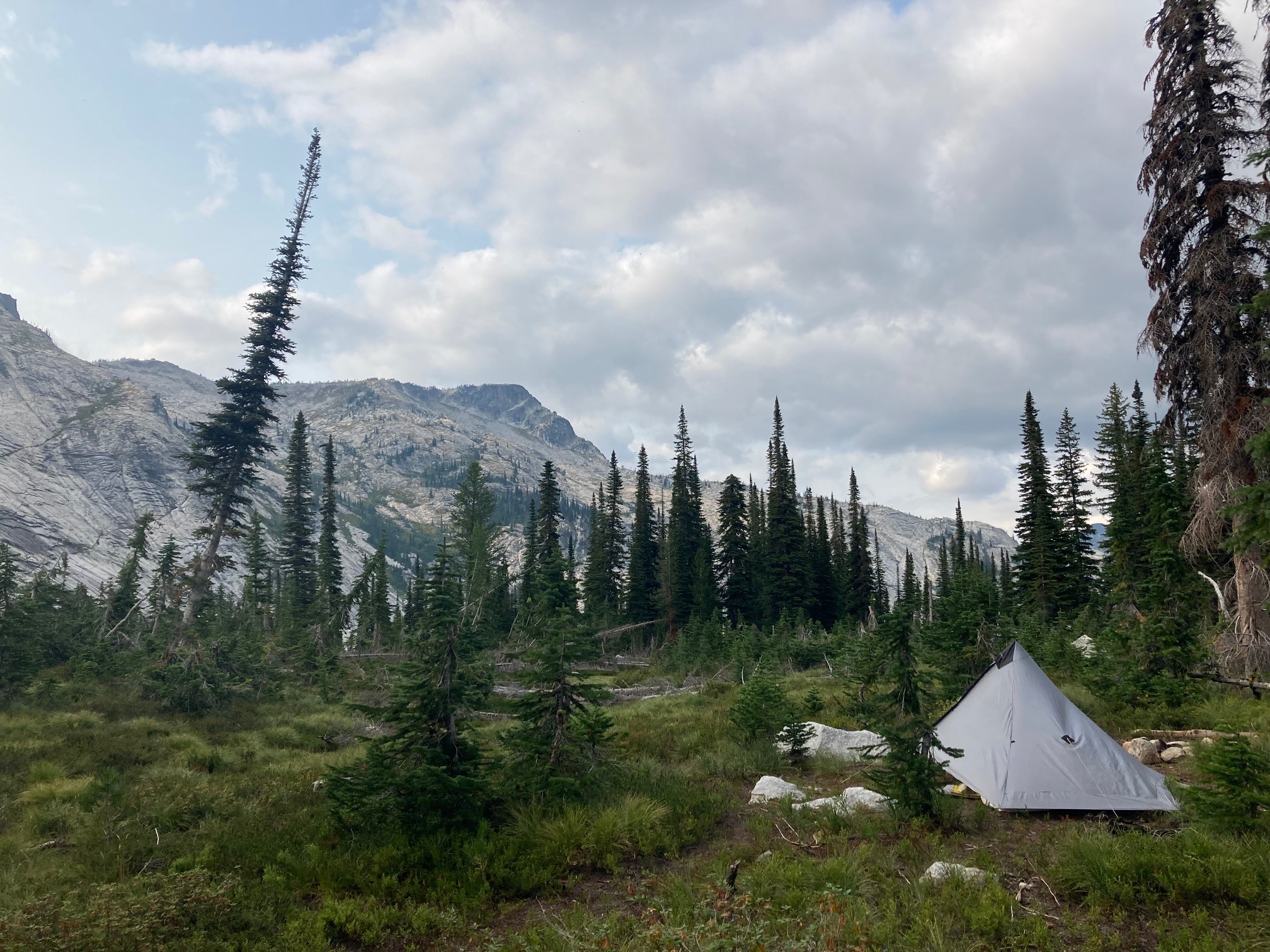
Though most testing occurred in the same general area, the conditions encountered and miles per day varied considerably between the various trips. My longest day with the pack was approximately 15 miles (24 km) on a well-maintained trail in Tennessee’s Big South Fork National River and Recreation Area with modest elevation changes. My shortest day was less than 4 miles (6.4 km) on a faint trail in the Selway-Bitterroot Wilderness. That day included a short but steep detour to a minor highpoint on a nearby ridge for a stunning view. This was a day where I focused more on meditating in meadows, swimming in alpine lakes, and fishing than hiking long miles. Most of the time, the distance walked fell between these two extremes, with 7 to 12 miles (11.2 to 19.3 km) per day being the general range. I was usually on a well-maintained trail and cruising along on longer days. On shorter days, I was often hiking cross-country for a significant portion of the total distance or hiking on faint trails that had limited maintenance and were more difficult to follow or had more obstacles (washouts, deadfalls, etc.).
I did not have any significant water carries when using this pack. I kept the weight between 12 to 22 lbs (5.4 to 10 kg). My pack weight varied, depending on the length of the trip, the weather forecast, and whether or not I packed extra gear (reading material or fishing gear). I feel confident that I tested this pack in the way most backpackers would use it. My experience and observations provide a reasonable assessment of the performance that hikers could expect with extended use.
I used the Pa’lante V2 backpack for a total of 19 days of backpacking and an additional 7 days of day-hiking.
I also used it for a short packraft day trip on the Bitterroot River near my home in Hamilton, Montana. I loaded it up with my packrafting gear, walked a half-mile (0.8 km) to the river, floated for a mile (1.6 km) or so, then exited the river and walked a mile (1.6 km) home. The ability to easily compress and stow the pack on that impromptu outing was very convenient. However, due to its limited capacity, this pack is unsuitable for more extended packrafting adventures where the raft, backpacking gear, and food all must be loaded simultaneously and carried for any appreciable distance.
List of Performance Criteria
- durability and fabric
- unique and innovative: the bottom stash pocket
- hipbelt
- comfort and fit
- capacity
- pockets and storage
- weight
- design and aesthetics
Durability and Fabric
Member Exclusive
A Premium or Unlimited Membership* is required to view the rest of this article.
* A Basic Membership is required to view Member Q&A events


Discussion
Become a member to post in the forums.
Companion forum thread to: Pa’lante V2 Review
The Pa’lante V2 Backpack (16.8 to 17.5 ounces / 476 to 495 g, MSRP $240) is a lightweight, frameless backpack for low to moderate weight loads and compact equipment.
Wondering what your thoughts are on the integrated tent stake pocket (sewn into the front stretch mesh pocket)? Functionality? Dimensions? Thanks!
I wish they offered more sizes…..every other manufacturer except for Palante (and Yar gear) offer three sizes or more. They should offer a 21-22 inch torso size. Their 19 is only 18 inch torso length. And their pack expands near the top. So, if the torso is short and since spines are S shaped with your back jutting outwards near the shoulders, it will have a tendency to pull back. Tried the Palante’s…..went back to my beloved MLD!
Mark,
Thanks for the comprehensive review.
I especially appreciated your description of the transition(s) from a more traditional internal-framed backpack with padded hip belts, to what some have described as a sack with a waist strap. Seemed like the switch worked well for you, as long as you kept the total weight below 20 pounds, and arranged the contents thoughtfully.
However – seems like carrying a fully-loaded bear canister could be challenging. Any thoughts?
— Rex
Beau: I didn’t find that pocket to be particularly useful to me. I’ve already got a system that works well for me in regard to stakes, so I found it a bit odd to separate them. For someone as stuck in their ways as me, it seemed like I’d just end up forgetting them somewhere once I stopped keeping them in their usual place (rolled up with my tyvek ground cloth). But that’s not a fault of the pack, just more that feature not being something that I found useful. The dimension are: 9 inches long/deep by 3 inches wide (roughly). The actual sleeve for the tent stakes on the inside is probably closer to 8 inches deep though.
Murali: Yeah, it’s a bit of a bummer they don’t have more sizing options or offer the range you mentioned as a custom request or something. But I do get that for a lot of cottage manufacturers limited options just makes managing the whole operation a lot easier. I’m lucky that this pack fit me so well, probably had a lot to do with why I found it so comfortable.
Rex: Thanks! Glad you liked the review. And yeah, I didn’t want to belabor the whole hip belt transition thing but for me it was such a big switch and one that I (and I think a lot of others) find really intimidating. But with a well-designed pack, a light load, and reasonable expectations it turned out great for me. As far as a bear can, even with the wide-mouth top opening of this pack it would be challenging to put a bear can inside. Just for kicks when I was testing it I played around with trying to get my BV450 in it (the BV500 was pretty much a nonstarter) and couldn’t figure out anything that would be close to comfortable with my kit. I’m sure others that have different kits or skills might be able to find a way to cram it around or lash it on the outside, but given the carrying capacity and weight comfort limit of this pack I wouldn’t recommend it to folks who need to carry bear cans.
From experience I feel the BEST frameless design was the JENSEN pack from the ’70s. It had two vertical columns sitting on the horizontal sleeping bag/hip belt area. If you cut a closed cell foam mattress in two (top half & loser half) and rolled each to put in the two column for a “frame”you might at the least have enough stiffness when fully loaded to transfer weight to the tightly stuffed. hip belt/sleeping bag area.
Yeah, the closed cell foam mattresses would have to be joined with Velcro strips glued to each.
Otherwise I’ll take my Osprey EXOS 58, “tank youse veddy nice!”
Mark,
Very nice review. But here is a question, that is not related to your pack review.
I noticed that you were using Hilleberg DAC trekking poles. Do you like these poles? A while ago, Backpacker Magazine tested a pair of these, and the reviewer commented positively on their strength. He claimed to have taken a 2 ft fall, going downhill, and planted the poles, and neither did they telescope (flick locks held), not did they bend or break.
He and his pack weighed about 200 lbs.
What has been your experience?
Bill
Bill, glad you enjoyed the review.
I suppose I’m uniquely qualified to answer your question about the Hilleberg poles since I tested those poles for Backpacker, took the fall you mentioned (and others since then), and provided my notes to the Backpacker staff who write up the articles. So you’ve come straight to the source : )
I’ve found the poles to be excellent and they’re the poles that have worked best for me and my hiking style/habits/idiosyncrasies (not to be confused with a claim that they’re “The Best Poles Ever”). Regarding that particular note about taking an approximately two foot fall and the poles not having any issue, that’s pretty much exactly what happened.
I was hiking cross-country and coming down a section of terraced, slab granite in the Bitterroot Mountains after camping at a delightful subalpine basin (I weigh about 180, pack was roughly 20 lbs). As I was easing down a short near-vertical section that had a wide crack in it filled with dirt/dust/roots/etc. I slipped and fell about two feet right onto the ground, but was out of reflex able to plant my poles, which probably kept my feet from sliding out from under me on the dirt/dust/pebbles that were at the bottom of the crack. To my surprise, the poles didn’t collapse, bend, break, etc. They just kept on trucking. I’ve had them in similar off-trail situations since where I’ve had to put my entire weight on them and they haven’t had any issues yet. They’re going on two years old now I guess and haven’t seen much wear on them, and I probably put 500 miles on them each season.
A few caveats:
– They’re not featherweight or even particularly light, but they are solid.
– The handles feel good to me, as do the straps, but the handles tend to leave my hands looking a bit black after use (not sure if this was because I maybe got a sample or prototype pair or what, but just FYI . . .it looks like I palmed a piece of charcoal sometimes after using them — that might be a bit of an exaggeration but it is kinda weird).
– The flick locks are great at keeping the poles secure, but they also catch on pretty much every shrub I brush against especially when hiking off trail. So there’s usually some debris stuck in them from time to time when I hike in areas with overgrown trails.
Happy to answer any other questions you have.
Mark,
Thank you for this very interesting answer. And what a coincidence that you were the source of that Backpacking Magazine review on these poles! Didn’t you wonder a bit how I figured out that you were using the Hilleberg poles? And how, after I figured that out, found that past review in Backpacker Magazine? This bit of sleuthing took me awhile. But I am pleased to know that you are the World’s Expert on Hilleberg poles. :)
I plan to add these Hilleberg poles to my collection. If they pass my extreme weight test (my weight, not these 17 oz pole weight), I will share them with a deserving child/grandchild. But not until I have had a bit of use out of them. I am historically gently on poles. I have an old set of aluminum poles (Trek’r 3), that I downhill skied with, cross country skied with, and hiked/backpacked with. They now require a bit of tape to steady the joints.But still usable.
But I still either own or passed around all the poles that I ever had.
The single exception are a couple of pairs of Gossamer Gear polls that a friend broke (tips) Section Hiking the Pacific Crest Trail. I was impressed with the low weight. But they vibrated a little too much for me. (This is probably unique to me). And my friend says that trekking poles are the least reliable of all his gear. He weights about 100 lbs less than I weigh. But I never hiked with him. But he says and I know that he is careful with all his gear. May be that I am super careful.
Anyway, I would like to make a comment on the many reviews I have seen here. And referenced.
I think that some of the analysis and speculation may not be correct. I plan to do a bit of analysis myself. And I understand why there could be misconceptions when it comes to weight and energy expended. And why, up to a certain point, I don’t care much about weight. Ok, I don’t care about a few ounces. But I also hiked and or backpacked over 20 miles a day many times. But never hiked / backpacked 2,000 or 3,000 miles. And at the end of those hikes, parts of me were very tired. But not so much my arms.
Here is what I am thinking. I am thinking that either no energy is lost or very little energy is lost due to pole swing. I will start with a very simple model, and make it more complicated. And if anybody out there wants to beat me too this, then have at it. Be warned. We could turn this into a competition. And have some fun. Also, I worked in this area for almost all of my long life. So I have a bit of a head start. :)
However, my work was almost completely in a zero G environment. So… gravity and constraints make this type of analysis very challenging.
Finally, apologize for drifting so far away from the reason why many of us go out and hike and backpack. For the beauty. For the adventure. To just breath free. To be in the Wild. And to escape the many constraints of the ‘Civilized World’. At least for awhile.
In the interest of making sure consumers are fully informed before making a purchase – I’d like to make some notes of Palante’s changed return policy, lack of warranty and some concerning issues with their post sales support as well as construction methods they use for ultra packs.
Palante now will only accept returns within 3 days of receiving the pack. In my mind, this is a prohibitively short period. A week would still be too short, but at least that guarantees a weekend for someone to be able to put aside time to test the fit of the pack and inspect it for issues.
Palante offers returns within 30 days for manufacturer defects. Again, this is a prohibitively short period. I personally am having issues with major stich elongation along every stress point with my desert pack after ~500 miles, 270 of that being a long trail thru. Before the thru hike the stich elongation was not visible, but on the hike I began to notice a concerning amount of stich elongation on the pack body and strap attachments. I contacted Palante, and they informed me they were aware of this issue and had no way to fix it. It seems that they used the exact same construction method as their other packs, a single top stitched binding. It seems the stiches cannot hold in the ultra 400 material when constructed this way and elongation/pulled seams will become an issue. I’ve seen some conjecture that ultra 200 suffers less from stich pulls, but the ultra200 version of the v2 is constructed with the same flaw. Other makers, like SWD, have opted for flat felled seams to mitigate this issue.
Palante offered “maybe a discount on a new pack” if it fails on me completely. I rely on my gear to keep me safe in remote locations, and risking pack failure on trail by using a pack that is showing obvious signs of failure is not an option for me.
Palante designs wonderful packs and the V2 and Desert packs are no exception. But these shifts in their customer support, rising prices, and prohibitively short warranty/return windows are concerning, and have already caused issues for consumers like me. I’ve been happily using their packs for years before this, but buyers should be aware of the shift in support and the potential that issues caused by construction methods will not be supported by the vendor if you don’t use it enough in the first 30 days for issues to become apparent.
Sorry you had this bad experience with them. Thanks for sharing it in a fair manner.
Thanks Ito – at the end of the day, its not a massive issue for me. I’m fortunate enough to be able to afford a new pack after this one started failing early – but I know that most people cant take a $280 hit on a piece of gear.
I’ve been recommending their packs for years, and the idea that someone else is out there stuck with a failing pack because of my recommendation hurts a lot more than just having issues with my own pack.
I’m not suggesting people completely avoid Palante, as I’ve said they make some of my favorite packs of all time and have been innovators in the industry. I just think that people should be fully informed that these purchases are essentially final with no support after the fact, and that there may be issues caused by construction and design decisions that you will have no recourse for. If you can’t afford a risk like that, there are a number of other pack makers out there that offer similar features and still support
At the very least we need to see Palante address the issue with their next batch of ultra packs, or I expect to see the situation spiral out of control
Judging by their website (which is just terrible), I assume they are a very small company? Maybe just 1-2 people?
Could explain why they have such a strict return policy?
Either way, having a really poorly-designed website and unusually strict return policy, I can’t see them ever growing in size. Just going to their website, one isn’t instilled with confidence that they are a legit pack maker. Feels more like some guy’s side-hobby site.
Which is frustrating to see, because I am usually rooting for the underdog startup types to keep growing by making smart decisions. Not sure that being strict with customers is a good long-range plan for smaller companies.
I know Zpacks probably has lots of cash to toss at web design, but they do a fantastic job of making the pertinent info obvious, and it’s easy to navigate, with detailed images of products.
It’s all about having the product “drop” and moving on. Based on my one experience dealing with the guy I’d never purchase any gear from him. Getting any information beyond a minimal response was like pulling teeth and those policies speak volumes about what to expect if you have an issue.
The hype around ultra fabric doesn’t help either.
Become a member to post in the forums.