


The Lambda stove is my personal MYOG Alcohol Stove that I plan on writing a future article about. This article will cover the Snuffle Flask an alcohol fuel dispenser than can be used with any alcohol stove. A fuel efficient cooking system consists of a stove, the environment, one's fuel supply, the ability to measure, a lighter/starter, a pot, a pot stand, and a windshield. Each item has to work together properly to create an efficient system.
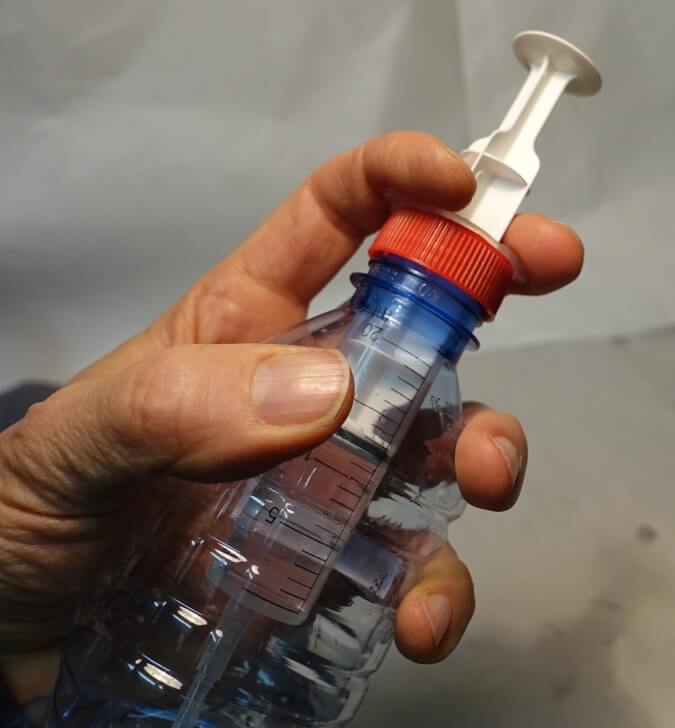
The Snuffle Flask is a fuel bottle with an integrated fuel measuring and dispensing system. It is a simple and reliable way to fill the exact amount of alcohol needed for any alcohol stove without utilizing multiple devices.
Disclaimer
This project is not a beginner's project. You will be working with very sharp tools. Be sure you have the necessary experience to work safely with the tools you will be using. And: alcohol fuel burns. Use common sense and don't burn yourself or anything else.
Measuring fuel without the Snuffle Flask
Everyone who has operated alcohol stoves knows that accurately measuring the amount of alcohol going in the stove is challenging. You are supposed to use a small measuring cup, but if you are tired and hungry, filling the necessary amount of alcohol into the cup is difficult. Trying to get a decent read on the amount of alcohol poured when it's dark is difficult also. It is difficult to fill the stove without spilling, to keep track of the fuel bottle cap, and to keep the fuel bottle from tipping over. After all, you are in the backcountry, far from any picnic table. Also, dexterity and intellectual abilities tend to deteriorate rapidly once a person gets tired and hungry.
The video clips on youtube make operating an alcohol stove look easy. Alcohol stoves can be quite sensitive to their environment. The usual "penny stove” will die in anything but warm and sunny conditions. I have once used nearly 10.1 oz. (300ml) of alcohol to cook 33.8 oz. (1 liter) of soup. I missed a warm meal once because of this. Here is my solution to provide a no fuss, no fumble, no spilling, and easy to operate system that works under most conditions encountered on backpacking trips. The system described can even be operated wearing gloves.
The core element of the system is the fuel bottle. For one to two person use, a fuel bottle of 8.5 oz. (250ml) to 11.8 oz. (350ml) is fine (for me) and will work for a couple of meals. Actually, one single 11.8 oz. (350ml) bottle of fuel (yellow "Heet") was more than plenty for a 5-day/4-night summer trip my wife and I took in the Sierra Nevada. We were at 10'000 ft+ (3048 m+) elevation and had dried meals to rehydrate and no restrictions on the amount of tea, coffee, soup, etc. For 2 to 3 people or for longer trips, I may take a 16.9 oz. (500ml) bottle, or I may prefer to refill my smaller bottle every once in a while. Larger groups will carry more than one system, especially when will have to melt snow to get their water.
The diameter of the bottle cap matters when wearing gloves. There are mainly three sizes of bottle cap diameters on the most popular PET bottles. Water or pop/soda bottles usually come with cap diameters of 1.1 in. (29mm) or 1.3 in. (32mm). You will also find the lightest bottles in this group. You might feel they are a bit on the flimsy side for a fuel bottle. I believe, however, that they are okay as I integrate them into my system and carry them in my backpack, protected by the windshield and another (flimsy) PET-container. Lightweight gear is designed for use, not for abuse. If you want to abuse your gear, go to the army surplus store. The bottles containing fruit juices and smoothies come with 1.6 in. (40mm) caps and tend to be a bit sturdier. The 1.6 in. (40mm) caps are nice to operate with your gloves on, too.
Developing the Fueling System: The Stages of Error
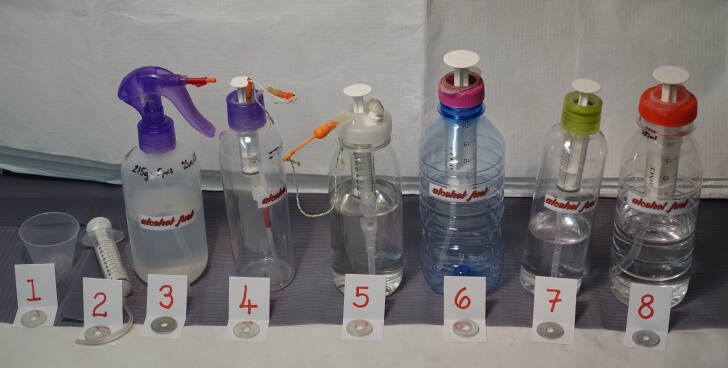
- The usual measuring cup. There is no easy read of the amount measured.
- This was my system during the 2015 season. It consisted of a 10ml syringe fitted with a short length of flexible fuel tubing from the RC model hobby shop. It is easy to read, but the fuel cap has to be taken off and left unattended during operation. The flexible tubing can direct the alcohol into the wrong compartment of the stove if you are using a Trail Designs 10-12 stove, for example. A piece of stiff tubing is a wiser choice.
- This model is an air freshener pump with a drilled out nozzle fitted to your fuel bottle. Needs two hundred (sic!) pump strokes to get out .7 oz. (20ml) of alcohol. Not trail worthy!
- This was my first attempt with a built-in .2 oz. (5ml) syringe and also with two valves from a foot freshener spray. A real pump puts out .2 oz. (5ml) of alcohol on each stroke. Aptly called the "Snuffle Flask" by my elder son, the flask needs an air bleed device to let in some air, so there are three holes in your bottle cap. The holes pose sealing issues. The two caps used as an air bleeding device and fuel spout are prone to leakage, too.
- The photo shows the enhanced Snuffle Flask with an air bleed screw and larger diameter bottle cap to accept a 10ml syringe. Handling all three devices on the cap at the same time is still a bit fiddly (open air bleed screw, uncap fuel outlet, pump the necessary amount, close all openings again). At least, there are no items of which to keep track. Everything is attached to the fuel bottle. There are still three holes in the bottle cap that are prone to leakage. The air bleed is a screw that is a bit tricky to manufacture. During a family discussion, I proposed to skip the air bleed screw and replace its function by merely untightening the bottle cap. Whereupon, my elder son proposed to leave out everything except the syringe mounted to the cap – bingo!
- This photo depicts the first versions of the final design of Snuffle Flask. Leakage remained a problem, as gluing a syringe to a bottle cap is problematic, i.e. the soapy type of plastic used for bottle caps tends to split from any type glue.
- This is the first coupling-nut system. This system presses everything down on a sealing ring. It is fuel tight and trail-worthy.
- Same as #6.
Fuel Bottle Design and Construction of the Snuffle Flask
I will show you three fuel bottles
- The "Simple-simple Flask" may leak unless you are proficient with hot glue or find a lucky combination of a syringe and bottle cap (see pics 02, 45 and 46);
- The "Screw-on cap Flask" is the "normal" choice for anyone. It uses a wide cap (see pic 51, the right flask); and
- The "Coupling-nut Flask," is probably the safest example, but a bit tricky to make (see pics 51, left flask, and pic 65). Choose a bottle with a large cap if you intend to operate it wearing gloves.
Read on to here how to make the Snuffle Flask
Article Outline
- Introduction
- Fuel Bottle Design and Construction of the Snuffle Flask
- Operation
- Conclusion
# of Photos: 60; Word Count: 5900
Member Exclusive
A Premium or Unlimited Membership* is required to view the rest of this article.
* A Basic Membership is required to view Member Q&A events


Discussion
Become a member to post in the forums.
Companion forum thread to: How to Make a Lightweight Fuel Dispenser for Alcohol Stoves (the Snuffle Flask)
The Snuffle Flask is a lightweight fuel dispenser that works with any alcohol stove. Learn how to make one from items in your home.
Wow. Amazing.
Cool work
This is very cool, but if you’re not too handy and want to go the quick route check out the Dual-Chamber Fuel Measuring Bottle at Litesmith.com. Not too bad for $3.95…
^Yes. I use one of those as well. I believe it is called a Bettix Bottle.
Gotta love the ingenuity and drive to perfect something like the Snuffle Flask.
Those “bettix” bottles are very familiar to us home brewers :)
What’s the name of that type of lighter? I’ve been looking all over but can’t find one.
First of all…. very nice article. Second…. you really missed the opportunity for some great names here! It is the “Lambda Stove”, so it just makes sense that you would call the fuel bottle the “Omega Moo”. Duhh! I mean, really, people, I get tired of doing all the heavy thinking around here. At least you didn’t name it the “Alpha Beta”…. :)
We tend to use bottle adapters for the oral syringes in the hospital pharmacy. They come in several styles and sizes.
http://www.medidose.com/Press-InBottleAdapter.aspx
http://www.totalpharmacysupply.com/baxa-adapta-cap-size-m-24-mm.html
Very cool! I used your “elegant” method but made it on my small lathe (Jet 1014 bench lathe).
Cap Jig: I made a jig for the cap by taking a large(ish) dowel (OK – I cut about 20 cm off the end of a broom handle) and lathed it down to snugly fit the thread portion of the bottle from the inside. The result: I can easily screw a cap on and there is a space under it to cut the hole.
Cap: There are 2 types of caps. One has a ridge that seals to the inside edge of the bottle opening (the plug you mention) and the other is flat inside and seals to the top edge of the opening. I used the “no ridge” type. Using my jig (centered by the slight bump in the middle of the cap from the molding process), and without measuring, I cut out the hole using an Exacto knife. I then tried the plastic end of the plunger in the hole. Shaved the cap until it just fit and then I was done. Removed the cap and slid it over the plastic part of the plunger and then replace the rubber plug, The cap is secure because the thumb end of the plunger is larger and the cap won’t slide past either end.
Syringe: No jig needed. Used a 20 ml syringe. (Graingers Item #: 45CR33) Mounted the syringe in the 4-way clamp and backed it up with a live tailstock. I then shaved the syringe grips to where the material was the same diameter all around.
Now the best part. No need for seals or O-rings. Slide the syringe body into the bottle and inserted the plunger. Screwed down the cap and the bottle simply seals against the syringe body. No leaks.
You can do the same thing using your method but it was much quicker and easier with the lathe. It took me about an hour to figure all this out and then I made about 4 of these things so far in about 10 minutes. I now have an easy way to measure 2-cycle engine oil. Gasoline additives (Seafoam). Adding bactericide to the humidifier. Oh and one for my alcohol stove. :o) Brilliant! Thanks so much for the idea!
Hank, can you post some photos?
Clever solution but complicated and time consuming.
I have been using re-purposed prescription mouth wash bottles for alcohol. The benefits are:
The only down-side is the weight at 1.75 ounces, but that is the price for gear that isn’t fragile.
Yes, I have used the mouthwash bottle as well (my favorite was “Act”). But I don’t typically use mouthwash so I had to wait for my wife to be done with her’s. I like the syringe because there is no fumble, no spills, you get more accurate measurements, (all as advertised) and I can obtain a soda bottle easy, cheap compared the mouthwash bottle. BTW, I didn’t like the “child proof” feature on the mouth wash bottle so I took a large nail clipper and snipped off the two catch points around the neck of the bottle.
I’m at work right now (shhh – don’t tell anybody) but when I get back home I’ll post some pics.
Oh and I forgot. The syringes were $9 for a bag of 25. So 36 cents each. I did have to buy the whole bag but I have made other more questionable “investments” for this sport. This one totally was worth it to me.
The Jig
The jig in the lathe
The finished syringe. I have to take off the rubber plug off the plunger to put the cap on. The ml marks look like they would rub off pretty easy so I scored over then from 15 to 20 ml.
No seal.
Weight of the unit. (oz)
Weight of the empty bottle. (oz)
Since the post was deleted that suggested just practice using a flip top bottle that is readily availability and needs no modification, I hesitate to post that this has worked fine for me. Especially using a stove like the Starlyte where you can save unburned fuel.
I do appreciate these ultra gear nerd articles though. Gets the creative juices flowing.
@Hank: I just used the bottle itself to cut the hole into the cap…
@Hank, measuring wearing off: Yes, same problem here. After about two days of hiking, the constant “alcohol waves” impaired the printed scales heavily. My solution: Hot glue. After gluing the syringe to the cap, heat the syringe again with you hairdryer, heat a spring steel spatula at the same time, then cover the length of the syringe with one bead of hot glue and immediately spread this bead thinly over all the syringe with the hot spatula. Voilà, the scales are protected premanently.
@ bigfoot: see the book of Mike Clelland, Ultralight backpackin’ tips, 153 amazing & inexpensive tips…, page 2, Manifesto, paragraph 5: “it’s okay to be nerdy”. So: Thanks for the compliment :-)
Bettix bottles: didn’t even know they exist! Thanks for the hint! I really appreciate the discussion.
Complexity: I have to admit that I now did a couple of “simple-simples”, just using hot glue, and they did not fail (so far…)
After all: SORRY I AM LATE! For no apparent reason, I have been locked out from posting until today.
Happy trails!
Urs
A follow-up after two years of use:
The “simple-simples” used to start leaking after two days of hiking. Even if resealed, using your lighter (pour all alcohol out and let the flask thoroughly dry out for a few hours first, for heavens sake!), alcohol seemed to find its way to “squeeze” between the hot glue and the syringe and the caps, so I now go with the coupling nut system. If the hot glue gets loose in this system, it’s still mechanically pressed together by the top nut.
Happy trail cooking!
Urs
Become a member to post in the forums.