Topic

Winter tents – unsupported fabric span between poles in tunnel tents

Viewing 25 posts - 1 through 25 (of 52 total)
PostedFeb 14, 2019 at 10:37 am

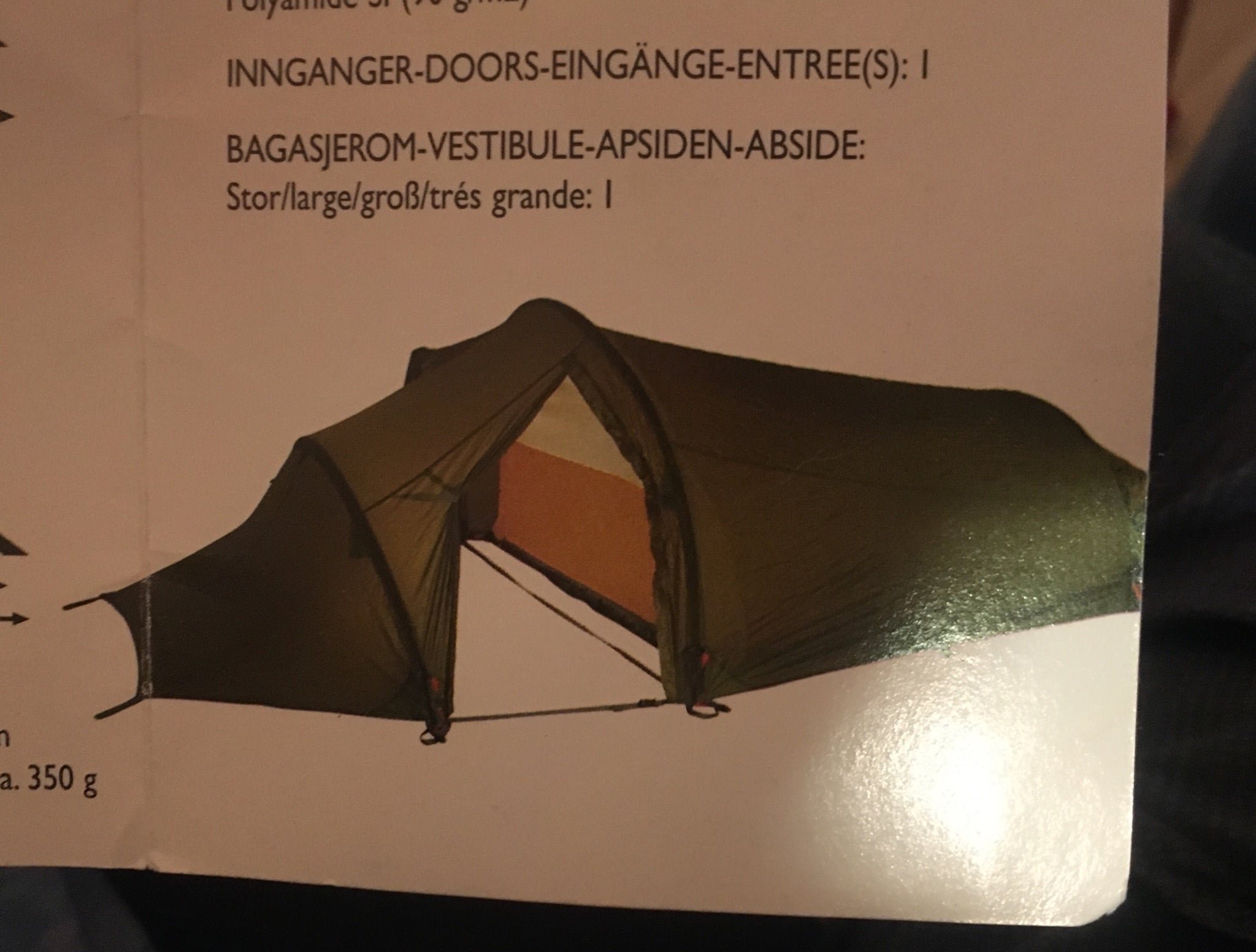
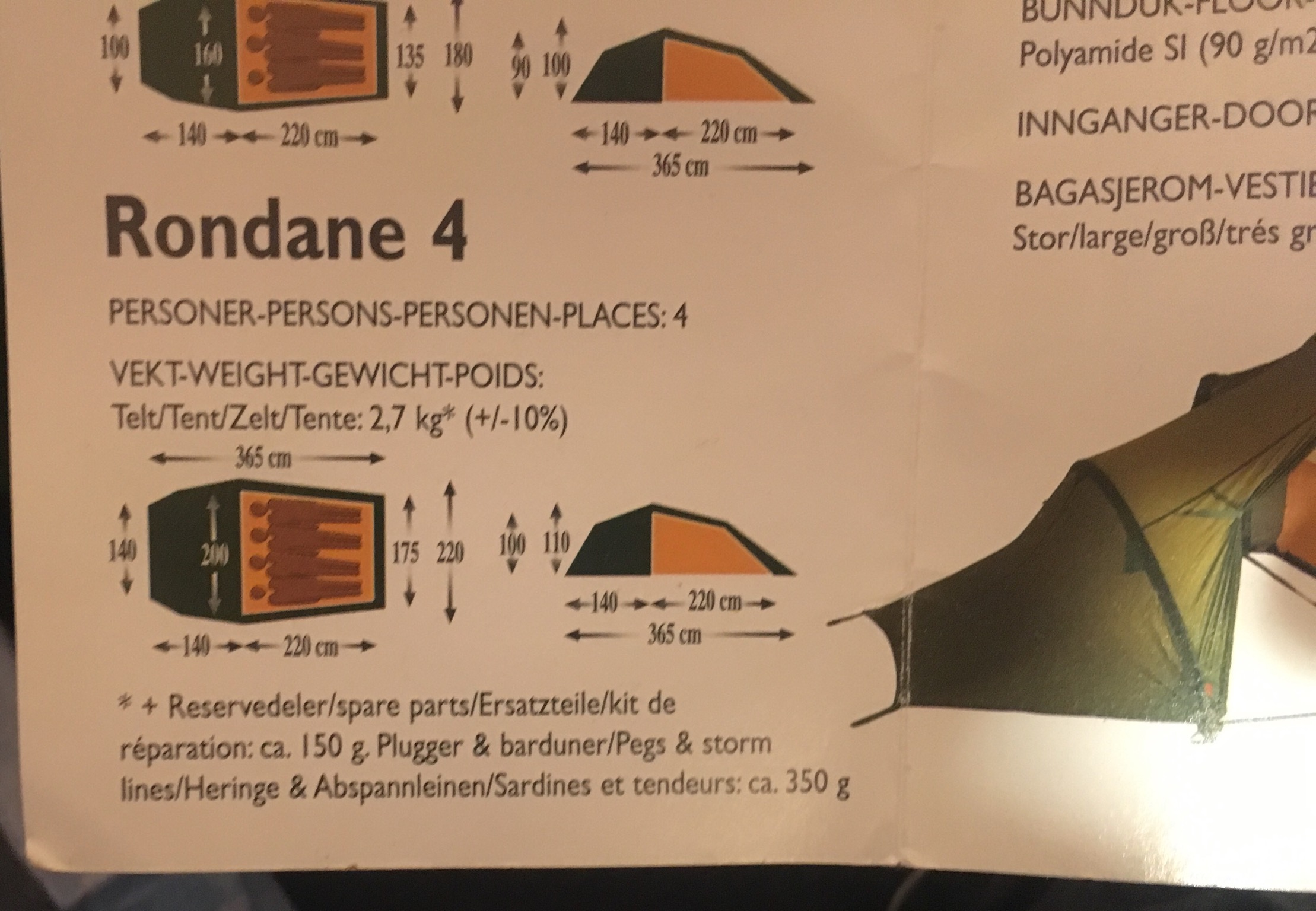
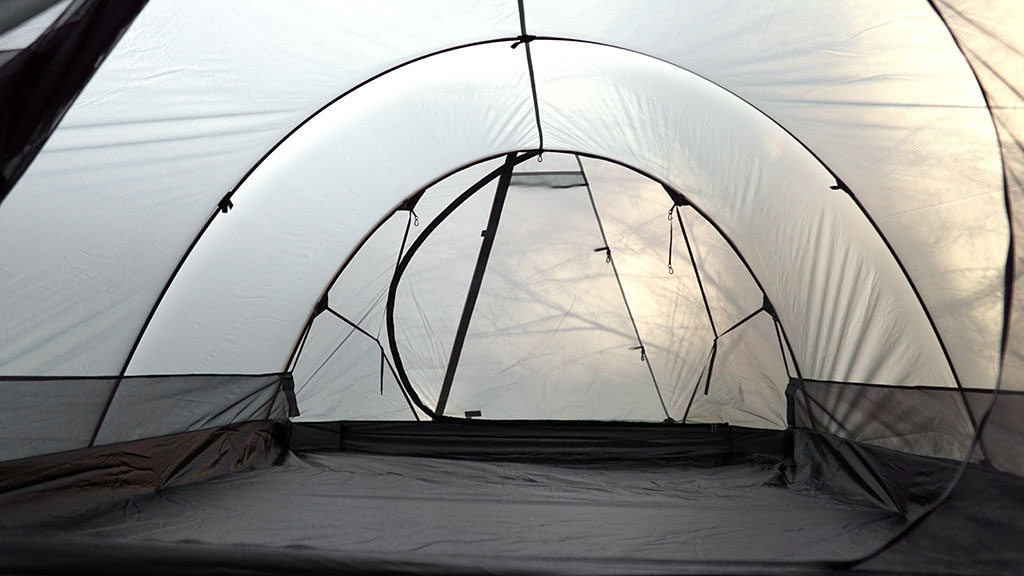
regarding the distance between poles in tunnel tents – roger caffins recommendations point toward 1m as an ideal distance for maximum unsupported fabric span for a winter tunnel tent. I inherited an earlier model helsport rondane 4 (see pic below if interested) that has similar 3 pole spacing and ventilation to the hilleberg nallo 4 GT. Between the largest pole at the high point of the tent and the next pole toward the leg end of the tent the spacing is 160cm. Acknowledging that this isn’t optimal how have people’s experiences been with nallos under heavy snow loading and or high winds? Wondering if I can get away with using my helsport above treeline (quality and pole strength are similar to hilleberg) in the Nordic winter and if so what steps can I take to compensate for the unideal pole spacing? Plan on sewing in interior cord supports as roger recommended to help stabilize against snow and wind from above? Any other tips or is it just planning on waking up a bit more often in the event of heavy snow and clearing it off? The obvoious recommendation is a hardier tent like the Nammatj etc but it wouldn’t be backpackinglight if we didn’t try to go a bit lighter by adding a few skills and gear mods to the game.


thanks in advance for your input

brendan


PostedFeb 14, 2019 at 10:41 am

Also, what are people’s experiences with ventilation when camping in the snow (and high winds) with the nallos ventilation system (one side has a vent scoop high up) other end has ventilation at ground level). Obviously not ideal but are there any workarounds to keep ventilation effective when you would ideally have a snow wall around the tent? My helsport uses the same system as the nallo and am wondering if I should add an air scoop vent   to the end that just has ground ventilation or if I can make it work without the mod….

James Marco BPL Member
PostedFeb 14, 2019 at 12:45 pm

I tend to believe that there is no one set minimum spacing for poles. Rather it is the product of support (poles,) the angle (or “steepness”) of the roof and the frictional characteristics of the material used. Wind loading is about the same. The loads can vary. Sometimes winds/wind loading can help, for example in a 12″ snow fall in a gradually rounded roof wind loads can “clear” the snow from the roof and causing it to deposit on or near the lower and steeper edges. Sometimes it can be bad by catching on any loose fabric imparting extreme wind hammer to the fabric ( open panels,) stakes and lines.

With ventilation, a bottom to top flow is considered best. Sometimes it doesn’t happen if the tent is too large and condensation occurs mostly on the inside. Sometimes it is too small and ventilation is simply overwhelmed with the amount of saturated air inside. Conditions effect this either way by a large degree. A tent in winter, with a ground level intake, is often overwhelmed by the amount of snow sliding off the steeper sides plugging the input, though. In this case a couple vents at opposite ends works well by providing a cross ventilation (with the help of any wind/breeze.) But, in winter, be careful. Spindrift can easily penetrate mesh. You could find a light dusting inside the tent using cross ventilation schemes. A scoop vent works well, but you would likely want some way to seal it closed. In very cold conditions, a simple breathable fabric works better than vents. A few tents were actually produced with eVent. But if the temperature gets above 0C, you could have problems with water penetration.

Tipi Walter BPL Member
PostedFeb 14, 2019 at 4:07 pm

I have alot of experience using tunnel tents in cold and snow and high winds.  All my experiences have been with Hilleberg models, namely the Nammatj 3 and the Keron 3.

Since I do all of these trips in the Southeast mountains of TN and NC—winter trips therefore include alot of nasty weather with 35F rainstorms and 0F cold snaps.  And high winds on mountaintops.

These tunnel tents slap around tremendously in high winds and I sometimes have to place rocks on the tent pegs to keep them in the ground.  The side guylines help of course but there’s a limit to how much sway they will prevent.

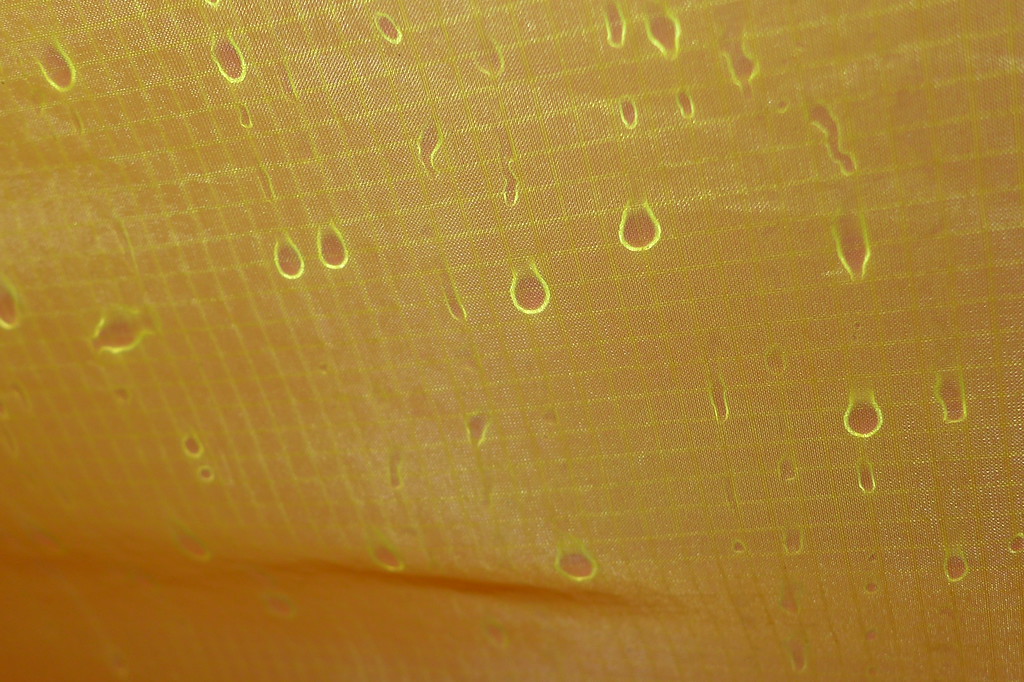
Condensation under the right conditions is terrible.  If your tent fly perimeter comes all the way down around the bottom of the tent, expect terrible condensation.  This condensation will drip from the inside of the fly and land on the inner tent canopy—which will shunt the water off to the ground.  Under the right conditions there is no way to prevent this condensation—except to use a double wall tent and make sure the inner tent fabric IS NOT mesh but a solid ripstop.

Here’s a pic of the problem during a 75 hour butt cold rainstorm in December—the fly condensation lands on the inner canopy and drains.

Gunnar H BPL Member
PostedFeb 14, 2019 at 6:54 pm

There is a plenty of people that have endured winter storms in a Nallo here in Scandinavia (not me though), but I believe Rondane is a 3-season tent according to Helsport? Nallo is a 4-season tent, so if piched correctly it is designed to withstand at least the 60-80 mph winter storms we have a few each winter here.

PostedFeb 14, 2019 at 7:10 pm

Thanks for all of your input guys – much appreciated.


I think I will consider adding another vent scoop higher up on the end of the tent that only has ground level ventilation.  Nice to keep the airflow and still be able to build up some snow around the edges in high winds…


Gunnar – there have been several model variations of the Rondane.  My version was from the Pro line of Helsport tents  and used the same poles and fabric as the X-Trem (burlier winter) versions did at the time.  It was definitely directed more at a 3 season high mountain market originally but only due to features/ventilation – its bones are very similar to the Nallo.  The current iterations of the Rondane (rondane superlight etc) use much lighter materials and I would agree are firmly in the 3 season category,


Roger Caffin BPL Member
PostedFeb 15, 2019 at 1:01 am

Hilleberg models, namely the Nammatj 3 and the Keron 3.

These tunnel tents slap around tremendously in high winds

Forgive me if I dispute some of this.

If a tunnel tent slaps around badly in a high wind it was pitched wrongly or outfitted wrongly. End of story.

If the wind is end on there is only one way the tent could move: if the ground anchors at the corners of the tent are made from bungee cord rather than solid nylon. I have seen tunnels with this fault and it was not pretty. Bungee cord at the windward end violates just about every rule for a tunnel. Replace the windward bungee with solid nylon and put good tension at the lee end, and the tent will be stable against end-on wind.

If the wind is cross-ways then it is a matter of the length of the fabric span between the poles. Some 3-season tunnels do have long spans – over 1 m, and the fabric can then move a bit. This is either a design fault or a misuse of the 3-season tent. You can do so much by guying the poles well with double guys, and putting a high tension lengthwise, but long fabric spans are just weak. Get out there in a gale and see for yourself.

The Keron 3 has a fabric span of 1.1 m between poles. Personally I think that is too long, but it is manageable if you always pitched the tent end-on into the wind. Cross-wind – not so good. With a packed weight of 4.2 kg, that is a very heavy tent nyhow.

The fabric span on the Nammatj 3 is also about 1.2 m. Same comments apply. Packed weight of 4.1 kg: still very heavy.

and I sometimes have to place rocks on the tent pegs to keep them in the ground.
This has very little to do with the design of the tent. Rather it is a function of the ground and the length of the tent pegs. If the ground is that difficult, or if the tent pegs are too short, what’s the matter with adding a few rocks anyhow?

</soapbox>
Cheers

PostedFeb 15, 2019 at 1:24 am

Maybe you could mod the tent to take another pole between the two over the inner for those winter trips.

I don’t know how quick and easy it is to at least partially remove the inner with yours  but if it can be done it could work.

Take a look at how it’s done with the Tarptent Cloudburst 3 :

https://www.tarptent.com/product/cloudburst-3/

Tipi Walter BPL Member
PostedFeb 15, 2019 at 3:18 am

Who mentioned using bungee cords on a tent?  I sure didn’t.

Roger says—

“If a tunnel tent slaps around badly in a high wind it was pitched wrongly or outfitted wrongly. End of story.”

This I find weird what with all his experience in high winds.  Maybe our winds here are different?  Our worst winds slap the tent around from various directions—sometimes at once—it’s a swirling maelstrom—and so comes the “slapping” description.  My Hillebergs take a pounding and I’ll survive the night but I’ll get slapped and pounded in the process.  Don’t we all?

What’s it like in a slapping Hillie?  Just study this vid and wonder no more—Go to 4:15 and you’ll get a perfect example of slapping.  (Of course it’s in an Akto but my Keron’s yellow inner shakes just as much—if the wind is right—it’s why I use this vid as an example)—

https://www.youtube.com/watch?v=-SKawxq3p_M

Anyone who owns a Hilleberg tent and has used it in a tough windstorm will relate to this video.

And one more point.  When I first starting using Hilleberg tents back in 2005, I was discouraged by how badly the yellow inner tent would move and get pushed around by the wind—even though it was of course inside the kerlon fly “shell”.  It took me several years to figure out the phenomenon.

My Hilleberg tents—the Nammatj, the Staika, the Keron etc—all have inner tents which are suspended from the poles and the fly by black elastic webbing.  The inners are therefore not rigid as with most American style tents like MSR and Mt Hardwear and North Face—which have rigid pole-supported inners with the fly draped over the poles.

Hilleberg inner tents “float” on elastic webbing and so of course any strong wind will move and sway and slap the inner tent.  This is the real “bungee” problem—and takes some getting used to by people raised on VE-24s and Trangos.


PostedFeb 15, 2019 at 9:31 am

Franco – I like your idea of having the option of adding another pole in winter conditions.  In my case the problem lies in the difficulty of adding a pole where a seam doesn’t already exist (mid-panel).  It appears that the solution the Cloudburst uses is to have the pole anchored to the fly in just 3 places (5 if you include the anchoring at the ground to the groundsheet/pegs).   Everything that I have read has indicated that running pole placement along seams is by far the strongest option.  In addition, it appears that the MYOG experience is that building poles mid fabric panel can make the tent difficult/impossible to tension properly resulting in poor shape and wind performance.


I would be very interested in opinions regarding the Cloudburst solution that allows the extra pole to “float” a bit due to limited connection to the fly.  Obviously this construction if used on ALL of the poles on a tunnel tent would greatly reduce the stability of the tent as too much pole wandering and instability would compromise rigidity.  I’m wondering however if the compromise when using this floating pole method solely for the extra pole in my case might allow for a 3.5 season solution that would not cause undue compromise to the fly integrity/tautness but also provide extra support for wind/snow loading across that 1.6m “3 season” fabric span.

My main hesitation would be that the connections between the extra pole and the fly (especially if they were few and far between) could cause undue stress on those seams and cause fly failure in high winds.  I wonder if allowing the pole to “float” a bit at those interfaces would reduce stress or just allow for a whipping motion of the fabric that would exacerbate the problem?

Any thoughts?

PostedFeb 15, 2019 at 9:59 am

Here is a picture for reference of the cloudburst without and with the additional pole added


Roger Caffin BPL Member
PostedFeb 15, 2019 at 9:36 pm

OK, I watched the video for a while and saw the inner tent flapping like mad. I am not sure what model tent they had, but either it was not what I would call a full tunnel or it was pitched very badly. I did see a collapsed pole several times, which might explain some of the problem. I am not sure I could see a second pole on that tent, so I have no idea what it was. The height of the inner tent over the guy’s face makes me doubt the quality of the tent: far too low.

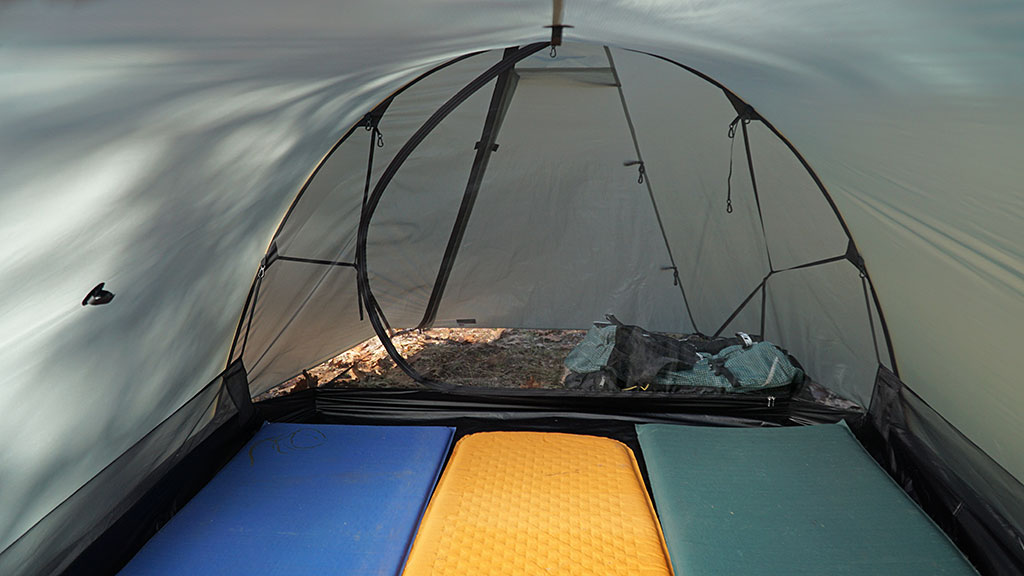
This is a real tunnel:

First of all, you will see the head clearance. A little more than in the video. Next, while this is a still photo, there is no evidence of flapping of the inner tent – because there was none. The wind outside at this stage was in the 80 – 100 kph range. And there was no flapping anytime in the night either. And the poles did not move, because they were properly guyed. We got the tent down in the morning in the proper way, and there was no damage to anything.

Yeah, you get a lot of very heroic tent videos on YouTube – usually of guys doing something ‘unwise’ with the wrong gear. Along the lines of “Look how tough we are”. I have been over Knock Fell on the Pennine Way in the UK, and it is a bit exposed. Camp up there with the wrong gear – tough.

Cheers

PostedFeb 15, 2019 at 9:47 pm

The one in the video was the Hilleberg Akto.

At 138 kmph  I would be thankful that the tent (any tent of that type)  is still standing.

Roger Caffin BPL Member
PostedFeb 15, 2019 at 9:55 pm

Adding a third pole to a 2-pole ‘tunnel’

This is quite easy to do. First of all, you put the pole on the INside of the tent for best strength. Second, don’t rely on a couple of relatively useless clips: use a full sleeve. Take a length of matching fabric about 50 – 60 mm wide, fold it in half lengthwise, and sew a tube. Then sew this tube to the inside of the fly. Macpac put their poles on the inside of their top tents, and it works just fine.

While you are sewing the tube to the inside of the fly, sew two anchor points on each side of the outside, for double guys. Obviously, you sew through the pole sleeve as well as the fly!!!

Then it may be a good idea to run some light webbing across under the groundsheet with eyelets at each end to take the pole feet. LIGHT webbing is quite enough. Secure it lightly to the groundsheet walls at each side.

Cheers

Roger Caffin BPL Member
PostedFeb 15, 2019 at 10:00 pm

Hilleberg Atko – that figures. And pitched side-on to the wind.
Absolutely NOTHING to do with tunnel tents! It’s a fine-weather 3-season tent which should never have been up on Knock Fell.
NOVICES!
OK, very ‘heroic’ novices …

Cheers

PostedFeb 16, 2019 at 12:21 am

That video from Tipi Walter is worth a thousand words, probably many more.
Can’t imagine that anyone who treks for enjoyment would want to spend a night in that tent in such conditions. Especially when there are alternatives short of a hasty retreat:
One would be to add a center hoop pole. If the fabric coating is polyurethane or ‘TPU’, a PU coated reinforcement strip can be bonded very securely to support stitches holding an added pole sleeve. McNett Seamgrip, or a low viscosity 2-part PU adhesive would create a strong bond, but must be applied extremely thinly so as not to make the canopy stiff, and the strip clamped till dry. If the patch is stiiff, it will not flex and distribute stress evenly from the pole sleeve.  This should be done only after experiments with bonding swatches in order to get a preview of the outcome. Would not try it with silnylon – while there is a place for bonding silnylon, the peel strength of the bonds are nowhere near what can be achieved with PU. Of course, even with an added hoop, side-guys are needed on all the hoops for a tunnel to withstand such winds.

Also, as suggested by Tipi, inners must be as taut and well supported as outer canopies, in order to shed condensation and resist distortion.

But in the final analysis, I think designs for those kinds of winds need to be based on poles that criss-cross and mutually reinforce each other. This is illustrated by the tents chosen by those who trek the Hindu Kush mountain regions. But almost all of these 4-season tents, whether tunnels or domes, are too heavy to be acceptable to most for BPL. So the approach is to come up with the most stable design with at least two pole crossings – certainly not the single cross-pole designs descended from the Jan Sport wedge tents. There were some interesting designs from the proprietor of Trekker Tent, used in the Scottish highlands, that still appear on his website at http://www.trekkertent.com/home/17-tents
Then fabrics must be tested in the field to determine the minimum weight that will be durable in such conditions.  I’ve posted some designs occasionally on BPL, but think it remains to be seen whether a ~two pound tent can be built that is comfortable and stable in winds like those in Tipi’s video.  But that’s no reason to keep us from trying to improve our homes away from home.

I recently posted a proposed design without double-crossing poles in order to save weight and shorten pitching, but intended to follow some of the above.   https://backpackinglight.com/forums/topic/proposed-clamshell-hex-tent-solo-with-side-entries/

Hope some of the suggestions there will be helpful to those seeking more durable and stable tents.  Note that the proposal looks a bit  similar to Trekker Tents’ current offering for a 4-season tent; but that there are two hoops rather than one, and they are arched to better shed wind, and resist breakage.  They are also heavily canted outward to reduce pressure on the stakes.

Roger Caffin BPL Member
PostedFeb 16, 2019 at 12:53 am

Hi Sam

I think designs for those kinds of winds need to be based on poles that criss-cross and mutually reinforce each other.
As I am sure you know, I totally disagree. From my practical experience, the poles do NOT need to cross to reinforce each other. If placed sufficiently close together, the fabric provides all the mutual support needed. That has been proven with my tents.

The problems for commercial mfrs are several. The CF poles are probably more $$ than the Al poles. Having enough poles simply adds to that cost, and especially to the weight if Al is used. And few Asian tent factories have the sewing technology to make tunnels properly.

But almost all of these 4-season tents, whether tunnels or domes, are too heavy to be acceptable to most for BPL.
Dunno about that. If you use cheap materials and poor construction techniques, then you may be right. But light weight is possible:
Blue summer 3-pole single skin tent: 1.26 kg complete w poles
Red winter 4-pole double skin tent: 1.80 kg complete w poles

I have omitted pegs here. Ti skewers for the summer tent weigh 82 g. What you use for a winter tent depends on whether you plan to camp on grass (Ti skewers) or on snow. My Ti snow peg kit weighs 400 g, which sounds like an awful lot, but they are possibly a bit of an overkill. OK, but they will never fail, no matter the storm.

the peel strength of the [silicone] bonds are nowhere near what can be achieved with PU.
Sorry, but just plain wrong. A siloxane bond between two layers of silnylon is stronger, as it is a chemical fusion between the silicone coatings. It is not just a sticky layer of acrylic adhesive. Mind you, I have torn the PU layer off the surface of nylon fabric during testing; you can not do that with silnylon.

As for fabric strength – forget it. I have seen photos and videos of tents failing, and never once has it been the fabric which gave way. The poles break, the tent pegs fail, or the whole tent collapses, but nylon fabric survives. Um – I do not have enough experience with Cuban fabric to comment, and I would be less confident about polyester.

Single pole tents are not for the mountains under any conditions. Tents with the poles running lengthwise are just as weak. Both designs are for cheapness. Yes, I HAVE tested them myself.

Cheers

PostedFeb 18, 2019 at 4:55 am

Hi Roger,

Will take your points one at a time, but first should ask if the canopy of the OP’s tunnel tent is made of two fabric pieces, in which case there may be a seam already where one might wish to install a sleeve for a center pole.  Forgot to mention that.

Multiple cross-pole designs:  In the past, you have acknowledged the value of these tents for high altitude winds, but forgive me for not spending many hours to dig out those comments.  My opinion is based on the mutual reinforcement that two multiple crossed poles provide to a frame.  The reinforcement from the fabric is in addition to that.  It is primarily a matter of two poles being stronger than one, and multiple crossings is a tried and true configuration.

Multiple crossed poles also create a self supporting frame that reduces the stress on stakes.

As discussed in my OP linked above, carbon poles are quite durable if the right arrow shafts are used, and Easton now has heavier carbon poles sold through Quest that are designed for tents.  They do add to the weight, however, by about 33%.  (8.9 gpi compared with 12 gpi for the heavier Easton pole-the light one has very little rigidity-not OK for a wind tent IMO).

Weight:  Yes, that is the perennial issue with 4 season tents.  Your BPL article on tunnel tents acknowledged that the offerings on the market were quite heavy, with the possible exception of the Warmlites, which you found to be of inferior construction.  Their short poles for their smaller tents are made of very malleable alloy.  You may recall the video of one of those distorting badly in high winds.

For a solo tent with two carbon supporting poles, I would like the get the weight down to around two pounds.  Much over that, it might be easier to buy and mod a tent, as I did with a One Planet Goondie posted on BPL. We will have to experiment with the newer fabrics to achieve lower than market weights.  Fortunately, we have had Richard Nisley’s test reports on BPL to help with that.  As for the durability of the sub one oz fabrics, note that the so-called membrane fabrics from RBTR have no ripstop reinforcement grids, not even mini-ripstop.  At one point, RBTR had a table on its site that acknowledged the low tear strength of the membrane products, and my experience with using it for just scale models bears this out.  At some point, taking polyester, or even nylon fabrics to lighter weights has to backfire.  Note Dan Durston’s observation in a recent post that polyester fabrics are generally more durable than nylon.  Not inclined to agree, but note that there are many polyesters out there, and some may be competitive with nylon, and with no sagging to boot.,  Just because I haven’t seen them, doesn’t mean they don’t exist.

Bonding:  My comment was based on the seminal BPL article on bonding silnylon, where the author recommended GE sil glue, NOT sealers or slurries made of sil caulk and mineral spirits or camp gas.  I tried bonds done per the article, but they were no comparison with what can be done with PU coatings – the fabrics literally merge to form one inseparable material.  I’ve noted  your comments about sil bonding for years, but have not found anything like the sourcing and techniques explained in the BPL article.  Can you do an article about this?  Note that the sil/PU coatings coming into use, can be bonded on either the sil or the PU coated side.

Durability:  So are you going to make a tent using the Rockywoods 0.7 oz mini-ripstop nylon?  I am, but only for a smallish fly that can be easily duplicated and replaced with a stronger and heavier material.  We are talking about severe winds here.  If the Rockywoods .7 oz nylon is really that durable, I’d be for making the whole canopy from it, but am proceeding cautiously; for as Tipi Walter’s video dramatically shows, heavy winds can be totally without mercy.

I tend to think we agree on most points, but perhaps are expressing them differently, or from differing experiences.

Roger Caffin BPL Member
PostedFeb 18, 2019 at 5:38 am

ask if the canopy of the OP’s tunnel tent is made of two fabric pieces, in which case there may be a seam already where one might wish to install a sleeve for a center pole.
That would be ideal! Murphy says it won’t be so …

Multiple cross-pole designs: In the past, you have acknowledged the value of these tents for high altitude winds,
Could be some confusion here. Geodesic domes using 4+ poles are indeed very strong, but they are usually close to square AND they weigh a LOT. The poles are often a bit thicker than we use too. Now, if you want to house 4 – 5 people in a single tent at 6,000 m, they might actually be realistic on a per-person weight.

But light-weight long/narrow ‘domes’ with crossed poles on the diagonals are a very different matter. If we go for a 2-man version then the poles are going to be long and flexible and weak. Wind-tunnel testing and outdoors testing with wind machines have shown this over and over again.

Carbon fibre poles: much care needed here. There are 3 sorts: pultruded, fabric-wrapped, and 2D wrapped. The pultruded poles will split when bent and are utterly useless for us. (Yes, I have tested them …) The fabric-wrapped poles are made by many vendors and do not split, but they are usually a bit bendy. Most anyone can make them. The genuine ‘2D wrapped’ poles have few sources as they need a huge machine for mfr, but they are superb for tents (and arrows). They are available in America.

My CF poles weigh 1.9 g/cm or 4.66 g/in (grams, not ‘grains’). The idea of 12 grams/in boggles me, but maybe you are quoting arrow vendors in grains/inch? A very strange measurement. In my experience, the Easton poles do tend to be a bit heavier than needed, but I can understand their position.

EDIT: Rene (below) is right. I mixed millimetres and centimetres. The CF tubing in my poles weighs 19 grams per metre. So the figures above should be 0.19 g/cm or 0.466 g/in. Mea stupida. Thank you Rene.

membrane fabrics from RBTR have no ripstop reinforcement grids,
Which is about time too! The whole ripstop idea is a marketing concept of no use to us. Very seriously.
The presence of the larger ripstop threads drastically reduces the HH over a plain weave, and I DO have the test results from my own lab. Such fabric leak along the ripstop threads so easily.
The ripstop weave has essentially NO effect on tear strength for silicone coated fabrics as the silicone coating spreads the load way beyond the next thread. Again, I have the test results from my own lab. (But PU coating reduce the tear strength.)

At some point, taking polyester, or even nylon fabrics to lighter weights has to backfire.
Of course, but I don’t think we are there just yet!
A silicone-coated nylon fabric has huge strength against wind loading, and I have yet to see a nylon fabric failure in the field in a well-designed and properly pitched tent – or even in a tent being hammered by a wind machine.

Bonding: a silicone seam sealant or silicone adhesive may well fail under load – at least in peel mode. The adhesive does not really bond to the silicone coating all that well. You MUST use a siloxane adhesive (usually a transfer tape) to get the chemical/structural bond I keep mentioning. Again, I have tested this many times in my lab and in the field. Yes, some acrylic tapes do bond very well to PU.

are you going to make a tent using the Rockywoods 0.7 oz mini-ripstop nylon?
I would prefer to use a plain-weave fabric, not even a mini-ripstop. Would I go down to 0.7 oz/sqyd? At this stage, I don’t know. I am NOT prepared to go to stupid extremes just for the UL-boasting privileges. I would need to play with the fabric a bit first.
Not going to happen right now as I am busy with stoves and packs, but my blue 3-season tent is getting a bit long in the tooth.

Cheers
PS: biased? Who, me?

PostedFeb 18, 2019 at 6:59 pm

Roger,

Can you confirm your pole weight? That seems rather heavy.

Roger Caffin BPL Member
PostedFeb 18, 2019 at 9:25 pm

Hi Rene

I am slightly confused. Are you saying that my 1.9 g/cm is heavy, or are you referring to Sam’s 12 g/in?
My measurements of many Al and CF poles show that Al poles are 2 – 3 times heavier than CF, or that CF poles really can be that light.

Cheers
EDIT: Rene is right. That should be 0.19 g/cm or 19 grams per metre. Mea culpa.

PostedFeb 18, 2019 at 10:25 pm

Sorry. 1.9g/cm seems heavy.

Over four 3m poles, that’s 2.28kg.  Your four pole tent weighs 1.8kg?

Roger Caffin BPL Member
PostedFeb 19, 2019 at 9:29 am

Aarghh.
I have no idea what happened, but I suspect a Windows crash while posting.

Rene, you are right and I am wrong. My apologies.
I had confused cm and mm in my data (a factor of 10!).
My CF poles weigh 19 grams per metre.

Cheers

PostedFeb 19, 2019 at 4:37 pm

Roger, as you do not make/sell tents anymore, would you consider making a set of extensive instructions (maybe as a nice PDF?) that one could buy for a DIY project?  I’d buy it.

Viewing 25 posts - 1 through 25 (of 52 total)
Loading...