Topic

What is the purpose of the thin down jackets?

Viewing 25 posts - 26 through 50 (of 68 total)
PostedDec 11, 2015 at 1:25 pm

Yep, I’d go with the “athleisure” explanation:

Car camping, day-hikes, err strolls, and general futzing around in the daytime.  No high output activities, so sweat isn’t a concern; picture the wearer with a Pabst in one hand and a Holga around their neck.  They picked it over a fleece because the smooth fabric didn’t catch on their flannel shirts all the time, not to mention the cachet of down, the airy weight, and the sleek look.

-J

James Marco BPL Member
PostedDec 11, 2015 at 2:20 pm

Thin jackets are really a worth while investment here in the NE. I use it for active days in winter, but more importantly, I use it in three seasons for extra warmth when I am not active.

I often need the jacket in addition to the 100wt fleece the rest of the time to stay comfortable hanging around camp, mornings and evenings. I tend to sit around in the mornings, watching/listening to critters and drinking coffee (or having Marco’s Mud for breakfast-cocoa, coffee, and oatmeal.) I also use it for sleeping in my 40F bag in spring and fall (sometimes in the middle of July, too.)  This takes my same gear, it rarely varies except in details, down to about 30F comfortably. I could survive with occasional shivers, down to 25F if I am not hiking on a damp night. I always bring it, even on summer trips. It always gets used on my one to two week trips.

This may be against the popular notion that the down in the sleeping bag would be lighter. I find it far more convenient to wear it around camp, along with a 100wt fleece and/or a midweight base layer and possibly my hiking shirt. Rather than fooling around pressing my sleeping bag into service for something it was not designed for. (Though, I have done that, too a few times.)

PostedDec 11, 2015 at 5:32 pm


Short answer :

Less bulk/more warmth than other layers (for me)

My light down jacket is the WM Flash.

About the same weight as my Merino jumper but a lot warmer and compresses down to about half the size of the jumper,

I lose at least one feather on every trip but there are thousands of them in there so I don’t worry about it.

Never hiked with that on my back, just for breaks or around camp and in cooler/colder weather inside the sb.

Works well at camp under my rain jacket it it is cold or windy enough for it.

Anton Solovyev BPL Member
PostedDec 11, 2015 at 10:51 pm

I suspect that a thin and hoodless down jacket may not be warm enough to be really useful in colder temps.

In early November this year I had a revelation on how cold it can really feel in “3-season conditions”. We hiked a route in southern Utah in the temps from mid-20 to 50. There was a stretch where we had to wade and cross repeatedly Paria river in the shade and in freezing temps (come out of the water, shoes and gaiters immediately ice up). I was wearing all layers, including full on hooded down jacket (Patagonia HiLoft Down sweater, old model 800-fill, 440 grams/15 oz) and was barely warm and barely keeping my toes from going completely numb. The down jacket was a longish one and quite puffy (thicker than similar jacket from Marmot and much thicker than a typical “down sweater”).

With the short daylight and low sun angle the constant pressure of cold temps over several days is significant. I had no shortage of calories, but the down jacket had to stay on hand most of the time. I think it would have been very difficult to function w/o a full protection hooded down jacket. There’s a big difference between the temps dipping below freezing for the coldest part of the night and constant 20-something with a short window of upper-40ies and no direct sunlight most of the day.

The high loft down jacket has probably at least twice the fill weight of 2oz ultralight down jackets (Google reports 3oz for non-hooded non-hiloft version).

I vote for a warmer jacket now.

Justin Baker BPL Member
PostedDec 12, 2015 at 12:12 am

An ultralight down jacket is useful for something like summer in the sierras. You just need something to get you through the evenings while you eat and set up camp before it gets dark. Not for chilling in freezing temperatures. For that I like my montbell mirage with has 5.3 ounces of down with full baffling.

The only advantage of down is having a high warmth per weight. It is entirely inferior in every other way. Not something that I would plan on hiking in. It confuses the hell out of me why people spend $300 on a high fill power down jacket for every day use, considering it is an entirely inferior product except for weight and packed bulk.

PostedDec 12, 2015 at 6:58 am

“The only advantage of down is having a high warmth per weight.”

Compressibility/recovery and general longevity are pretty major advantages also.  Hopefully someday soon the new polymer aerogels will start to be used for clothing insulation.  It’s the only thing that i know of that might best Down in some areas, though i doubt for compressibility or longevity.

Paul Magnanti BPL Member
PostedDec 12, 2015 at 11:44 am

A thin down coat is simply a lighter, less bulky replacement for a 200 wt fleece in three-season conditions.  No more, no less.  Not meant to be worn in deep shoulder seasons or winter conditions.

Now, if people do use it it colder conditions, that’s another story…

It has it’s place like any other tool we discuss.

The fact that is popular for around town is secondary. Fleece jackets, when they first started becoming popular, were co-opted for fashion, too.  My Filson Mackinaw coat that was a 30th birthday present was designed for hunting, logging and other outdoor activities long before any of us were born, for that matter.

re: car camping

That is merely the how a person choose’s to spend their time while sleeping. What is done during the day is another story. Many cool places don’t allow backpacking (Chaco Canyon, Hovenweep National Monument and so on) but really can’t be seen unless you are willing to hoof it for some of the more interesting places.


Dale Wambaugh BPL Member
PostedDec 12, 2015 at 12:23 pm

The purpose of thin down jackets is to relieve your wallet of a substantial amount of cash.

The reality of the construction: two thin non-breathable shells. The fabric can’t be breathable enough for active use if it is to be down proof.

Then you get a thin layer of down that gives a 1/2″ if loft on a good day. I imagine the ratio of quilting to loft is less efficient than a garment with more loft as well.

It’s the same issue with 60 gram synthetic insulated garments. There too, the fabric needs to be a fine weave to prevent “bearding” fiber leakage as with down.

A 100w fleece plus a windshirt deliver as much insulation with far more versatility, but a few ounces more.

If I am hiking in weather that requires quilted insulation at rest, it needs to have an 1″ or more loft to be worth the weight/volume/cost.

I have hiked and skied at temperatures well below freezing and over-dressing is an issue. Most of the time a base layer plus a fleece or sweater plus cap and gloves were more than enough. Once you stop, you need the loft and it needs to be more substantial than the “ultralight” marketed items.

Like soft shells, the thin down garments are great around town and single purpose use where you know the conditions and activities for that day, but lack the versatility for a backpacking layering system. They are probably never  practical for active use.

KRS BPL Member
PostedDec 12, 2015 at 12:32 pm

I love my thin down jacket. I mainly do 3 season backpacking trips in Virginia but occasionally do an overnight winter trip. I always carry my hoody cap 4 1/4 zip, Houdini, Montbell UL inner jacket and Lukes’ UL silnylon rain shell. Unless its summer then I leave the down jacket at home and just bring the Cap 4 and shells. I wear them in that order as needed and they have taken me into the high twenties comfortably. If I get cold with this setup its usually time for bed. Hiking I just wear the cap 4 and Houdini and that is good to about freezing for hiking. In camp or long stops I pull out the UL inner. The rain shell only comes out for bad weather or if I can get warm in camp. By sandwiching the down jacket between the Houdini and silnylon it protects it form any sweat caused by the VB effect of the silnylon rain jacket. Winter trips I would bring a heavier down jacket and a 3 layer shell.

Dale Wambaugh BPL Member
PostedDec 12, 2015 at 12:57 pm

Kurt, you could do as well with a   200w-ish fleece and leave the Cap4 and down jacket at home.

In shoulder seasons I would be wearing a Cap3 base, fleece and wind/rain shell, backed up with a 90g synthetic vest which can used in several combinations.

Paul Magnanti BPL Member
PostedDec 12, 2015 at 1:32 pm

The purpose of thin down jackets is to relieve your wallet of a substantial amount of cash.

Hmm… never realized that these past few years. Thanks for correcting me. :)

You do realize that, unlike the Catholic church I grew up in, there is no One. True. Way. of doing something.  When there are statements like that above, I wonder if a person is so use to doing something one way that they just assume their way is the only correct way of doing something.

Enough experienced people like the three-season puffies for various reasons (myself included) that I suspect there may be a reason why people use them depending on conditions, location (PNW vs Colorado Rockies for example).  time of the year, other gear taken (I use a quilt, for example), etc.  I don’t see the utility of windshirts or ponchos for me or my system of backpacking.  However,  I’d be foolish to say my path is The. One. True. Correct. Way (sit, kneel, stand..repeat)…I’d also say other dogmatic statements are foolish as well.


Ben C BPL Member
PostedDec 12, 2015 at 6:24 pm

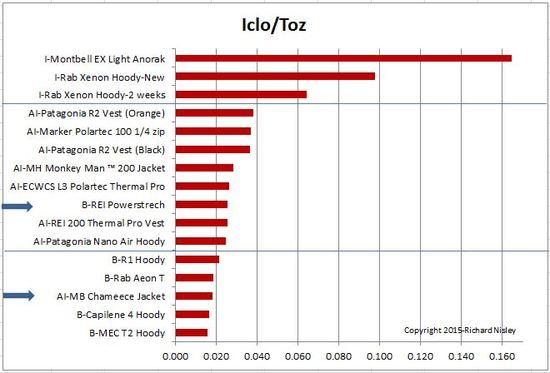
Richard Nisley’s research indicates a light puffy is a lot warmer than a 200 fleece. That is consistent with my experiences.

Roger Caffin BPL Member
PostedDec 12, 2015 at 8:23 pm

To my mind, a major problem with the use of light down jackets during the day is that the down gets badly crushed and damaged by the shoulder straps and the pack against your back. Down is just not meant to handle that, but most any fleece can laugh at it.

Cheers

Richard May BPL Member
PostedDec 12, 2015 at 8:26 pm

A thin down coat is simply a lighter, less bulky replacement for a 200 wt fleece in three-season conditions.

+1

It’s my favorite piece of gear. Round here it doesn’t get very cold all year and this, with a thin layer, gets me through winter.

Best part is that traffic cone orange is suddenly “cool”. Now that god-awful Stoic Hadron I bought super cheap (it was the last one at Backcountry) is wearable in public. I wear it all winter even in town. (-:

James holden BPL Member
PostedDec 12, 2015 at 10:55 pm

The stated purpose of down sweaters is as

  • a primary insulation layer in mild (above freezing) temps in fairly dry conditions
  • a booster layer in colder conditions
  • an “active” layer in exceptionally cold and dry conditions (think arctic)

However the REAL purpose is fashionable outerwear for the hipster masses for most of these mass market brands

Nothing is as light per weight as down if its dry … That being said if yr soaked from hiking in the rain all day and its still raining cata and dogs in camp, a fleece will be warmer and wont collapse

all that moisture needs to end up somewhere and in 100% humidity it doesnt just evaporate

If a down sweater is yr only insulative layer in our constant multi week PNW rain spell … Unless yr a true “expert” … Yr simply screwed


;)

Justin Baker BPL Member
PostedDec 12, 2015 at 11:49 pm

“To my mind, a major problem with the use of light down jackets during the day is that the down gets badly crushed and damaged by the shoulder straps and the pack against your back. Down is just not meant to handle that, but most any fleece can laugh at it.”

Roger, down is terrible for hiking in. Down is best for static use for rest breaks and camp. A thin down jacket gives you a small amount of warmth for the lowest possible weight for static use in milder weather.

Paul Magnanti BPL Member
PostedDec 13, 2015 at 12:41 pm

I never wear down when active. My active layer is a sub-$10 fleece 100 wt pullover I wear in all four seasons.


re:Puffy being warmer than a 200 wt fleece

Maybe..maybe not. Dunno. There are too many variations (lighter, heavier, synth vs down, fill power) and manufacturers.

But as far as functionality, I think it is fair to say a light puffy has replaced a 200wt fleece as the “go to” layer for many outdoors people in general.

If the 200 wt fleece was the general layer of the 1980s and 1990s (and perhaps into the early 2000s) for three season use for many backpackers/hikers and so on, it seems to me a three-season puffy has become the de facto go-to layer currently for most.

As far as hispsters..no doubt.

OTOH, I am wearing a light wool sweater before going to a friend’s Hanukkah party (good ex-Catholic, Italian-American that I am..I’m bring lasagna. Pairs well with latkes).  The 3/4 zip was popularized by mountaineers and similar back in the day.  And I’ll be wearing my Filson coat as it is winter… Perhaps I’m merely a classic hipster…  wearing outdoor clothing to go to a party. ;)

Being somewhat serious…when does outdoor clothing become just functional and practical and not for “hipsters”?

I’d argue that the simple fleece jacket, something that is ~30+ yrs old in terms of general use, is a great example. It is not for the outdoors, it is not hipster fashion. It is just simple, durable and practical  garment with much widespread use from a person walking a security beat at a local hospital to a person working on their car outside the garage to people backpacking/camping or your office worker.


PostedDec 13, 2015 at 2:22 pm

Oh you fashion challenged proles! Silly geese, (pun intended) don’t you know,  “Darling, it’s not how you feel, it’s how you loook!” (Fernando Lamas)

Yeah, narrow seamed jackets and hoodies are all about the stitching pattern and cool factor. It’s really saying, “Hey, so it’s not warm but it’s expensive and I can afford it, just like my Michael Kors stretch pants.”

SHEESH!, Doesn’t everyone subscribe to GQ or Vogue? ;o)


PostedDec 13, 2015 at 2:57 pm

“If a down sweater is yr only insulative layer in our constant multi week PNW rain spell ”
Yes of course, nobody is arguing otherwise but there is a big difference between
it doesn’t work in these conditions
and
it doesn’t work

jscott Blocked
PostedDec 13, 2015 at 4:57 pm

In three seasons, I carry one big hooded puffy, and lose one or two of the layers I used to carry. The puffy is for around camp; like most I would never wear down while moving. In fact while hiking I’m usually just in my shirt.

“Layering” makes sense in wet or cold conditions. In the Sierra, I’ve found that I don’t swap out layers during the day. So why carry them? (I may put on/take off my shell for wind or rain.) Down is warmer and lighter than anything–so why carry  a fleece, merino and a light down jacket? Lose the merino or the fleece, carry one puffy hooded down jacket instead–for the same weight–plus an event shell. Then use the big puffy for a very luxurious pillow.

Less bulky too–again, down squishes better than any layer that you might leave behind.

Dale Wambaugh BPL Member
PostedDec 13, 2015 at 4:59 pm

If you are going to compare light down vs fleece, here goes:

fleece: lower cost, durable, versatile, easy laundering, better in wet weather, breathable, bulky, heavy

down: expensive, light, compact, less breathable, less versatile, useless when wet, more difficult to launder, fragile, not very warm in thinner versions.

James holden BPL Member
PostedDec 13, 2015 at 8:04 pm

from uniqlo marketing material a few years ago …


<div>


<div>


<div>

down sweaters make alot of sense when the conditions are MILD and DRY …. or when you can simply stop in at the sbucks for a latter to dry off … im wearing one right now as i type this

you can use it in DAMP conditions if yr careful and if you layer it UNDER a synth … though fleece is more certain for wet conditions

they actually dont cost very much either if you dont buy the $$$$$$ brand names and buy em on sale/clearance

you can get a 600-700 fill one for ~50$ on sale (ex. uniqlo)

;)

</div>
</div>
</div>

Viewing 25 posts - 26 through 50 (of 68 total)
Loading...