Topic

Ultralight solo back packing for comfort minded middle aged woman?

Viewing 25 posts - 76 through 100 (of 117 total)
Bob Moulder BPL Member
PostedOct 27, 2016 at 3:07 pm

Weight doesn’t matter as long as the poles are used; only if they’re going to spend time on your pack does weight become important.

I realize that’s a quote, but the simple physics of the matter is that more weight requires more work to move it.

I used my heavier (8 oz each) poles on a recent trip (mentioned above) and really noticed it after having used my 4.3 oz poles exclusively since last spring and summer.

However, I have listed WTBs here on BPL and on Whiteblaze to see if I can acquire some PP handles.

Geoff Caplan BPL Member
PostedOct 28, 2016 at 1:25 am

There’s another dimension to this light vs heavy pole discussion – you have to trade off weight against robustness. It all depends on your usage.

Lightweight carbons in particular are prone to failure. Composite is challenging to manufacture so quality issues can leave them weakened in ways you can’t see. They are compromised by abrasion and become more brittle in cold.  They are very strong for forces that run along the lay of the carbon (eg from top to bottom) but more vulnerable to shear forces from side to side. Carbons tend to fail suddenly and completely, with a jagged break. Good aluminiums (which should be made of 7075-T6 alloy) are heavier. But they can put up with more abuse and tend to fail more progressively so they can often be bent back into shape to finish your trek.

If your pole gets hung up between rocks or in a bog, for example, your momentum can generate a lot of shear force. This is less of a problem with Pacers, because you can simply let go. But with conventional poles, you are strapped in.

Basically the lighter you are and the more groomed your trail, the more you would tend towards lightweight poles. But if you are big and walk gnarly terrain, carbon breakage can be frequent. For example Philip Werner of SectionHiker.com broke 4 sets in a season walking off trail in New England. I’ve also seen reports of carbons failing in storms while holding up tarp-tents, with the jagged ends damaging the fly.

As with most lightweight gear decisions, there’s no right or wrong answer – just the best balance of tradeoffs for your particular usage.

For my style of walking Pacer advised me strongly to stick with aluminium. As others have said, you couldn’t accuse them of being light. But I walk some pretty extreme terrain and haven’t had a breakage yet. (Famous last words…)

PostedOct 28, 2016 at 5:27 am

4 folks in our household + numerous pairs of trekking poles – all sorts and qualities. The only catastrophic breakage we’ve had was a Titanium pole, caught in a bog. We live in Scotland so most of our hiking is on rough ground.

I have a lightweight pair carbons. I take the pair . If one fails I can still manage with just one both for walking and for supporting my shelter.


Anne W BPL Member
PostedOct 28, 2016 at 8:35 am

It sounds to me that Pacer Poles could make some money selling their  grips!  Definitely like the ergonomic design.  I used an ergonomically designed pair of crutches following foot surgery a number of years ago.  They were wonderful.  Got a smoking deal on a pair of carbon fiber poles on Sierra Trading Post, but my mind is definitely open to those grips.  Who actually uses their straps on regular poles?  I remember digging into them as a kid on skis for better purchase but have never really used them that way hiking….

James Marco BPL Member
PostedOct 28, 2016 at 10:23 am

Anne, I actually use my straps all the time. I do NOT use handles at all on my poles. I set the pole height to about 43″. This is a bit high for me. Then I set my strap length to about 2″ low for me. A simple twist in the strap will shorten it enough to make it perfect. Going up hill, I usually have the pole behind me so, I may drop the twist. Going down hill, I just use the pole with my hand over the top, relieving pressure from hopping down rocks and big steps. A simple “pencil” grip is enough to move to the next spot. I rarely grip them hard, this can leave your forearms very tight. I really hate having to carry anything while hiking, even a staff. Except going down steep rocky terrain, the strap takes all the weight naturally and picks up the weight of my arm/shoulder sway. Corse, these are light 4oz poles. They work really well as shelter poles.

Light poles make a HUGE difference. I went through two pair of Komperdels at around $80 and and a pair of Lekis at around $120 before I started making my own. The tips were constantly snagging on stuff, then, breaking/bending. Just the wrong size even after removing the baskets. And, they were rather heavy at about 6-7oz each. I only ever use one, my other hand needs to be free to grab things, drink, eat, etc while I am hiking.

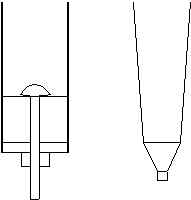
I have been known to switch hands on longer uphill grades, though. That is the only place I miss having two. I do not use a standard tip. Just a bolt tip. Hard enough to bite on ground and wood, soft enough for rock. Yes, it wears slowly…change the bolt once every couple years. Looks like a paper spike except shorter.

Note the wider shoulder near the pole tip. It actually supplies better support than the more conventional tip on the right.  The somewhat longer bolt-tip means I can plant it into the ground and expect it to stand up when I need both hands or at rest stops. This is all epoxied together and has a diamond wrap of nylon .75mm line, also epoxied, around the lower 4″.

Roger Caffin BPL Member
PostedOct 28, 2016 at 2:54 pm

In the middle of all this pole adulation, just remember that many very experienced walkers do not use trekking poles at all. For many walkers, trekking poles are the ultimate marketing spin success.

Cheers


Geoff Caplan BPL Member
PostedOct 28, 2016 at 3:23 pm

Props to James for making his own poles – only on BPL! Sounds like a smart design. Have you written this up?

Roger – for the first 45 years of my walking life I would have agreed. Then I found the Pacers :-) As I get older, I appreciate the added balance on difficult ground – especially when crossing tricky streams. Practical field research by a UK university found that poles really do save the knees on steep ground and aid recovery on multi-day walks. I use them for holding up my shelter, probing bogs, vaulting puddles, hooking down wild figs and apricots, steadying my camera, and adding extra power up that last pull to the pass,,,

Left them at home the other day by mistake and felt surprisingly naked…

Dena Kelley BPL Member
PostedOct 28, 2016 at 3:32 pm

“In the middle of all this pole adulation, just remember that many very experienced walkers do not use trekking poles at all. For many walkers, trekking poles are the ultimate marketing spin success.”

<hr />

While no doubt true, some of us find them to be a Godsend. I tend to have balance issues and at one point rolled my ankle so badly it took a year to heal (and 3 hours of hopping to get back to the car). I tried boots but always blister in them. Poles allowed me to go to trail runners and yet still have the additional balance security I needed to protect myself from injury. I do balance work now, also, but I feel more secure with poles. When I hike without them, I always miss them.

Roger Caffin BPL Member
PostedOct 28, 2016 at 4:03 pm

One big difference is that we don’t have many cleared trails, and off-track usually means a bit of scrub. Poles can be an utter pain in such country, so we avoid them. Saves money too.

But to each his own. If you find them really useful, go for it.

Cheers


James Marco BPL Member
PostedOct 28, 2016 at 6:00 pm

Geof, I actually got the original design from another mailing list about 10-15 years ago. I believe it was the backpackinglight list on yahoo, now pretty much defunct. I tweaked the design to suit. Added a longer strap, and diamond braid wrapings to protect the bottom from abrasion.  Several other minor tweaks to the bolt selections, nut selections and tips, as I remember. Definitely not an original. Let me see if it is still there… Nope, it’s gone. They archived the mail files only. Let me check I ever downloaded it…Nope. Anyway the document is missing…

Roger, I have been known to do a bit of bushwhacking. Seems every trip requires several miles of exploration for some dammable reason. Anyway, I find my staff to be invaluable. Probing ahead to *feel* the ground, catch myself when a rock moves, sliding off balance between a couple rocks, and so on. It is rare I do not bring one. I usually end up making one anyway at a significant weight penalty. I have never broken my MYOG ones, but broke 4 commercial ones. Soo, I guess they are as good as anyone could expect. They are significantly larger diameter (~3/4″ or so, maybe a mm less than 2cm.) They do flex a bit, which helps preserve them.


Geoff Caplan BPL Member
PostedOct 28, 2016 at 6:52 pm

I’ve been checking out reviews of those Fizan poles mentioned above. They are amazingly light, but I was assuming that they would be fragile. In fact, reviewers are saying they perform well on poor ground. They use a rare 7-series aluminium alloy that I’ve never heard of before. Now I’m thinking it might be an idea to graft the Pacer handles onto them. I think it’s a non-destructive process, so not much to lose. Hmmm.

Bob Moulder BPL Member
PostedOct 29, 2016 at 7:12 am

The handles being the only thing that differentiates them from any other poles, why not? Very interested to see what you come up with, both the process — especially removing the handles — and the final product.

Be warned: light poles will spoil you for anything else. :^)

Diane Pinkers BPL Member
PostedOct 29, 2016 at 7:26 am

I would totally use Pacer Poles if they weren’t so darn heavy.  Geoff, if you found a source of grips from them, you could probably make a little money on the side providing Pacer/Fizan fusion poles to BPL.

Geoff Caplan BPL Member
PostedOct 29, 2016 at 1:24 pm

Hi

If you scroll up the thread I posted a link to a detailed description of how to transplant the Pacer handles. It’s actually relatively simple, and it’s reversible in case it doesn’t work out.

I doubt they would sell the handles separately, so you’d be buying both the Pacers and the Fizans if you wanted to combine them. Quite a pricy option! I have a pretty beaten up set of Pacers so a transplant makes a bit more sense for me.  My doubts would be whether they would feel balanced, and whether the Fizans really are strong enough for the kind of walking I do.

The current shafts are OK but not best-of-breed. The locks work but are a bit troublesome. The alloys are quite heavy but seem very sturdy – I’ve given them a lot of abuse and they’re still going strong. I’ve seen people suggest how Heather could improve the shafts, but like many innovators she has quite strong opinions so don’t expect changes any time soon.

Personally I don’t find the weight much of an issue, and I’d certainly rather have a heavy pair of efficient and comfortable Pacers than a lighter pair of conventional poles. But the Pacer handles with a lighter shaft might be the best of both worlds.

For MYOG I can’t see a practical way to do a similar handle, unless perhaps you had the skills to carve them in a light wood? Pacer are using an injection moulded thermo-plastic/rubber which does the job very well, but it’s hardly something you can do in the shed. The plastics used for 3D printing don’t seem suitable, unless someone better informed can suggest otherwise. Anyway, Heather must have invested a lot of time and resources in developing the handle and really deserves the custom.

Diane Pinkers BPL Member
PostedOct 29, 2016 at 2:51 pm

The issue is obtaining the grips.  I thought that being in the UK, where they are more prevalent, you might have access to more instances of used/broken poles than I would over here.  Yes, purchasing the brand new ones out right, just to hack them up and exchange the grips, would be a spendy proposition, which is why I’ve stuck with the conventional Fizan poles, which I already have.

Bob Moulder BPL Member
PostedOct 30, 2016 at 6:48 am

The issue is obtaining the grips.

Yes, and in the PP website’s “Spares” section neither the grips nor the upper pole sections are sold separately.

I emailed PP to see if I could get some. I got a polite email back that said ‘no’ along with a copy of C. Townsend’s article stating that weight doesn’t matter.

Alrighty then. :^)

James Marco BPL Member
PostedOct 30, 2016 at 11:45 am

Really, a strap functions almost identically to the fancy grips. The staff itself, is free to pivot around in the hand while making the wrist load bearing. Your hands end up doing little work, just picking up the staff and placing it for the next step. At 4oz, once every second (a “marching” pace,) it’s really easy on the hands and forearms. ‘Corse, you feel it in your shoulders after a long approach.

john hansford BPL Member
PostedOct 30, 2016 at 2:58 pm

<i>”Really, a strap functions almost identically to the fancy grips. The staff itself, is free to pivot around in the hand while making the wrist load bearing. Your hands end up doing little work, just picking up the staff and placing it for the next step. At 4oz, once every second (a “marching” pace,) it’s really easy on the hands and forearms. ‘Corse, you feel it in your shoulders after a long approach.”</i>

i have to disagree with that. I like to put a lot of weight on my poles coming downhill to spare my knees, especially if it’s a steep descent. With hand straps all that weight goes onto your wrists and results in stressed wrists. With Pacers it’s just like using a hand rail.

I’ve also heard of people falling whilst wearing a wrist strap, and injuring their wrist. I can just throw my poles to the side if I slip so I don’t get tangled in any strap, and don’t fall on the pole either.

With uphill climbing, a strap tends to crease my skin painfully, not so with the Pacer.

The Pacers work fine with aTrailstar, and this year on the HRP with a Hexamid, I just put a couple of pieces of tape where the handle might rub. No problems.

Btw I’ve got the carbon Pacers so not so heavy, but still very strong.

Roger Caffin BPL Member
PostedOct 30, 2016 at 4:22 pm

With hand straps all that weight goes onto your wrists and results in stressed wrists. 

Cross country skiers use their poles a LOT more than you. I have never heard of any problem with the wrists provided the straps are used correctly. I dare say using the straps incorrectly might do that.

Some like them, some don’t.

Cheers

Geoff Caplan BPL Member
PostedOct 30, 2016 at 6:38 pm

I’m with John – I know how to use straps correctly, and I find the Pacers much more comfortable and efficient. Not to mention safer, as he says.

Chris Townsend was one of the first to use cross-country poles for walking. Now he’s gone full circle and uses the Pacers for cross country…

jscott Blocked
PostedOct 30, 2016 at 7:14 pm

“Now he’s gone full circle and uses the Pacers for cross country”…

If you’re serious about this look at the Swix comfort straps for Nordic poles. Honestly they function far better than traditional straps; I can’t see how anyone would prefer a basic pole strap over these for performance in Nordic and back country skiing. AND I wouldn’t want to have these on my hiking poles (and I love them for Nordic skiing) precisely because of how they lock you in in case of a fall.

However, if this isn’t a concern for people, then go all out and attach this style strap to your hiking poles; you’ll love the performance if you use your poles for hiking the same way Nordic skiers use theirs for skiing.

Which would be weird, I think.

john hansford BPL Member
PostedOct 31, 2016 at 3:34 am

“Cross country skiers use their poles a LOT more than you. I have never heard of any problem with the wrists provided the straps are used correctly. I dare say using the straps incorrectly might do that.”

Cross country skiers don’t descend steep rocky mountainsides, now that really would be a sight worth seeing. Providing you are on some sort of tread, poles can give your knees a lot of relief. Cross country skiers don’t load their wrists anything like as much as I do.

Roger Caffin BPL Member
PostedOct 31, 2016 at 4:12 am

Cross country skiers don’t descend steep rocky mountainsides, now that really would be a sight worth seeing. 
Try Tuckerman Ravine  :-)

Cheers


Bob Moulder BPL Member
PostedOct 31, 2016 at 6:30 am

I hope that by now Anne W isn’t sorry she asked. :^o

The price of the PPs isn’t horrible with the current exchange rate of $1.22 per pound sterling with free worldwide shipping… or is there a surprise VAT trap to be sprung? Don’t know how that works as I’ve never ordered anything from our friends across the pond.

Viewing 25 posts - 76 through 100 (of 117 total)
Loading...