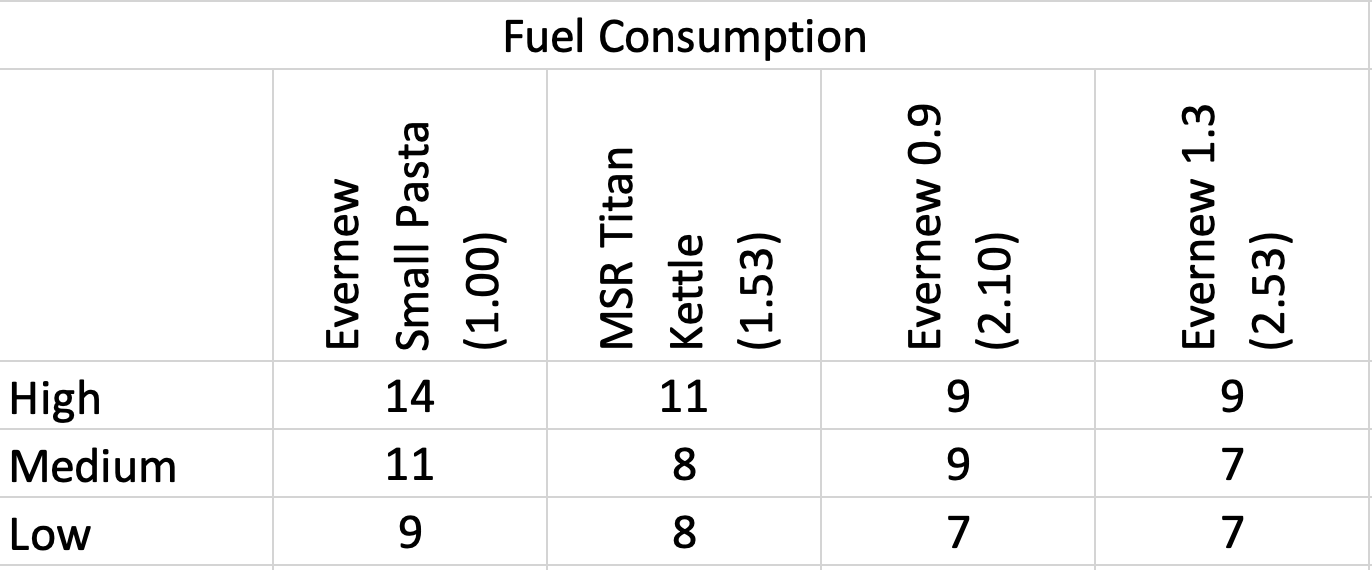
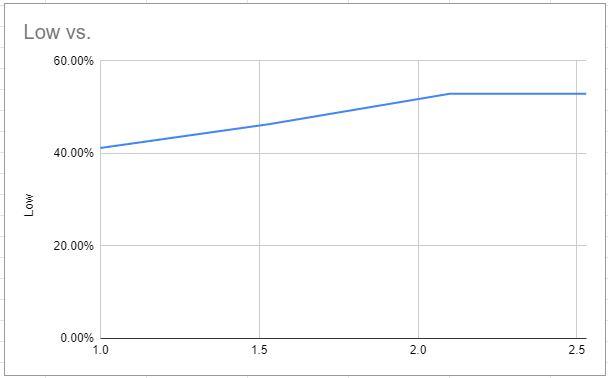
I would humbly disagree as Joules/gram assumes linearity
What metric would you propose? I’ve been giving it some good thought and here is how i’m interpreting the problem.
We want a solid metric to compare the efficiency of varying pot/stove combinations. Ideally, this metric would be decoupled from as many environmental influences as possible. Such as elevation, source water temp, volume of water boiled, etc. Both the (Joules absorbed)/(grams of fuel) metic and the (Joules absorbed)/(Joule emitted) metric do this, and because the Joule/gram metric is only a scalar of efficiency (joule-in/joules-out), but much easier for the average person to compute, I’d argue it’s a good start for a metric choice. But I think Jon brings up a great point (admittedly it took me 3 days to understand it, not the sharpest tool in the shed over here. lol), we have a pretty big issue with this metric.
The Issue:
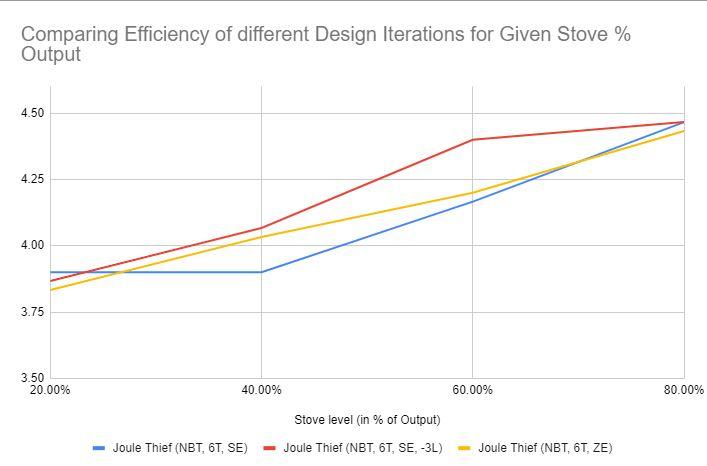
The non-linear response of a pot/stove systems efficiency in terms of stove output level is the problem with this metric (it’s also a problem with every other metric I know in wide use by the UL community). Because it may lead to misleading information. This is the case with the Joule Thief stats I stated earlier; here is my non-linear response between 3 different prototypes of the Joule Thief. We can see that all three have about the same efficiency at 20% stove output. (Here is the link to the spread sheet for data collection transparency) <- Note this sheet was made before I started using the Joules/gram metric

If we only measure stove/pot combo efficiency at 20% stove level output (which I did in my initial post here on the Joule Thief), then all these pots in this test would have nearly the same efficiency value, but by looking at the graph its clear one pot is definitely more efficient on average over the others. BUT its not consistently more efficient, thus non-linearity exist. If the efficiency difference was linear between the three, we could ignore the stove output differences because they would all be scalars (multiples) of what ever efficiency value was measured initially. This is the issue.
The metric is dependent of the stove output level you measure it at being the same across all test, and offers little to no insight to the performance of the system at a different stove level than an individual tested. Thus different people across the world may experience or measure different values of efficiency using this metric, thus the metric isn’t well suited for accurate stove/pot efficiency comparisons between different test ran by different individuals who probably have different preferences on a stove output level.
<b>Varying Pot Diameter:</b>
The issue of varying pot diameters is null IMO; I think we can ignore the non linear behavior of efficiency given a set stove and vary pot diameters because such an observation is the point of having a nice efficiency metric. We don’t want a metric that squashes this effect because we want to be able to find varying efficiencies between different stove/pot combinations to find the most efficient solution for the weight. So I argue whatever metric we come up with can ignore the issue of non-linear response to pot diameter. Even though is is fascinating! (please correct me if i’m wrong)
Call to arms for a Better Metric:
Now the question is, how do we come up with a metric that isn’t affected as much by the non-linear response of efficiency in terms of stove output level for a given pot/stove combo?
It sounds like both you (Jon Fong) and Roger are more well versed in statistics and interpreting data than I. Are there any statistical tools you two can think of that can be used to express some metric of efficiency that is less affected by, or completely decoupled from, the non-linearity of the stove output level problem?
Half Assed, on the Spot, Solution Proposal:
Off the top of my head, I was thinking of taking the average of Joule/gram across jon’s three “low” “Medium” and “High” stove output levels he does in his test. This isn’t ideal because “Low, Medium, and High” are open to stove user interpretations, HOWEVER, it would be better that just some random Joule/gram value on that curve. <- which is what I initially did for the Joule Thief efficiency measurement and the issue Jon is calling attention to.
Perhaps we could give “Low, Medium, and High” definitive definitions. Some kind of flow rate most stoves can achieve. Something like (2.5 grams)/min for “high”, (1.5 grams)/min for “Medium”, and (.5 grams)/min for “low”.
<b>Conclusions</b>?:
Bad idea? Good idea? Possibly on the right track? let me know! Very curiose over here! If a nice metric is possible to be formulate for all to use when comparing stove/pot combinations, i’m positive it can come from the likes of this community!
Best wishes and kindest regards,
Tyler/TRex
Edit #1: I see I was using Tags wrong, corrected to tag the right people.
Edit #2: I have removed the tags, I sadly can’t figure them out. lol, apologies if you were incorrectly summed to the post by me.