I posted this in Jetboil Stash thread and realized I was probably steering it off topic with my post so here it is in its own thread for y’all to ask questions, love, hate, give feedback/suggestions, share ideas, etc.
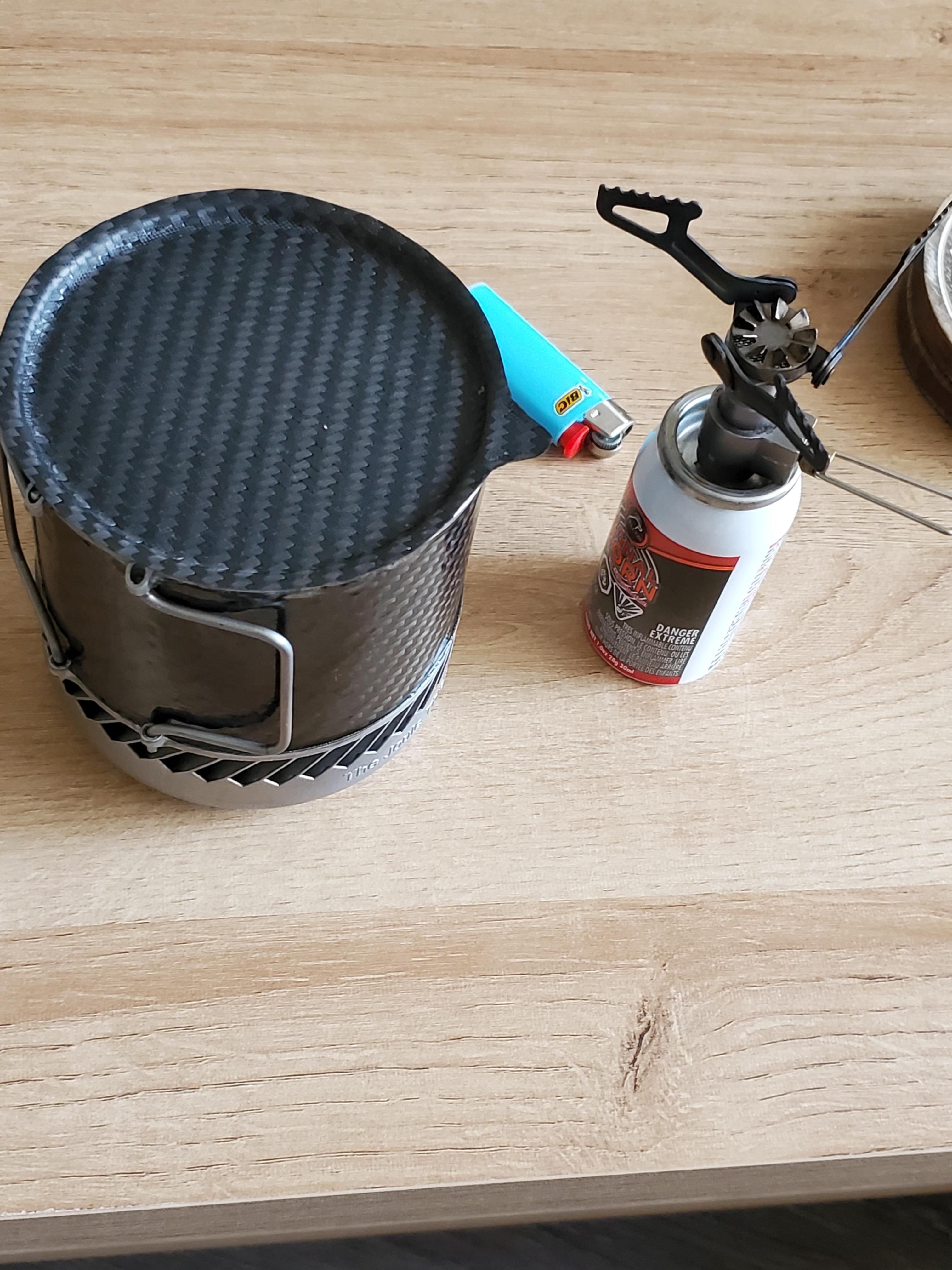
The Joule Thief:
A heat exchanger pot that weighs 2.9 Oz (with lid) and is 17% more efficient than a Jetboil Stash System (indoor test) when paired with a BRS 3000t.




 Inception:
I’ve been lurking on this forum for some years now, but out of all the threads I’m always finding my way back to Roger Caffin’s article and Colin Kruser’s thread on Heat Exchanger Pots. The complexity of the problem and the theoretical ways to attack it have always intrigued me. This past summer after an extended JMT hike, I finally decided this could be a fun project if it means I got a working pot out of it.
The goal going into the project was to create a HX pot that answers the question Roger posed in his article “Is a heat exchanger pot worth the weight?” with a yes. Because IMO, most HX pots are only worth the extra weight in hyper specific circumstances.
Efficiency of The Joule Thief:
So efficiency is tricky, and I’m no expert on the subject, but I choose to measure it in terms of Joules absorbed by the pot per gram of fuel burned. I choose this metric because of the following reasons.
- its not dependent on maintaining a constant water start temperature across all test
- its not dependent on maintaining the same elevation across all test
- its not dependent on maintaining the same volume of water across all test
- and it doesn’t require you to go all the way to a boil
Thus, I think it is a finer method for strangers to compare cook systems across the internet vs the traditional grams of fuel burned to reach a boil method most of us have been using for years now.
I made a video on how to use this method here.. Its not without its flaws but I do think its an improvement over the common alternative methods. PLEASE let me know if I have made a mistake in calculations or an error in fundamental understanding. As I said, i’m no pro.
But to the point, the Joule Thief absorbs 33,514 Joules per gram of fuel burned when paired with a BRS 300T stove. That is a 17% increase of efficiency over a similar system, the Jetboil Stash at 33,752 Joules per gram of fuel.
Construction:
- The Joule Thief HX is 3D printed Aluminum made via the Selective Laser Sintering process (so no binding agents are used).
- The carbon fiber wall is infused with a high temperature epoxy and cured around a mandrill
- The CF wall is than coated with a top coat and epoxied to the Aluminum HX and Aluminum lip ring using an epoxy that is Title 21 FDA CFR 175.105 complaint for food coatings and also happens to be great at joining to materials with dissimilar coefficient of thermal expansions(its proven wonderful so far!). I also fill this epoxy with microglass spheroids to create an electrically insulative layer between the CF and the aluminum to protect against galvanic corrosion.
- The inside walls of the pot are then coated with an additively cured silicone coating that is FDA compliant for direct food contact. I put the pot on a homemade centrifuge and dispense a premeasured volume of silicone to achieve a .2mm coating. The pot is left on the centrifuge for the silicone to cure under the centrifugal force. This coating leaves no epoxy exposed on the inside of the pot.
- I then bend Titanium handles out of 2.4mm titanium welding rod using a cheap amazon wire bender. Next these handles simply popped into the handle holes, then a Joule Thief is born!
Longevity:
I just finished up thermal cycle testing with two of the pots. 1 cycle consisted of performing a boil, shaking the pot vertical with hot water in it 20 times (trying to simulate handle loads on the joints while epoxy joints were hot), than dumping the water and cooling in a freezer to below freezing. the point of thermal cycle testing was because I wanted to see if there would be any signs of delamination between the carbon fiber and the aluminum HX, or between the carbon fiber and the silicone coating. One pot endured 280 thermal cycles before someone convinced me to sell it to him. My own personal pot just finished up my goal of 450 thermal cycles. I chose 450 because I wanted to see if it could survive the quantity needed for an average PCT thru hike, assuming 150 trail days and 3 boils a day. Both pots made it to those number with no signs of delamination, so i’m really stoked about that!
Here is a video I made of the pot. A few things said in there don’t apply anymore, but the general gist is there.
So, is it worth the extra weight?:
To answer this question, I made a fuel consumption calculator that is based on the Joules per gram metric of pot/stove combo efficiency mentioned above. Then I compared it to a sister system without an HX. But in short, I personally think it is worth the weight!
Joule Thief with BRS 300T vs Toaks 550ml with BRS 300T.
This graph shows system weight on day one vs the trip duration. Blue line is Joule Thief, red line is the Toaks 550ml. The conditions for this calculation are 9,000 ft elevation, 51 degree F source water temperature, and 950 ml of water boiled per day.
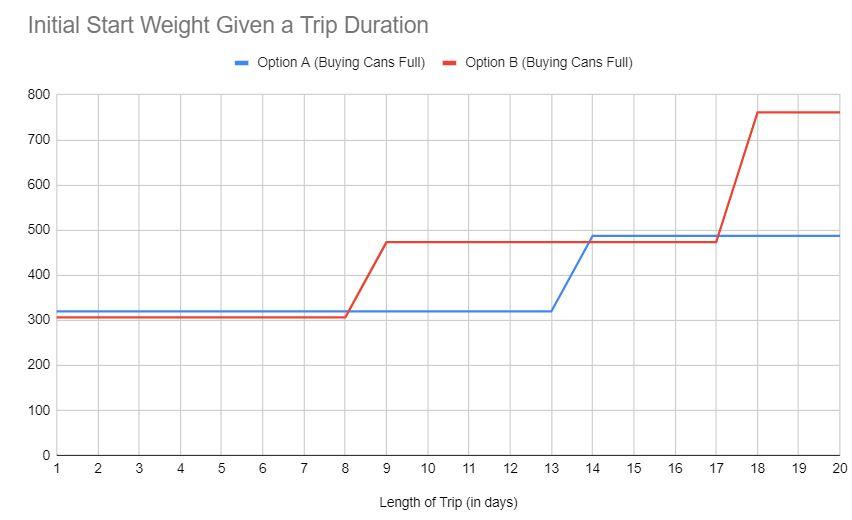
As you can see, it’s your typical step function you encounter with HX pots. They often can only save you weight in the scenarios where it saves you from having to bring the larger fuel can. With the Joule Thief though, these margins in trip duration cenarios are much wider. And the weights are so close, that the added 14 grams even on trips where its efficiency isn’t saving you from a larger can, may be worth the benefit of faster boils(near ondemand coffee folks!).
What about Custom Filling your own cans?:
This is where the Joule Thief really shines. If you have gotten into the practice of filling your own cans, than the Joule Thief is actually the lighter option over the Toaks 550 in all trip durations due to its efficiency.
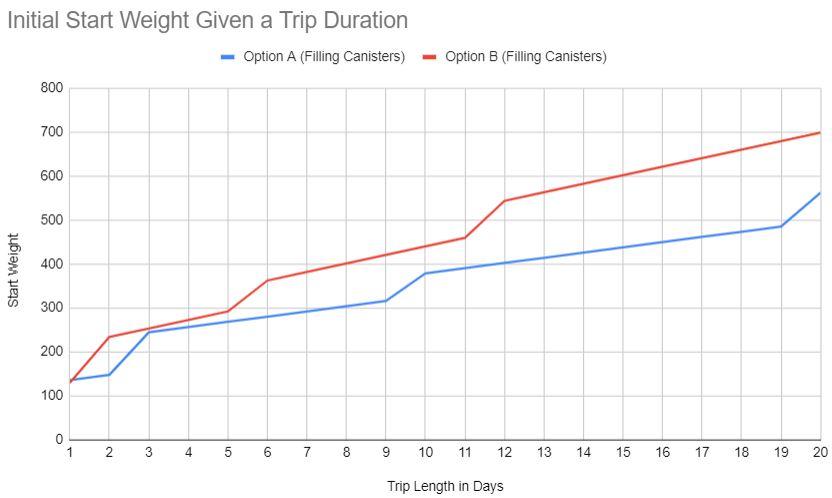
Of course it’s not always this simple, sometimes you have to factor in weight carried per day as well. A more efficient pot/stove combo burns less fuel, which ends up being more weight your carrying in fuel if your not custom filling your cans. Here are two graphs to show this. Both generated using the same environmental conditions mentioned above. They graph system weight per day of the Joule Thief vs the Toaks 550ml (JF in Blue, Toaks in Red).

For these graph, I purposely chose a trip duration of 5 days because it shows something interesting in both cases. If your buying fuel cans full, the efficiency of the Joule Thief ends up causing you to carry more weight per day over those 5 days because its not burning as much fuel. And so although the start weights of the two systems are similar, they diverge greater each day.
And if your custom filling your cans, we can see the Joule Thief is the lighter complete system on day one, but eventually becomes heavier as it sips its fuel each day and the toaks overtakes it (or undertakes it i guess) and both systems reach a constant weight on day 5 when they run out of fuel.
A Note on the Graphs/Calculator:
If you like those graphs, and want to compare your own stove system against others you own using these, I made the calculator spreadsheet that produced those graphs available to mess with. I actually go over it and how to use it in the video link I left above when talking about the Joules per gram metric of efficiency. You can find a link to that calculator spreadsheet in the video description.
Health Concerns:
This pot uses carbon fiber, there are health concerns posed by this both because of toxicity of different types of epoxies, and the chance of tiny CF fibers abrading off the material and into your food if the top coat is ever abraded away down to the CF core.
I chose combat both health concerns by coating the carbon fiber and epoxy joints in direct food contact FDA compliant silicone. A widely industry accepted food safe material. As an extra precaution, the epoxy used as the top coat of the CF and joiner to the Aluminum parts is Title 21 FDA CFR 175.105 complaint for food coatings. I decided to use this just in case a part of the silicone coating were to ever delaminate during a trip and I couldn’t recoat it in the field. So far the silicone coating on my pot has been holding up way better than I expected, and I havent had the need to recoat it yet, but I went the extra mile to source the epoxy out of an abundance of caution.
As an extra remptive precaution, I have switched to using a bamboo spoon versus a titanium spoon. The idea here is that it will cause less abrading the on the silicone over time. Giving me longer service life between recoatings.
Another thing I need to look into is getting the HX hard anodized, as untreated aluminum isn’t bad for you per say… but it’s also not recognized by experts as being anywhere near the best either.
If you made it this far, wow you read a lot! thanks for your time and I look forward to all aspect of what will be discussed here!