Topic

Synthetic top layer for a winter mummy bag?


Forum Posting

A Membership is required to post in the forums. Login or become a member to post in the member forums!

Home Forums General Forums Winter Hiking Synthetic top layer for a winter mummy bag?

Viewing 25 posts - 51 through 75 (of 78 total)
  • Author
    Posts
  • #3843579
    Eric Blumensaadt
    BPL Member

    @danepacker

    Locale: Mojave Desert

    YIKES! When I first posted this topic I never realized it would generate so much discussion, especially technical discussion. But hey, knowing if a bag/quilt “condensation cover” needs to have a certain R value to be effective is important. I’m not sure my cover will work as hoped. We’ll just have to see this winter. If not then an added layer of Alpha Direct 60 will be called for. I have enough to do that.

    #3843584
    Bill Budney
    BPL Member

    @billb

    Locale: Central NYS
    • On one hand, calculations of moving the dew point make sense, intuitively. Requires a thick outer layer.
    • On the other hand, people who DO IT (Nunatak, Timmermade, Monte, GW Hayduke) report that Alpha Direct or (relatively thin) Apex is sufficient.
    • How?

    Another article from Building Science appears to suggest that the outer layer provides a “seed” for condensation to form, similar to the way that a grain of dust can seed a rain drop in a cloud.

    If I understand correctly, moving the dew point isn’t the, um, “point”. It’s more about giving the condensation a seed to place it where we want it.

    Does that make sense? I don’t know one way or the other, but it does square with the real-world field reports.

    #3843595
    Eric Blumensaadt
    BPL Member

    @danepacker

    Locale: Mojave Desert

    I’m a-hopin’ yer keereect ponder. Because I discovered tonight that indeed I already have a lightly insulated synthetic bag “topper” in a Thermarest mattress insulated cover that snaps to a mattress sheet. But it’s heavier and much bulkier than my planned Alpha Direct 60  W/ very light polyester cover. Really, almost any synthetic insulation is heavier than Alpha Direct!

    For shoulder season camping I could also use my Alpha Direct cover on my overstuffed Western Mountaineering Megalite  down mummy and extend its range a bit below its rated 20 F.  Still I’d add my down pants along with my light down jacket to my pack “just in case” because I’ve suffered through a night of “just in case” in August, at 8,000 feet on the PCT at 16 F. in my WM 30 F. bag before it was overstuffed. And THAT is precisely why I had it overstuffed.

    #3843643
    Tom M
    BPL Member

    @twofeathers

    Locale: Kalispell

    https://backpackinglight.com/forums/topic/dcf-waterproof-breathable-over-quilt/

    Ive been using this for a few years now. works like a charm.

    #3843647
    Bill Budney
    BPL Member

    @billb

    Locale: Central NYS

    That’s a cool piece of gear, Tom (bivy+overquilt combination). I hope we will be able to buy fabric like that eVent/DCF hybrid again, someday.

    A couple of other comments in the thread that I linked above suggest a silk liner as an “overbag”, a thought that nylon might work just as well, and the explanation that the outer layer cools to the dew point first, so that’s where the condensation forms.

    That last part makes a lot of sense to me. It suggests that the insulation is not the important part, other than it gives the moisture somewhere to collect so that it doesn’t spread into your down quilt or sleeping bag.

    It makes me wonder whether a blanket made of Swedish dish cloths might work as well as an overquilt?

    #3845050
    Eric Blumensaadt
    BPL Member

    @danepacker

    Locale: Mojave Desert

    Well I’m finally able to work on my “topper” for winter camping. As mentioned I’ve got the Alpha Direct 60 weight and a very light polyester top sheet where I hope the frost will collect.

    During September and October I was doing 8 rounds of chemo for a tumor in my left kidney. Then on November 13 I had my left kidney removed at Cedars Sinai in LA. Yeah, I’m from Las Vegas but got surgery in LA. As the saying here goes, “Where do you go in ‘Vegas when you’re really sick ? The airport.”

    The latest lab reports show no cancer in the surrounding lymph nodes or surgical margins. My Cedars oncologist said there could be no better outcome possible so I guess that makes me a cancer survivor. Now I’m getting well enough to begin to work on some “science projects” like the winter frost catcher topper.

    Laying the fabrics out on my fat -20 F.winter mummy bag, marking and cutting it then basting it together so my tailor can sew it will take a week or so. Every day I also have to make time for getting back in shape to ski. Winter camping this year will be car camping in a campground that happens to be open just below my ski resort. Time test my new Thermaest X-therm NXT winter mattress.  I’ll snowshoe around that area for entertainment and conditioning. Hopefully I’ll be able to resort ski by late January on “groomers”. Life is good once again, thanks to excellent care from great doctors and my beautiful wife.

    #3845106
    Terran
    BPL Member

    @terran

    Cedar Sinai?

    Did you get the penthouse suite?


    #3845532
    Eric Blumensaadt
    BPL Member

    @danepacker

    Locale: Mojave Desert

    Actually I got the 6th floor with a lousy view of other buildings.

    I’ve decided t wrap the Alpha Direct 60 bag cover 360 degrees around theft end for about 18 inches to hold it on better. Then I’ll use two clip on elastic straps to hold the rest on the mummy.

    #3845556
    Terran
    BPL Member

    @terran

    The view was lousy, but the room was nice, especially for a hospital. CS is top notch.

    I put a JRB alpha quilt liner inside a MLD 7D liner. Making a midnight call, I have to be careful to not pull the alpha liner out. They’re both dark colors and a little tricky to sort out at that time of night. The alpha does fit over my quilt and that combination will fit inside the MLD liner, which is the best arrangement. It doesn’t really compress the down. Rather the quilt will fold up and tuck  in around me. I haven’t frost tested it. Right now we’re having summer for winter.

    #3845581
    Ken Larson
    BPL Member

    @kenlarson

    Locale: Western Michigan

    When does a person use a Vapor Barrier Liner inside rather that a Topper Bag, and what are the pro and cons of each?

    #3845582
    Jerry Adams
    BPL Member

    @retiredjerry

    Locale: Oregon and Washington

    according to the warmlite guy, you should use a VBL liner for arctic expeditions – multiple days at very cold temps

    #3845584
    Ryan Jordan
    Admin

    @ryan

    Locale: Central Rockies

    Ken: Use a VBL when the main problem is your body moisture freezing inside the insulation over multiple nights (deep cold subzero °F temps, limited drying opportunity, down bag). Use a topper bag (synthetic overbag/overquilt outside) when the main problem is external condensation/frost buildup on the outer shell of your bag (moderate temps between 0 °F and freezing).

    #3845591
    Jerry Adams
    BPL Member

    @retiredjerry

    Locale: Oregon and Washington

    Or, use a topper if the place that reaches freezing is inside your sleeping bag.  According to the website of some climbing organization in the northeast, I forget which.

    For example, there is an air layer around you that’s about 0.7 R.  Maybe a sleeping bag is 5 R.  Maybe your skin temperature is 90 F, the air temperature is 20 F.  Temperature difference is 70 F.  Total R value is 5.7 R.  The temperature of the sleeping bag surface is 70 F * 0.7 / 5.7 = 8.6 F warmer than air temperature = 28.6 F.  So the place inside the sleeping is just inside the sleeping bag.  Any water vapor that goes out through the sleeping bag will hit that point and then freeze.  Since it’s only slightly inside the sleeping bag, this wouldn’t be too bad?

    If the air temp was 0 F, the outside surface of the sleeping bag would be 11 F, so the point inside the sleeping bag where it reaches freezing is well inside the sleeping bag – that’s where there’s a problem.

    If you put a topper over the sleeping bag, then hopefully, the place where it gets to freezing is in the topper, outside the sleeping bag, so no ice accumulates in the sleeping bag.

    This is all for when the air temperature gets below 20F or so, and when you’re out for many days during which time ice will accumulate.

    #3845648
    Jerry Adams
    BPL Member

    @retiredjerry

    Locale: Oregon and Washington

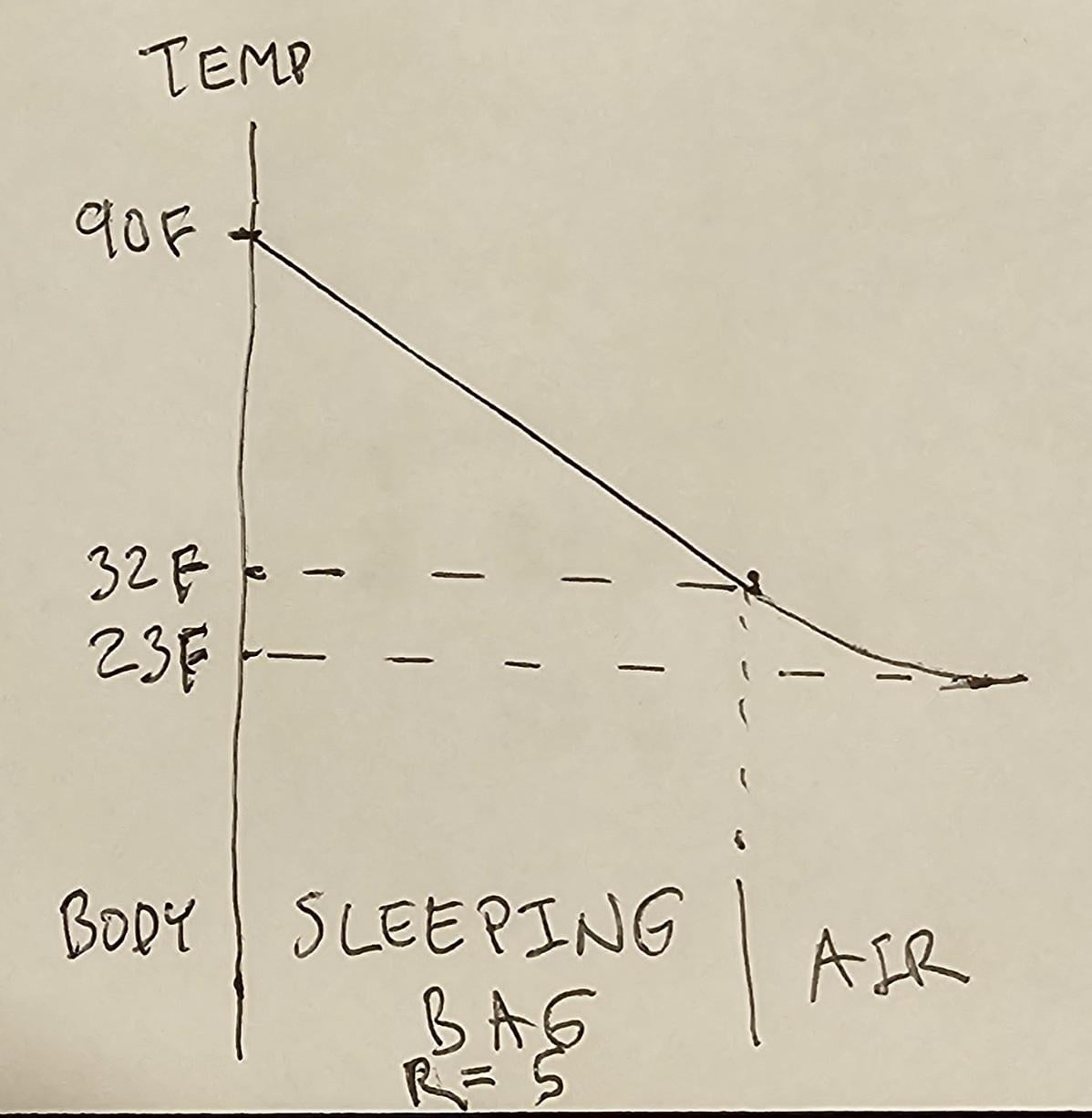
    A picture is worth a thousand words?

    The temperature at my body is 90 F.

    It linearly goes down, through the insulation, then goes down a little more in the air because of the insulation value of the air layer next to the sleeping bag.

    In this case, the outside air temperature is 23 F.  The outside edge of the sleeping bag is 32 F.  Any water vapor going out from the body, through the sleeping bag, will freeze at this point.  Since this is outside the sleeping bag, it’s not a problem, just frost on the outside.

    Here’s the problem.

    When the outside air temperature is 0 F, then the outside of the sleeping bag is about 11 F, so the point inside the sleeping bag where it goes down to 32 F is somewhere in the middle.

    Any water vapor leaving the body and going through the sleeping bag will freeze at this point.  If you do this for many days, the sleeping bag will accumulate a lot of ice.  According to Jack Stephenson, the warmlite founder, on arctic expeditions, this becomes a significant problem – the sleeping bag will get very heavy, stiff so you can’t stuff it into a bag, will lose a lot of insulation value.

    If you put a topper on it you can move the point where it’s freezing out of the sleeping bag.

    If the topper is R = 1, then you can go down to an air temp of 13 F before the freezing point goes inside the sleeping bag.

    So, the topper allows you to go down about 10 degrees lower before frost starts accumulating in the sleeping bag.  If it’s colder than that, then the point where it reaches freezing is inside the sleeping bag so you’ll have the same problem – ice accumulating in the sleeping bag.

    I’m not sure what you do on an arctic trip if your topper accumulates frost.

    The Jack Stephenson solution is a vapor barrier against the skin.  Then, no water vapor is going through the sleeping bag so you won’t have a problem with frost accumulating in the sleeping bag.  No matter how cold the temp gets.

    I think Jack has actual practical experience in arctic expeditions which is better than any theoretical arguments.

    My calculations are close to correct, and the drawings are close to scale.  If I wasn’t so lazy I’d use the computer to make better calculations and drawings.

    #3845691
    Tom M
    BPL Member

    @twofeathers

    Locale: Kalispell

    Jerry thanks for the detailed information and me personally I prefer the hand written graph. Recently I discovered a material “Aluminized Dyneema”. There is a company called Gryphongear using it in there sleeping bags for “vapor-radiation barrier technology”. Has anyone tried his bags before? https://www.gryphongear.com/pages/taurus-vrb%e2%84%a2-sleeping-bag-information

    #3845693
    Terran
    BPL Member

    @terran

    Here’s an old thread about reflective coatings in jackets.

    BPL


    Aluminized Dyneema


    #3845694
    David D
    BPL Member

    @ddf

    Reflective liners and vapour liners will add warmth for less weight but the trade-off is sweat accumulation and claminess. That’s what I find with my Columbia hiking vest that uses an “omni heat” liner that’s similar, and my shoulder season bag that uses a nearly unbreathable 40d inner liner.

    For me these leave me wet so I don’t use them.  But others sleep in their rain gear and if that works for you, I think this might work ok.  It’s personal so if you get first hand advice, it’s worth knowing if the user is a sweater or not

    #3845708
    Jerry Adams
    BPL Member

    @retiredjerry

    Locale: Oregon and Washington

    On those crude drawings, the critical temperature is not 32F, but the dew point temperature.  Where the diffusing water vapor will condense.  If that’s below 32F it will freeze. But the idea is the same, to push the dew point temperature out of the down.

    #3845709
    Jerry Adams
    BPL Member

    @retiredjerry

    Locale: Oregon and Washington

    In order for a radiant barrier to work, there has to be an air space.  For maximum effect it should be 1 inch or so.

    If the radiant barrier is the inside of the sleeping bag, and that is touching you, there’s no air space so it won’t do much.

    I got some fabric that looked like it was aluminized, but when I measured it, it was the same as non reflective fabric.  It’s difficult to tell just looking at it – our eyes don’t see IR wavelengths.

    #3845721
    Jerry Adams
    BPL Member

    @retiredjerry

    Locale: Oregon and Washington

    I keep thinking about those three diagrams which I recreated from memory from a website I can’t find now

    That diagram would be good if the air inside the down sleeping bag was stationary.  But the down fibers are very small and there are air currents inside.  The fabric inside and outside the down does stop air flow much better.

    So, a better model would be like water boiling in a pot.  The water gets heated at the bottom.  A blob of water then rises up to the surface where the heat is released.  Then the cooled water sinks to the bottom and the cycle repeats.  The flow of water is very chaotic.

    So, air inside the sleeping bag is warmed on the bottom surface from heat from your body.  A blob of air rises through the down to the top, where it is cooled on the top surface, then sinks back to the bottom and repeats.

    If the top surface is below the dew point, then water will condense on it.  If it’s below freezing it will freeze.

    That’s like a window in your house.  A single pane window will have a very cold inside surface temperature and a lot of condensation – it’s below the dew point.  A double pane window has an air space in between which adds insulation so the surface facing the inside of the house will be warmer.   If it’s above the dew point there won’t be any condensation.

    My old house had single pane windows and a lot of condensation.  My new house has double pane windows and no condensation.

    So, putting a topper on a sleeping bag is like a double pane window – making warmer the inside surface of the top layer of fabric.

    So, a topper acts like a double paned window, hopefully raising the temperature inside the sleeping bag above the dewpoint.

    Has anyone every noticed their sleeping bag getting wet in cold weather?  I never go more than a week with a low temp of 20 F and my sleeping bag weighs the same at the end of a trip, so I have not.  Jack Stephenson reports this but it’s in very cold weather for many days.  And he has a verified solution, vapor barrier liner.  But maybe this isn’t needed for more realistic conditions.

    #3845780
    Eric Blumensaadt
    BPL Member

    @danepacker

    Locale: Mojave Desert

    Jerry, Thanks for the graphs and info. I kinda-sorta thought that very low temps would defeat the topper. But I won’t be on any long winter campouts so I’ll stick with the topper because I cannot wrap my head around a VBL for my bag. That’s B/C I can’t see me getting out of the mummy in a cold tent, all WET with sweat, or drying out a wet mummy  VBL. YEECH!

    My bag has Down Tech DWR treatment for the down so I’m counting on it to keep the bag’s loft and warmth a lot better than down in an untreated bag.

    #3845817
    Ryan Jordan
    Admin

    @ryan

    Locale: Central Rockies

    That’s B/C I can’t see me getting out of the mummy in a cold tent, all WET with sweat

    In the right conditions for vapor barriers – typically subzero °F temperatures with a sleeping bag warm enough to keep you comfortable without relying on the VB – this doesn’t really happen. Base layers, when chosen correctly (thin, non-absorbent, minimal – such as Brynje or Finetrack mesh), do not meaningfully wet out. Yes, the microclimate inside the VB becomes humid and can feel slightly damp, but liquid moisture accumulation is minimal. If you are getting wet or uncomfortably clammy, conditions are probably too warm for a VB liner.

    At very cold temperatures, a well-insulated sleeping system allows the body to remain warm at near-basal metabolic rates, so moisture production is limited to low-volume insensible perspiration. In warmer conditions, excess insulation combined with a vapor barrier forces the body to shed heat through sweating, which produces liquid moisture and discomfort.

    This begs the question: why bring excess insulation at warmer temperatures and then just rely on a VB to protect it?

    Because without a margin of excess insulation, you risk being cold. A vapor barrier does not solve that problem – it provides essentially no insulation. Its function is moisture control, not warmth.

    This is why ambient temperature is such a critical driver in the decision matrix. At subzero temperatures, once insulation is sufficient to prevent heat loss, additional insulation generally does not force the body to actively shed heat. The system is heat-loss-limited by the environment, not comfort-limited by surplus insulation, and it is difficult to create conditions that demand sweating during sleep.

    At around 20 °F, however, the difference between a thin bag and a thick bag has a large impact on comfort. It is easy to over-insulate, which means the body must actively shed heat to maintain thermal balance. Inside a vapor barrier, that excess heat can only be shed through liquid sweating. Any condition that produces liquid sweat inside a VB system indicates a mismatch: the insulation, not the ambient temperature, is governing the rate of heat loss.

    #3845826
    Jerry Adams
    BPL Member

    @retiredjerry

    Locale: Oregon and Washington

    Jack Stephenson’s argument is that if you have a VBL, then insensible sweating will stop, because the humidity at your skin under the VBL is 100%.  Otherwise, the insensible sweat water vapor will flow out through your sleeping bag and freeze if the conditions are wrong.  People insensibly sweat even if they’re not over heated.

    I think this is just a niche case – arctic expeditions for example.  I’ve tried VBL a little and I was comfortable enough sleeping.  But I’m never in those extreme conditions so my sleeping bag never has ice accumulating in it so a VBL doesn’t do much.  It provides a little insulation but its heavier than other insulations.

    If I was doing an arctic expedition I’d take Jack Stephenson’s advice and have a VBL.  Except I’d have a VBL shirt and pants so I could wear all my day insulation inside sleeping bag.

    If you have too much insulation and you overheat, then that’s different.  You need to remove excess insulation.  Unzip your sleeping bag for example.  You don’t want to sweat from over heating.

    I have a down vest that I have in reserve in case it gets colder than I expected.  Don’t put that on unless I get cold.

    #3845862
    Alan W
    BPL Member

    @at-reactor

    Jerry’s review of the thermal conduction (thermal diffusion) profile though our sleeping kit, from body temperature to surrounding ambient temperature is very well done.

    Also, it behooves to observe that the freezing point temperature of 32F (0C) is NOT an impenetrable steel wall forbidding additional removal of water vapor from our kit by mass diffusion — any more than 0C might be (is NOT) an impenetrable barrier for additional loss (diffusion) of thermal energy.

    WHAT????

    Reflect that the vapor pressure of water-solid-ice at its freezing point is MORE than zero.
    – Ice sublimes directly to water vapor, without melting first.
    – All of us who hung laundry on clothes lines in subfreezing weather before owning clothes driers well remember stiffly frozen towels and underwear drying during one sunny daytime.
    – And, the energy required for sublimation of solid directly to vapor is only about 10% more for evaporation of liquid at the same temperature

    In fact, the vapor pressure of water-solid-ice at its freezing point is EXACTLY the same as water-liquid at this freezing point.

    This means that water-ice frozen at 0C has exactly the same driving force for mass diffusion outwards into surrounding ambient air as does water-liquid condensed at 0C just before it froze to ice, because the driving force for said mass diffusion is vapor pressure difference.

    Let’s look at vapor pressure values for water, which are the upper limits for diffusive vapor permeation driving force at a given temperature.
    98F 0.066 atm
    80F 0.031 atm
    50F 0.012 atm, about 5x reduced from our skin temperature.
    32F 0.006 atm, SAME for ice or liquid, and 10x reduced from skin temperature.
    14F 0.003 atm, ice of course, and a further reduction of 2x compared to when ice first forms.

    Reflect that warm humid air at 80F and 80% Relative Humidity (RH) can accept twice as much more additional water vapor partial pressure: (1-0.8)* 0.031 = .006 atm; than can cold, totally dry air at 14F and 0% RH: (1-0)*0.003 = 0.003atm.

    The loss of loft problem is truly rooted in the declining vapor pressure of water, declining exponentially with local and eventually surface temperature.

    The accumulation of water in our sleeping kit during prolonged “icy cold” temperatures can be usefully understood as an extension of the same problem encountered with “breathable” rain gear when ambient temperature cools.

    When actively exerting (hiking hard) our body produces a lot of perspiration to provide cooling. As ambient temperature cools and/or ambient RH increases, this amount of perspiration can overwhelm the transport capacity of any breathable membrane.

    Accordingly, we must change something: increase the amount of vapor venting (zips, etc.), remove clothing layers to improve body cooling without as much perspiration, and/or reduce our hiking intensity to avoid soaking ourselves with condensed sweat that cannot diffuse (permeate) sufficiently rapidly through an outer, chilled membrane fabric into a cooler and/or more nearly saturated outer ambient.

    Fortunately, when resting in our sleeping kit, our body produces a VERY much-reduced amount of at-rest insensible perspiration. This enables us to delay vapor condensation and liquid freezing inside our sleeping insulation to temperatures usefully colder than for condensation woes with rain jackets.

    Generally speaking, and as observed by diverse experiences rather than calculations, the vapor pressures of cooler water-liquid and of frozen water-ice are typically sufficient to support diffusive removal of our at-rest insensible perspiration through the relatively large outer surface area of our sleeping kit for ambient temperatures down into and below the teens F.

    Of course, this balancing also depends on how wet our clothes are inside the sleeping kit (how much water vapor is being produced near our warm skin surface), the temperature of the surrounding ambient air, and the “dryness” of the surrounding ambient humidity (which sets a limit of the driving force based on water vapor pressure in the outside air).

    In fact, our down sleeping insulation can begin to wet with condensed vapor even when temperatures are a little above freezing if, for extended times, we keep adding wet clothes or are camped inside a fog-cloud or inside a tent that is condensing.

    Or, if the surrounding ambient air is low-humidity, crystal-clear air, we can defer condensation and subsequent icing down to single digit F range, variously depending on details.

    TLDR, the root cause for moisture balance problems becoming more difficult at increasingly cooler temperatures is the exponential decline for the vapor pressure of water with temperature declining and not simply the initial formation of ice crystals per se.

    Staying dry when cool or cold is a balancing continuum: Exertion level. Ambient temperature. Ambient humidity. Accumulated liquid on skin, on clothing surface, and absorbed inside fibers, down plumes, etc. Venting. Duration of the events. All are factors for the moisture condition of our clothing and other insulating layers.

    When sufficiently cold that diffusive permeation of our bodily-produced water vapor cannot avoid condensation and freezing, then a VBL usefully keeps water from our bodies from entering insulation. Turning the VBL inside out the next morning, the water can freeze and then be shaken away as ice crystals.

    =================

    Returning to the original post:
    Yes, a synthetic over-quilt can extend the useful comfort temperature range without having to purchase a new primary insulation.

    Yes, an over-quilt can be easier to dry in cold conditions, even when iced, since it is thinner than a sufficient single layer of insulation and because it can be more conveniently laid open on both sides. (Permeation drying time varies about with total thickness-squared (1-sided) plus 2-sided provides about another factor of 4.)

    Yes, an over-quilt can accumulate less condensed and frozen moisture in the same bodily and ambient conditions owing to the gaps and convective air flows at the warmer interface between the inner and outer. This is akin to opening pit zips on a rain jacket; but it is hard to control while asleep tossing and turning and, like pit zips, it comes with a convective heat loss, which is less desirable when at rest.

    There are no perfect rules for condensation and icing control because ambient conditions are so variable: temperatures, humidities, winds, durations; and because each event comprises a different human body starting with different accumulated moisture and having different sleeping patterns.

    The situations/ranges cited by others for when a VBL becomes useful and indeed necessary are valid experientially.

    #3845934
    Steve S
    BPL Member

    @steve_s-2

    One factor seems to be overlooked in the discussion — the molecular weights of gas molecules. H2O = 18, O2 =32, N2= 28; so, the insensible perspiration displaces other molecules and tends to rise, even getting a slight boost by being warmer than the other nearby molecules (because it continues to rise into the cooler air molecules while losing heat to them).

    I do not know the strength of the molecular weight effect, but when you add the impact of reevaporating water and ice also rising before redepositing, it seems to me the condensation point should be significantly further out in a sleeping bag than this discussion has so far indicated.

    Note also that in the lower air pressures at increasing altitudes the condensation point should move further from the body, other things equal, because the water vapor has fewer O2 and N2 molecules to displace and lose heat to while rising. But I suspect at lower pressures other things are not equal, because the sleeping bag insulation effectively gains efficiency when there are fewer air molecules to cool it. A partial vacuum bottle effect on heat transport.

    Last, consider that water vapor can supercool to well below freezing while awaiting a surface or something else to form crystals on. I do not know the extreme of supercooling that can take place in a sleeping bag’s insulation, but minor supercooling seems feasible. Because the water vapor would tend to rise, any supercooling would move the condensation point further out in the insulation.

    I am looking forward to reports from the field, specifically for reports of apparent success with relatively thin alpha direct at fairly low temperatures at 6000 feet and above.

    BTW, I have used VBLs and have never had a wet VBL in the morning to dry or let freeze.

Viewing 25 posts - 51 through 75 (of 78 total)
  • You must be logged in to reply to this topic.
Forum Posting

A Membership is required to post in the forums. Login or become a member to post in the member forums!

Loading...