Hi
I think my flirtation with floorless tarps may be coming to an end. Sharing my living space with bog, thistles, dung, slugs and other delights is beginning to get a bit old. So my next project is a single skin A-frame along the lines of the Tarptent ProTrail or the Yama Cirriform.
US-focused designs tend to go for a gap around the flysheet paired with a suspended floor and plenty of mesh in the walls for side-ventilation. Ventilation at the foot end tends to be limited.

Suspending the floor like this adds a good deal of complexity to the build and also complicates pitching.
I’m focusing on a design that will be storm-worthy for mountain camping in 3.5 season Scottish and Nordic conditions. This pretty much necessitates a fly that reaches down to the ground, which will reduce airflow through any mesh in the side walls.
Plus, the side mesh would be an issue with wind-driven dust or snow (though the Yama does have an ingenious closure system using a running cord to mitigate this).
So I’m tempted to dispense with the mesh walls and sew the groundsheet directly to the fly. With the low flysheet I’m not convinced that side-mesh will add much to the ventilation.
Instead, the idea is to have a well-sheltered vestibule at the head and foot ends that can be kept open in all but the worst weather to provide a vigorous through-draught. If the wind is strong enough to force me to close both ends, I’ll have plenty of draught anyway, plus I may fit a couple of vents as well.
My first thought was that sewing the groundsheet to the fly would be a recipe for a sweatbox. But then I remembered that the venerable Stephensons Warmlite tunnel tent does precisely this – it is a long-lived design with many diehard fans.
I also remembered an interesting little bivy tent from Turner Lightweight Tents which implements the idea of a sewn-in groundsheet paired with well-sheltered vestibules to promote airflow. I’ve been in touch with the designer and despite the small internal volume he says that the airflow has ensured that condensation isn’t a significant problem.
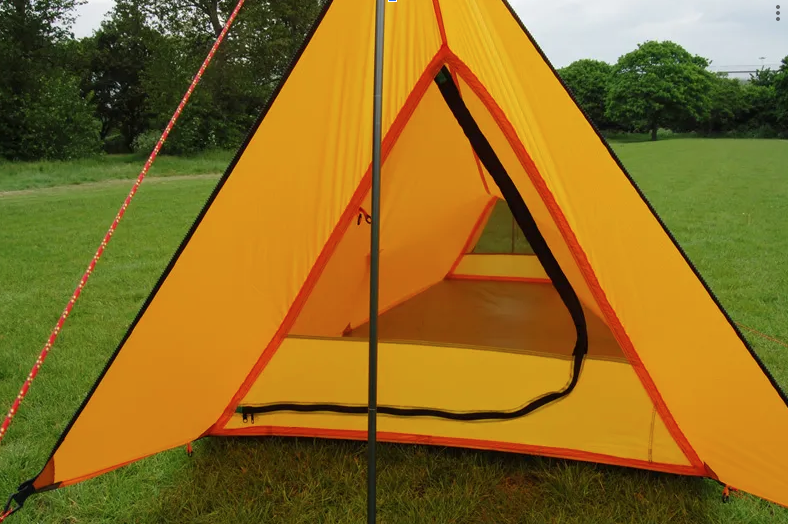
So I’m beginning to think that this isn’t such a daft idea after all. I get a simpler build and an easier pitch, while a proper rear vestibule (which can be adjusted from inside) should hopefully still give me enough airflow to keep condensation at bay.
Clearly, this won’t be a warm design. But I’m of the Chris Townshend school that the job of the tent is to keep off the weather, while keeping warm is the job of your clothing and sleep gear. My thinking is that if you go for a small and very lightweight shelter you simply have to accept that it will be a bit draughty if you want to keep the condensation at bay. I’ll implement adjustable solid panels in the front and rear doors so I can keep the draught above my bag if needed for comfort.
I’m a newbie at this game, so before I get too invested in the idea I’d very much appreciate input from all you more experienced tent-makers. Do you think this has a decent chance of working?