Topic

Smallest lightest pressure cooker?

Viewing 25 posts - 1 through 25 (of 28 total)
Edward John M BPL Member
PostedOct 4, 2018 at 6:48 am

I used to own a very small pressure cooker that made cooking beans and rice at altitude quite easy. That went to my Ex and in the last dozen years I have looked and found nothing small enough

Am I looking in the wrong places or are such items no longer made?

The one I had was made in England and held just on 3 litres

Edward John M BPL Member
PostedOct 4, 2018 at 6:51 am

Can’t edit first post.

Naturally I need one as light as possible and with small handles on either side, not a unit where the locking mechanism depends on a big long heavy handle

PostedOct 4, 2018 at 7:38 am

TIL: microwave pressure cookers are a thing!

2.5L, 12.8oz, plastic.  I imagine this would work in a double boiler configuration, so requires a second, slightly larger, metal pot.

Here is a 3.7L port that wighs 12oz, but may be just a touch too small in diameter.

I bet you could find a working pair under 2lbs.

Roger Caffin BPL Member
PostedOct 4, 2018 at 8:21 am

Hi Rene

The first pressure cooker is plastic. That is not going to work too well over a flame of any sort, even in another pot. The bottom surface of the outer pot would get very hot without adequate water circulation.

A double boiler is getting a bit too heavy imho.

Cheers

Edward John M BPL Member
PostedOct 4, 2018 at 9:47 am

Hawkins are good Dave but that long handle gets in the way and adds weight; size is right. Maybe I should just wait for the small Kieth pressure cooker in 2 years

Ben H. BPL Member
PostedOct 4, 2018 at 2:52 pm

The Hawkins cooker rang true to the first thought in my head: Have you looked at Indian grocery stores?  This sounds like a thing that would be popular in India and lightweight to decrease the cost.

PostedOct 4, 2018 at 8:21 pm

I was definitely *not* encouraging anyone to put plastic on open flame. I guess I should have lead with double boiler rather than lead up to it. I didn’t dig too hard, so the 24oz combo I suggested compared favorably to all the 2lb+ options I was seeing.

The OP didn’t provide any specific weight, volume or cost references.

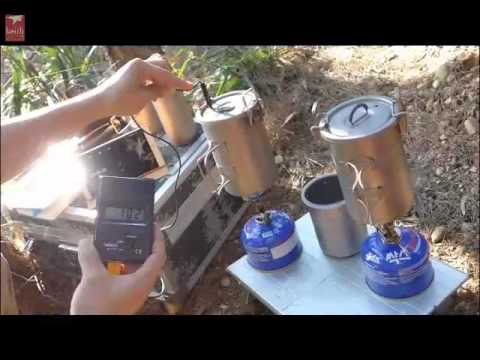
There’s a Keith available now on Amazon – 900ml, 9oz, $95.

David Thomas BPL Member
PostedOct 4, 2018 at 8:31 pm

I’ve used a plastic pressure cooker for 30 years now in the microwave.  Mostly for rice because it cuts the cooking time in half (11 minutes instead of 22 for white rice and 22 minutes instead of 45 minutes on a stovetop for brown rice).  And because the microwave oven has a timer on it, so after 11 minutes, it shuts off.  Unlike the stovetop which burns the rice if I walk away and forget about it.

It could also cook vegetables faster, too, but I’ve rarely used it that way.  Maybe if I had lots of squash or potatoes in my diet.

But it’s a heavy plastic.  It has to be to contain the pressure.

There’s a simply, lighter solution to this “problem”: bring Minute Rice and reconstitute it in a regular pot.

PostedOct 4, 2018 at 8:39 pm

The Keith Titanium Ti6300 Multifunctional Cooker is not a pressure cooker.  It is a pot with clamps a hole in the lid.  A lot of money (and weight)  for not much benefit.  My 2 cents

Does this come with some sort of pressure regulator as seen on youtube?

Answer: Keith Titanium Multifunctional Cooker has two versions, standard and upgraded. The only difference is that the upgraded version has the pressure regulator you mentioned. The upgraded version is for regions with altitude higher than 13,000 feet. The standard version has been tested on mountains higher than 13,000 feet. Even though the standard version is very popular now, we won’t produce the upgraded version until 2019 because we think the market demand for it is very low.

PostedOct 4, 2018 at 9:22 pm

Low pressure KEITH TI6300 900ML TITANIUM POT MULTIPURPOSE TITANIUM RICE COOKER

Jon, read my first post. Do a search and you’ll find it on the net.

The Keith is a “low” pressure cooker.

Roger Caffin BPL Member
PostedOct 4, 2018 at 9:53 pm

In many cases, all you need is a slight increase in pressure to raise the boiling point a bit, to get better/faster cooking. This becomes obvious at high altitude. In such cases it may (almost) be enough to put a rock on the lid (assuming no leak holes in the lid).

The down side of all this is the tendency of pasta and rice to ‘froth’ up when the pot has a lid on it. I don’t have a solution for the frothing.

Cheers

Edward John M BPL Member
PostedOct 4, 2018 at 10:11 pm

I’ve used the “Brick on the lid” a few times but it isn’t as effective as a properly designed dedicated pressure cooker, and a trick is to put the lid on tight after the rice has started to absorb the water, and turn the gas down as low as practicable; not really effective with pasta tho.

As a cooking vessel the Keith design is really too tall and skinny to use fuel as effectively as a more squat design.

PostedOct 4, 2018 at 10:12 pm

Additionally, (from Keith) straight from the horses mouth.

Will the cooker reach high pressure(does it act as a pressure cooker) without the pressure regulator or will it let the steam out like a normal pot?
Answer: The cooker still lets the steam out but reaches slightly higher pressure than a normal pot.

Followed by a user

There is a small hole in the lid. It will develop a little pressure, but not like a pressure cooker.
It may speed up cooking time by a small margin, but it’s really made to steam stuff like rice and veggies IMHO, and for that it does great. Plus without the insert, you still have a nice titanium pot for boiling water or cooking for 1 person.
GSI makes a small pressure cooker for camping that you may want to look into if it’s a pressure cooker you’re looking for.

PostedOct 4, 2018 at 10:19 pm

Reading between the lines , my guess is that Ed is not going to take a microwave oven with him so that he can use plastic pressure cookers.

But it is just my guess.

Roger Caffin BPL Member
PostedOct 4, 2018 at 11:11 pm

You can try to use a pressure cooker for various foods, but they are heavy. A really good alternative is the so-called ‘Dutch Oven’ technique.

Bring pot with food and water to the boil, simmer for 10 – 15 seconds, then turn stove off, wrap pot in cozy of some sort (I often start with my hat), and leave for 5 – 10 minutes. This works fine, carries almost zero weight (beyond a basic pot), uses no fuel, and cannot burn your dinner or spray it out in a jet of super-heated steam.

Simplicity.

Cheers

PostedOct 4, 2018 at 11:41 pm

A suitably sized screw should suffice to pressurize the Keith. File a notch down the shaft for some adjustment in vent size. Upgrade to a bolt, lock nuts and spring to roll your own pressure relief valve.

Venturing further in to MYOG, any pot with a rigid lid could have clamps, gasket and a vent added.


Roger Caffin BPL Member
PostedOct 4, 2018 at 11:43 pm

Yes, you could turn an ordinary pot into a pressure vessel.
You could also have it blow up in your face.

Cheers

PostedOct 5, 2018 at 12:43 am

You can use a modified screw thread to build up pressure.  Some people have done that to create pressurized alcohol stove and that technique has some risk associated with it.  A preferred embodiment is probably using a known weight to generate pressure.  A typical “low” pressure cooker setting is 6-8 psi.  Given a 3.5″ diameter mug, at 6 psi that’s 57 pounds on the lid.  My 2 cents.

PostedOct 5, 2018 at 12:57 am

A 1/4″ vent hole only needs a 4oz weight to reach that pressure.

A stamped sheet metal lid clamped at two points is likely to flex and vent before the pot ruptures. A tire valve could be temporary installed in the vent hole and attached to a pump with a gauge to test it in a controlled, low temperature manner.

But indeed, a diy pressure vessel requires an abundance of caution.

Roger Caffin BPL Member
PostedOct 5, 2018 at 1:40 am

Caution: vent holes are not fool-proof!

In my dim and distant past I remember my mother making ??pea soup?? in a pressure cooker. Something – possibly a tough pea, blocked the small hole which was the standard pressure valve outlet as found on most pressure cookers. Eventually the pressure got so high that the emergency over-pressure relief valve (small rubber bung?) blew out. A column of very hot, very high speed pea soup hit the ceiling and spread far and wide across the kitchen.

Having this happen in a tent (cooked rice maybe?) could be exciting. It might of course simply punch a hole straight through the fly …

Cheers

David Thomas BPL Member
PostedOct 5, 2018 at 5:16 am

Yeah, all the commercial pressure cookers I’ve seen have two independent means of pressure relief.  None of these proposed “weight on a hollow bolt” schemes have back up pressure relief nor have the pots been designed to hold pressure plus a safety margin.  I know someone who was next to a pressure cooker when it exploded and had second-degree over the left side of her trunk and face.  That was (incredibly painful and) dangerous when a mile from San Francisco General Hospital as she was, and would be even more problematic in a remote setting.

I once dabbled with designs for a lightweight triple-effect evaporator for sailors and trekkers on sea shores to use one unit of heat to evaporate/distill three times as much sea water, but staging pressure cookers with integral heat exchangers seemed just too demanded an application to do on the light & cheap.  And if you took advantage of it to bring 1/3 as much fuel, you would then be dependent on it continuing to function.

Viewing 25 posts - 1 through 25 (of 28 total)
Loading...