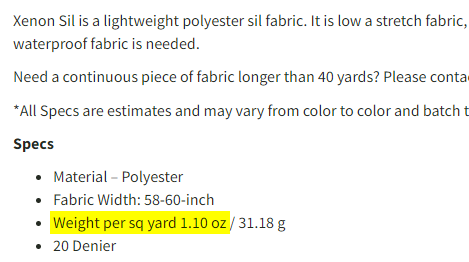
Re denier, or ‘D’: Looked up the definitions on Google some time ago. My impression was that it is a measure of the weight of the yarn or thread that is woven into the fabric. If I got that wrong, please correct. But if I have it right, it means that it is NOT a measure of the coating weight, or tightness of weave; meaning that with the same yarn, a tighter weave would be heavier. Hence, fabric weight can vary substantially with the same denier. Years ago, I protested when one of the BPL gurus posted to the contrary by stating the denier is a good measure of the fabric weight.
All this makes me wonder why the Yama fabric, which is spec’d at 20D, weighs only 1.08 oz/sq/yd on my scales (have two scales for double checking), while fabric from retail merchants runs around 1.2-1.3 oz/sq/yd for 20D silpoly. It could mean that the coating weighs less, or heaven forbid, that the weave is not as tight, or that other things added during the weaving change the fabric weight. Go ponder.
Those are some of the factors that vary fabric weight; but there are even more factors. When Stephen Seeber posted about a plain weave silpoly at my request, he found some large variations in the strength of the fabric when purchased at a different time by a different buyer; suggesting that ‘QC’ (quality control) is a big factor in fabric variations. So is aging.
So with all these variables, what is a customer to do in selecting fabric, or a shelter based on the fabric used by the manufacturer? For DIY/MYOG, it is a matter of testing and using fabric from the same roll, and if from a different roll, retesting again. For others, it is not possible to test in the store, and very inconvenient or impossible to order a shelter, test it, and return it unused when quality is an issue. So as a practical matter we are left to the fabric manufacturer, as distinguished from the retail seller, to perform QC. And we must rely on the tent makers, as distinguished from the fabric makers who are unknown to us, to perform QC. Fortunately, we can develop a good idea from BPL posts by experienced hikers about quality; and it is evident from forum posting that this is a good way to choose sellers. Complicated of course by posts that reflect fads or inexperience. Since we face the same dilemma with all our shopping, we get plenty of practice.