How do you do “real cooking” with titanium pots to prevent burning/scorching the food and pot? So many times I hear ti is only good for heating water…..is that true?
Topic
Become a member to post in the forums.
 .
.
How do you do “real cooking” with titanium pots to prevent burning/scorching the food and pot? So many times I hear ti is only good for heating water…..is that true?
Well, it kind-of depends on what king of “real” cooking you mean.
For stir-frying on rather high heat works OK. Simmering a stew on low heat does not. It tends to stick badly.
Continually stirring a vegetable soup for a few minutes is fine, but letting it sit for a few minutes will likely result in browned vegetables.
Cooking spaghetti is a constant chore of stirring else it sticks and burns.
Basically the conductance of ti is at fault, I think. While liquids seem to help, mostly the heat comes pretty much straight up from the burner. On an older Simmerlight and a 1400ml ti pot, It created a ring of burned on food where the flame contacted the pot. With narrower burners, such as the Svea, a smaller ring was created. With the FMS 300t it was a burned blob in the center. There simply was not enough dispersion of heat through the ti to prevent these hot spots from developing in the pot. Constant stirring was required to prevent burning. I dropped the ti and went back to aluminum. With thin aluminum it was better, but it was still possible to create the burn patterns. I created some ridges in the bottom of the aluminum pot, and, I could avoid most of the burn patterns with less than a quarter of the stirring. So, yes you can do real cooking with ti. It is just about 3-4 times easier with aluminum. Stainless steel lies somewhere in between. This conforms with the conductance of the materials. At a guess, I assume that material conductance plays a part in real cooking. I like to use cast iron at home. This rarely burns stuff, unless I forget to stir it for an hour.
It takes practice. Due to poor conductivity of Ti, the stove will create a hot spot on the base of the pot. To minimise this, use a VERY low flame and stir frequently. Add extra water to recipies. Instead of simmering (rice, pasta, dhal, oatmeal etc), take pot off stove when boiling and put in a cosy for 10min.

Real foods that I have cooked on the trail include: steamed rice, lasagna, bread, thick chili, pasta, pizza and so forth. The list goes on and on.
Some tips for cooking real food on the trail. First of all, it helps to have experience cooking regular meals at home. Being familiar with various cooking techniques will enable you to prepare most food. If you can’t make rice at home, you’ll never be able to make it on the trail. It helps to know the fundamentals of boiling, steaming, frying and baking (steam and dry).
Know your backpacking equipment. It is going to be hard to simmer using a WhisperLite. You’re probably not going to be successful stir frying with a thin titanium pot or fry pan. That being said, I have baked using a SVEA 123 and can do just about anything with a Kovea Spider.
Know when not to cook. If you’re putting in a lot of mileage, don’t plan on making a gourmet meal as you probably just want to eat. Save the fancy meals for zero days. Know your limitations as cooking real food is not everyone’s cup of tea.
How do you get to Carnegie Hall? Practice, practice. Cooking is just like any other backpacking skill (navigation, water treatment and so forth), if you put the time in the results can be quite rewarding.
My 2 cents.
All very helpful comments.
Lesson Learned = PRACTICE :-)
If you burn your dinner, you have the flame too high – for that combination of stove and pot. But you can burn any pot if you try.
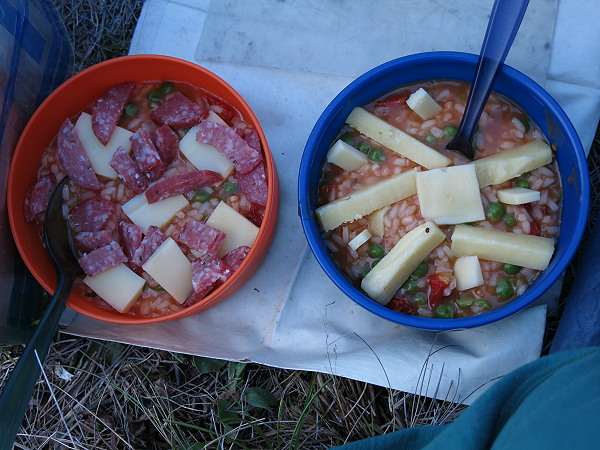
MSR Ti Titan pot.
Cheers
Second Lesson Learned = Low heat/flame
Here is a review by someone who purchased a Toaks Ti pot:
700ml toaks
Great for a small veggies saute
William Plowden (Sapphire, NC) 11/28/2015 2:43 PM
Threw in a morrel, some ramps, golden rod, and dandelions to add to a bigger pot for a pasta dish. Touch of oil and careful attention. It’s perfect for the small handful and dash cooking.
There was a thread like this a few years ago and I think some one wiser than me (Bob Gross?) suggested trying a DIY heat diffuser from for example bottom of a soup can before buying yet another pot.
Cheers/Bruce

Get a pot with a good handle and a glove to handle heat. Stirring AND keeping the pot moving over the flame will even the heat. Hard anodized aluminum is better but no miracle. Recipes with a quick boil and a hot soak are less work.
Last week there was a thread started over at whiteblaze.net. It’s what got me thinking about cooking in Ti. It started out like this:
Cheyou
>Sick of ti cooking !!!<
I have had it with ti cooking. I can’t cook popcorn in it without burning . What I need is a cook pot I can cook real food in . Don’t want to spend time cleaning or heavy stuff. I use esbit , canister stoves ,alcohol, depending on the trip. My GSI soloist is the best real food cooking pot I have . It is not a very wide pot . What’s your choice for real food cooking ? Can’t afford to buy 10 pots or pans . Help me narrow the field. Long live real food !
</div>
I can’t cook popcorn in it without burning .
And the relevance of this to backpacking is ??? Blimey.
Not picking on Dan Y at all, but maybe boggling at the original author.
Cheers
Cooking Real food in Titanium – Panang Beef on the Kalalau Trail, Kauai HI
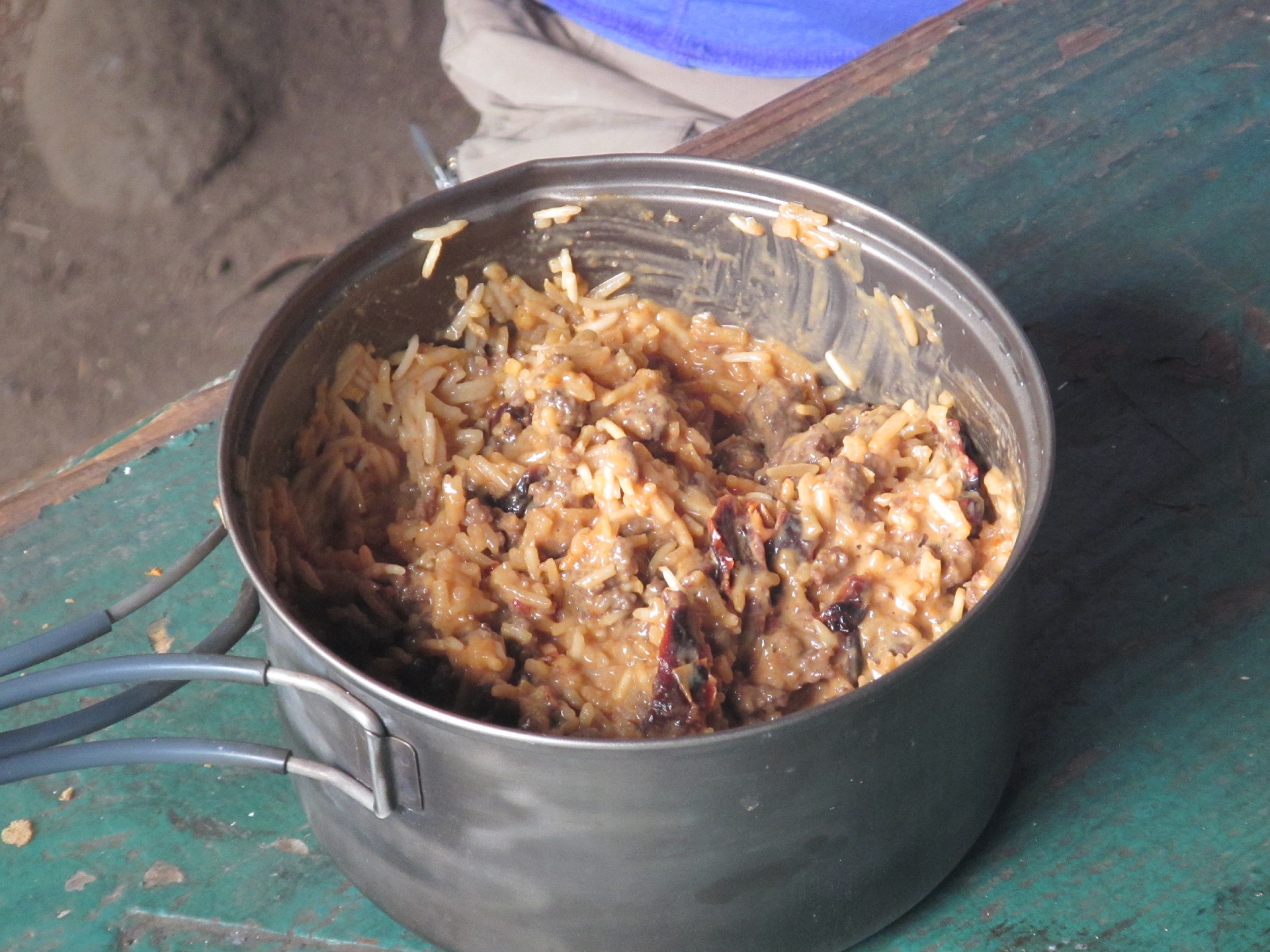
Cooking Real food in Titanium pots – fettuccine carbonara on the JMT
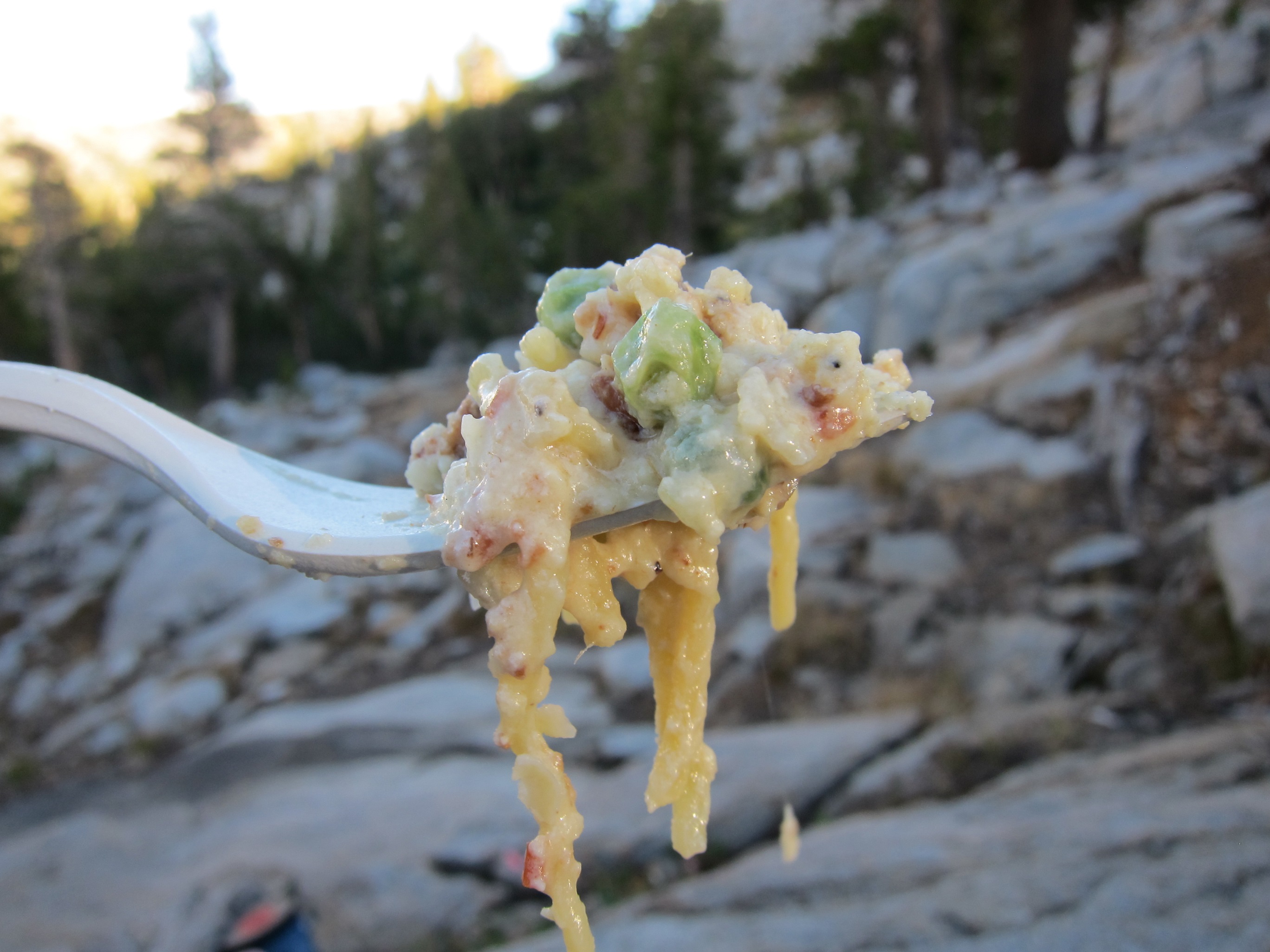
The popcorn guy is not the first one I’ve read about saying Titanium pots are not good for “cooking” because of the scorching of food.
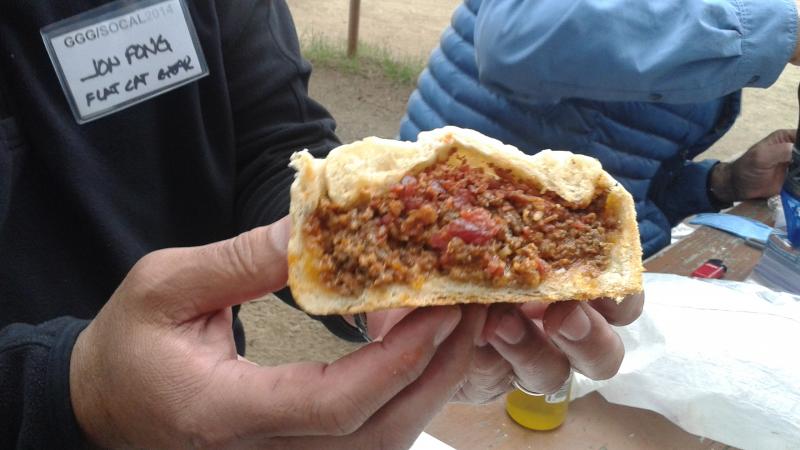
Jon has had many failures and got him to where he is today with “cooking. Like he said, practice makes perfect.
I have not tried “cooking” with Ti pots. Aluminum, yes. Aluminum takes patience and know how. All things are relative. You need to be a “cook” at home in order to be a cook when out on your favorite trail or place in the outdoors. Yon said that and I agree.
Cooking with Titanium – Deep Dish Double Crust Pizza on the JMT
It takes practice to learn how to pitch a tarp, it takes practice to filter water and it takes practice to spell correctly. If you enjoy eating real food on the trail it takes practice, but I find it rewarding. For those of you who have not tried it, I suggest that you try to make rice. Bring it to a boil, and then let it simmer. When the water level drops to about the height of a grain of rice, remove it from the heat and leave the lid on for about 15 minutes. My 2 cents.
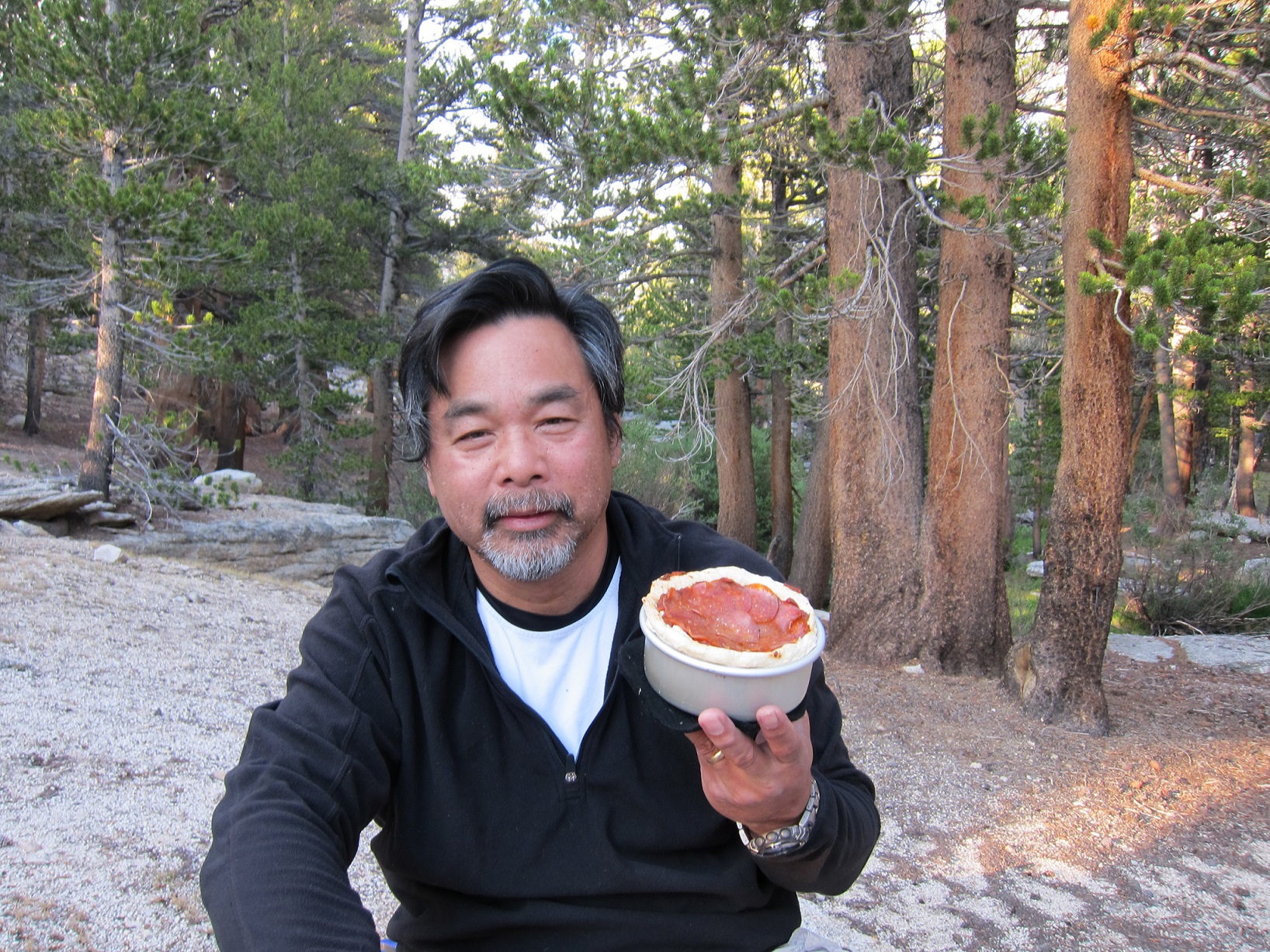
@jonfong do you have instructions for these new recipes? Your cookbook looks great and I can’t wait to try them out. This Carbonara recipe looks great too.
Hi Nick
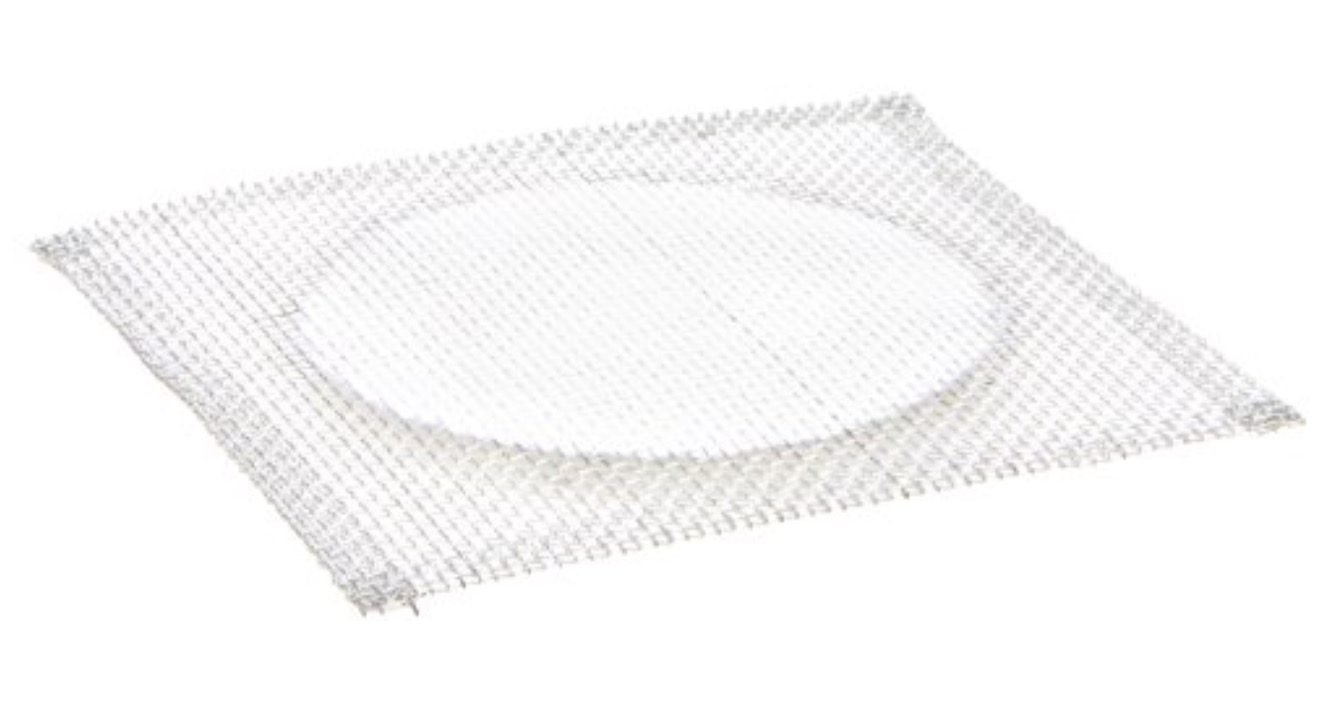
just be careful with those old bunsen burner gauze mats. The white stuff in the middle was usually asbestos.
You can get similar mats without the asbestos – or you can buy some SS mesh and make them. Or you can turn the flame down. Or, you could even just use a square of 1 mm aluminium sheet.
Cheers
Roger, one of the sites said that the center disc used to be asbestos but is now ceramic applied under a gazzilian pounds pressure :-) I ordered some for future kits ;)
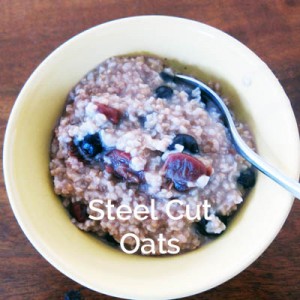
When using an alcohol or Esbit stove that simmers well, a heat diffuser is not needed. As a validation/reality check, I cook real food to test a design. Here, I made steel cut oats in a titanium pot: bring it to a boil and simmer for 20 minutes. I only stirred it at the 10 minute mark and then at the end: no burns or scorches. A 100 watt output stove seems to works well for simmering. My 2 cents.
The wire gauze, which are now ceramic not asbestos, worked very well with a Svea 123 that has a fairly small concentrated flame. I haven’t done much “real” backpacking cooking in decades so I can’t validate how well they work on more modern stoves.
The wire gauze I used in the 70’s did indeed use asbestos but of little concern to me vs the years I worked on vehicles with asbestos brake linings and plenty of asbestos dust when servicing brake systems.
If you want to actually cook with tIranian, the wire gauze might be helpful, however I have no ideas what they weigh.

The Bunsen burner wire gauze works. It’s heavy.
a .1mm piece of copper foil works perfectly. https://www.aliexpress.com/item/32846449941.html?spm=a2g0s.9042311.0.0.27424c4dP58n81
Also, you can season titanium in the oven just like you would cast iron pan. Works perfectly and creates a non stick surface. (avocado oil rubbed on (THIN) with paper towel, place pan upside down in oven on 500 for an hour, repeat many times to build up a layer of non stick surface)
Didn’t see this post before….but here are my few cents on it.
It all comes down to your stove and your ability to dial it in.
I’ve wrecked a Ti pot. Not hard. Well, it is still usable. But it’ll never be flat again, and has a rainbow scorch in the middle. I left it on a Pocket Rocket and did that.
I only cook on my simmering stoves (the ones you can dial down to a whisper). I save the hot stoves for HAA.
I don’t use ANY lined pots at all however. You gotta use oil.
But in the end, I choose HAA nearly everytime. They are nearly as light, and it’s easier to cook in. And clean up.
>> one of the sites said that the center disc used to be asbestos but is now ceramic applied under a gazzilian pounds pressure :-)
I would certainly expect that (ceramic) to be the case today!
Cheers
Become a member to post in the forums.
 New Gear with Aluula FabricsLighter, stronger, more abrasion-resistant, and highly water-resistant - explore ultralight backpacking gear made with ALUULA Graflyte fabrics. Engineered for exceptional strength, durability, and lightweight performance, ALUULA Graflyte helps reduce pack weight without sacrificing reliability, making it ideal for demanding backcountry adventures.
 © Beartooth Media Group Inc.
 Loading...