Topic

Quadratic tent experiences? does it match the Caffin criteria?

Viewing 25 posts - 1 through 25 (of 33 total)
Roger Caffin BPL Member
PostedAug 3, 2018 at 12:09 am

Yeah, I have seen that tent before, but I have not tested one.

If you take out the longitudonal poles you have a conventional 3-pole tunnel tent which can be ‘adjusted’ slightly at purchase (sod cloths etc).

The interesting Q is whether the 3 longitudonal poles actually add anything to the design. (Obviously, the designer thinks they do.) I have some doubts.

I cannot see what advantage or benefit the top pole offers. It will not support the other poles against a high snow loading: you need internal storm guys to do that. It will not provide any lengthwise tension which cannot be supplied by the corner guy ropes and anchors. As for the idea of ‘free-standing’ – forget it!

I can’t see what advantages the side poles offer either. I suppose the theory is that they will resist a sideways wind, but in my (field) experience poles there will make little difference. You would be much better served by having 4 arch poles instead.

As a straight 3-pole double-skin tunnel tent (without the longitudonal poles) it seems fine to me. The designer lives in Germany.

Cheers

Roger Caffin BPL Member
PostedAug 3, 2018 at 1:11 am

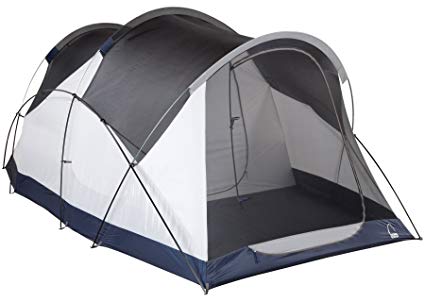
#1: yes, but really only 2-pole with a large vestibule
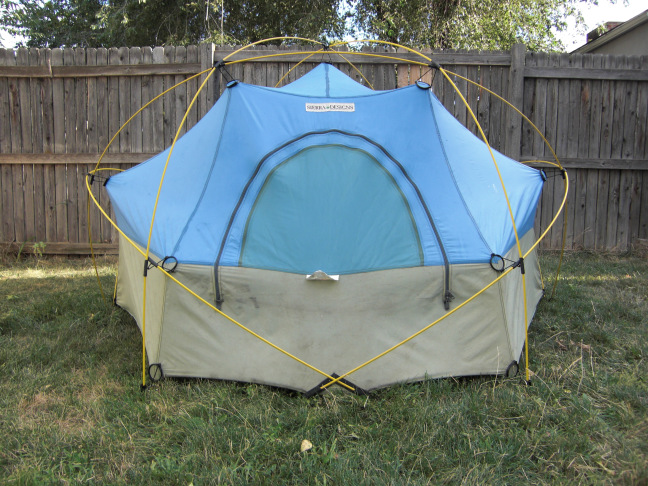
#2: NO – the poles do not go in the fly. What is it anyhow?
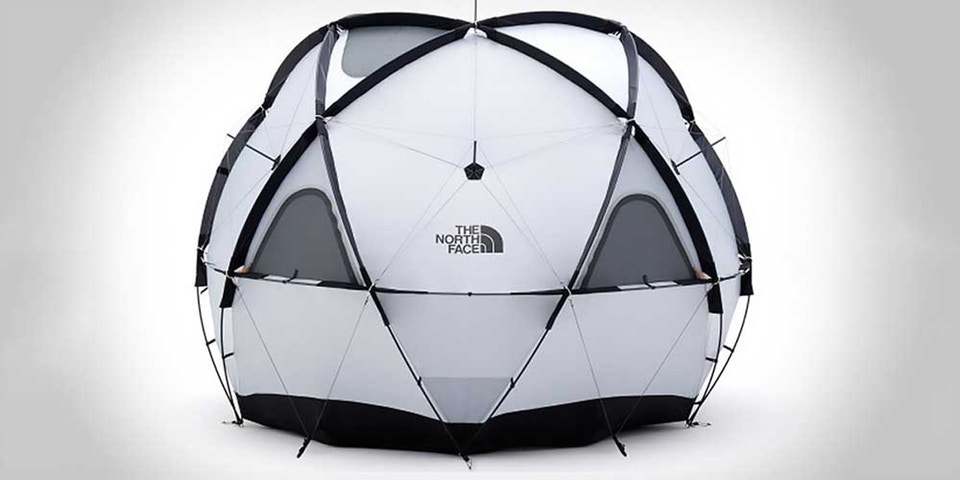
#3: geodesic dome, not tunnel.

Cheers

PostedAug 3, 2018 at 1:25 am

Different designs but in all cases those lower poles are there to spread the tension to offer resistance against side winds.

Maybe all of those designers are wrong, I don’t know.

Roger Caffin BPL Member
PostedAug 3, 2018 at 2:08 am

Hi Franco

to spread the tension to offer resistance against side winds.
I can’t see that myself, for at least two reasons.
First of all, my tunnels take quite big winds without that bracing, so clearly it is not ‘necessary’. The double side guys are quite sufficient.
Second, I don’t think those poles would have anywhere near enough strength in compression. They could buckle quite easily. Tension from the end anchors is what works for me and other tunnel designers, and my winter end tent pegs (titanium deadman anchors actually) are much stronger than those poles.

My own opinion is that while it was an interesting idea which maybe needed testing, it does not make the cut. We could put that another way: would I retrofit such poles to any of my tents? The answer is a very clear no.

Cheers

PostedAug 3, 2018 at 6:19 am

My interest comes because Roger mentioned that a tent with 3 poles over the span where people sleep is better than a tent with 2 poles only (and four poles would be even better), because it is much better to have shorter spans of unsupported fabric.  After finding the dimensions of the tent it does not seem to be doing better than the Hilleberg Kaitum 2 (in fact it seems to be exactly the same).  One plus is the carbon fibre poles.

If someone were rich enough to buy the tent and test it we could know how well (or how poorly) the lateral braces work — the tent seems to have normal guy ropes anyway.  Hence why I ask whether anybody has experience of this tent in practice.  TBH, while people might bitch about head space, the internal string bracing Roger has in his tent (1) is lighter and (2) is proved to work.  If I had the skills to retrofit it to this tent it would be a no brainer, but sadly I am not there yet.


James Marco BPL Member
PostedAug 3, 2018 at 2:16 pm

Actually I sort of agree, but dynamic pressure from the side due to wind loading devolves into total pressure from inside and outside. As wind pressure blows onto the side it will force fabric & poles to cave in with the top coming down. On the other side, a low pressure gradient develops giving pressure from inside to outside, tending to billow out the down-wind side pulling poles out and the top down. You can easily see this in the clips Roger posted about setting up tents in 70mph winds.

In both cases the lateral struts on the sides and top actually help support the curved poles. So, I disagree that they do nothing. An “eyeball” estimate would give between 20-40% more dynamic strength by utilizing the smaller surface areas of the ends (low dynamic loading) and transferring that to areas that have high wind loading.

Rather than having larger unsupported panels, the lateral poles divide each panel between the arched poles into 4 smaller sections, each supported around the perimeter with a pole (or staked out to the ground.) This will help overall static loading, and, reduce the effects of dynamic (wind) loading by reducing the effect of sagging of the panels. This will help maintain the poles in correct alignment (improving strength) under heavy wind loading. In essence, this is what Roger recommends doing for static loads (snow loading) by tying his roof joints together. Of course, this can also be done on the Quadritic tent improving it’s strength.

The overall strength of the tent (static loading) would only be slightly improved by the addition of just the lateral poles. The internal bracing would perform better and be far lighter for relatively static loads (snow loads.) Both Roger and Stephenson use these successfully. But, they really only address outwards pressure. And when between two sides of the same pole, do very little to protect against lateral dynamic loading, especially compression on the windward side. Heavy duty stakes, and guyout points on the sides help more against compression, but these can also be added to the lateral pole design.

I believe the two components of tent strength (dynamic and static) and their interactions are not well understood and people are missing the distinction. Would I use one? Well, no. It gets very heavy with all the poles, extra guyouts, and connections…around 8pounds heavy. This is around the weight of my summer kit in total.

Matt Dirksen BPL Member
PostedAug 3, 2018 at 7:35 pm

“In both cases the lateral struts on the sides and top actually help support the curved poles. ”

+1 to that.

I wouldn’t underestimate the benefit of reducing the exposed area of fabric by adding those poles.

More importantly, the lateral poles are creating a semi-geodesic form. While adding an internal guy system to the poles of a traditional tunnel would make those poles stiffer, they would still operate independent of eachother.  The poles would still be completely dependent on how tight one could pull the front/rear axis of the tent. By  “binding” the three primary hoops together with three lateral poles, the six poles will operate more as a single system then independently.

“Second, I don’t think those poles would have anywhere near enough strength in compression. ”

Roger, I’m not sure I understand this statement.

A .4330-T9 diameter aluminum pole has tensile strength of approximately 96ksi and compression of 105ksi.  Again, if those poles are properly seated, they could potentially provide a huge amount of lateral resistance, and be able to more uniformly distribute the wind load around the tent. And wet snow would shed off the top better because there would be so much less potential for deformity on the top ridge.

As much as I love tunnels, just don’t think anyone could physically pull a tunnel tent tight enough to come even close to the resistance gained by adding a lateral pole system like that.

While my math skills are limited to my architectural profession, I’ve been around enough geodesic forms long enough to witness them in action. Perhaps there’s a structural engineer amongst us who can whip up some math on this.

BUT, as Franco said – is it ultimately worth the weight for the added benefit? And just as important: is it simply overkill?

Roger’s tent seems to be a well proven design without any lateral pole bracing. If a well-rigged tunnel can handle 50/60mph perpendicular winds without lateral bracing, then why add it?

Who knows: perhaps “The Theory Works” can provide a white paper, some field data, and a tent for BPL to review.


PostedAug 3, 2018 at 9:49 pm

To be fair, the design of the Quadratic is modular, so one could just take what is reasonably needed for a trip.  I would probably not take lengthwise poles unless I knew I’d be in alpine or otherwise exposed situations (or maybe for heavy snow load?).  Any camping in less extreme conditions and I’d probably just leave these poles at home and go for the lightest setup I feel I would need.

James Marco BPL Member
PostedAug 3, 2018 at 9:55 pm

Well, reducing the weight would be a matter of reducing the tent/inner weights and reducing the individual pole strength, utilizing thinner poles and more of them. Anyway, this has been tried many times and always results in a heavier tent being carried.

Roger Caffin BPL Member
PostedAug 3, 2018 at 10:20 pm

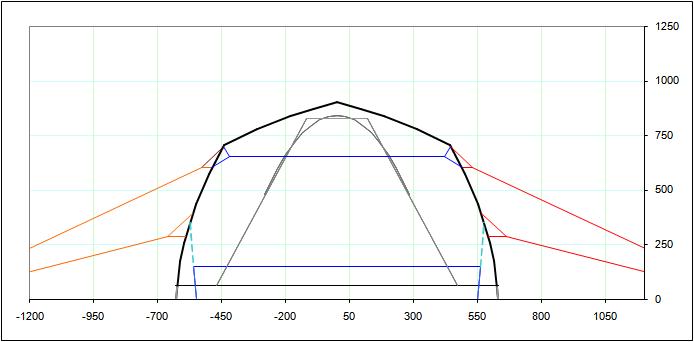
I agree that the lateral poles could add strength against a side wind if that was all the support available, but it is not. The primary sideways support is always the guy ropes, double ones if possible. They are much, much stronger than the lateral poles, and properly configured they do not permit flexing. See:

These guys ropes are 1mm Spectra on my summer tent and about 2.5 mm Spectra/Dyneema on my winter tent. They do not stretch. With these in place and correctly tensioned, there is less than a few mm movement under strong sideways winds. Anything more than a few mm and you have lost the guy ropes!

Yes, lengthwise tension is very important, and loops of 4 mm bungee cord at the downwind corners (never at the upwind ones!) can add a lot more of that than can any curved lateral poles, but the external side guys (orange lines) are far more important if the wind is not reliably end-on. Even in fine weather I place all side guys every time.

The internal storm guys (blue lines) look after snow loading just fine. The peak of the pole arch can not depress while those storm guys are in place and lightly tensioned. So either the snow builds up and is supported, or it slides off.

Reducing tent weight is a good idea, but at some stage, say around 2 am in a howling storm, my focus is a bit more on secure survival than shaving off another 50 g.

All field tested.

Cheers

PostedAug 4, 2018 at 12:49 am

Roger,

Given your diagram, wouldn’t this mean that a dome tent would also benefit from similar tie downs (though the layout may be more radial)?

Roger Caffin BPL Member
PostedAug 4, 2018 at 2:48 am

Hi Jon

Most likely.
Mind you, a geo dome has a lot of poles up there anyhow, so maybe less benefit.
On the other hand, a light dome with only a couple of poles would certainly benefit.

Cheers

PostedAug 4, 2018 at 7:27 pm

Just FYI, the Quadratic does allow to use external guy ropes (which have two anchor points exactly as in Roger’s diagram above), and I have been told by the manufacturer (I did see the actual photos of how to do it) that one can actually set up their own internal guy ropes as Roger advocates — the internal guys are not provided though, but hey, that’s is an easy fix.

Knowing this I would say the main thing is fabric weight, but then again I do remember a tent manufacturer here on Backpacking light saying he could make equally strong tents with lighter fabrics, but he had discovered that J Random User is a careless bozo that will damage a potentially strong but lightweight tent by mishandling it in the most horrible way (sorry I cannot find the post again).

Roger Caffin BPL Member
PostedAug 4, 2018 at 10:29 pm

he had discovered that J Random User is a careless bozo
Chuckle. That could have been my comment!
An Oz mfr told me he would not do UL gear because J Random tended to fall over such a tent in the retail store and trash it (and walk out without paying for it), and then the store owner would want to return the tent for CREDIT!

Cheers

Arapiles . BPL Member
PostedApr 6, 2019 at 1:43 pm

FYI, my Fairydown snow tent has a central pole which makes it a free-standing tunnel.

Roger Caffin BPL Member
PostedApr 6, 2019 at 8:22 pm

A free-standing tunnel with a central pole?
This I have got to see. Photo?

Cheers

Edward John M BPL Member
PostedApr 7, 2019 at 12:43 am

That is a FairyDown tent I am not familiar with and I have a few

I also would like to see pictures

Edward John M BPL Member
PostedApr 7, 2019 at 12:46 am

J Random User and 16 YO boys are the reason one local makers “Institutional” tents are a full kilo heavier than their standard 2P versions

Arapiles . BPL Member
PostedApr 7, 2019 at 2:06 pm

It’s a Fairydown Snow Cave – it’s the purple and green tent pictured and referred to in this thread:

http://bushwalk.com/forum/viewtopic.php?f=15&t=5204

Mine’s currently happily sitting up in my shed by itself and not pegged or guyed out, courtesy of the ridge pole mentioned in the thread above.

Once the poles are in (specifically, the ridge pole) it’s easy to just pick it up and move it around like a dome.


Roger Caffin BPL Member
PostedApr 7, 2019 at 8:47 pm

Aha – I see all! My mistake.

When you mentioned a ‘central pole’ I had visions of a vertical pole in the middle, like a teepee! Complete misunderstanding.

The Snow Cave is a 3-pole tunnel tent, quite standard. 3-pole tunnels are far more capable of handling wind and snow than 2-pole tunnels or tarps or pop-ups. The middle pole not only makes the tunnel stronger, but it cuts down the unsupported fabric span immensely.

Yeah, I’m biased. By experience.

Cheers

PostedApr 7, 2019 at 11:39 pm

I see only 2 reasons for the “side” poles:

  1. to make the tent & vestibules freestanding
  2. to help a bit in high winds to keep the fly from touching the inner tent on the sides

Otherwise too much extra weight for too little gain.

Now if they could tie the “side poles” to the arch poles then you may have a more rigid structure for spreading stress in high winds.


Roger Caffin BPL Member
PostedApr 8, 2019 at 1:14 am

to make the tent & vestibules freestanding
Trouble is, as far as I can see, the side poles only support the inner tent. The vestibules would be left to flap in the breeze (or gale). If correct, that makes them of very little use in my book.

to help a bit in high winds to keep the fly from touching the inner tent on the sides
I have never had that problem in one of my tents when the outer layer has been properly tensioned from the ends. The outer layer just does not flap around the way many other tents do. Proper tension is quite important for storm resistance anyhow.

Cheers

Viewing 25 posts - 1 through 25 (of 33 total)
Loading...