David,
You said in part, “So you are saying that if the HH of a fabric is exceeded, the fabric ‘mists?’ Or does it leak?”
Water passes through the 1μ – 15μ interstices between the fibers and forms water molecule aggregations of approximately the same dimensions. Average size rain drops aggregate to a nominal size in the 3 – 4.5 mm range (~1,000x larger). Our vernacular uses mist for the small water molecule aggregations and drops for the large water molecule aggregations. Any water passing through the rain fly is a leak regardless of the water molecules aggregation size.
You said in part, “If a fabric’s HH is exceeded and it leaks, does it leak continually after than or does it just briefly wet out?”
A drop forms at an interstice at some specific pressure. If the pressure is reduced and the drop is wiped away, it will not form again until the pressure returns to the point where the drop originally formed. Wetting out is not relevant to measuring HH; wetting out is a measure of the fabric’s surface energy only as opposed to its ability to resist water pressure.
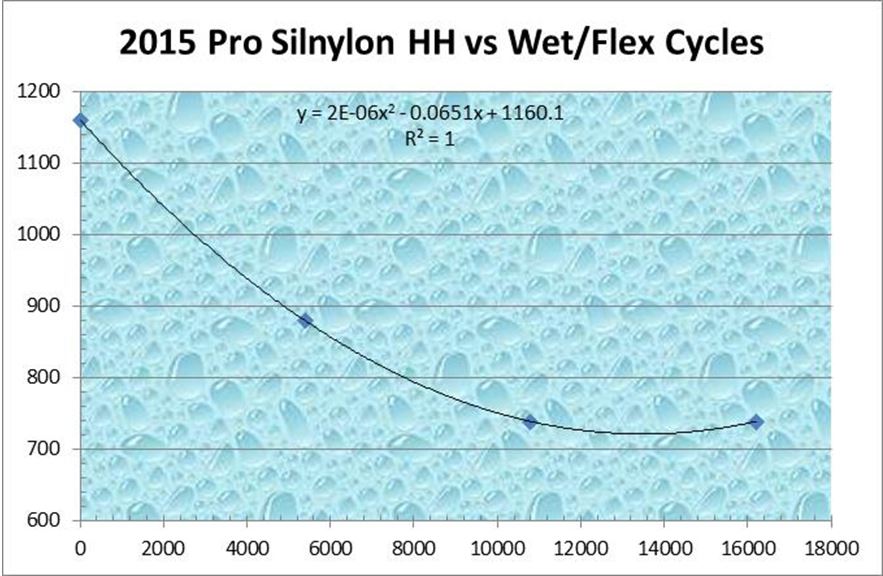
My HH tester has the face at a 45 degree angle to facilitate seated viewing. The pin-head sized water aggregations look exactly like condensation. The vast majority of the time, if the pressure is left the same or reduced, they stay stuck to surface of the fabric like condensation. I assume it is the bipolar forces in the capillary under the pin-head sized water aggregation that holds it in place. If I flick the surface with my finger, they again act exactly like condensation drops. It is impossible for me to look at the roof of my shelter with a strong light and make a distinction between water molecule aggregations formed from condensation and those related to HH. My only recourse is to measure the HH periodically and recoat when it falls below the1500mm HH threshold. Not coincidently I have much less moisture on the roof with adequate HH.
You said in part, “Since rain is not localized, how can a HH tester replicate rainfall? Does the shape of the canopy make a difference?”
The physics related math and the field transducer measurements are highly correlated regarding determining a water drop’s kinetic energy. They are also highly correlated regarding the Impulse-Momentum form of Newton’s Second Law calculations for a rigid surface like soil. The primary guess work for different shelter shapes is determining the drop deformation, from impact, found in the purple field of the spreadsheet segments I presented in my prior post.
Some of the top scientists of the world collaborated to ascertain both the 1,500 mm threshold for considering shelters rainproof and the HH testing procedure. I understand their calculations and I follow their procedures but, I didn’t create them.
You said in part, “Can you replicate ‘misting’ in the lab? Have you?”
Yes and yes; detailed in prior responses.