


But TheTrek says it’s “The Most Efficient”! Surely they can’t be wrong???
https://thetrek.co/the-best-backpacking-stoves-of-2021/
Okay…
Topic
Become a member to post in the forums.
 .
.
But TheTrek says it’s “The Most Efficient”! Surely they can’t be wrong???
https://thetrek.co/the-best-backpacking-stoves-of-2021/
Okay…
Is there a reasonable way to visually detect this condition, roger? How would we know?
would a “Floppy yellow or orange flame on your gas hob, rather than crisp blue” be an easy indicator, or what else. I read this at https://www.gassaferegister.co.uk/help-and-advice/carbon-monoxide-poisoning/
The trouble with CO emissions is that they are NOT all that obvious.
For sure however, “Floppy yellow or orange flame on your gas hob, rather than crisp blue” is a good guide in many cases.
That gassaferegister web site was (imho) rather good: simple, easy to understand, and to the point.
A good preventative measure anyone can take is to make sure that the flames from their stove get a good chance to burn completely. Having the pot too close to the flames will ‘quench’ the flame and stop full combustion – and create CO.
Techie explanation follow:
When fuel is burnt, the chemistry is complex. The usual first stage is for the fuel molecules to break up. Then the carbon atoms burn to make Carbon Monoxide (CO) – NOT CO2. Then, as the CO molecules go up the flame, they burn with extra oxygen to make CO2. Interrupt the flame (pot too close) and it is ‘quenched’, so that the combustion process is not completed. CO in volume follows.
This is a problem with more than half of the upright stoves on the market omho: the pot is too close to the burner head so the flame gets quenched. In my series of articles on CO from stoves, I found that i could get big reductions in emitted CO by raising the pot 10 – 15 mm higher than the pot supports. The series starts here:
https://backpackinglight.com/stoves_tents_carbon_monoxide/
This is also a reason I don’t like Heat Exchanger pots very much. They seem designed to ‘absorb’ the flames in the fins, which is about the same as quenching the flames. If you look at a new Reactor stove and pot, you will find it covered in CO warnings. I will claim some responsibility for that, due to our testing in the above series. The Reactor can be quite lethal.
Why do we have these problems? A very biased reply would be ‘ignorance’ by the marketing guys. They seem to think that having the pot really close will get more power and be more resistant to the any wind. One day, in the dim and distant future, stove vendors might be required to provide CO figures for their stoves – from standardised testing. But they will fight against that.
Cheers
I wonder if setting the stove-to-pot distance such that it mimics that of a household stove would be a good setting. I realize the stoves burn different fuels, but maybe the home stove manufacturers have had a little more time and regulations to design their products against. Also, sorry for drifting off topic.
That is not a bad idea. Home gas stoves are designed generally with lots of small flames, with lots of room around the flames for extra air to get in. Or so it seems to me.
Cheers
I just did a 4-day trip with the Stash in mild, summer coastal Alaskan conditions and it performed fine. Through years of Jetboil Sol Ti use I know my fuel consumption to be about 17-20 g per day, and the Stash consumed about 20 g per day. This surprised me a little because at home it was slightly more efficient (in admittedly very little testing) than the Sol. When it was breezy I just boiled water behind a flap of the vestibule of my shelter.
I really missed the integrated ignitor on the Sol burner. The weight and size of the Stash are not a game changer relative to the Sol. I have my Sol set up where my burner is always attached to the 100 g canister and these fit in the pot together, so the assembly/disassembly of the Stash was an extra step for each use. The stove seems somewhat like a lateral move at this point. That said, I do like simple canister stove operation and am a fan of JB stuff as it has been reliable for me.

FYI – I got a message from someone who just purchase the JetBoil Stash mug by itself. He said that it wasn’t cheap, but here is how he did it.
I actually just gave them a call and asked if they would sell me the Pot, Handle, and Lid. The person on the phone was really nice and even gave me free shipping. I hope they will eventually bring this to market and make it available as a standalone product.

I’m a sucker for the 60% better fuel efficiency so bought a Stash to pair the pot with my PRD. Now a 4oz cannister should make it for an upcoming trip where before I’d need 8oz.
I noticed something odd about these tests. They show show much higher fuel consumption rates than elsewhere. Appreciate that windy conditions require high flame but were the flames set to 11 for all tests?
I made a comparison against other tests published online. I converted all tests to #cups boiled/oz fuel assuming 2 cup boils (which is more useful for fuel planning) and compared for room temp low wind conditions:
– tests in this article: 5.5 cups/oz
– here, 9 cups/oz
– here, 8.9 cups/oz
– here, 13-14 cups/oz
– here 7.5 cups/oz
– gear skeptic’s latest tests, using 118mm pot & PRD stove (similar to the MSR Titan used in BPL test), 7.5 cups/oz @ med flame, 8.5 cups/oz @ low flame
My field use in those conditions (PRD stove but MSS 1.2L Al pot) gives me ~ 9 cups/oz. It drops down to ~ 5 cups/oz with temps in low thirties and with moderate wind. Tests here were ~ 2.5 to 3.5 cups/oz in similar conditions.
I’m wondering, why are results here so low? They were taken at higher elevation, but will that cut fuel efficiency in half? I trust in the 60% fuel efficiency gain finding but trying to better understand the absolute numbers.
What you may notice in a lot of these ‘tests’ is that the stove is running without a windshield and, in some cases, without a lid.
No wonder the figures are all over the place! Such tests are not, in my humble opinion not worth a brass razoo.
In fact, I have seen (some years ago) one pic or video of a stove under a pot and the water was barely warming. Yeah, good wind, narrow pot, and the flame was blowing out the side without hitting the pot. Well, what do you expect?
I have also seen a ‘test’ with the stove going flat out where the flames were coming up the side of the pot, so that more than half of the heat energy was totally wasted. Well, what do you expect?
Cheers
As I mentioned in my post, I’m being careful to compare like conditions: room temp and low to no wind. Gear skeptics results just posted by Jon elsewhere were also surprising in how little effect the lid had. So there is something else at play in the weirdness of the BPL numbers, other than lid on/off or wind.
As the BPL tests and my field #s posted show, low temps and moderate wind can double the fuel required.
High wind can obviously make a boil almost impossible without a shield so comparing high wind numbers is pointless and why I didn’t bother posting those.
edit: I also was careful to only compare tests with ~ 2 cups/boil. I suspect 1 cup boils may have lower efficiency numbers as the pot has to be heated twice as often, but I haven’t tested that. I also tried to compare tests using similar stoves as well. A BRS will give very different results in wind than a PRD
surprising in how little effect the lid had.
Now try the comparison at -10 C. One may get slightly different results then.
Cheers
I think there would be some difference depending on how full the pot was. At around 1/2 full you would have an inch or two of air to act as an insulator. If you use a small pot, like a MSR Titan, you would have considerably less air space.

Watch the flames in the video. As they come to the top of the pot they curve inward and rise, not all of them but if you watch there are a lot of them indicating there is heat flowing over the lid of the pot. If the pot had no lid, would the updraft pull a small amount of heat out of the pot, slowing the heating of the water or is the rising heat over the top pushing heat into the pot???
Are lids good ????

If the pot had no lid, would the updraft pull a small amount of heat out of the pot,
As a physicist, I would expect that the rising flames would pull any water vapour from the top of the pot, slowing the heating rate.
Cheers
Why do companies sell millions of miracle devices?
Here’s one . . .
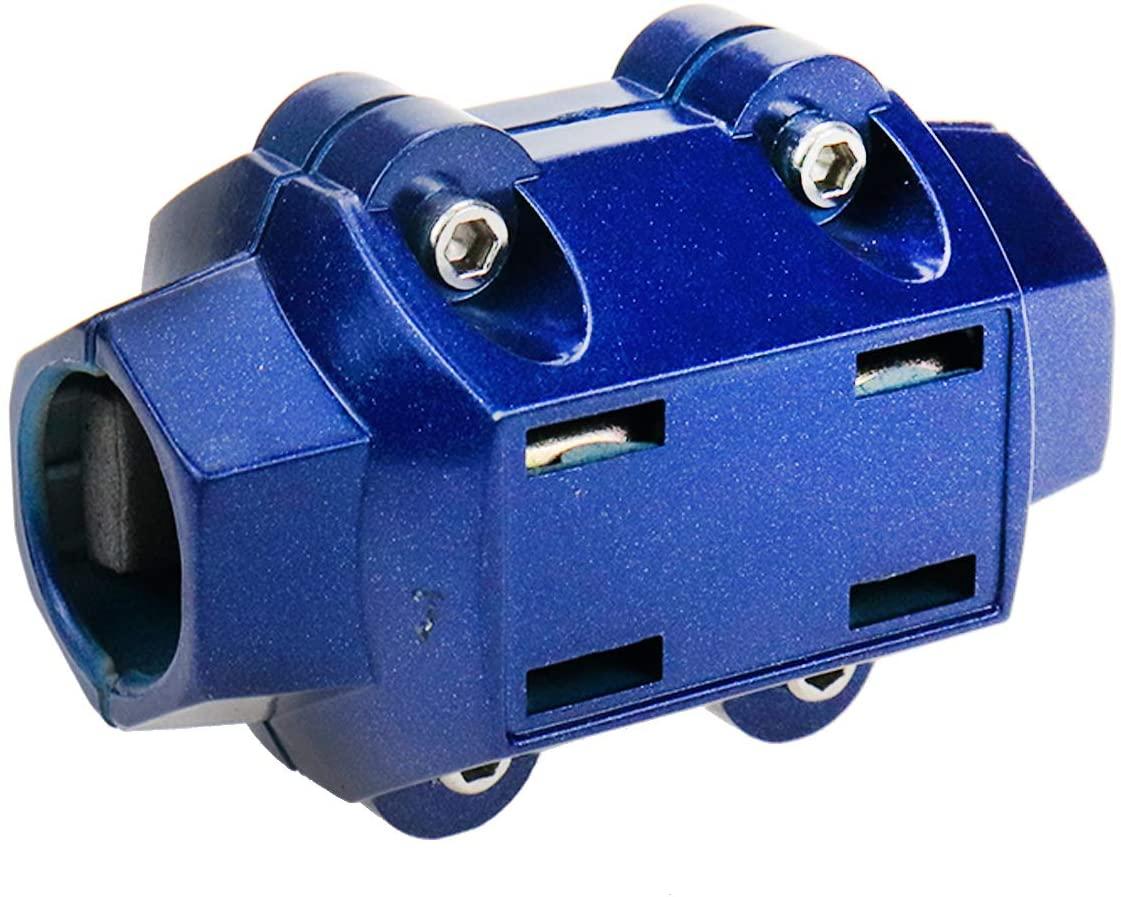
Product Description
Product Features
1. Save fuel costs
2. Low speed, high horsepower, torque output
3. Increase ignition efficiency
4. Extend engine life
5. Reduce air pollution
6. Fuel saving and acceleration
7. Directly installed on the oil inlet pipe
Working Principle:
1. Many substances change under the action of a strong magnetic field. This phenomenon is called “magnetization”.
2. When the gasoline macromolecular cluster is cut by the strong magnetic magnetization, it becomes small molecular clusters, the viscosity is reduced, the atomization effect is enhanced, and the activity of the small molecular clusters increases, and they are more fully burned after being mixed with oxygen.
3. The magnetizer can generate a specific resonance frequency through the neodymium superconductor. When installed on the fuel supply pipe, it will destroy the hydrocarbon chain of the fuel molecules flowing through, so that the fuel structure molecules are catalyzed by the neodymium compound to produce a specific resonance effect.
4. Under rearrangement, the original chaotic and disorderly movement arrangement of fuel molecules becomes a neatly arranged straight line of movement, which makes the fuel combustion fully and effective. Under normal circumstances, it can reach a fuel saving level of 10%-30%.
Buy one here
Why do companies sell millions of miracle devices?
No-one ever went broke trusting to the credulity of the average idiot.
Cheers
f the pot had no lid, would the updraft pull a small amount of heat out of the pot,
As a physicist, I would expect that the rising flames would pull any water vapour from the top of the pot, slowing the heating rate.Cheers
And it would be more efficient with lid on:
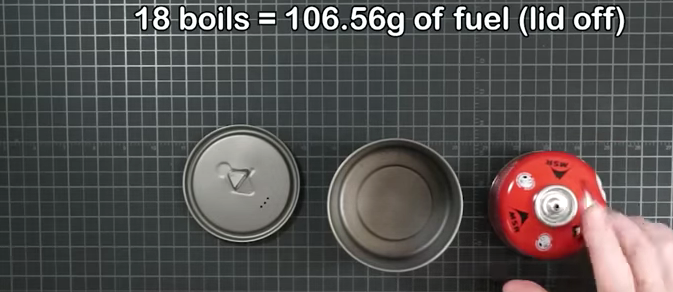

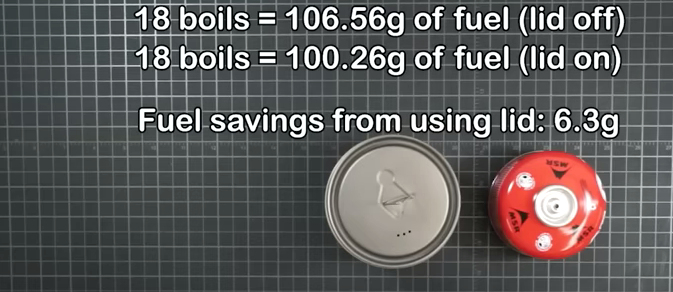
I think that you are looking at the discussion about overall weight. If your saving 6.3 grams of fuel by adding a say 20 gram lid, then a lid does not make sense. Albeit dead calm conditions.
He makes a point later on, that it really comes down to the tipping point: do I need to bring an additional canister? Small gram differences are not the issue. If you can avoid bringing an additional canister by throttling back on the fuel burn rate, then that is a good tradeoff. Isn’t that the whole point of intelligent UL practices: use knowlede to safely reduce your pack weight? My 2 cents.
avoid bringing an additional canister by throttling back on the fuel burn rate,
I guess so – in fine weather. Been sort-of there, done that, when calcs went wrong. I had to run at very low power to get the remaining fuel to last the distance.
On the other hand, when ski touring I always bring extra gas so we can have an ‘unbudgeted’ hot soup during bad weather. That can be a life-saver.
To be sure, ‘UL’ is good – but only if safe. Stupid Light is not good. Knowing the difference – ah, that can be difficult!
My 2c.
Cheers
If you look at the comment section in Gear Skeptics video, you would be amazed by the number of people who do not understand the relationship between fuel burn rate and efficiency. Somehow, this is all new to a vast majority of people. go figure.

It’s should be easy enough to plan fuel usage for any trip. Include a little extra for unplanned contingencies. And there should seldom be a need to carry more than one canister. They are easy to refill.
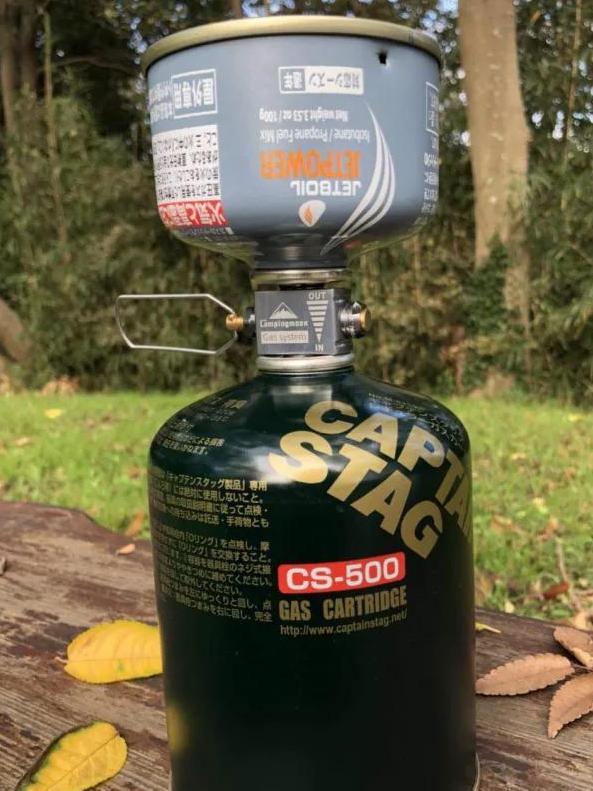

David D – I think the different test results could be explained by different flow rates on the stove – if you turn the stove on high it will require more fuel to boil the same water
or, it could be explained by different start and stop temperatures of the water
or, it could be explained by more or less windy conditions especially if you don’t have a wind screen. I’ve seen double or triple the amount of fuel required to boil in just moderate wind of a few MPH
The problem of the Stash (which I know nothing about) is the same as the problem with lids that the gear skeptic detailed – yes, it can save fuel but when you do the math, it’s difficult to have the weight of saved fuel justify the weight of increased cook kit weight
If you can reduce fuel usage so that you don’t need an extra canister, or you can use a 4 ounce canister rather than an 8 ounce canister, then it might make sense to have some extra kit like the Stash.
There are also other techniques to reduce fuel usage like turning the stove down. Another technique is to not heat the water up to as high a temperature
Ditch the lids. Don’t boil, just pasteurize.
i’d like to see the lid test in real life conditions
a lid makes the pot easier to stow in my pack
I’d like to see the complete 18 boil tests on all pots without the hands talking.
Become a member to post in the forums.
 New Gear with ALUULA Graflyte FabricsLighter, stronger, more abrasion-resistant, and highly water-resistant - explore ultralight backpacking gear made with ALUULA Graflyte fabrics. Engineered for exceptional strength, durability, and lightweight performance, ALUULA Graflyte helps reduce pack weight without sacrificing reliability, making it ideal for demanding backcountry adventures.
 © Beartooth Media Group Inc.
 Loading...