Topic

Light and insulating material for wet conditions? Just had down failure.

Viewing 25 posts - 26 through 50 (of 69 total)
Todd Stough BPL Member
PostedMay 29, 2016 at 6:23 am

I’m not an expert like you guys.  I just wanted to mention that even though you are not sweating you produce a surprising amount of moisture.  Put a pair of rubber gloves on and do some light work.  Normally after a fairly short time you’re hands will be wet.  Take you’re whole upper body and in an hour or two you’ll be pretty wet.

The leaks into the down jacket look like more than just cross transfer of water, there must have been a lot of water coming through.  Perhaps repeated laundering damaged the fabric?

Brad Rogers BPL Member
PostedMay 29, 2016 at 8:42 am

Sounds like a fantastic BPL article.

I too am disillusioned with Wp/b shells. I have used eVent, GTX Packlite, GTX active, and all sort of “proprietary” fabrics and so far have found them all lacking. I haven’t tried NeoShell or GTX Pro but I have no doubt they are similar.

You could have a leak but I still think it could be sweat. I would be sweating in two down jackets and hard shell at 50*.

Fleece is still king for wet conditions. I wouldn’t take fleece to WRR or the high Sierra but I would (and did) for Alaska.

Jerry Adams BPL Member
PostedMay 29, 2016 at 8:53 am

I have an eVent jacket that did that.  Worked for a while but then started leaking when it rained.

I believe your logic is correct – bad DWR will cause perspiration to stay inside, but if you were just walking around you should be okay

I reapplied DWR on my eVent jacket and it didn’t help much.  I now use it around the garden so if it wets out after 30 minutes it doesn’t matter.

I have a Pertex Shield jacket that seems to be working better, but I’ve used it for only a year.  I just spent two days straight in rain and didn’t notice any leakage.  The back of my shirt did get wet from sweat, but dried off quickly after getting in my tent.

An argument could be made to have a synthetic jacket or vest rather than down because regardless of what you do, it can get wet.  I had synthetic vest with my leaky eVent jacket and it didn’t matter that it got a little wet.

A jacket or vest has smaller surface area than a sleeping bag, so if it’s synthetic, it doesn’t weigh that much more.  Down sleeping bag will weigh quite a bit less, but it’s easier to keep it dry inside tent.  And body heat will dry it out.

When I’m hiking, I rarely wear insulated layer, I’d just sweat.

Having a synthetic layer outside of down only applies to very cold conditions, like 0 F or below.  The temperature gradually drops from body temp to ambient temp as you go through the insulation layers.  Body sweat vapor is constantly going through the insulation to the outside, but the point where it’s freezing, the body sweat vapor will freeze and will tend to accumulate rather than exiting the insulation.  If synthetic insulation is at that point, it’s better than down.  But just a little better.  Better solution is to use vapor barrier next to your skin.  If you’;re not going to spend days below 0 F this doesn’t apply.

Down can get compressed more than synthetic, so in some cases it would be better to have a down layer on the outside.

Matt Dirksen BPL Member
PostedMay 29, 2016 at 9:38 am

Victor,

Your pics suggest to me you have enough of a case to bring it back to REI to have them either repair or replace the garment. I will say (as others have) that detergent reside can severely impact wpb materials.

Many detergents nowadays have built-in fabric softener, which will effectively clog the garment, as well as strip the dwr. Once the permeability is compromised, (and the outer surface is saturated), moisture will pass right through, especially if there is a temperature/humidity difference between the inside and outside. Also, if you are warmer than the outside air, often your own vapor will condense on the inside surface when the pores are clogged, especially in humid-like conditions.

Vapor is supposed to move both ways through a garment like this, but when outer surface is saturated with water, the “drive” reverses direction, since the air around your body is “less humid” than actual water molecules.

There is decent info on the physics of how this works in the building science world, but I can’t dig it up at the moment. I will say that this “moisture/water/vapor” stuff is still an emerging science, in my opinion, and there aren’t many scienfists out there who both truly understand and can articulate how vapor “transport” truly works to the masses.

Finally, you asked about a true WP jacket. Personally, I like a good ole poncho, since I can easily control ventilation more than a jacket. But just know, when the temp and humidity are just right, you can still easily “wet out” on the inside of any waterproof non-breathable garment, due to your own body’s vapor. That’s why good ventilation is always key.


PostedMay 29, 2016 at 10:34 am

I can’t recommend it yet as i haven’t done testing with it, but i suspect that reticulated foam (“dryfast”, etc) holds promise in this area.  Awhile ago, i had set up for an experiment to test this material.  I went to Lowes, bought a large trash barrel, filled it with water on the last truly cold night of the season and was planning on getting in the water next morning with the foam on.  When i went out there, the barrel was knocked over (not sure how that happened).  I tried my garden hose, but it was frozen.  I was p!ssed, especially since i spent a good portion of the night trying to finish the foam vest for this experiment.

Anyways, the reason why i think it holds promise in this area, is that this form of open celled foam, is much more air permeable than other kinds, but unlike other, more traditional synthetic insulation–even Climashield, it has more inherent structure.  That means that even if it gets sopping wet, it will not lose loft whereas fibrous type insulation, even synthetic, will lose loft if sopping wet.  Supposedly, water drains out of it fast too, while it does not absorb much into the material itself.  Even if true, i think ideally it should be lined with very breathable materials to help speed up the drying process.

I am definitely going to do testing with it come mid or later Fall, and unlike usually, even if there seems to be little interest, i will report since i think this is a particularly important subject/area, unlike some of the other pieces of gear i’ve made or experimented with.

James holden BPL Member
PostedMay 29, 2016 at 1:39 pm

jerry …

having a synth layer over down applies to ALL conditions, not just freezing ones

even at milder temps the synthetic will move the condensation from the down to the synth … if it didnt then the condensation would accumulate in the down right under the outer shell …

in terms of jacket … using a synth or fleece on top of a down sweater means you can keep down mostly dry in even wet condtions

i use a fleece or synth over a down sweater all the time

it also means you can protect your down bag/sweater from internal and external condensation

when theres several days of sustained rain and no sun to dry stuff out  … thats an important consideration

;)

Ryan K BPL Member
PostedMay 29, 2016 at 2:27 pm

My preferred layering for active, cold, in heavy rain: poncho + windshirt + fleece-lined long-sleeve base layer

Sweat breathes out through windshirt, poncho nevers fails or wets out like WPB jackets do, and windshirt helps prevent condensation inside the poncho from reabsorbing into base.  1/4 zip on base and full zip on windshirt, plus cinching/uncinching poncho waist, helps me easily modulate my body temp.

My down puffy is great when stopping with no or very light rain, but in heavy rain it never comes out until I’m safe under shelter.  I don’t like to layer anything over my down puffy, except of course my synthetic bag/quilt at night. The down just gets compressed, feels uncomfortable, and doesn’t seem to keep me as warm.  But that’s also because I like all my layers to be pretty close-fitting.

Ian BPL Member
PostedMay 29, 2016 at 3:48 pm

This quote seems to indicate that you’re going to get wet no matter what? There’s no scenario where you start the day in dry clothes and, because of waterproof outerwear, you *end* the day in dry clothes as well?

That’s been my experience as well.  The best I hope for is to not be wet and cold at the same time.

I’ve only had experience with Goretex and have never owned an eVent product.  I presume care is basically the same.  Here’s Arc’teryx’s tutorial on how to care and launder your jacket.   I will eventually buy an Arc Alpha SV but it’s for reasons that have little to do with the breathability of the fabric.

When I’m choosing gear, I place a higher priority on venting over the perceived/advertised breathability of the fabric.  For example, I require pit zips and have recently returned to Ponchos, which I’ve had great success with.

As mentioned above, if I am going to hike with insulation on or in the rain, it’s fleece and other synthetic insulation for me.  I’d only use my down insulation on breaks (under a tarp if raining) or to bolster my sleep system.

Jerry Adams BPL Member
PostedMay 29, 2016 at 3:51 pm

“having a synth layer over down applies to ALL conditions, not just freezing ones

even at milder temps the synthetic will move the condensation from the down to the synth … if it didnt then the condensation would accumulate in the down right under the outer shell …”

I don’t think that’s right.  Water vapor will move through down or synthetic about the same.  Assuming the down doesn’t get so wet it loses loft.  I’ve measured it a little.

We will have to agree to disagree : )

James holden BPL Member
PostedMay 29, 2016 at 4:20 pm

jerry ,,,

the synth moves the dew point out of the down generally … even in milder (freezing rain) temps

even a light fleece blanket (or even a cotton bedsheet) will do the same to a certain degree

an easy test is on the next PNW high cold rain (20mm+) night to sleep in the tent all buttoned up (minimal ventilation) … no bivy

with down, youll likely get moisture right in the outer layer … even leaving it in the tent the entire wet day might have the same effect

with a synth or fleece overquilt … the moisture will migrate … when you wake up the synth/fleece will be damp, but the down will be pretty dry

this can sometimes also be duplicated in a cool open bivy without any cover or overbivy … BEFORE the sun rises (which will get rid of the condensation)

regardless the additional synth/fleece overlayer also protects the down from external sources … such as the sleeping bag rubbing against wet walls, or condensation being knocked off during heavy rain … etc …

in the case of jackets the body heat will push the mositure to the last layer … which if down itll end up trapped in the outer shell, or between the outer shell and the rain jacket and rub back in

one can dry out damp down sweaters and keep em fairly dry even in wet conditions with the proper techniques with a synth/fleece overlayer

;)


Jerry Adams BPL Member
PostedMay 29, 2016 at 4:55 pm

I just spent a few nights of rainy PNW weather.  Down sleeping bag never seemed wet or lost loft.  Inside M50 bivy inside floorless mid.

I couple months ago I screwed up and got my socks fairly wet and wore them inside down sleeping bag, which lost it’s loft in an area where the socks were, but after a second night, the down sleeping bag dried out enough that it seemed normal.  It was rainy so there was no opportunity to dry the down bag in the sun or anything.

Your body heat will dry out a down sleeping bag.  No need for anything over it.

I have little experience at really cold temps, like below 16 F, but I have read some articles posted here.


James holden BPL Member
PostedMay 29, 2016 at 5:05 pm

jerry …

there are definitely times when its so humid and cold enough that the down wont dry out without the sun or some other outside intervention

in fact compressing your down when packing it up when damp just spreads the moisture out more …

there are BPLers who have experienced this including our dear leader

When we left, the weather was forecast for lows near 10 degrees – perfect winter conditions. Instead, we awoke this morning to temperatures that were exactly 32 degrees in my Epic tent and overnight snowfall of nearly a foot of heavy crud.

After two nights of this, it became clear that any gear – whether down or synthetic – is going to fail. It’s just a matter of when, and time zero starts at the trailhead.

Just for kicks, we weighed our bags and measured their loft when we got back into town tonight.

Carol was using a Valandre Shocking Blue, which lost almost 20% of its loft for a weight gain of water of around 10%. I was using an Arc X, which only weighs a pound dry, gained 25% of its weight in water (interestingly, about the same weight gain as the Shocking Blue – 4 oz or so), but with far less down to buffer the effect, lost an amazing 80% of its loft.

Neither bag was particularly “flat” this morning – we speculate that the primary mechanism by which so much loft is lost is during packing – stuffing a bag with moisture on its shell into a stuff sack, causing that moisture to migrate into the insulation.

In these conditions, synthetic will delay failure, but not necessarily prevent it. My synthetic jacket, a MontBell Thermawrap Parka, which I wore in camp and on the trail at rest while it was snowing/slushing, gained about 25% of its weight as well, but lost less than 10% of its loft.

And so, if you’re heading out into winter crap, which is about the only term that describes “temperatures near freezing with sustained heavy snow and rain and no opportunity to dry gear”, follow these rules:

1. Down won’t work. Don’t even try to make it work. No waterproof-breathable fabric bivy sack or tent will help. No super breathable system (think: tarp, no bivy) will help. At these temperatures, the dew point will be inside the bag and any moisture in your shelter (bivy, tent, tarp, snow cave, it doesn’t matter) will condense on the outer fabric. You’ll pack your wet bag into a stuff sack in the morning and enjoy the beginning of an absolutely awful night when you unpack it that evening.

2. Synthetics won’t work either. But they at least will allow you to spend an extra night or two

http://ryanjordan.com/blog/2006/02/down_gear_in_sc/

i suspect that some folks get away with it because they actually use bags that are OVERATED for the temps … which is a smart idea …

as our dear leaders mreasurements above show, a bag thats overated will lose less loft proportionally than one that just meets the temps … simply because theres more down fill and more margin

right now its not really “cold freezing rain” … the temps are around 10-20F lower in the winter rains up here and the relative humidity higher

;)

Roger Caffin BPL Member
PostedMay 29, 2016 at 5:16 pm

There seems to be a lot of misunderstanding here about the eVent fabric. Too many people have drunk the KoolAid or believed the marketing spin and assumed that eVent is ‘waterproof’. So let me make it very clear:

                                  eVent is NOT waterproof.

It is able to block the passage of water up to a certain hydrostatic pressure: after that it LEAKS.

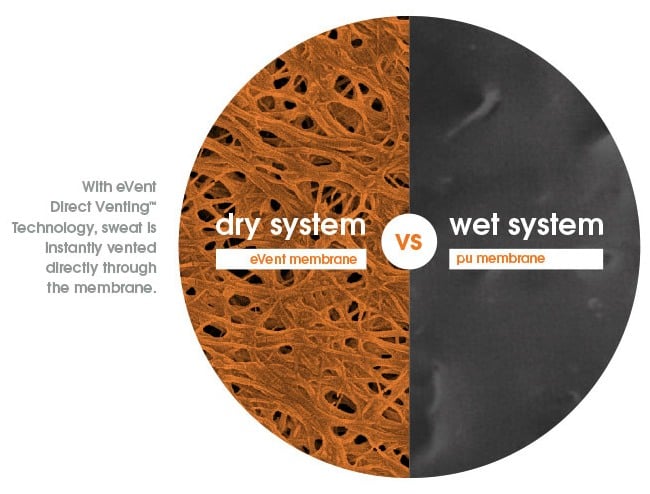
This is a diagram of the eVent technology from the eVent web site itself. The porous orange layer is expanded PTFE – the same as the original GoreTex V12 stuff.  It has HOLES in it.

The Teflon layer does repel water to a significant degree, and that gives the fabric the appearance of being waterproof. But that depends entirely on the Teflon keeping its water-repelling properties (surface tension in technical jargon). It the surface of the Teflon loses that water-repellency, water will go through all those holes.

Goretex V1 failed in the field when the Teflon layer became contaminated with skin oils. Water came through. So Goretex V2 has a thin layer of PU over the top of the Teflon. Gore will not tell you this, but the harsh reality is that Goretex these days is just  PU-coated fabric, with some internal enhancements.

When the Gore patents expired some years ago, eVent basically produced the equivalent of the original GoreTex V1 fabric. Same Teflon, same holes.

Now, why did the jacket leak?
Because the water-repellency of the Teflon layer was destroyed, at least temporarily, by the common washing powders. Those powders contain a whole range of stuff like perfumes, brighteners and so on, in addition to the basic detergent, and any of these washing powders (laundromat or domestic) will leave surface contaminants on the Teflon, to wreck its water repellency.

Yes, you done it to yourself!

The ONLY solution is to wash any W/B clothing or gear in a proper Sports Wash. I like Atsko Sports Wash, but there are several other brands. These do NOT leave any residuals on the fabric. This is crucial.

You may need to wash that jacket in Sports Wash, in a clean bucket, not a contaminated washing machine, a couple of times. Could be an idea to reapply whatever DWR material was originally used. I recommend you do NOT mix DWRs. Some are totally incompatible with others.

Cheers

PS: even fleece prefers Sports Wash to washing powders.


Victor Lin BPL Member
PostedMay 30, 2016 at 3:15 am

Ok, I’m confused. I just looked at my leaky eVent jacket and it says “Wash me often! Warm water with liquid detergent.”

So… should I NOT follow their instructions?

Roger Caffin BPL Member
PostedMay 30, 2016 at 4:04 am

Wash often is fine.
Liquid detergent is infinitely better than laundromat powder, although not as good as a genuine Sports Wash.
Tricky, ennit?

Cheers

Jerry Adams BPL Member
PostedMay 30, 2016 at 7:44 am

Eric, those are colder temps than I go, my lower limit is like 20 F.  I suspect that encompasses most sleeping of most people here.  Floorless pyramid tent.  M50 water resistant bivy.  850 FP down.

I’ve weighed my bag before/after about 10 times.  6 night trips.  Sometimes rainy, sometimes dry.  23 ounces before.  Gains between 0 and 1 ounce after the trip.

Body heat dries out your bag in normal conditions – at least enough to get rid of sweat – nighttime temps above 20 F

Another thing that Ryan talked about was doing a study of down at cold humid conditions.  He wanted to see if lower FP down worked better.  I wonder what happened to that.

Jerry Adams BPL Member
PostedMay 30, 2016 at 7:58 am

I question the idea of washing often.  Too many opportunities to screw things up.  But those laminates are susceptible to dirt and body oil so you have to wash them when they get dirty.

My eVent jacket started turning color.  Especially on the hood and shoulders.  I think I washed with liquid Woolite which should have worked, but didn’t make any difference.

That was 2.5 layer eVent.  It seems to be just one layer of fabric – the outer layer of nylon is bonded to the eVent membrane.  And there’s no liner fabric, just some pattern that’s supposed to protect it from body oils.

So, I made my new jacket out of 2.5 layer Pertex Shield (thru-hiker).  I put a liner of nylon under the hood and shoulders.  Seems to be holding up better.

I question whether those 2.5 layer laminates are sturdy enough.  They are lightweight which is good.  But they delaminate and lose waterproofness after about a year.  If someone made a jacket with a liner on just the hood and shoulders that might be better without gaining much weight.  Or if you were satisfied with getting just one year of use, then the light weight is great.  This would be better for an occasional user, then it could last for years.

James holden BPL Member
PostedMay 30, 2016 at 9:48 am

Actually jerry

those are temps right around freezing as our dear leader mentioned in the link above

ive also found it to be the case that body heat is not enough in the freezing (under 40F continuous wet conditions)

as to bivies, its hit or miss, for some folks it works, for others its causes more condensation …. Theres plenty of threads on BPL about the issue

event should be washes all the time …. It said so on the little tag that came with the stuff the last time i checked

of course each wash will also eventually degrade the garment

but if one wants “waterproof” get gore …. They “guarantee” it with an extra warranty

;)

PostedMay 30, 2016 at 9:57 am

The technical knowledge here is a fascinating read.

From a hands-on practical viewpoint the following works for me:

It’s not your living room out there. Expect to get wet or at least uncomfortably damp. Experience and proper gear hopefully will keep this from escalating into a life threatening situation.

WP/B products are at best a waste of money. Total reliance on them can be dangerous.

DWR coatings are fleeting and a pain in the butt to maintain. Forget about them as a major player. Easier to stomach if one has already eliminated WP/B’s.

Down products are to be used only when one is not on the move. They are the life savers, the ‘oh shit I might die now’ back-up package securely sealed up somewhere in your pack.


Jerry Adams BPL Member
PostedMay 30, 2016 at 10:21 am

ahhh…  you’re right… forecast for 10 F but it was actually 32 F

Different people have different experiences.  Like I said, for about 10 trips of 6 nights, many of which were around 32 F and raining, my down bag never gained more than 5% weight.  Rarely I do a trip with snow and have not measured weight of bag after, so that might be a difference.

What’s great about this website is there are many different opinions.  Sometimes ideas that are “out of the box”.  People can try different ideas and see what works for them.

Ken Thompson BPL Member
PostedMay 30, 2016 at 10:30 am

Victor probably would be better served with an inexpensive fleece top and a cheap waterproof raincoat. Neither needs special care. And possibly an umbrella.

Bob Moulder BPL Member
PostedMay 30, 2016 at 10:49 am

Frogg Togg and a fleece from WalMart. about $30 total. :^)

I have used a MB Versalite and Chameece (~100wt fleece) and have been quite comfortable in 45F rain.

PostedMay 30, 2016 at 11:56 am

Adding to what Roger said earlier, occasionally degreasing these synthetics will help too (will also help a lot with stinky polyester and polypropylene clothes).  Problem is that with most synthetics except for PU, our skin oils bond strongly to them, strong enough that regular soaps and detergents aren’t able to get all or even most of the fatty substances off.

You need a heavier duty degreaser of some kind.  I saw one guy recommend and swear by using Simple Green, but i haven’t tried it.  I’ve only used hot water and dissolved Washing Soda (followed by a wash with an Atsko type cleanser and very thorough rinsing).

Optimer realized skin oils were part of the problem with polyester stink which is why they developed “Fresh Guard” for their Dri-Release tech, which is nothing more than a PU coating on the polyester (the oils/fats don’t bond to the PU).  It also helps that there are some moisture absorbent fibers (cotton, tencel, wool, silk) on the outside of the fiber bundles, which both don’t facilitate the growth of stink producing bacteria (electrical charge based) and it’s easier to wash the oils out of after.

It would be interesting to take out an old eVent membrane and analyze it, I suspect besides finding skin oils and other gunk bonded to it, probably would find microbes that feed off these too (which would further increase the surface energy and lower it’s DWR nature).

If using a degreaser, make sure you rinse really well.

Also adding to what Matt said earlier–the more air permeable (measurable CFM) a WPB system, the less the humidity gradient issue is an issue. For PU coatings and layers, it’s a particularly important issue because these tend to have very low air permeability and move moisture in a different and less direct way.

This is why i think combining non reapplying DWR fabrics, 1 to 3 CFM air permeable WPB front fabric combo, and ventilated Poncho design, would provide the ultimate in breathability and practical rain protection.  However, it does have a weakness–it will need to be occasionally deeply degreased/cleansed, and rinsed somewhat often.  I plan to use shock cord, and cord lock to tighten or loosen poncho as needed–as this can be an issue with very high winds, etc

If i lived in a drier and less humid climate, i probably wouldn’t care as much about having very high breathability.

Roger Caffin BPL Member
PostedMay 30, 2016 at 4:08 pm

I rather like Bob’s version:
“Frogg Togg and a fleece from WalMart. about $30 total. :^)”

Reality is that there is nothing on the market which is much better than this. Sure, once upon a time we had worse gear, but there’s nothing magic about ‘expensive gear’ these days if Walmart (ie China) can duplicate it.

The only extra you get from the glamour brands today is a psuedo-warm feeling from the marketing spin.

Cheers


Viewing 25 posts - 26 through 50 (of 69 total)
Loading...