Topic

HMG "The Shell"

Viewing 24 posts - 26 through 49 (of 49 total)
Sam C BPL Member
PostedSep 3, 2017 at 9:05 am

HMG was originally built for UL mountaineering/alpining, I believe they still are for the most part.  All of their products are also items that St. Pierre himself uses, so in reality they are built to his specs based on his own desires and usages. All cottage manufactures did this at one point in time and most are still doing it to this day.  It all comes down to which flavor of Jim Jones Party Mix you like best. Bottom line, The Shell is more-than-likely meant to be an alpine shell and not one meant for general hiking–UL or otherwise.

To an alpinist and/or climber, this will be more than an emergency shell and when compared to other high-end alpine shells it is far from the most expensive.

Ryan Smith BPL Member
PostedSep 3, 2017 at 10:56 am

When it comes to rain shells, it’s like watching Groundhog Day. New shell is released with great specs and test numbers. Everyone says, “Finally, this time is different. This shell is the real deal.” Two weeks later Richard runs his tests and it turns out to be a slight variation of the same ol’ hot sweaty mess we’ve had for years.  I’m not holding my breath.

PostedSep 3, 2017 at 3:16 pm

Holy frijoles, I’ve driven cars that cost less.I’m sure it’s wonderful, but come on.

Geoff Caplan BPL Member
PostedSep 12, 2017 at 2:52 pm

I’m with Ryan -, another new fabric, another marketing department promising the Holy Grail. Allow me to be cynical.

There are already some reviews on the site from their testers and ambassadors, and they are extremely vague about how it performs in the areas where other fabrics fail. Does this thing wet out in extended downpours? Does it keep breathing when you sweat up in humid and warm weather? Nobody’s saying.

Some posters are pointing out that it may have been designed as an alpine jacket, but on the product page the list of applications begins with thru-hiking, so it’s fair to evaluate it in that context. But if you don’t need alpine abrasion resistance, I really can’t see how anyone needs to spend this kind of $$$. And if you do, I personally wouldn’t choose a fabric with an unprotected Event membrane, as it’s generally thought to be very fragile. Really – how long is the membrane going to last under your pack-straps?

Personally I’ve given up on fancy fabrics – I buy cheap mass-market stuff, add some zips and keep it vented. It seems to perform just as well as the upmarket garments for all practical purposes. I’ve survived biblical downpours in the UK and the Alps with only minor discomfort.

Will this thing really deliver much more at 15 times the price?

JCH BPL Member
PostedSep 12, 2017 at 3:22 pm

Geoff – mind elaborating on your choices (brand/model) and mods?  Rain gear is the last bit of my kit that isn’t fully sorted. TIA.

Geoff Caplan BPL Member
PostedSep 12, 2017 at 6:26 pm

JHC – my current jacket is a Regatta, but the label doesn’t say which model. Cost around £15 in a sale. Weighs 280 grams but is longer than most lightweight jackets, which I like. Uses a fabric called Isolite 5000 and is fully sealed. Regatta is a low-to-mid market consumer brand in the UK that has regular sales.

In the past I’ve unpicked the side-seam on a cheap jacket and added pit-zips, but haven’t bothered with this one as I’m only doing day-hikes and weekenders for the next few months.

The Regatta works fine, but I wouldn’t particularly recommend it unless your budged is very tight – the cuffs and hood could do with improvement, though they’re bearable. Probably better to spend a  bit more for a better cut.

But my point was that it’s perfectly usable. I vent at every opportunity, and If I don’t over-dress under the shell, use a good base-layer and moderate my pace so I don’t sweat up I can finish a long alpine day in the rain with nothing worse than a bit of dampness. My fancy Goretex did no better. Technique and venting trump fancy fabrics, I think.

I go back to the days before Goretex,when we simply used waterproof nylon cagoules. And guess what – we had a great time in the hills and never got all that wet (and that was in Scotland!). They were cut loosely to let air circulate, and we did learn how to vent whenever possible.

I just can’t accept that you have to spend upwards of $450 on a shell to stay safe and comfortable. It’s all marketing, I feel. I’m much more interested in the work that Sierra Designs have being doing with Andrew Skurka to offer an affordable cagoule with improved venting. Now that’s something that does make sense…

JCH BPL Member
PostedSep 13, 2017 at 5:09 am

Geoff – you seem like a very pragmatic guy. What you are saying speaks to what I have experienced…I’m somewhat surprised to not hear similar statements very often.

If I may, one more question: Your location and experience seem to include prolonged, if perhaps not torrential wetness, and it is being comfortable in those conditions that interest me. I’m currently carrying the Montbell Versatile jacket and pants for “just in case” in cold weather but do no harbor any expectation of them being of much value for days-long rain.  I recently got a sil rain skirt for cool to warm weather and really like it.  I’m seriously considering moving to a ZPacks cuben poncho (lots of good things written about them).  Any experience with ponchos or the ZPacks in particular?

Geoff Caplan BPL Member
PostedSep 13, 2017 at 8:00 am

JHC – well, we’re heading OT, but as the thread seems to be dying I guess there’s no harm…

My first tip is to use the Brynje-style mesh base-layer which is popular in Norway (or a mesh cycling base layer if looks are an issue). Then cap it with a well-vented fast-wicking conventional base layer. In cold weather you keep the conventional layer closed, trapping warm air against your skin. If the conventional layer gets wet, it doesn’t touch your skin and you stay warm. If you get hot, vent the conventional layer and the mesh layer dumps heat instantly. Outside of a blizzard,that’s all I need under my shell, though you have to add insulation fast if you stop. The mesh top dries in a few minutes on your body – much faster than any conventional layer. So when I’m on the trail I rarely take it off. Highly recommended. With the mesh layer, putting on damp clothing in the morning is much less of a trial.

In the UK very few people use ponchos in the hills – it’s simply too windy for them to be practical. So I’ve no experience.  But before you take the poncho route, you could take a look at something a bit more shaped like a Packa or Roger’s MYOG mountain poncho:  https://backpackinglight.com/myog_mntn_poncho/  These offer most of the poncho goodness in a garment that works in the wind – Roger is very happy with his design, and I’m sure you could find someone to make one up for you if you don’t sew yourself. Or take a look at the Sierra Designs cagoule that vents from the bottom.

As for the lower half, I’m planning on taking the kilt route as well – very attracted by the ease of putting it on in our changeable weather. But as a Scot who’s worn a conventional kilt a fair bit, I’m thinking of making something more kilt-like, with pleating on the back for freedom of movement rather then the rather ungainly tubes most people seem to be making. And RSBTR are offering tartan silnylon, so it might look quite cool! Team it up with MLD-style snow gaiters and it should be a 4-season solution for most conditions.

So this kind of approach gives you good performance without shelling out $$$$$$ on high tech (non?) solutions.

PostedSep 13, 2017 at 10:27 am

As someone who isn’t scottish, how to pleats work to improve movement? I’m interested in making my own kilt too, so makes sense to get scottish perspective!

PostedSep 13, 2017 at 11:28 am

Geoff,

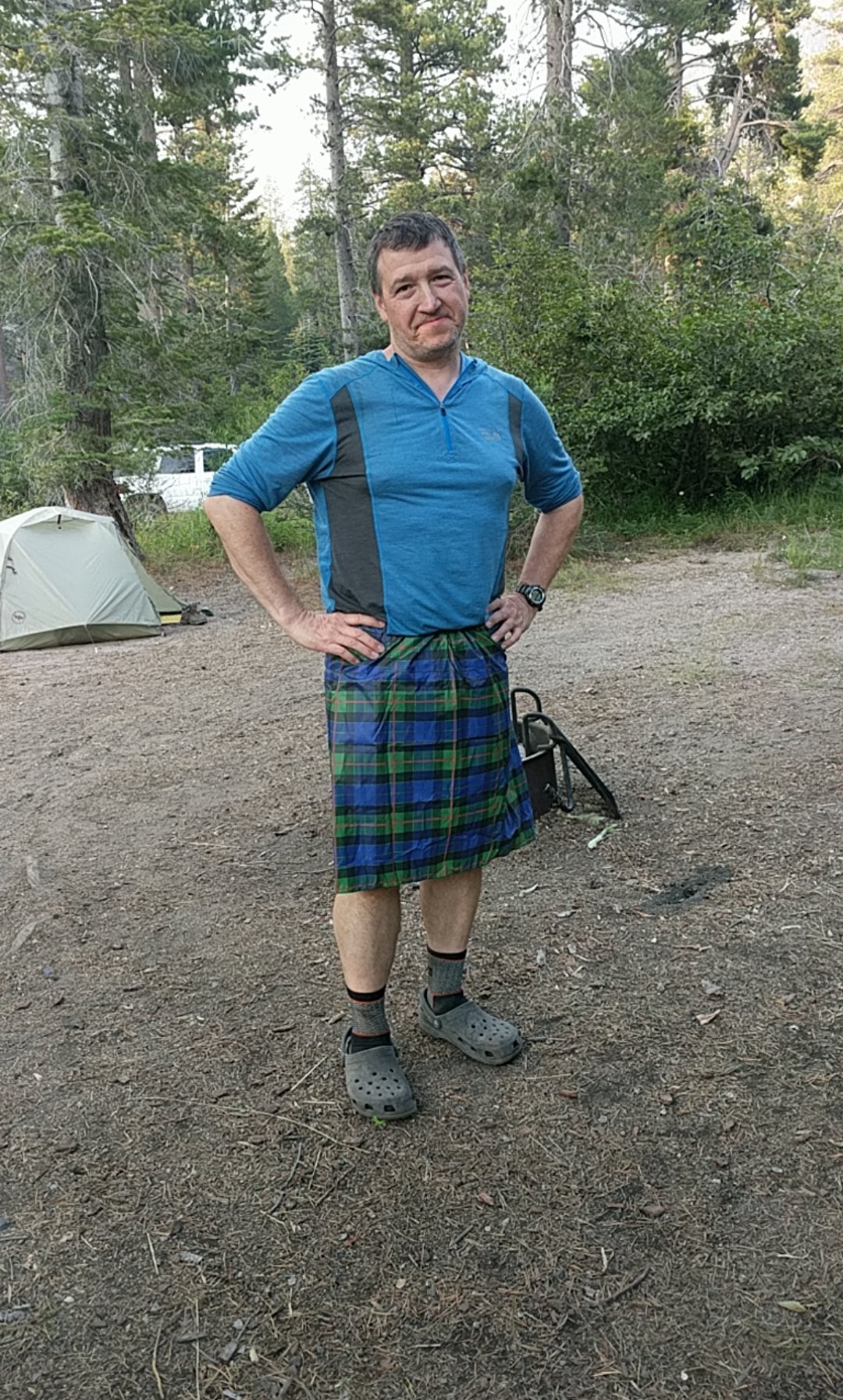
Funny you should mention the RSBTR tartan fabrics.  I did exactly what you described using their printed waterproof nylon.  The picture is me from mid-August on the JMT, camped at Reds Meadow campground. I never got to use it in the rain.  This was laundry day and I was waiting for my hiking pants to dry.

This one has two pleats on either side, which is barely enough, and pretty much the most I could do using a standard 58″ width fabric.  I’ll need to sew two widths together to make one with more pleats.

Jonathan – I own a ZPacks rain kilt.  I found it extremely annoying because any stride longer than a half-step is limited by the diameter of the lower hem.  Push hard enough with ZPacks’s wimpy velcro, and the kilt bottom opens up and flaps in the wind.

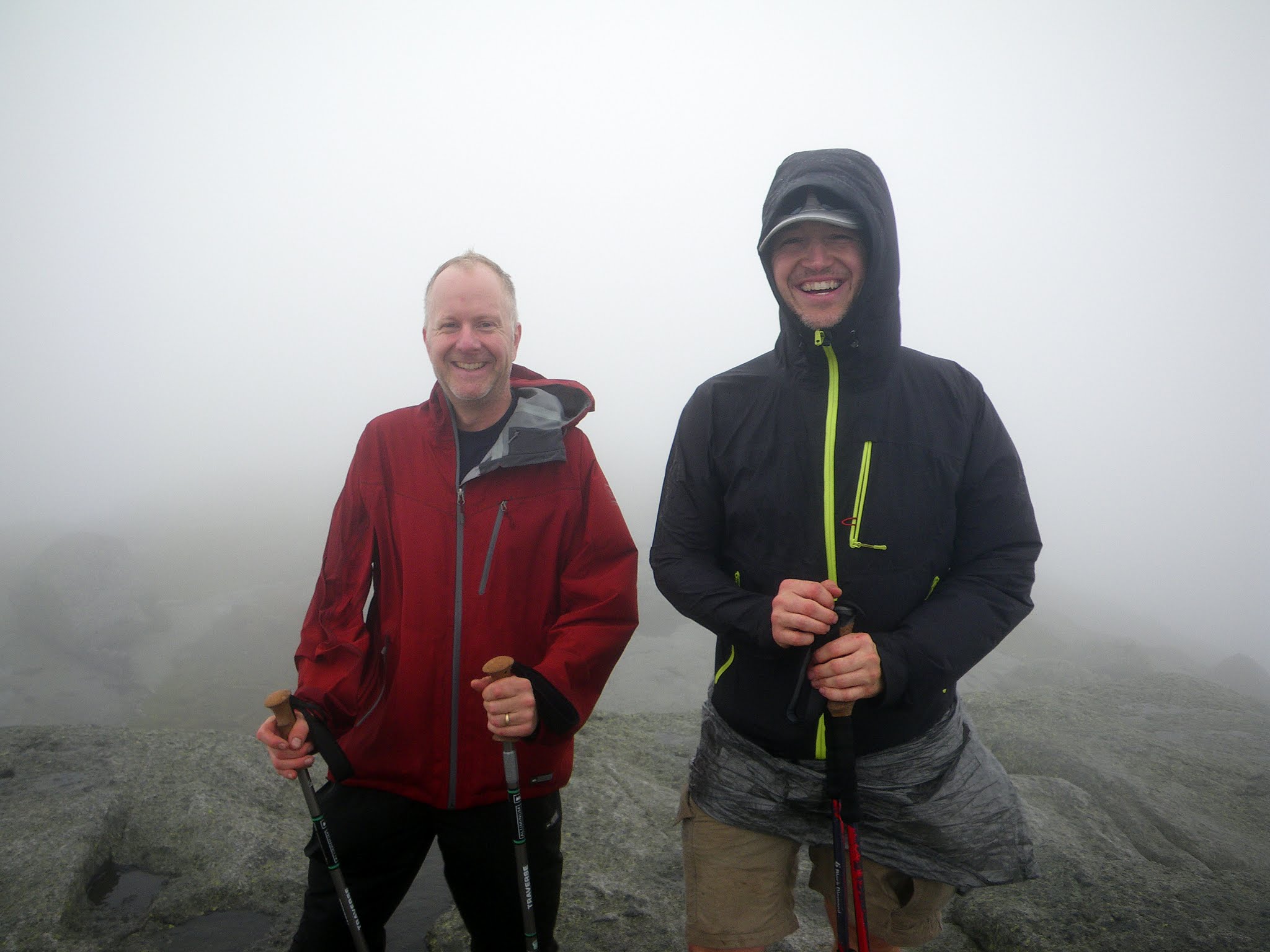
Which is exactly what happened on Mt Marcy in 2012.

The pleats allow the kilt to have a wider diameter at the bottom than at the waist, to give you more legroom for long strides, climbing up and down rocks, etc.


nunatak BPL Member
PostedSep 13, 2017 at 12:33 pm

Another diversion from the original content, and a shout-out for Brynje mesh base layers. I have used them since the eighties, and there’s nothing better for damp, cold environments (like rain in the mountains!) and winter trips.

A few years back I added several new pieces by contacting Brynje directly and having them shipped to the US. Looks like there’s a web shop and maybe a dealer these days?

Now that I live in the Southwest my Brynje tops only go on while backcountry skiing.

Geoff Caplan BPL Member
PostedSep 13, 2017 at 5:45 pm

Curses – I guess I won’t be the first with a tartan rain kilt!

Jonathan – Jeff pretty much sums it up – the pleating (kilting) at the back provides freedom of movement so you can take a long or high stride without being restricted. The Highland Regiments used to fight in these things, so done properly they are a very functional garment. I wouldn’t like to try this in the Zpacks kilt:

Image result for highland regiment ww1 kilt

The tubular rain kilts try to deal with this by leaving them open at the back, but as Jeff points out this doesn’t work very well. A real kilt wraps all the way around without restricting movement. The trick would be to find the minimum number of pleats to do the job, to keep the weight down – I’ll just play around with garbage bags and gaffer tape. I think there’s quite a lot of scope for improving the rain kilt, but that’s for another thread.

PostedSep 14, 2017 at 7:47 am

Geoff,

You may not be the first, but you’d give it an air of legitimacy that I can’t as a Yankee.  :-)

I look forward to seeing your incarnation of the rain kilt.


PostedSep 14, 2017 at 8:05 am

Great stuff. It seems bizarre that with all the rain wraps about no big mfgs took inspiration from more mainstream kilt/skirt designs for mobility. Look forward to seeing Geoff’s project and trying it out myself at some point :)


And great discussion in general on venting. I’ve read very little on the subject which seems bizarre given most of the ul world seems to be aware of the problems with waterproof breathable. I hadn’t heard of brynje before so I’m glad to learn about it!

JCH BPL Member
PostedSep 14, 2017 at 8:48 am

Full-on, complete thread drift in progress…although shell venting was an integral aspect of the jacket that started this discussion :)

re: Brynje – I was also completely ignorant of this mfgr and their products.  Very interesting stuff.  I’m particularly interested in the Super Thermo Mesh line (polypro) but somewhat concerned about the comment about the mesh in the shoulders not being comfortable under pack straps…seems only the Wool Thermo Mesh line offers jersey knit in the shoulders and even that seems like it doesn’t extend far enough onto the front of the shoulders.  Any other opinions/experience with wearing the STM line under a pack?

Geoff Caplan BPL Member
PostedSep 14, 2017 at 9:38 am

OK – let’s go with the thread drift. I guess we can justify it by saying we’re offering an alternative to spending $450…

I’ve been wearing the Super-Thermo under a pack with no issues at the shoulder, but I use an Aarn-style body pack which takes almost all the weight off your shoulders so your mileage may vary.

I use the mesh top whenever it might rain, or whenever I might be sweating in cool weather – ie whenever there might be moisture to manage. It works well in both scenarios provided your capping layer has a long zip and you can vent it. And if it’s cold I wear it under my sleeping layer – it adds a lot of warmth for it’s weight, and even if it’s damp it soon dries out.

Though the polypro mesh isn’t the most comfortable, to be honest – not a show-stopper but not ideal. I wish it felt a bit softer. And because it’s so open it doesn’t work to block sun so you pretty much have to cap it – it’s useless on its own. I’m thinking of trying one of those mesh tops the cyclists wear – you could use it on its own in the heat so it would be more flexible. I don’t think it would work quite as well in the wet at the mesh isn’t so deep, but I’m rarely in extreme cold so it might be good enough and a bit more comfortable.

By the way I feel the Brynje run small – talk to the vendor but it may be a good idea to size up.

nunatak BPL Member
PostedSep 14, 2017 at 10:08 am

I have the Brynje polypro and the same in wool, both with full netting even on the shoulders.

The wool one is noticeably softer and, while I have never personally had issues with any of them, should almost eliminate all worries about uncomfortable pack ‘imprints’.

Geoff Caplan BPL Member
PostedSep 14, 2017 at 12:29 pm

Nunatak – how do you find it works in wool? Up in Seattle you must see all kinds of weather so I’m interested in your experiences.

I’m concerned it might wear too fast under a pack (I’ve given up on merino base layers because they just don’t last for me). also that it might take longer to dry.

I guess the wool would be better for odor on long trips? The polypro isn’t too bad but id does whiff up a bit between washes.

When would you take the wool over the polypro?


Michael F BPL Member
PostedSep 17, 2017 at 11:19 am

So any review for this yet? it’s be out a while now..

Ken Thompson BPL Member
PostedSep 17, 2017 at 5:14 pm

From the latest BPL newsletter a mini review from RJ.

“2. How About That Cuben Fiber Rain Jacket?

Lots of hoopla recently on “the internets” about The Shell, Hyperlite Mountain Gear’s new waterproof-breathable DCF-WPB (“Cuben Fiber”) rain jacket, especially in regards to its durability. I’ve been wearing The Shell for several months now, including this trip, and can attest that its durability is just fine. I even wore it on this trip while bushwhacking through a pine-and-spruce subalpine forest. My jacket has no holes or rips! Now, you may not want to go thrashing around in devil’s club or an old burn, but for routine expedition backpacking, it should serve you just fine. The best part is the jacket’s comfort: the jacket’s fit and function is outstanding, its construction quality is solid, and its fabric breathability is on par with the very best and most expensive fabrics on the market. I lived in this jacket almost the entire trip and never found myself overheating, even on the several dozen switchbacks that led up to an 11,000 foot pass topped with a couple of feet of new snow!”

Jeff W. BPL Member
PostedFeb 20, 2018 at 6:52 pm

Resurrecting this thread again.  It’s been five months since the last post.  Anyone use The Shell through the winter?  Care to share any reviews or updates?

Ben Pearre BPL Member
PostedNov 26, 2018 at 6:00 pm

I used The Shell for a few winter trips last year. About 10 day-hikes, skiing, etc., in the White Mountains in the eastern USA. Hikes were usually ~10 miles, 3000–4000 vertical feet, winds 0–40 mph, temperatures -20 C +, all kinds of weather except extreme whiteouts. Pack weights for these trips were typically around 10 kg (MIT Outing Club requires a lot of safety equipment). I’ve done some glissades, some self-arrest practice, some bushwhacking, etc. The Shell held up great. It picked up some weird colours probably from tannins in the ice I was self-arresting on…?

I haven’t been out much in serious weather this summer, but I used The Shell for a trip to Newfoundland this August (pack weight more like 15 kg, shorter distances but more bushwhacking (not through actual tuckamore, of course, but we were mostly off trail, some heavy and some prolonged rain, temperatures 15–20 C). My not-terribly-old REI eVent pants wetted out in under an hour, but The Shell continued to exceed expectations. There was a little moisture, but not much. Sorry I don’t know the source (sweat, fabric wear, zipper, head hole…?) but basically it held up great!

I’ve probably put less than 20 days on it with a heavy pack, so I can’t speak to shoulder wear, but…

I’ve been really really impressed. I sweat, and The Shell actually vents it better than any other shell I’ve used (and I do have a propensity for eVent). Summer and winter, rain and snow and wind and calm and cold and varying levels of exertion, and it’s kept me dry exceptionally well. It really does breathe, and it really is windproof, and it really is waterproof. I’ve never used a jacket that good before. Of course, nor have I used a jacket this expensive before…

I managed to tear a hole in the elbow. Must have taken me a few trips to notice it, but it didn’t spread, and it was easy to patch. Patch tape is light.

Problems:

  • In heavy rain and a headwind, the zipper leaks. Ridiculous not to use a waterproof one. Their website claims that it should be weather-resistant. Perhaps that’s a recent upgrade? Not sure… sorry :(
  • The “self-stuff pocket” is way too small. It takes a lot of work to stuff the jacket into itself.

If someone stole it, of course I’d do due diligence and see if I could get something better. But by default I’d probably buy another. If they released full-waterproof-zipper pants (so I didn’t have to (1) find or make a packed-down patch of snow, (2) remove my skis/crampons/snowshoes, (3) remove my gaiters, (4) remove my boots, (5) just to don/doff shell pants, (6) reverse [4, 3, 2]) then I’d almost certainly buy it if they did it right. Especially if it had suspenders and ideally a full front-to-back don’t-have-to-take-them-off-to-poop zipper. If they released a summer-grade (=no-side-zip?) pant, it’d be competing against offerings from many other manufacturers, but I’d still seriously consider it for summer off-trail trips. Or any summer trips.

Basically, yes, I have found it to be great so far. Hoping it continues to wear well, although who knows? Definitely keep asking around for people who have more winter miles on it, but that’s my own experience so far…

Paul S. BPL Member
PostedNov 26, 2018 at 7:21 pm

For reference, Weather-Resistant zippers are not waterproof.  There were similar complaints on the Norvan SL for using a less than WP zipper but since it’s a running jacket the extra ventilation is likely preferred.

Les BPL Member
PostedJul 6, 2019 at 2:30 pm

I’m on my second one of these jackets. They aren’t as close to perfect as you can get for about half a season and then start to seep water. I wash with mild detergent like they say but after some hard use they fail. I still use mine for a wind shell but would not trust it for when getting wet would compromise safety!

Viewing 24 posts - 26 through 49 (of 49 total)
Loading...