First off, I’ll enthusiastically agree with Roger that if spindrift is a concern then you want a solid inner. No debate from me there. As such, I’ll focus my comments here on condensation specifically, as I think mesh can be designed to function well in that context.
It seems that a lot of manufacturers view mesh inners as simply bug netting, and thus give little thought to how mesh can combat condensation. Certainly it gets mentioned that mesh provides protection from contacting condensation, but far too often you see mesh inners deployed in designs where:
1) The gap between the mesh and fly is too small, or the mesh is limp (or both), so if you bump the mesh you easily bump the fly too.
2) This is made worse by nylon sagging. In many tents, such as the Big Agnes Fly Creek series, it’s almost impossible to keep the fly from sagging and sticking to the inner mesh on a heavy condensation night.
3) The roof of the fly uses relatively flat panels, so when you get heavy condensation here it will drip onto the mesh and splatter (as opposed to running down the inside of the fly).
It’s worth noting that #1 and #2 above are still issues even with a solid fabric inner – as is #3 to a lesser extent. So regardless of the type of inner material, a good design should minimize these issues.
Gaps, Taut Inners and Fly Sag
Most tent designs use a 3-6″ gap between the inner and fly. Here, a 3-4″ gap is usually too small. Nylon expands by about 3.5% when wet, so the longer sides of a tent can easily deflect inwards by 4″ and stick to the mesh. 6″ of gap is better, but is still problematic if the inner material (mesh or solid) isn’t tight or if the fly has long nylon sides that will sag a lot (of course guylines can combat this, but it wouldn’t be simpler/lighter to have a design that avoids this need). For these reasons, my tent uses a polyester fly to largely eliminate fabric sag, and then still has a 7″ gap in crucial areas (e.g. at the ends of the tent at the bottom, where a sleeping bag is likely to be pushing). Towards the top of the tent, less gap is needed, but it still has at least 4″, which in combination with the non-sag poly makes it very hard to accidentally contact the fly. The key points here are that canopy sag is avoided, and thought is put into determining an appropriate fly-inner gap. Other tents do this, but too many designs do not.
A key part of designing a tent to handle condensation well is having the inner taut. This is harder to do with mesh because it has more stretch to it than solid fabric. So achieving a taut mesh inner is actually quite hard to do (this was probably the hardest attribute to refine in my tent). In general, mainstream tents do a pretty good job with having the inner taut (be it mesh or solid), whereas a lot of UL/cottage tents have limp inners. Most of this has to do with the number of connection points. In a traditional dome tent, the inner might clip to the poles at 10 – 20 places, whereas on the other end of the spectrum is a single pole mid tent where the inner typically is only connects at the peak (plus the four bottom corners). So you get much longer expanses of unsupported material that are going to deflect more easily. In that case you need a larger gap.
Panel Slopes
Something I’ve been ranting on about over the last few months is consistency in panel slopes. A tent can have many steep panels that shed snow well, but if there is one flat panel then the snow will accumulate there. Similarly for wind, if most of the sides have a good slope but one side is vertical, then it’s problematic in high winds. A tent is only as good as its weakest link.
For snow and condensation specifically, the roof panels are typically the weakest link as these are usually on a lower angle than the side panels. Thus if you have heavy condensation, it might run down the inside of the side panels, but drip off the roof panels and splatter onto the mesh. It’s better to have a design where all the panels are on a consistent slope that is steep enough to shed snow and condensation, but not any steeper so that it doesn’t catch more wind than necessary. The ideal slope is around 45 degrees. This something that I worked hard on with my tent, and as a result, the roof panels aren’t nearly as flat are almost every other tent – they are very similar to all the other panel slopes so condensation will run down these panels instead of dripping, aside from droplets knocked loose by wind gusts of course. Thus, my position is that a mesh inner tent can provide excellent protection from condensation in non-windy usage if it has proper panel slopes, taut inner and sufficient gap.
Mesh and High Winds
You could argue that all of what I’ve just said is mute in windy conditions, since gusts can knock droplets loose from any panels slope. However, a few counterpoints here are:
1) In windy conditions condensation tends to be less. Wind increases airflow through the fly, and thus the combination of heavy condensation + high winds is a rare one. There are exceptions (e.g. fog rolling over an alpine ridge, or the wind suddenly picking up), but generally the worst condensation happens when you’re camped in a damp valley bottom with stagnant air. So getting hammered by high winds while simultaneously having heavy condensation is a rare combo that often indicative of poor site selection (but not always).
2) If you do get heavy condensation and moderate winds, this still shouldn’t be an issue if your panel slopes are sufficiently steep. A strong wind gust can knock droplets right off the fly, even from steep slope, but moderate winds jostling the tent will just agitate the droplets so they start rolling down the inside of the fly, if the slope is steep enough. Picture a dome (or “pop up”) tent with heavy condensation in the morning. If you give that tent a shake, some drops will likely fall from the flatter roof part, but on the steeper sides you’ll get drips running down the inside of the fabric. The key point here is that on shallow slopes condensation will more readily drip than run down the fabric, whereas on steep slopes that condensation is more likely to “run” than “drip”. Thinking about the fundamental physics, on a steep panel the surface tension holding the droplet to the fabric is much greater than the outward pull of gravity, and you have gravity pulling it along the panel where it doesn’t have to break the surface tension, so it takes little additional force to make it run, but a lot of additional force to make it drip. Thus if you have a tent with sufficiently steep slopes, moderate winds shouldn’t be a problem – condensation will be coaxed into running long before it drips. Of course high winds exist that are strong enough to do whatever they want. Generally I view the core problem here as the flat panels, and then solid fabric is a backup if that doesn’t work out due to extreme conditions. Even with solid material you still don’t want drops landing on it because they can soak through and start to drip again onto you.
Overall, my view is that the combination of high winds and heavy condensation is a rare one, and in most cases (but not all) it can be avoided through reasonable site selection. So for most folks a properly designed tent with a mesh inner can offer good protection from condensation. I’ve done a lot of my hiking on Vancouver Island, BC, Canada which is home to the wettest place in North America with 260 inches / 700 cm of annual rain, and I’ve never had an issue with a mesh inner. Any mesh issues I’ve had are in the winter.
Certainly there are conditions where a solid inner is better (spindrift, sand storms, high winds) but each design has its place. I find mesh much more pleasant in hot, muggy conditions typical of bug season. A core part of going ultralight is recognizing what functionality you need and ensuring you are only bringing that plus a reasonable safety margin, rather than selecting overkill gear for hypothetical conditions you won’t (or shouldn’t) encounter.
I personally only use a solid inner in the winter to keep blowing snow out. If it was summer and I somehow wound up with a brutal combo of high winds and heavy condensation then at least it should be warm enough that I could duck my head into my sleeping bag and tough it out.


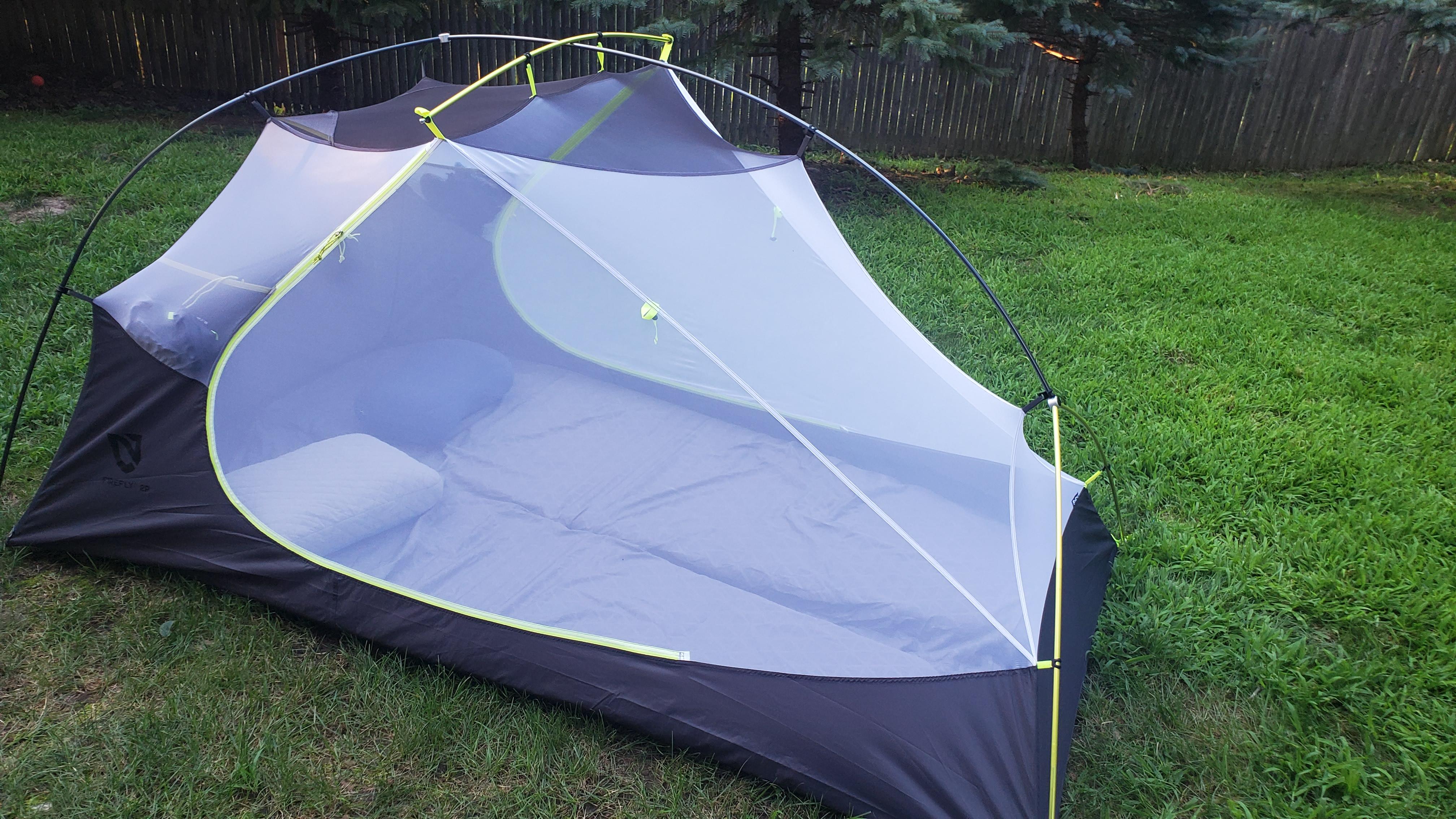

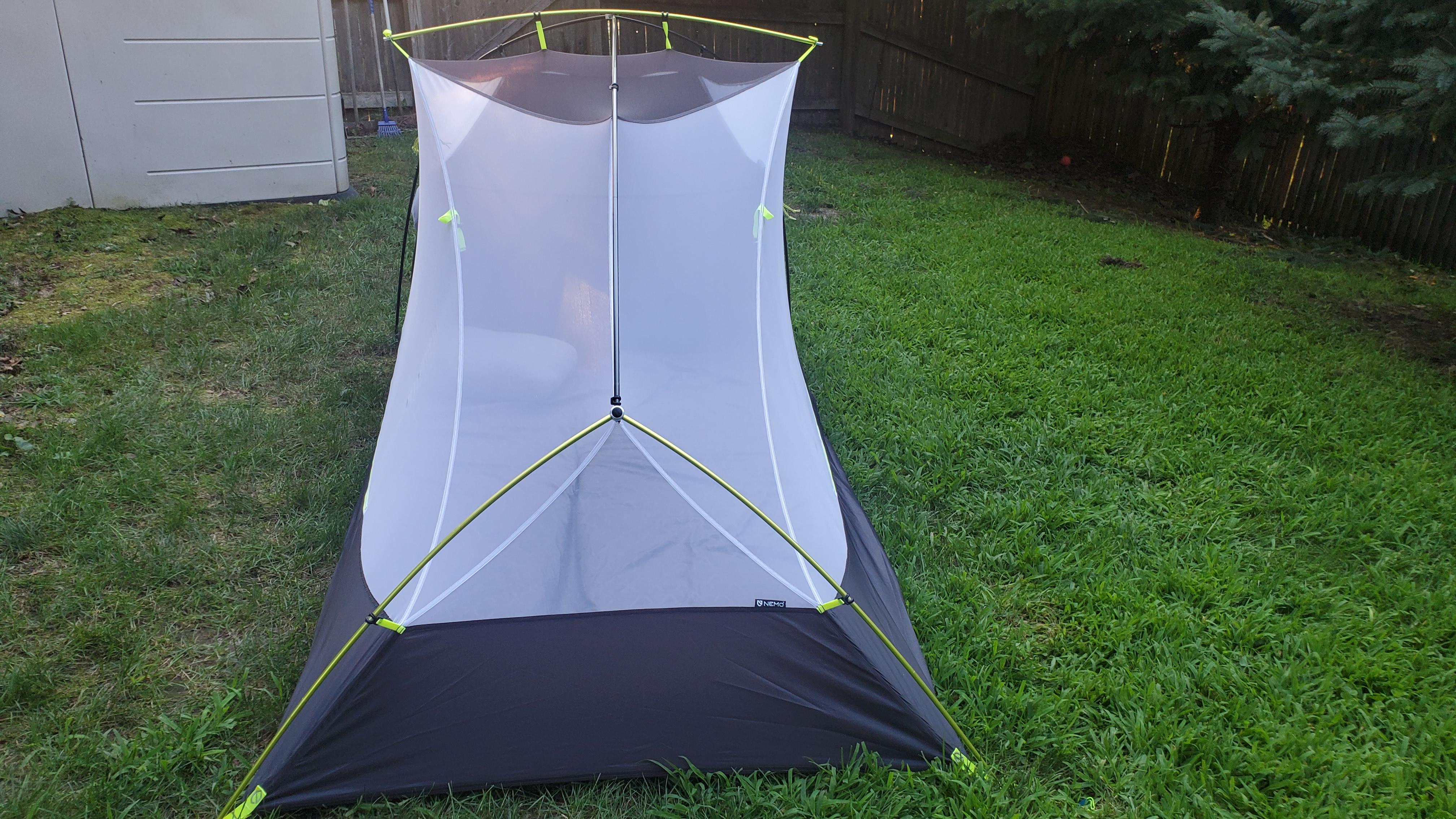
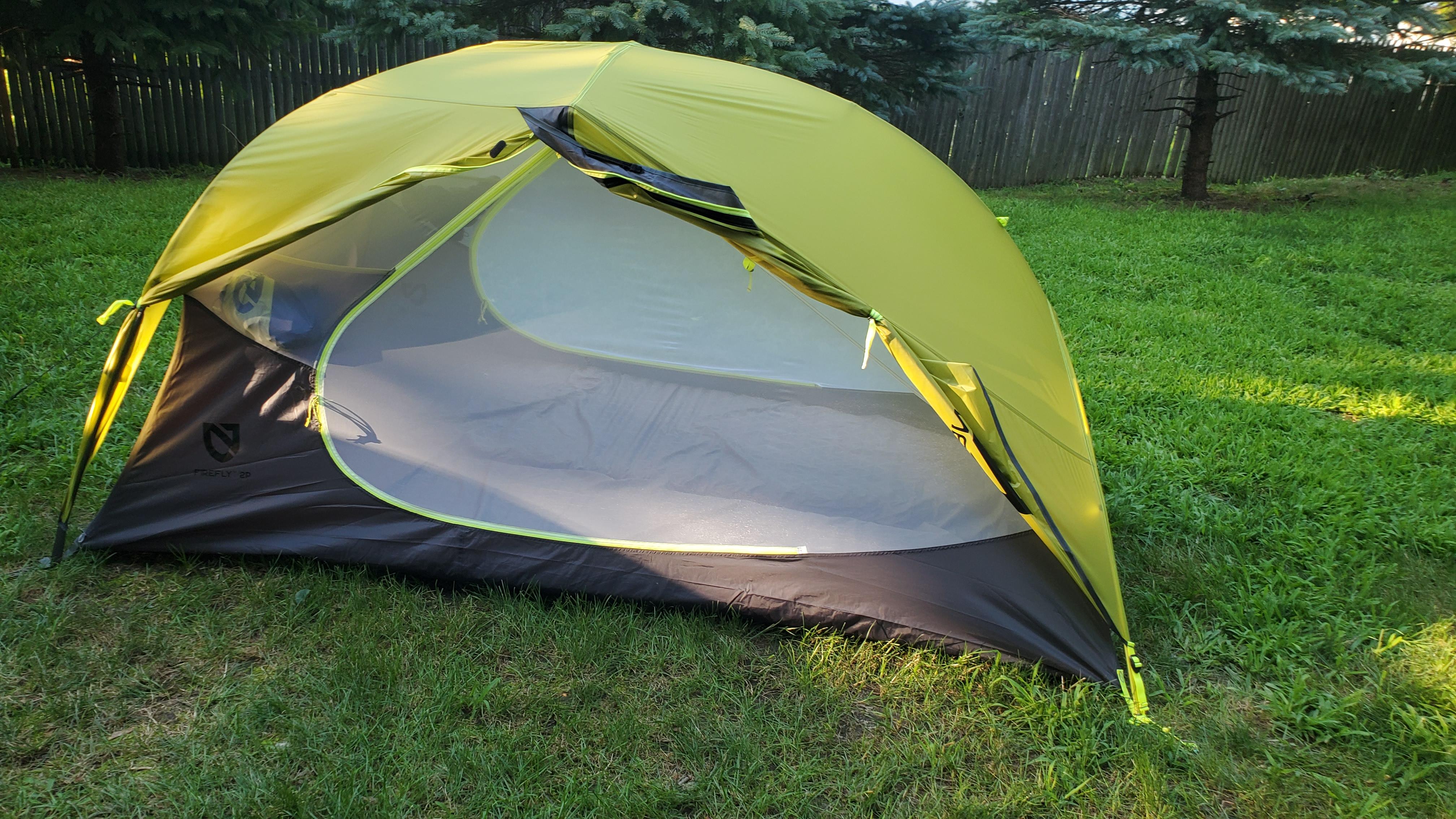
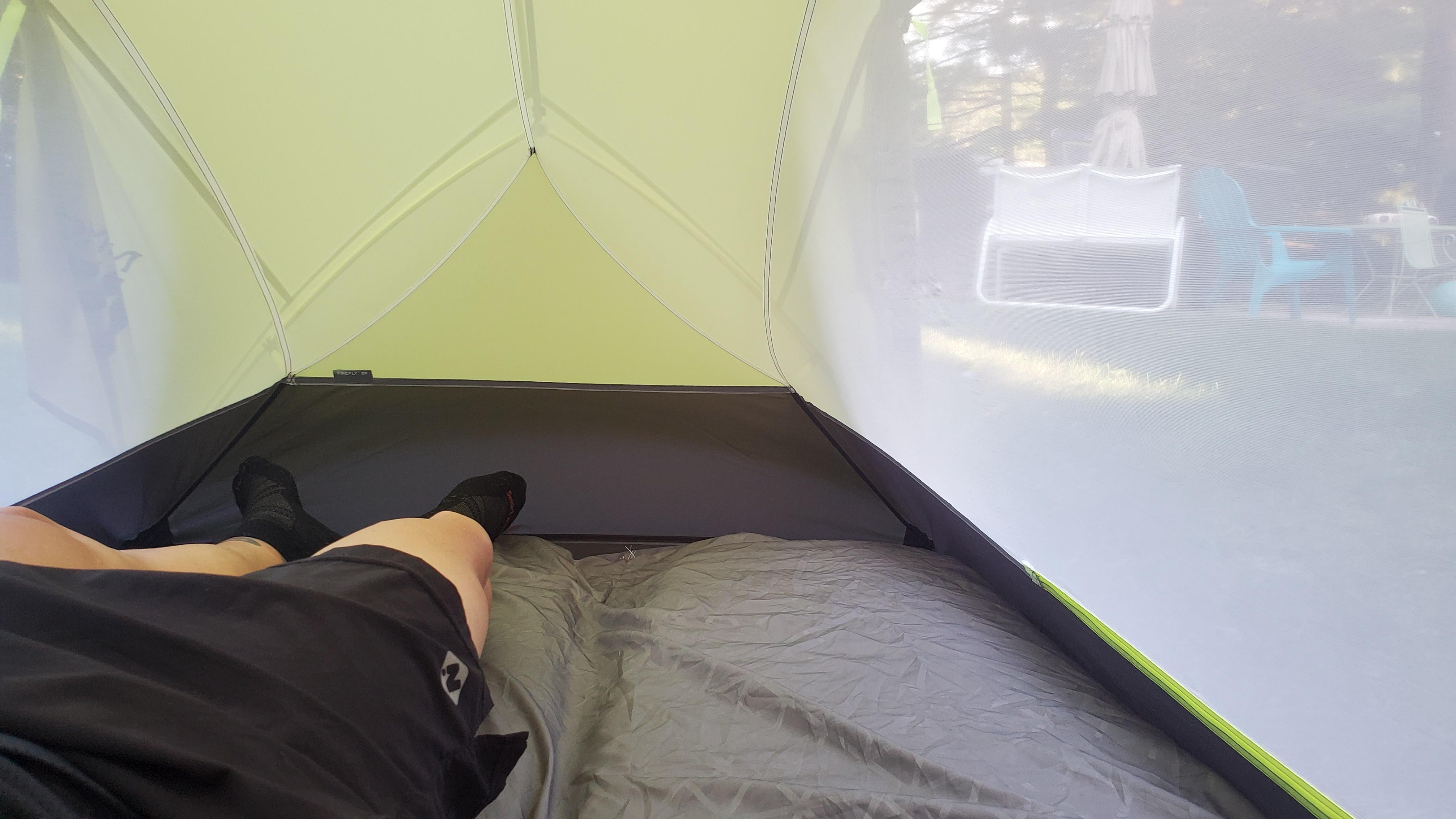
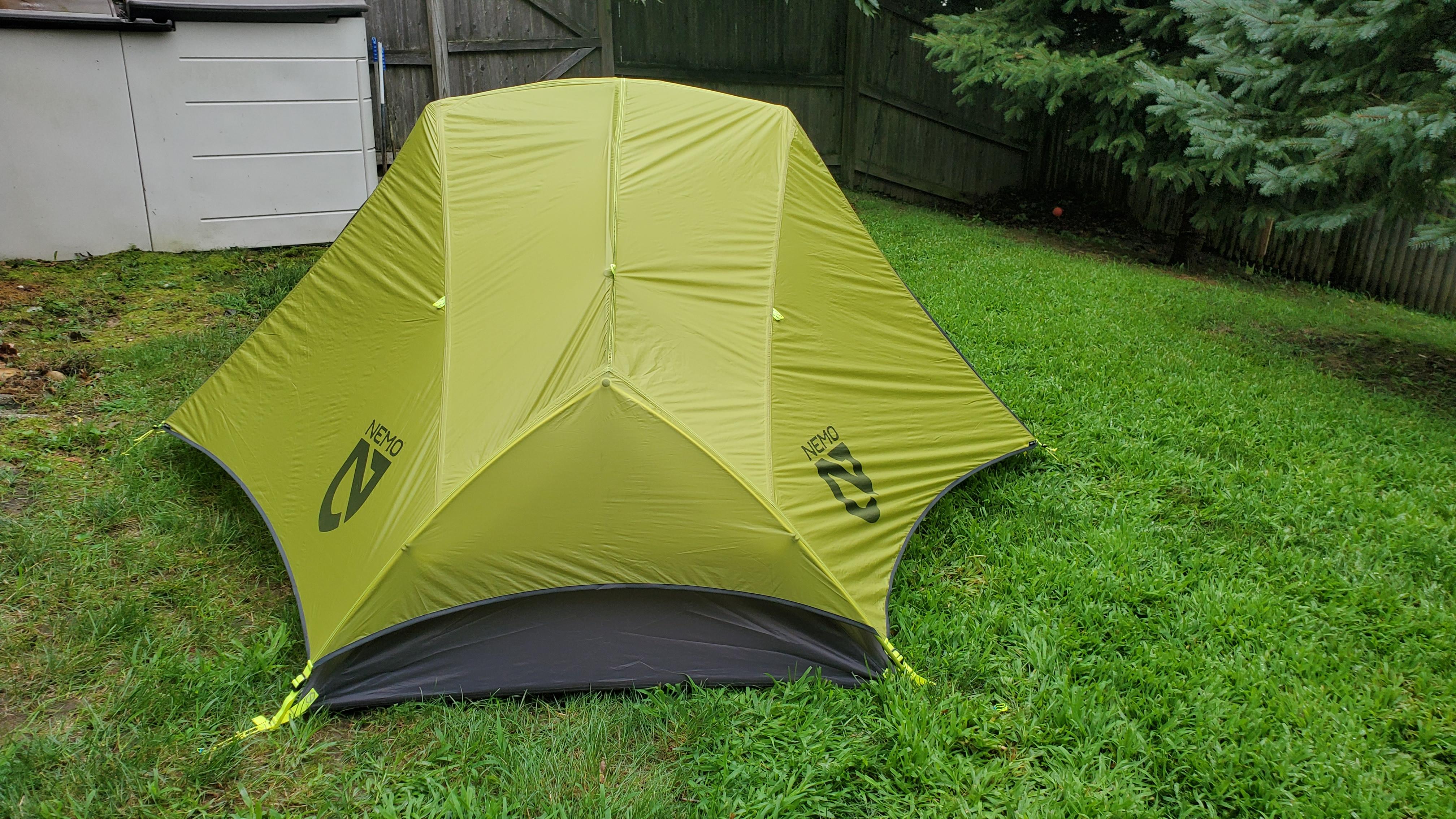
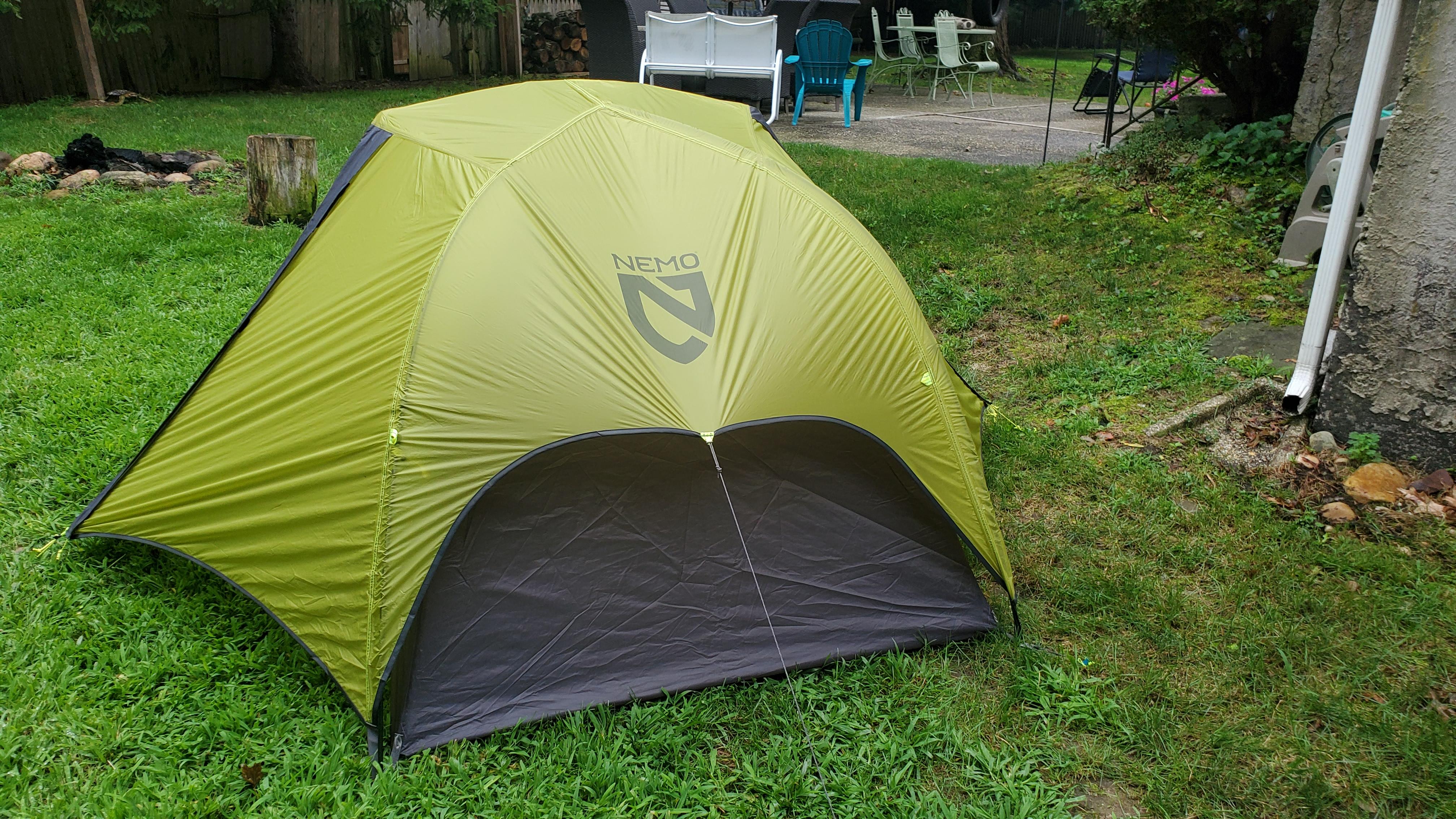 the top picture shows it fully staked out, all 4 corners and vestibule. The 4 corners are not necessary, but I did stake them here as I was leaving it set up a few days in my yard and it was going to be windy and rainy and I was not going to be home as I had to work. The bottom picture shows it with the head side staked out. Not necessary.. but works well.