Purchased an Evernew 1.3L on Amazon– newer model with the red handles and white sack. Is it normal on Evernew pots for the handle insulation to be slide-y? In the past when I’ve used pots with integrated insulated handles, the insulation is fused pretty tightly to the handle, whereas this Evernew they tend to slide up-down or rotate around, making pouring fairly difficult.
Topic
Evernew 1.3L — Handle insulation sliding?
Become a member to post in the forums.
- This topic has 33 replies, 10 voices, and was last updated 4 years, 10 months ago by .
I have noticed that brand new ones tend to slide a bit, not so much rotate though. It seems to get better quickly, I occasionally have to slide them towards the top. A little backpacking gunk will probably set tehm. My 2 cents.
Makes sense– I just noticed on the first burn that one side got significantly tighter than the other, so hopefully a combo of gunk and heat will fuse it pretty well. Thanks.
Could you pull it off and sand it a little?
I’m having the exact same issue. Mine is an older model with the grey insulation that I got secondhand, and it slides around so badly that I’ve thought about cutting it off and trying to coat the handles in something different.
yeah— a little disappointed: after trying it on a hard dryer and stove for a shrike, both sides are still roasting pretty badly. Wondering if I should try out a Toaks instead— not insulated handles but hoping they may be longer? Otherwise, thinking of cutting off the existing handles and finding something else to put on as well.
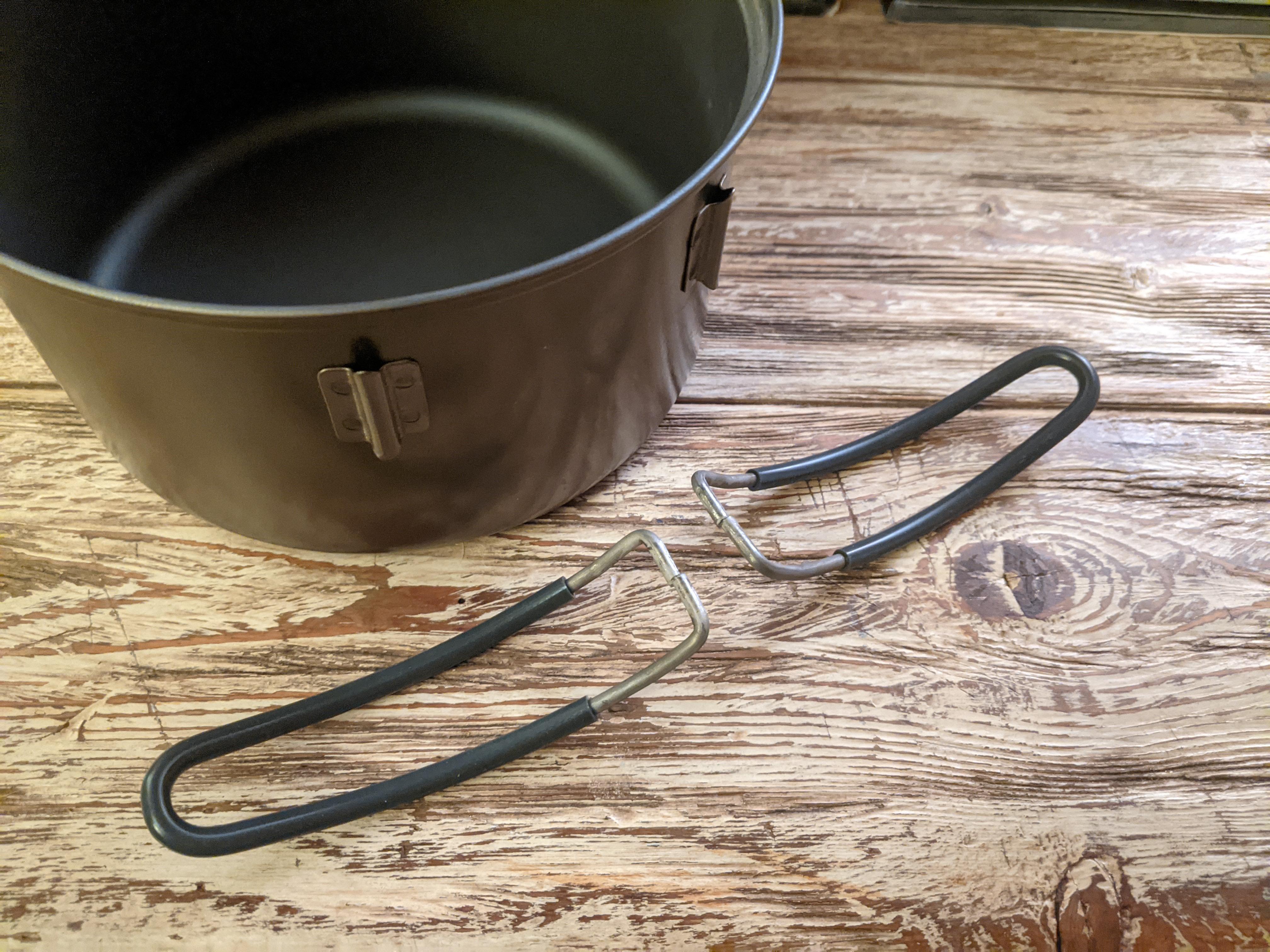
So, fun fact: the handles on the 1.3L Evernew are removable without cutting.
Pictured: Et voilà !

They pop right off, and the insulation slides off with ease; I think I’m going to look for a smaller-diameter tubing that fits better…or maybe just a longer piece of this stuff that can’t slide back and forth.
Ahh… that’ll certainly be easier/potentially reversible. Let me know how stability seems with the rubber removed.
Let me know how stability seems with the rubber removed.
Stability is better with 500ml of water in the pot; no slippery-sliding of the insulation. Noise, however, is worse: the handles rattle a bit without the dampening of the tube.
A quick search on Amazon has yielded a lot of high-temp tubing; I’ll measure the handles tomorrow and see what diameter is needed. I’m really glad this thread came along; I’ve been doing test boils in this pot all week and the handles are driving me nuts. Now I have motivation to get off the couch and fix it.
I’m doing 1000 mL tests with the pot, so you can imagine how precarious that is with the spinning/sliding rubber– just received Jon’s stoves/windscreens (excellent thus far), but the pot was a previous purchase off of Amazon (still in return window– would look into trying a replacement but they are OOS).
Let me now what ends up working out. Taking a closer look at the Toaks 1300mL dimensions and that looks like a little too narrow for a 5″ unmodified baking pan to fit for dry baking.
For anyone else reading this later, it’s loose enough so that the rubber tubing immediately slides down the handle, so that is up against the pot (where the bottom of the handle connects to the pot) when just  simply picking up the pot with 1L of water to place on a stove.
Yeah, I did a couple of 1000ml boils. Dicey… especially on top of a PRD that’s slightly off-level, itself.
I do not have a problem with the 1.3 pot pouring to the side. Â That being said, a possible solution to a full pot is to put off the water 180 degrees from the handles. Â This would not put a twist on the handles. Â Let men know what you think.
It’s not that the handles themselves are twisting… it’s just the slippery insulation that’s causing the issue. The handle wire is pretty sturdy; mine don’t twist or move very much.
The only problem with pouring 180° to the handle is steam rising up and hitting your hands.
I measured the wire of the handles: 3.01mm. I believe that a 3mm-i.d. silicon tubing would likely slide around just like the factory stuff. Perhaps a stretchy 2mm tube? Or, another thought: heat-shrink tubing. It’s obviously rated for temperature, so how about throwing a layer or two on the handles? Or, a third idea: remove the factory insulating tubes, put a layer of heat-shrink on the handle wires, stretch the factory insulation tubes back into place, and then add a second layer of heat-shrink to hold them in place.
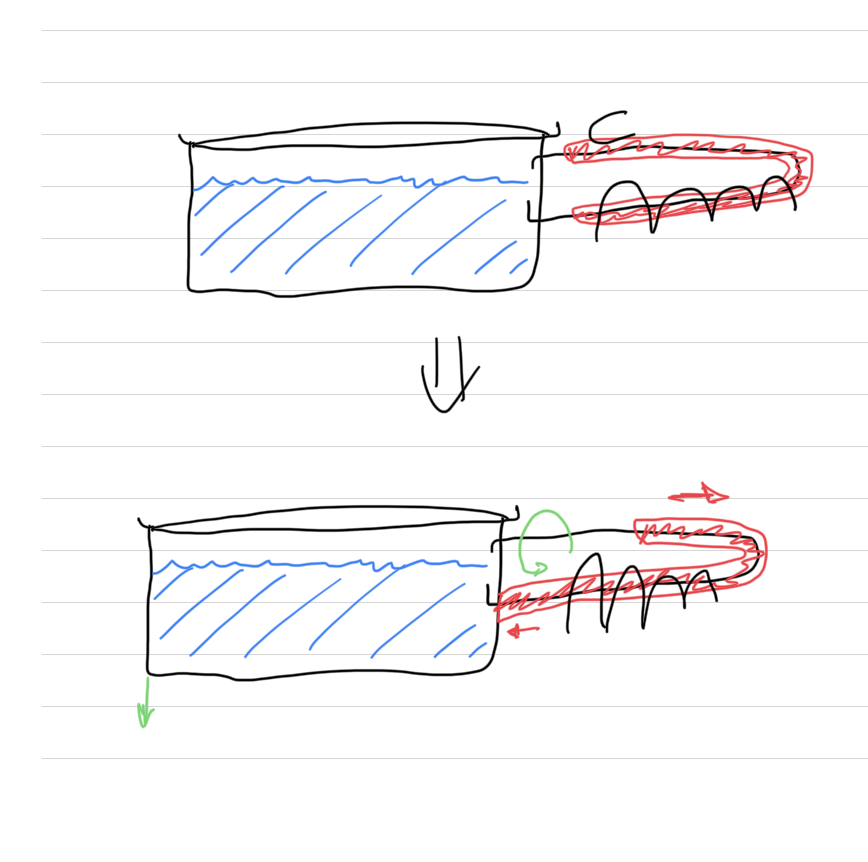
As @Bonzo mentioned, it’s a slipping of the insulation along the handle, rather than the handle itself. I tried to draw a diagram below of what this looks like. Due to the moment arm of the water in a full pot, the pot handle’s wire will slip though the handle insulation. In effect the insulation migrates down the handle. For side pours the insulation also slips/rotates longitudinally along the wire enough to act as rollers/bushings on one’s fingers, also similarly precarious. Pouring straight off the opposing end would help with the roller/bushing effect, but not the migration down the handle… the thing about the migration is that it’s nearly impossible to maintain a grip on only the insulate part of the handle, instead one needs to counter balance the pot by gripping the exposed wire, thereby rendering the insulation useless.
The handle length seems an inch or so too short to be comfortable in practice– it only transverses about halfway across my palm, whereas another inch or two would be much better for leverage, and probably help anchor the insulation a little better too. I could see this length being fine for a smaller pot– they don’t’ share the same handles across multiple pot volumes, do they?
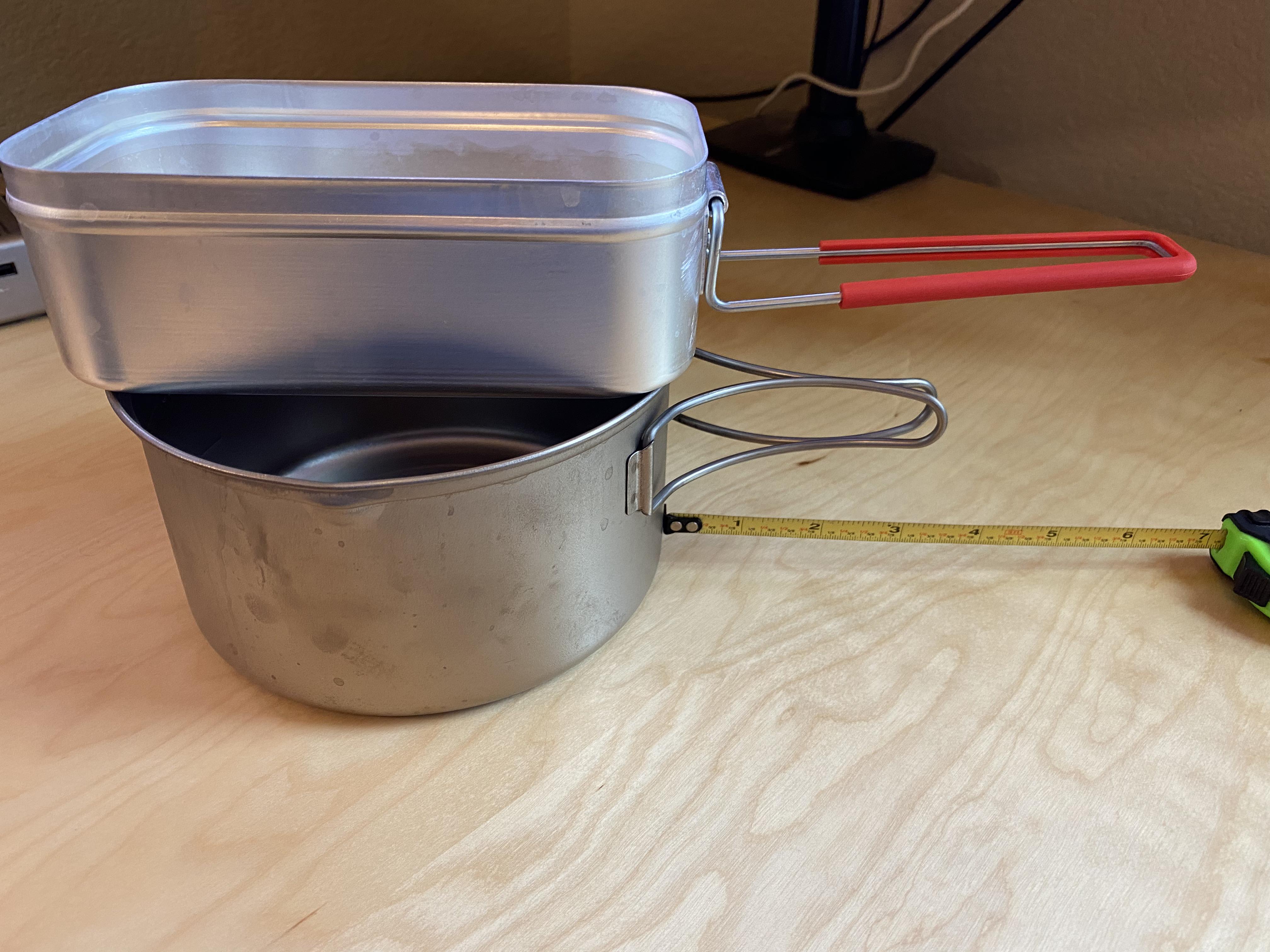
For comparison, a small Trangia mess tin is about the same length as the Evernew, has about half the volume, yet has a handle 50% longer (5″ versus 3.25″ from pot edge to tip of handle for the mess tin and the Evernew, respectively… photo below, handle insulation removed. @Bonzo, could you confirm the handle length matches yours? In case mine are uncharacteristically short).
Heat shrink tubing came to mind too. I may see how it goes insulation-less, since for anything requiring too much handling of the pot (beyond boiling water and using the handle to stabilize while stirring) I may switch over to a heavier Trangia pot with the separate pot grip.


For comparison, a small Trangia mess tin is about the same length as the Evernew, has about half the volume, yet has a handle 50% longer (5″ versus 3.25″ from pot edge to tip of handle for the mess tin and the Evernew, respectively… photo below, handle insulation removed. @Bonzo, could you confirm the handle length matches yours? In case mine are uncharacteristically short).
Yep, right about 3.25″ or so, depending on how you’re measuring.
Heat shrink tubing came to mind too. I may see how it goes insulation-less, since for anything requiring too much handling of the pot (beyond boiling water and using the handle to stabilize while stirring) I may switch over to a heavier Trangia pot with the separate pot grip.
Insulation-less is HOT if you grab the handle directly after shutting off the stove; the hot gasses going up the side of the pot make for a toasty environment. I might take an IR thermometer to the wires and see exactly how long they take to cool down; if they do so quickly, I’ll just heat-shrink the outer curve of the handle in order to keep the rattles quiet, and save a fraction of weight in the process.
Shrink tubing from what I can find, at least on McMaster, has a pretty low max temperature (~250F or so, generally tens of degrees above the shrink temp). There is some high temp shrink tubing (~500F), but shrink temp is quite high (600F). Perhaps thick walled silicone vacuum hose, and hopefully the increased wall thickness will help keep it in place and stop rotation? Assuming it has enough compliance to slip over the handle bends in the first place.
I usually put one finger through the handles to stop the slidey feeling. Alternatively, just putting it out there, ditch the handles and use a pot gripper instead.
Shrink tubing from what I can find, at least on McMaster, has a pretty low max temperature (~250F or so, generally tens of degrees above the shrink temp). There is some high temp shrink tubing (~500F), but shrink temp is quite high (600F). Perhaps thick walled silicone vacuum hose, and hopefully the increased wall thickness will help keep it in place and stop rotation? Assuming it has enough compliance to slip over the handle bends in the first place.
That’s another reason why I was thinking about taking some temperature measurements and then only using the insulation as a rattle-stopper: it’s hard to find the high-temp stuff and hard to shrink it unless you have a torch, and if you use the low-temp stuff up near the pot body it may well get scorched by the passing exhaust gasses. If the Ti wire handles cool off quickly enough to grab without hand protection, all of this becomes insignificant: strip the insulating tubes entirely and then place a bit of common low-temp heat-shrink way out on the ends of the handles, out of the hot gas plume, and be done with it.
Why not just use a silicone adhesive under the tube? Slip off the insulation, add a thin layer of silicone, then slide the insulation back on. You can add a primer to the titanium if you want to be extra certain it won’t slip.
@Bonzo I did a quick test with 2 cups. Methodology: outdoors, ~85F ambient, calm. Bobcat 2.0 stove and windscreen. 0.4 oz by weight (should be 0.5 floz.) of fuel. Scale isn’t sub 10th of an ounce accurate. Temperature measured with IR gun, generic Amazon, by sweeping it slowly across the handle segment I wanted to measure and recording the max temp it captured– so I wouldnt’ assume it does particularly well at capturing hot spots. Approx. 8-8.5 minutes to rolling boil, and burn out immediately after.
Mid way down the handles got up to about 150F, the side of the pot to 280F. Post burn out, handles got down to 120F mid-way down handle… I could pick it up bare handed at this point, but definitely at the limit of being manageable. After 2 minutes post burn out, handles were comfortably cool, even closer to the pot.
When I have some more time I’ll run 1L tests.
@’Ben H.’ Silicone adhesive sounds like a good idea… I may try that out.
I just removed the red coating on all of my pots. No problems now.
What about the dip-in coating stuff? “Plasti-dip” or “flex seal.” Would they stand up to the heat?
Yeah Plasti-dip came to mind at first too but 200F. Flex Seal looks better at 350F.
plasti-dip should be fine. If that handle is anywhere near 200F you wouldn’t be able to hold it.
Become a member to post in the forums.