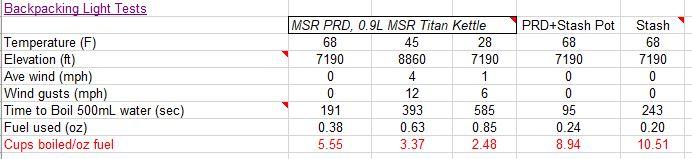
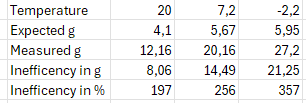
We seem, apparently, to agree that wind has a role in the effectiveness of stoves (and therefore fuel consumption). Let us then start from there.
As the national weather service shows with its wind chill chart (https://www.weather.gov/safety/cold-wind-chill-chart), we humans are cooled (and perceive it so) as a function of temperature and wind (the equation at the bottom of the chart). Can we, scientifcally spoken, agree that if there is an equation descrbing how wind/temperature combinations cool humans (for whom the chart and equation is produced) we can do one that describes cooling for our cooking contraption? This would mean that the lower the temperature AND the higher wind the larger is the cooling effect with impact on cooking time.
It appears reasonable to deduce that lower temperature also implies a cooling effect that gets stronger the colder it is even under calm conditions (There is a term in the equation at the bottom of the wind chill chart with contains “only” the variable T with a non-zero constant). Meaning, that even in calm weather cooling increases by lower temperature (for humans certainly and very likely for stoves as well).
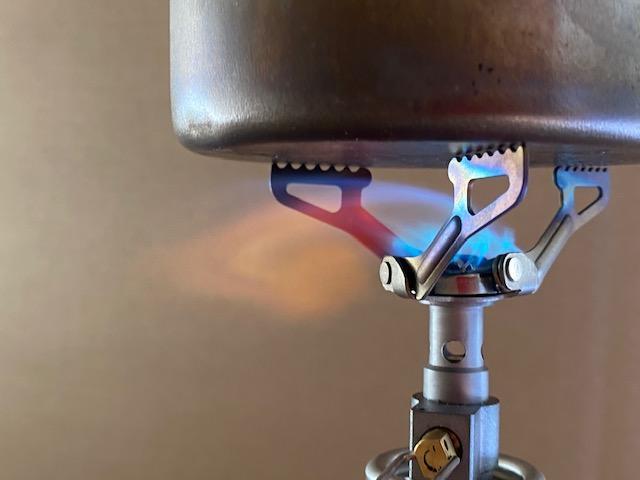
This is supported by our observation that when cooling occurs, we can observe that our cooking times are getting longer. Longer cooking times entail more fuel. And that independent from the stove and its effectiveness. I concede immediately that there are factors on stove efficiency that are also impacted by wind (flames blowing away for example) and the pot. Those are not contested here and need to be considered. However, the cooling effect occurs as well.
So, what I wonder is “What is the equation for heating water” given the equation for humans exist. Meaning what are the terms, constants and exponents.
Next step is then to consider what we can do about this. Humans can take on clothes to control the effects. What can we do for our stove that has effect on cooling?
Wind can be countered by a windscreen. We use it primarily to reduce the wind speed (with the obvious effects). However, a wind screen also reduces heat loss for cold temperatures as the still(er) air does warms up. This implies a flatter gradient and heat-loss is further reduced.
Luckily (or unfortunately), there is another effect that comes into play. Hot air rises and cold air is sucked in from below (and yes, this could be considered a localized wind). We need this chimney effect to ensure sufficient oxygen supply. Bad luck for us is that it also causes cooling. Which again, becomes more pronounced the colder it is due to the heat gradient. We need to accept this but maybe can quantify its consequence on fuel dependent on temperature or just ignore it by backing it into a windscreen effect (summarizing windspeed and others) as we can establish a test protocol for it.
However, as we have seen that convection occurs through the chimney effect, we find a second “event” where convection occurs. That is the convection for the water surface where the hot water vapor goes up. The colder it is, the faster this will go. (Coincidentally, we will end up with less water in the pot. Which we could account for by the increased cooking time). Putting a lid on our pot will reduce this significantly. (Hence my induction that the effect of a lid is more pronounced with cold temperature).
Now, I do not suggest quantifying each of these factors separately (although it would be nice). However, I suggest it as a hypothesis that ambient temperature has an effect, like wind, on cooking time.
In due time (next winter) I will set up a test protocol. However, if anyone has some data showing cooking time (or already translated it into fuel consumption) based on ambient temperature (and wind) I would be glad if those can be shared. I will try to do regression analysis to suggest a function.