Topic

By the Numbers: The New Breathability Gap in WPB Jackets and What the Breathability Tests Get Wrong

Viewing 25 posts - 26 through 50 (of 58 total)
Andrew S BPL Member
PostedOct 27, 2026 at 9:07 am

I saw a review of the Helly Hanson all polypro 3L jacket that reported some moisture absorption on the outer shell.  Or was that adsorption??  Anyway, how can that be, when polypro doesn’t absorb/adsorb water?  One thing I learned from one of Stephen’s earlier articles is that there is a difference between adsorption and absorption.  One is not into the fiber, it’s between the fibers, and how much it happens depends mainly on the knit or weave, with the fiber composition having little effect.  And at least with knit fabrics, the moisture retained between fibers (I think that’s adsorption) is far greater than the moisture that gets into the fibers.

Andrew S BPL Member
PostedOct 27, 2026 at 9:34 am

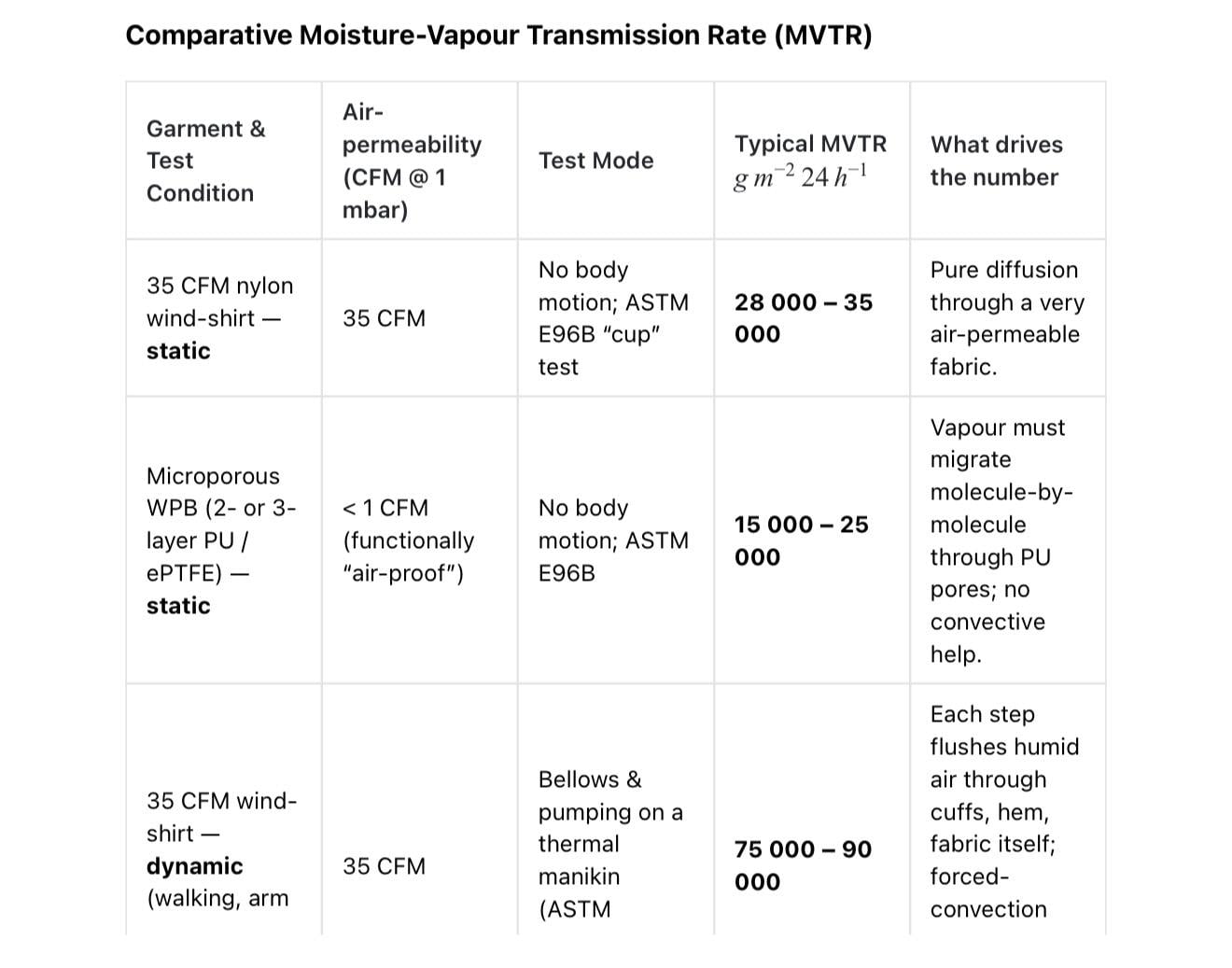
Thanks, Richard, for the very interesting table you uploaded!  (For anyone scrolling through, I definitely recommend downloading Richard’s attachement.)

Perhaps you or someone else can help me better understand one thing regarding dynamic pumping/ventilation while walking.  One study you cited found that a 35 CFM windshell gained an extra 8,000 MVTR from dynamic pumping.  Did it also find that a WPB gained none.  If so, why?  A lot (most?) of the air movement caused by walking/body movement/wind is around the openings, not through the fabric.

Also, Richard, you mentioned that pumping eliminates “the vapor-pressure bottleneck that limits static MVTR tests”?  Is this something different from how air moving in and out of a garment carries moisture away?

On the other hand, I believe Stephen published a test here on bpl showing that the effect of pumping is small (whether overall or on transmission through the fabric).  Or maybe he just looked at the effect of wind?  If there is indeed some apparent discrepancy, then the question is why?  And/or what real-world effects do the different tests actually test?

Regarding Outdry, the results you cited, Richard, seem to reinforce my guess that it is the best for the wettest situations.  However, if Futurelight – the highest MVTR fabric in this test –  loses 50-70% of it’s MVTR when wetted  out, it would still have higher MVTR than some or even all of the Outdry garments in this test even if they lost 0% MVTR (as opposed to the reported <5%).  I bet one would still rather have the Outdry garment on.  But in other conditions, I think I’d rather have the Futurelight.

I think … . But actually, how noticeable is the increase from, say, 2000 MVTR to 4000?  Do you feel twice as good?  What is the MVTR of a loosely woven linen shirt, for instance?  One can even get clammy in one of those (though perhaps because it absorbs moisture and eventually saturates, not because moisture doesn’t pass through).  Nonetheless, if that has an MVTR of 100,000, maybe the move from 2000 to 4000 barely registers?

(On the other hand, moving from a non-breathable plastic waterproof jacket to early Gore-Tex (from zero to probably a bit less than 2000) registers quite a bit.  But I can imagine how that can be true and it could also be true that moving from 2000 to 4000 barely registers.)

Jerry Adams BPL Member
PostedOct 27, 2026 at 10:05 am

yeah, good points

maybe what’s more important than MVTR is whether the DWR looses it’s effectiveness

that is really difficult to test because it depends on how you get the outside dirty.  Hard to do controlled tests.

not that the importance of MVTR isn’t useful

and the other thing is just wearing too much insulation so you start sweating

Jerry Adams BPL Member
PostedOct 27, 2026 at 10:07 am

absorption, adsorption, why do those two words differ by just one character :)  I often just say absorption even though it’s really adsorption

Hanz B BPL Member
PostedOct 27, 2026 at 11:08 am

Andrews’ question is super interesting regarding MTVR vs perceived difference. What do you suppose the scale is for notable differences in MTVR at similar humidity? What if every 1000 step in MTVR is perceivable in reduced “clamminess”. It 500 is not? Least scientific comment I’ll ever make lol.

also pumping moves air across a surface – increasing molecular movement on the inner surface – so this would reduce vapor pressure (bc of cooling effect and heat loss at the inner surface)? so for a nanospun this is irrelevant? But for a gortex it is relevant?

Stephen Seeber BPL Member
PostedOct 27, 2026 at 11:16 am

Hi Woubier:

For me, the main conclusion up to now is that there is much more that influences overall breathability than just the membrane itself.

I completely agree that the face and backer fabrics can have a significant influence on MVTR performance. Unfortunately, I cannot measure this directly. In the 2021 article, I presented some evidence that thicker face fabrics reduce MVTR.  My current tests show this isn’t necessarily the case.  I tested a very heavy fabric, perhaps 70-100 denier, and got an MVTR of 3600, which I thought was excellent for the fabric weight.  Across all the testing I have presented here, I still find a meaningful increase in MVTR for microporous jackets vs. MHPU jackets.  As I said in the article, membrane construction is generally a stronger predictor than other WPB construction features.

Stephen Seeber BPL Member
PostedOct 27, 2026 at 11:55 am

Alex: I have ordered two Kuiu jackets to test.  One is Toray Torain. The other is a Toray Dermizax HDM, I think a new microporous. I will post the results, probably next week.  Also, I agree that Ryan’s video is a very nice addition.  I hope it becomes a regular feature.

Terran BPL Member
PostedOct 27, 2026 at 12:21 pm

Torain Waterproof System Featuring Dermizax HDM Membrane

HDM High Durability Microporous

The hybrid configuration you mentioned—Torain System + Dermizax HDM Membrane + Primeflex Nylon—is a specialized ultra-premium upgrade.

To understand how it differs from a standard Torain setup, you have to look at the exact membrane and construction swap that Toray engineered.


The Structural Difference


• Standard Torain uses Toray’s proprietary Entrant® membrane. This is an incredibly reliable, highly breathable 20,000mm / 20,000g microporous polyurethane structure. It is standard for lightweight and midweight mountain shells.

• The Hybrid Torain System rips out the Entrant membrane and swaps it for a heavy-duty Dermizax® HDM (High-Durability Microporous) membrane. This shifts the performance ceiling significantly.


Direct Comparison: Standard vs. Hybrid Upgrade


Feature Standard Torain System Torain System featuring Dermizax HDM

Core Membrane Toray Entrant® Microporous PU Toray Dermizax® HDM Microporous PU

Waterproof Performance Standard 20,000 mm water column Extreme 30,000 mm+ water column (Maximum deluge protection)

Durability Priority Packability & general trail abrasion Extreme brush-busting, thick timber tracking, and heavy backpack friction

Face Fabric Elasticity Standard stretch nylon Primeflex® 4-Way Mechanical Stretch (Spandex-free coil-yarn that won’t absorb water)


Why This Difference Matters in the Field


If you drop the Entrant membrane and step up to the Dermizax HDM hybrid system, you gain two distinct operational advantages:

1. Impenetrable Pressure Protection: A standard 20k Torain jacket handles heavy rain easily. However, if you are kneeling on frozen ground, crawling through wet brush, or carrying a heavy 50+ lb multi-day pack, the localized pressure on your shoulders or knees can force water through a 20k membrane. The 30k Dermizax HDM upgrade ensures that water cannot be mechanically pressed through the fabric.

2. No Spandex Degradation: Standard stretch fabrics rely on elastane/spandex, which degrades quickly when exposed to body oils or UV light, and acts like a sponge when it gets wet. By utilizing Primeflex, the hybrid system achieves its 4-way stretch purely through the physical “spring coil” shape of the nylon fibers. The jacket stays fast-drying, light, and completely unrestricted.

Are you choosing a jacket for a specific climate, like wet coastal snow storms or sub-zero alpine terrain? If so, tell me what you’ll be doing, and I can tell you if the 30k upgrade is worth the extra cost.

KUIU

Our Technology | KUIU

Our Dermizax® membrane is completely windproof and waterproof and offers four-way stretch comfort while eliminating bulk and weight.

Carryology

The Best New Fabric Technologies from OR – Carryology

Feb 9, 2018 — TORAY created a new program called TORAIN with ENTRANT Technology. This performance garment system utilizes a proprietary material to create its highly breathab…

YouTube·TORAY │東レ株式会社

【TORAY】Dermizax™ _ What is ‘BALANCED’ category?

Mar 29, 2022 — Even under heavy rain, the fabric protects from getting wet. The fabric can withstand high pressure and impact. High B1 breathability prevents moisture condensa…

1:35

issuu.com

KUIU Ultralight Hunting 2021 Winter Offerings by … – Issuu

Oct 13, 2021 — Torain® 3-layer construction combines a spandex-free nylon Primeflex® face fabric, a highly breathable Entrant waterproof membrane, and a new revolutionary seam…

http://www.onlinehuntingauctions.com

KUIU STORM SHELL JACKET & PANTS WITH ACCESSORIES

Jan 15, 2022 — The new Torain 3-layer construction. Toray TORAIN 3-layer fabric construction – 175g/m2

http://www.facebook.com

Stay light. Stay dry. Stay out there with the enhanced Storm Series …

Feb 24, 2026 — It is constructed using Toray Entrant HB

(Hybrid) … Torain 3-layer construction.


Richard Nisley BPL Member
PostedOct 27, 2026 at 1:12 pm

Terran,

Yes … and no.

The “pumping” that happens when you swing your arms or bend your torso really does move tiny slugs of air through a jacket, but whether it helps or hurts depends on three things:

Where the pressure change is applied (inside the garment or outside);
Whether the membrane actually lets bulk air flow (air-permeable vs. air-tight);
Whether the nylon face fabric is still beading water or has already formed a continuous liquid film (wet-out).

1 How big is the pumping force?

• Arm swing, torso flex and pack-strap compression create transient pressure differences of only ≈ 1–4 Pa inside the jacket (a few thousandths of one atmosphere).

• That translates to a moving air velocity on the order of 0.1–1 cm s⁻¹ through any open path.

2 What a dry shell does with that energy

Dry face + pore network open → pumping is a bonus.

• If the membrane is air-permeable PU or ePTFE with very low resistance (NeoShell, AscentShell, early eVent DV):
– Those 1–4 Pa pulses can push 0.1–2 CFM through the laminate, adding a convective component to vapor transport.

– Lab tests at Kansas State and bpi (UK) show a 20–40 % boost over diffusion-only MVTR when the fabric is flexed at 30–40 cycles min⁻¹.

• Even with an air-tight membrane (classic microporous PU, standard Gore-Tex) the pulses can move moist air to cuffs, hem, pit-zips, and neck openings, where it escapes. The gain is smaller, but still positive.

3 What a wetted-out shell does

Wet face + blocked or water-bridged pores → pumping turns against you.

a) Diffusion path collapses

• The outer surface is now at ≈ 100 % RH. Vapour-pressure gradient that drove diffusion disappears, so the only way out is bulk air flow.

b) Pores fill with liquid water

• In microporous PU most pathways are completely bridged; in ePTFE perhaps half remain “half-pores,” but they are tortuous and water-lined.

• Trying to push air through a water-filled capillary ≈ pushing air through a straw with both ends submerged—you mainly move the water, not the air.

c) Net result of each pressure pulse

Out-stroke: warm humid air inside the jacket presses on the membrane but cannot pass; some of the pulse diverts downward between fabric layers, pulling the surface water plume with it (the “moisture plume” you see creeping toward the hem).

In-stroke: slight negative pressure can actually suck more liquid water into still-dry parts of the face fabric (Bernoulli effect).

Real-world observation: shoulders and upper back wet-out first; ten minutes later gravity and pumping have migrated that wet patch 30–50 cm downwards.
So after full wet-out the same mechanical energy that used to ventilate is now mostly re-distributing liquid water—bad for comfort, neutral to negative for vapour removal.

4 Can we harness pumping deliberately?

Design tricks that make pumping helpful even in rain:

• Built-in air gaps or spaces (pit zips, mesh-lined torso vents, bellowed back vents) give the transient pressure somewhere to drive air without having to cross the membrane.

• Air-permeable membranes with large enough pores (≥ 0.05 µm) resist water head but still pass 0.5–2 CFM—those fabrics continue to benefit from pumping until the pores themselves flood, which takes longer than face-fabric saturation.

• External membrane concepts (OutDry Extreme, ShakeDry) put the waterproof layer outside; there is no textile face fabric to hold a water film, so pumping never turns negative. That is why those jackets keep most of their MVTR in heavy rain.

Bottom line

• Before wet-out: body-motion pumping is definitely an advantage and is one reason air-permeable shells feel drier than their lab MVTR numbers alone predict.

• After wet-out: with a conventional face-fabric laminate, pumping mostly shuttles liquid water around and offers little to no vapor-transport benefit—sometimes the opposite.

• Designers can keep the “good” pumping and avoid the “bad” by using air-permeable membranes, external-membrane constructions, or generous mechanical vents.

Stephen Seeber BPL Member
PostedOct 27, 2026 at 2:08 pm

Hi Andrew:  Thanks for reading.  Let’s see how many of your questions I can address.

The key point about humidity for MHPU is that RH is measured across the fabric.  Not on a single side.  Gibson averages the humidity on each side of the fabric.  For example, at his 70% RH sample, the RH on the “skin side” is 95%.  The RH on the exterior side is 45%.  The average is 70%. In Figures 2 and 2A, you can see that as Gibson increases the RH across samples, none of the MHPU fabrics approach the Microporous.  The expansion of MHPU is limited.  This also limits the impact of RH concentration on a fabric.  At some point, the membrane loses resilience and fails.  The manufacturer’s chemical formulation must ensure that the membrane does not expand to that level.

As you recognize, a WPB cannot work under various conditions.  MVTR will decrease when it is raining, to some extent depending upon your DWR. Vapor pressure across the membrane depends on both temperature and RH inside and outside the WPB fabric. When environmental conditions cause external vapor pressure to exceed internal vapor pressure, then the WPB will not transfer moisture vapor.  Then you will have to rely on your pit zips and pumping. As you approach edge conditions, for whatever reason, microporous will generally continue to outperform MHPU. 

Concerning Outdry. I select my WPB based on the broadest range of conditions it will perform. Not on edge conditions where the system cannot perform. I do what I can to maintain DWR so that I get the best beading possible. I agree there may be a case where DWR fails on a WPB and Outdry may perform better. I use my WPB as both rain and wind protection. I don’t carry separate jackets. In my opinion, I can use my WPB shell across a much broader range of conditions and activities, with improved comfort and lower weight than Outdry.  Yes, PU in the table is MHPU.

Heat loss: When the face fabric saturates, you can feel cold from evaporative heat loss, when your body is the heat source driving evaporation. The face fabric determines how much rain can be absorbed when DWR fails. I think that will drive your discomfort far more than the membrane.

Shake-dry like fabric: It is made by Trenchent. I don’t think it is used in any available jackets. The MVTR is 3040, so much better, lighter, and more packable than Outdry.

Waterproof and windproof-I am not a fan of HH testing, but I tested my Papsura, my Finetrack Photon, and the Outdoor Vitals Tusher.  All lightweight jackets.  I ran them up to 10000 mm.  They all passed.  I stopped because I did not want to push them to bursting.  So, I think these are all adequately waterproof.  If you are glissading down a snowfield,  you might need more.  I also tested these jackets for air permeability. Papsura was 0.1 CFM/ft2, typical of an electrospun; the other two had air permeability too low for me to measure.

Durability: MHPU can fail through hydrolysis. This is a process whereby water molecules passing though the membrane break ester chemical bonds that are located in the monolithic membrane.  When this happens, molecular chains are shortened, and eventually, mechanical degradation can occur. This manifests as stickiness, loss of strength, delamination, and leakage.  The process is accelerated at warmer temperatures.  You don’t want to store wet garments that have PU membranes.  This includes both monolithic hydrophilic PU and microporous hydrophobic PU. Polycarbonate-based PU is the least susceptible to hydrolysis. Polycarbonite-based PU is used in the Finetrack Photon jacket. Over the years, electrospun membranes have had durability issues.  The Papsura is the first I have purchased on a while.  10 or more years ago, I experienced delamination and loss of water resistance in a garment made with Polartec Neoshell.  I will let you know if the Papsura fails.

Regarding your second post:

I don’t recall saying pumping has little impact.  If you can find the statement, that would provide some context.


Stephen Seeber BPL Member
PostedOct 27, 2026 at 2:23 pm

Hi Hanz: It is called PreCip Eco on the website.  They don’t say whether it is 2.5 or 3 layers. I have compared one 3-layer to an equivalent 2.5 (same face fabric and membrane, different backer coating).   The three-layer MVTR was nearly twice the MVTR of the 2.5. I think this is a result of the thickness and porosity of the .5 layer. That is a sample of one, so, I am curious but d0n’t have an answer.

Stephen Seeber BPL Member
PostedOct 27, 2026 at 2:45 pm

Hi Richard:

If it is not raining, a ~35 CFM wind shirt will have more MVTR than any WPB; if it is raining hard, every WPB that relies on DWR, will transition to less MVTR than a WPB that does not.

I have been waiting for years for you to provide a citation for your magic 35 CFM windshirt performance. Perhaps this would be a good time.

If you look at Bill Budney’s Shell Games article, which lists air permeability and MVTR for many windshirts, you will find that microporous WPB jackets can exceed windshirt MVTR.  In fact, my Papsura has higher MVTR than Patagonia Airshed, which has air permeability of nearly 90 CFM/Ft2.  Of course, it is pretty hard to find a 35 CFM/Ft2 windshirt.

Andrew S BPL Member
PostedOct 27, 2026 at 4:40 pm

Now how on earth can I quote other’s posts … ?

Anyway, Stephen, you wrote “I don’t recall saying pumping has little impact.  If you can find the statement, that would provide some context.”  I think that narrows it down from pumping or wind to wind.  Didn’t you do some analysis of the effect of wind?  As I now recall, wasn’t the conclusion that a WPB or windbreaker fabric with a CfM above zero doesn’t have a much higher MVTR when it’s windy because external surface pressure blocks vapor from leaving or something like that.  Or am I completely hallucinating?

Jerry Adams BPL Member
PostedOct 27, 2026 at 5:43 pm

I remember that but I couldn’t find a link to it

basically all fabric restricts air flow enough that wind won’t cause significant heat loss

probably over stating it, but I have existed much longer than AI so I can’t be hallucinating : )

Andrew S BPL Member
PostedOct 27, 2026 at 5:55 pm

Stephen, you noted how even when humidity is high, the MVTR of MHPU fabrics does not seem to rise to match that of the best microporous fabrics, citing charts 2 and 2A.  And I did indeed wonder if, given how much the best microporous fabrics you tested outperformed most of the others, high humidity could ever give MHPU the edge.  However, charts 2 and 2A were for old fabrics.  I believe the highest MVTR of the MHPU jackets you tested is for the new Montbell Versalite, with an MVTR of 2400 at 50% RH.  If the MVTR improves with RH at the same rate as GoreTex XCR in chart 2 (which seems pretty much the same as the improvement rate for most of the other MHPU fabrics in the chart), then if one is in Scotland with 80% humidity outside and 95% inside, it would transmit humidity as fast as a microporous fabric with a MVTR in your test of at least 5000, maybe close to 5500.  That’s if it improves at the same rate as XCR/other MHPU fabrics, continuing all the way up to 87.5% humidity.  You noted that the monolithic membranes can’t keep expanding forever, so perhaps it would reach it’s peak at a lower humidity with lower MVTR.  Still, if MVTR continues expanding a bit past the higher RH shown in chart 2 – 70% – then it would have a higher MVTR than the most breathable microporous (FutureLight).

Then there is Outdry.  The best Outdry you tested would also beat FutureLight if the improvement trend continued to the hypothetical (but realistic) Scottish conditions.  And at the lower 70% RH it would still beat most of the microporous jackets.  With the huge advantage that it doesn’t wet out.

On the other hand, table 1 suggests it might have miserable MVTR at RHs lower than the 50% at which you test.  (Though if internal humidity is just 40%, does one care?  I’m guessing that may depend on the temperature.  [I just edited this post to add the following:  Actually, if I’m in a dry place with 20% external humidity, then 40% average RH implies 60% internal, and I very much would mind having a low MVTR jacket.  But if I’m in a wetter place with 40% external humidity, then the MVTR wouldn’t be very low unless the internal humidity is also bearable.])  Anyway, if I recall correctly, Stephen, that you are based in Colorado, then you might never experience any benefit from how MHPU’s breathability rises with RH.  But for people in the Pacific Northwest, Scotland, etc., it still seems too soon to say that microporous is always the better choice.

Stephen Seeber BPL Member
PostedOct 27, 2026 at 6:12 pm

Hey Andrew: I can’t do anymore of this today, so I will continue tomorrow.  Here are some articles with air flow:  https://backpackinglight.com/air-permeability-cfm-wind-shirt-hiking-running-speeds/

https://backpackinglight.com/cfm-vs-mvtr-myths-wind-shirts/

https://backpackinglight.com/air-permeability-vs-mvtr/

https://backpackinglight.com/cfm-mvtr-relationship-seeber/

The last one is the most recent.  They are all relevant to the topic.  I have mentioned pumping in articles that may not be included in the above list.  Maybe you can enlist Jerry in the search!


Andrew S BPL Member
PostedOct 27, 2026 at 6:33 pm

Richard, you last post has me wondering about a few things.  First, let’s start with how, when the outer fabric has wetted out, “air-permeable membranes with large enough pores (≥ 0.05 µm) resist water head but still pass 0.5–2 CFM—those fabrics continue to benefit from pumping until the pores themselves flood, which takes longer than face-fabric saturation”.  Wouldn’t the 100% external humidity resulting from a wetted out fabric mean that the in-strokes would bring in more vapor than the out-strokes push out?  Or perhaps the instrokes would pull in enough air from beyond the face fabric which is less humid than the internal air to make the overall effect beneficial?

Second (again when the outer fabric has wetted out) “in microporous PU most pathways are completely bridged; in ePTFE perhaps half remain “half-pores,” but they are tortuous and water-lined. … Out-stroke: warm humid air inside the jacket presses on the membrane but cannot pass … .  In-stroke: slight negative pressure can actually suck more liquid water into still-dry parts of the face fabric.”  Do I understand correctly that these in and out stroke descriptions apply to ePTFE (or some other fabric who’s pores are not completely bridged), but not to microporous PU?  And what about monolithic PU?  I seem to recall that for standard (and therefore monolothic, no?) PU, wet-out reduced MVTR to zero.

I always thought that all else being equal, the best WPB fabric is the one that looses the least MVTR when wetted out.  But now it sounds like the opposite MIGHT be true, and no MVTR might be better than some (unless one has an external membrane like Outdry or perhaps something with large enough pores).  If that were true, it would imply that in case of wet-out, microporous PU beats ePTFE, and monolithic PU is still better.  But is that all correct?  It’s definitely not what I expected.

Richard Nisley BPL Member
PostedOct 27, 2026 at 7:46 pm

Stephen,

You said. “Hi Richard:

If it is not raining, a ~35 CFM wind shirt will have more MVTR than any WPB; if it is raining hard, every WPB that relies on DWR, will transition to less MVTR than a WPB that does not.

I have been waiting for years for you to provide a citation for your magic 35 CFM windshirt performance. Perhaps this would be a good time.

If you look at Bill Budney’s Shell Games article, which lists air permeability and MVTR for many windshirts, you will find that microporous WPB jackets can exceed windshirt MVTR.  In fact, my Papsura has higher MVTR than Patagonia Airshed, which has air permeability of nearly 90 CFM/Ft2.  Of course, it is pretty hard to find a 35 CFM/Ft2 windshirt.”

Backpacking is a DYNAMIC activity versus a STATIC activity such as watching TV. My assertion that a 35CFM wind shirt provides significantly more MVTR than any WPB, currently in production, reflects the actual DYNAMIC environment of backpacking movement.

For your education, I will provide you with some of the sources that directly compares a highly air-permeable “wind-shirt” fabric (≈ 35 CFM/ft² at 0.5 in H₂O ≈ 990 L m⁻² s⁻¹) with common waterproof-breathable (WPB) laminates and shows that, once locomotion–the so-called “bellows” or “pumping-action” effect–is introduced, the wind-shirt exhibits the higher moisture-vapour transmission rate (MVTR).


Stephen Seeber BPL Member
PostedOct 27, 2026 at 7:51 pm

Hi Andrew:  I had a few minutes, and you are asking good questions.  So, here is a bit and I will get back to this tomorrow.  Regarding Outdry.  Look at Table 14.  These are results from my concentration test which allows me to determine how the rate of increase in MHPU due to concentration, which is another word for higher average humidity across a sample.  Look at the Excess MVTR colunm for the three MHPU fabrics.   When concentration increases for Black Crow and Ortovox Ortler, MVTR due to concentration increases 50% and 42%, while Columbia Reign no Shine (Outdry) only increases 16%.  The increase in diffusivity with concentration depends on each membrane’s chemistry.  Outdry has a very low rate of increase.  It will never shine as moisture concentration increases. Got to go.

Richard Nisley BPL Member
PostedOct 27, 2026 at 8:49 pm

KISS (Keep It Simple Stupid)

Accredited laboratory tests and averages were used to create a very small table comparing MVTR for STATIC (watching TV) versus DYNAMIC (backpacking) activities.

Jerry Adams BPL Member
PostedOct 28, 2026 at 7:34 am

I wear my jacket loose.  It seems like pumping from moving your arms and so forth would cause air to flow out the bottom of the jacket, arms, pit zips if you have those, neck.

There would be only a small amount of pressure pushing water through the WPB fabric.

Stephen Seeber BPL Member
PostedOct 28, 2026 at 9:03 am

Hi Richard:  Before I spend a lot of time on your response to my question regarding 35 CFM.  Can you check your DOI  and other article references.  On item 1, the reference is not recognized at doi.org.  On Item 2, the doi reference is for an article Damage Growth in Prestressed Plain Weave Fabrics.  On Item 3, doi reference is not found. Item 4, doi reference is not found.  More on your #1 reference, The Annals of Occupational Hygiene, issue 42 is from 1998, not 2002, as you listed. On item 2, I looked up the article in Textile Research Journal.  That journal has one McCullough article on Phase Change Materials in 2001.  Also, can you check your conversion math for 35 CFM/Ft2 to L/m2/Second? I think the correct answer is 178. You did not complete the conversion after volume to account for area and then convert to seconds.   I searched for some of these articles by title and found none.  I am not proceeding further unless you can provide sources that exist.

Viewing 25 posts - 26 through 50 (of 58 total)
Loading...