Topic

By the Numbers: The New Breathability Gap in WPB Jackets and What the Breathability Tests Get Wrong

Viewing 25 posts - 1 through 25 (of 136 total)
Stephen Seeber BPL Member
PostedOct 22, 2026 at 7:00 am

Companion forum thread to: By the Numbers: The New Breathability Gap in WPB Jackets and What the Breathability Tests Get Wrong

Testing 21 current waterproof-breathable jackets and fabrics reveals a widening performance gap between membrane types. Stephen Seeber compares new measurements with earlier results, explains how humidity and temperature influence moisture transport, and examines why common breathability tests can overstate hydrophilic membrane performance under the conditions backpackers encounter on the trail.

JAshley73 BPL Member
PostedOct 22, 2026 at 10:07 am

That’s a lot to digest, and it seems like the future is a windy, rocky road. (Thank you for doing all of that testing BTW.)


If you had to purchase a WPB jacket, and wanted something with high-performing breathability, what would you buy? Or what materials would you look for? What would your shopping “criteria” be?

Would more mechanical ventilation (pit zips, etc.) loosen-up your “criteria” for the membrane/materials and MVTR specs?

Stephen Seeber BPL Member
PostedOct 22, 2026 at 3:16 pm

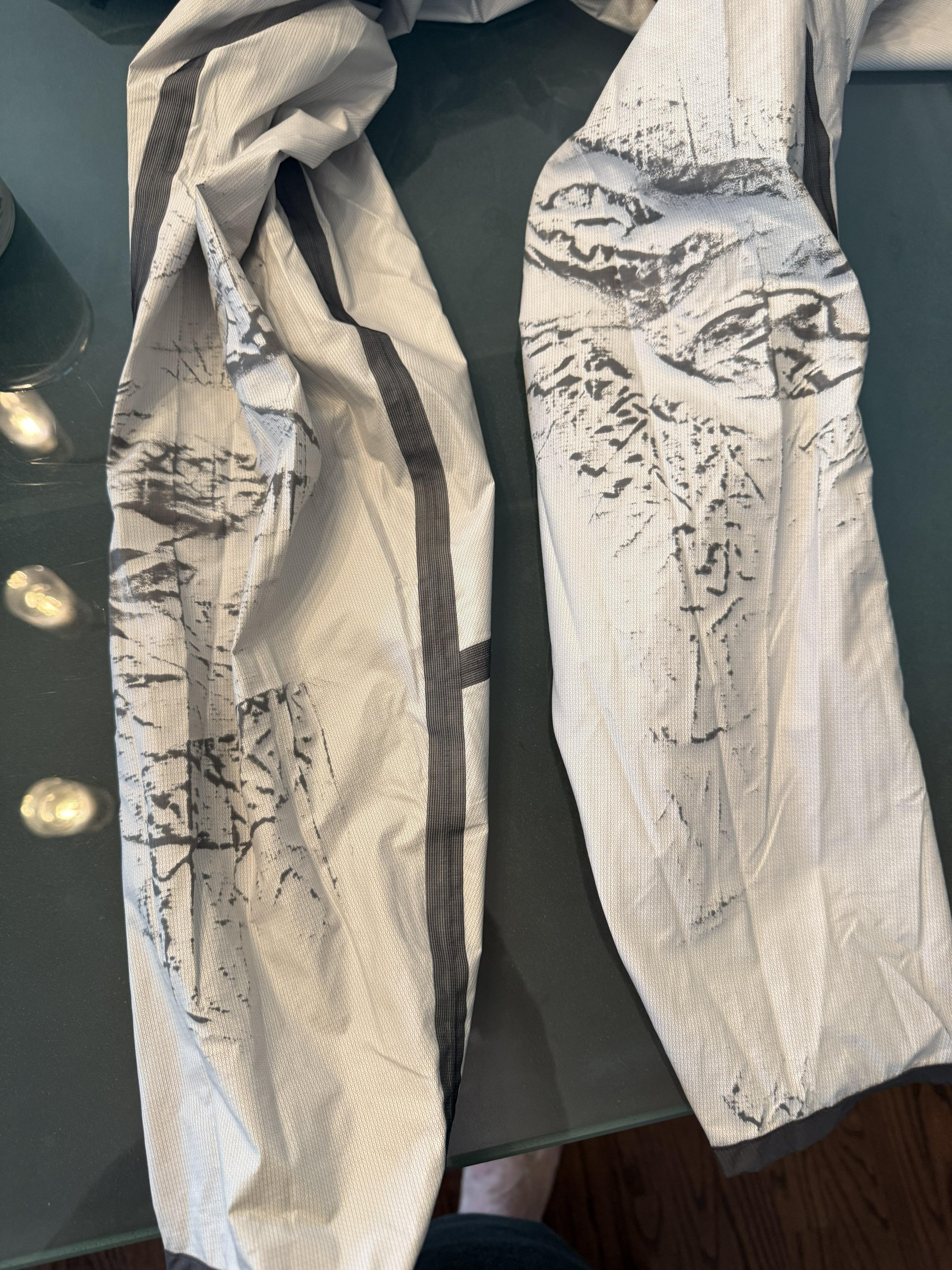
HI JA:  Thanks for reading. Look at Table 2.  I own the Papsura, the Outdoor Vitals and the Finetrack jackets. I want microporous membranes.  Fortunately, I can test jackets and determine how the breathability measures up.  None of these are perfect jackets, but each has its uses.  At the moment, the Papsura jacket is my go to.  I purchased the Outdoor Vitals for biking in the rain. It lacks mechanical closure on the hood and cuffs.  I spend a lot of time above treeline and need to seal things up in high winds.  A note on the Outdoor Vitals.  This is the sleeve interiors after biking for an hour.

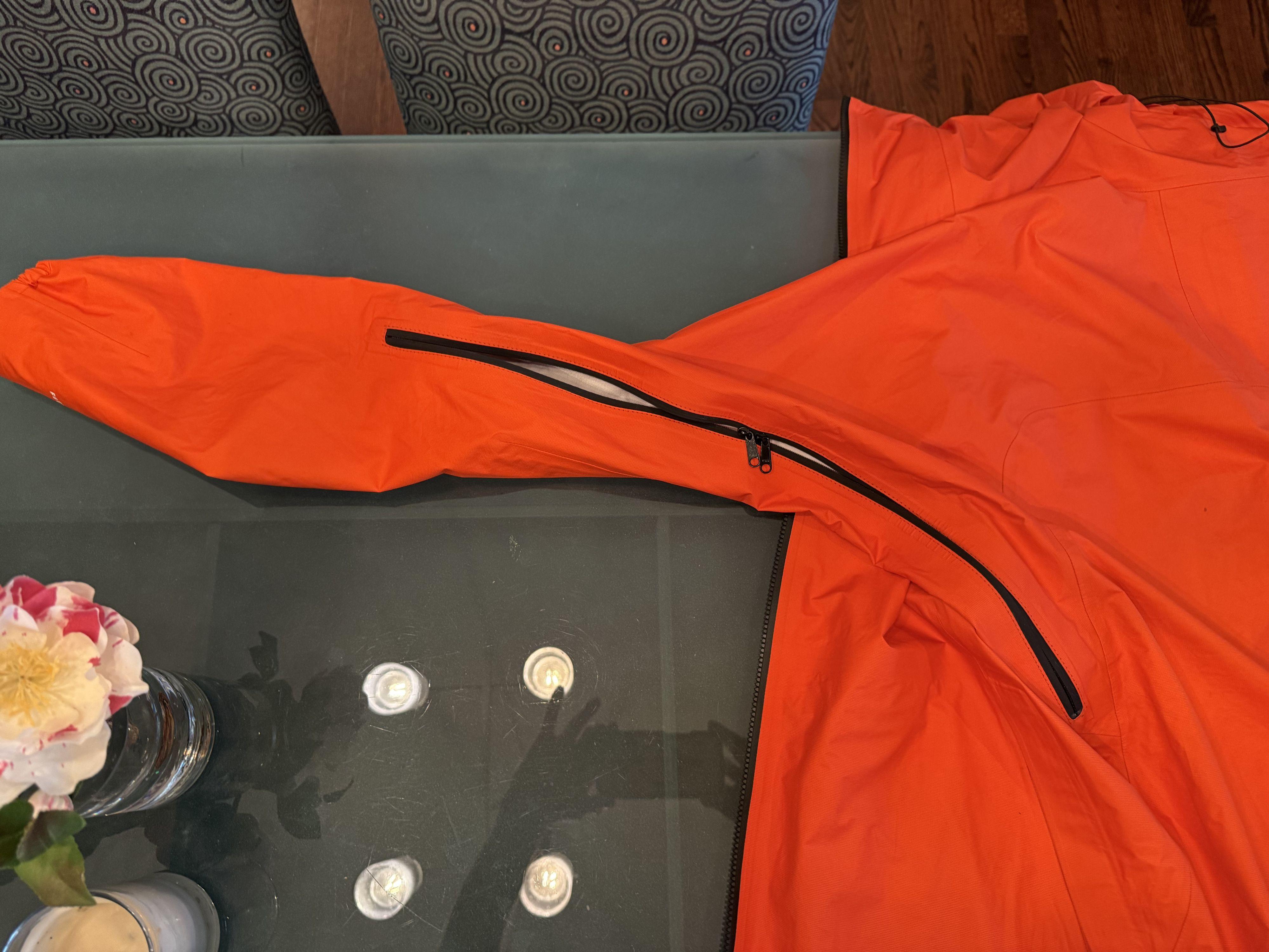
The discolored areas appeared after a one-hour ride when the sleeve interior rubbed against my bare skin, and I had applied sunscreen several hours before putting the jacket on.  Outdoor Vitals agrees it was likely caused by the oils in the sunscreen.  They are aware of the issue and say this discoloration doesn’t affect the jacket’s performance.  They suggest I wash the jacket, which might mitigate the discoloration. Time will tell.  However, it does make an excellent bike rain jacket: it packs small, has low weight, it is very breathable and has pit zips.  Regarding pit zips:  I want the broadest comfort range in my WPB so I always want pit zips and high MVTR.  I had them added to the Papsura jacket.

I don’t consider them to be a cure for low MVTR fabrics.  I just don’t see a use case for low-MVTR fabrics if I can find high-MVTR jackets that meet my needs.  Of course, most jackets on the market don’t offer high MVTR performance, as Table 3 shows.  As far as I know, only two gear manufacturers in the US offer Toray Torain. The other one makes ski jackets.  Too heavy and bulky for our objectives. I think only one, The North Face, continues to offer electrospun microporous membranes.  There is a new Polartec electrospun that is PFAS free.  It is used in a bike jacket. I have the jacket, but don’t recommend it.  So choices for market-leading breathability are limited.  You will get a good idea of how the market stacks up against the highest breathability performance that I have found.

Alex BPL Member
PostedOct 22, 2026 at 8:11 pm

Hi Stephen,

Again such a great article to read! Thanks!

Is this the ski shell you’re thinking of https://akovagear.com/products/mens-legacy-hardshell-jacket ? I’ve never heard of this company but I don’t like the price ahah!

I’ve seen this one on sale https://www.kuiu.com/products/kutana-storm-shell-jacket-gunmetal?variant=40479622594718 but they don’t state a weight :( is it the same membrane? It’s a shame manufacturers are giving so few details about what we buy!

Stephen Seeber BPL Member
PostedOct 22, 2026 at 9:29 pm

I forgot about Kuiu.  Yes, they are the third US company.  They have a couple jackets and I did not test them.  Perhaps I should, but I looked at them and thought they might be overkill for BPL.  I tested the legacy because I was curious and wanted to purchase a new ski shell. The pricing is OK for all the features it provides. Certainly, not out of line with other full featured ski shells.  It did very well in the MVTR test, especially for such a heavy face fabric. In the end, I decided I did not want a 2 pound shell jacket.  It did have some innovative features.

PostedOct 25, 2026 at 1:23 pm

The article in the link explaining GTX Pro completely missed it. The microgrid backer was already introduced in 2007/2008 and improved durability of the backer a lot while doing little to improve breathability. In 2012 there was indeed a big step but it wasn’t the backer. It was in the membranetechnology namely the change from ePTFE + PU to a multilayer ePTFE combo.

The different ePTFE-layers had different pore sizes with the outer layers having the smallest pores and act as so-called ‘catch’-layers for catching dirt, body oils, … . This made the membrane completely microporous, more breathable and even slightly air-permeable. The new membrane then was laminated to the microgrid backer on one side and a face fabric on the other.

Over time they found a way of colouring the ePTFE-membrane but only in black or dark blue, getting away with face fabric as it was esthetically not needed anymore. However, this caused a serious degradation in durability so such garments were only marketed for high activity. We got to know as Shakedry.

When they changed from ePTFE to ePe, they had to go back to the bicompoent construction with PU and this is, according to me, the reason for the big drop in breathability between Pro and ePe Pro.

BTW, at some time after 2016 or so, it got even more confusing then it already was. Pro was originally just the multilayer ePTFE-membrane. However, from 2016 or so, it was decided to split up the Pro-category in to Pro Most Breathable, Pro Most Rugged and Pro Most Stretchable. Most Breathable was the original but Most Rugged got an additional PU-layer to its membrane. The breathability of Most Rugged dropped considerable compared to Most Breathable. So the addition of just Pro meant little anymore e.g. the Arc’teryx Alpha SV was made of Most Rugged.

PostedOct 25, 2026 at 1:49 pm

@woubeir – Yep – your pushback on the linked explainer is totally justified. Micro Grid Backer was introduced with Pro Shell in 2007, and the backer fabric and the membrane’s PU component are separate parts of the laminate. The explainer conflates them. The subsequent multilayer ePTFE Pro construction is the relevant membrane change, and Stephen’s article does identify the removal of PU.

Your explanation for the lower breathability measured in the newer ePE Pro fabric seems plausible. Gore confirms that its ePE membrane incorporates PU. However, these tests measure vapor transmission through the complete laminate. They don’t isolate the contribution of the PU component from changes in membrane thickness, face fabric, backer, or adhesive coverage. We can document the performance difference in the tested fabrics more confidently than we can assign its magnitude to one component, but Stephen has looked at variability in these sandwiches before, so he may be able to comment further.

Gore documents multilayer microporous structures that resist penetration by oily contaminants while remaining air-permeable. The pore arrangement needs qualification, though: the three-region example in US9944044B2 places a tighter, smaller-pored region between two more open regions – the reverse of the arrangement you describe. That patent supports the contamination-resistance principle, although it doesn’t seem to establish the exact construction of a particular Pro fabric.

Some relevant evidence about coloration: Gore’s 2013 patent US20140205815A1 specifically addresses making an exposed membrane durably printable and visually “suitable” (“not white”?!!) for a garment while preserving its functional properties. So coloration was part of the development problem – but I don’t know if the evidence supports that it was the “breakthrough” that enabled Shakedry, or that the face fabric’s remaining purpose had become merely aesthetic. The documented engineering work addresses coloration, abrasion resistance, waterproofness, and permeability together – reasonable design principles.

PostedOct 25, 2026 at 2:14 pm

About the pore size in the multilayer ePTFE-membrane: you’re probably right and I confused things. Well, I read that patent the last time maybe ten years ago.

I don’t know the coloration was THE breakthrough but at that time, I saw it as important, explaining lots of things.

Jerry Adams BPL Member
PostedOct 25, 2026 at 3:11 pm

Thanks for another great article.  That is a lot of work.

I am looking forward to the polypropylene membrane on a polypropylene fabric by Trenchant.  It sounds like they have real products, I wonder if anything is currently available

Jerry Adams BPL Member
PostedOct 25, 2026 at 3:25 pm

Helly Hanson Lifa Infinity Pro is polypropylene membrane with polypropylene shell.  But you have to be a detective to figure out – they just talk about proprietary technology.  They also use the name polyamide which is a category that includes nylon.  Usually, polyamide is nylon.  Why do manufacturers try to be obscure???

Have you tested this?  I wonder if it would be good.

Stephen Seeber BPL Member
PostedOct 25, 2026 at 5:17 pm

Hi Woubeir: Thanks for the insights on the progression. As an industry insider, you had a ringside seat to observing the progression. There is a limit to how much I can learn from the patents I can find.  For those wondering what is discussed here: As far as I know, 3-layer Gore-Tex garments used a loosely knit polyester called tricot until Pro Shell was introduced.  Pro Shell introduced the Microgrid backer.  This provided the third layer, along with the membrane and the face fabric. I have an old Pro Shell Theta AR.  I don’t remember when I purchased it from Hudson Trail Outfitters in Maryland.  I do remember it was a lot of money.  This is the woven liner fabric:

At the time, the claim was that this liner was lighter and more wear-resistant than the prior tricot knit liner.  Woubier or Ryan can jump in if they have better information, but I think the membrane is the same as XCR, which was ePTFE with PU. I have never measured this jacket.  Pro shell was replaced by Pro, when, the PU was eliminated and the MVTR showed a meaningful jump.

Regarding the change I showed from the old Pro to the current Pro. The 2017 Beta AR that I tested had a Pro fabric with a 40D shell.  The 2026 Alpha SL has a 20D shell.   FYI: The two Arcteryx Alpha SL Pro and the Beta SL that I tested for this article are shown below. I do not have an image of the 2017 Beta AR Pro.

Beta SL Pro

Alpha SL.  (image at twice the magnification as the Beta SL image)

You can see that in the two ePE fabrics, a Tricot knit backer is used.  It is unclear whether the Microgrid backer is used with ePE.  Gore used Tricot for Shakedry.  I also have a 2021 jacket with a Gore Active membrane and 30D face fabric.  It also uses a Tricot liner.

What we know for sure is that the 2017 Beta AR Pro did not have an MHPU coating and the 2026 Beta SL Pro does.  The 2026 jacket’s lower denier should slightly improve MVTR compared with the 40 denier 2017 jacket, but we cannot know for sure without further testing.

It seems Toray, with their Torain line, is now the market leader in microporous membranes if your criteria is breathability.  Time will tell how durable their cutting-edge membranes are and how effectively they have addressed the environmental considerations of PU manufacturing. Toray also now provides cut-and-sew services at a very high quality level.

I tested a Shakedry-like product a few months ago that printed coloration on a polypro membrane.  The print was a thin PU coating, as I understand it, and it significantly reduced MVTR. Gore’s ability to print color on its ePTFE membrane while maintaining high MVTR is a notable engineering feat. I still have some Shakedry jackets, but they have all degraded over time. I no longer use them.  For a while, I wondered what would replace them, but this year’s study shows that is no longer a concern.


Stephen Seeber BPL Member
PostedOct 25, 2026 at 5:22 pm

Hi Jerry: Until last year, Trenchent manufactured the fabric.  I understand HH has changed suppliers.  I purchased one for testing last year.  As a ski jacket, it had a ridiculously heavy face fabric.  I did not see a use case for BPL, so I just sent it back, untested.

Alex BPL Member
PostedOct 25, 2026 at 8:18 pm

@crashedagain:

Oh you got me intrigued by the AKOVA jacket now… would you mind sharing the MVTR? Did you test the 3L or 2.75L? 2 pounds seems quite heavy for touring, but if it was the 3L I would expect the 2.75L to be a bit lighter and then it might work. Thanks in advance!

I watched the video from Ryan, and I must say it’s a nice addition to your reports. I should have watched it before reading the article, I know understand much more about breathable membrane \o/

PostedOct 26, 2026 at 3:50 am

Hi Stephen,

first I’m not an insider; just a sometimes very curious outsider who wants to know what’s really behind all those claims.

As to why they’re seming to go back to a knit liner, well perhaps they discovered an issue with the woven backer and they surely won’t tell us then.

For me, the main conclusion up to now is that there is much more that influences overall breathability than just the membrane itself.

Andrew S BPL Member
PostedOct 26, 2026 at 5:22 am

Thanks, Stephen, for another fantastic article!

Seems like Microporous is the way to go – and the latest results tempts me to upgrade my hardshell.  And yet, there still seem to be some uncertainties – and/or situations where one might look for something other than the best microporous products.

The first question is whether the high relative humidities at which MHPU fabrics do well are so irrelevant and unimportant.  If I’m caught in a storm and my face fabric wets out, won’t the membrane reach these humidity levels at which MHPU fabrics often outperform microporous in tests?  Of course, in such conditions, the high external humidity will inhibit vapor transfer to the outside.  But that effect also occurs with microporous fabrics to the same extent, so perhaps an advantage for MHPU?

Likewise if, despite efforts to manage temperature, I’m sweating inside?  This might be particularly relevant when there’s little between me and the fabric, so a burst of perspiration has no place else to go.  Or it might be relevant when I’m wearing a lot of clothes and when the humidity eventually gets high, there’s so much there that it will take a long time to go away.

If either possible advantage is real, it’s important.  I don’t care much about breathability when internal humidity is 20%.  When it’s 80%, or when it’s pouring outside, I do.

On the other hand, the article describes how while MHPU membranes have no holes that liquid water can pass through, because they are hydrophilic, it can get through molecule by molecule.  So maybe when the outer fabric is soaked through, lots of molecules do indeed pass through, but in the wrong direction?

A second question area also relates to wetting out.  Probably in some cases one would stay a lot drier in Outdry – with it’s external membrane – despite the low breathability, because it doesn’t wet out, no?  Whether in a heavy storm, or even in light rain, if it continues for hours.  Because with a wet outer fabric, even the best membranes have limited breathability, and some have none.  Also because, when the outer fabric is soaking, more water gets in through openings (cuffs, hoods, etc.).  And also because, shortly after the rain stops, the jacket will be dry, whereas a normal membrane jacket will remain wet for hours.

One question is whether microporous and MHPU differ in terms of heat loss when the outer fabric is saturated.

Regarding Outdry, the four jackets listed in the test result are shown as “PU”.  That’s MHPU, no?

Also, Stephen, in the comments you mentioned a shake-dry like external polypro membrane with it’s MVTR compromised by a PU outer layer.  What product was this, and how well did it perform?  If similar to or better than Outdry, it could be interesting.

The third big question area is waterproofness and windproofness.  Re. waterproofness, after seeing the previous test, I chose the Montbell Versalite (the old Infinium version is microporous, right?) because I understood the fabric to be more waterproof than the very most breathable fabrics.  I now wonder if that was really true for rain.  I thought there was some advantage to an HH over 10,000.  It now seems that rain can never reach that pressure, contrary to what I had read earlier.  On the other hand, there is an EU (or UK???) workwear standard that gives higher waterpoof ratings to higher HH garments, with a description I read mentioning ability to stay dry longer.  I wonder what that is about … .  Otherwise, I understand that the one clear advantage of a high HH garment is when pressure is applied, e.g. kneeling in a puddle or on snow, or under a shoulder strap.  But I also understand that some of the most breathable waterproof-breathable fabrics are not fully windproof, and those same fabrics can actually let some water through, despite their high HH ratings.  That sounds bad, and unless someone can quantify that so I know it’s trivial, I don’t want it.  Does that apply to any/all of the high breathability fabrics in this last set of tests?

In fact, regardless of water, I don’t want wind to get through either.  At least not for my main, go-to hardshell.  Are the most breathable jackets also windproof?

The final question area is durability.  Traditionally, that has been a big issue with PU membranes.  As I understand it, water can cause them to delaminate over time, and because they are hyrophilic, they can stay wet long enough for that to happen.  But now ePTFE has disappeared, and is there anything that does not in some way involve PU except the rare polypro membranes?  And to what extent have solutions been found to the PU problem?  (I understand that absent durability testing, the durability of different products involving PU will remain at last partly a mystery.)

JAshley73 BPL Member
PostedOct 26, 2026 at 7:45 am

Helly Hanson Lifa Infinity Pro is polypropylene membrane with polypropylene shell.  But you have to be a detective to figure out – they just talk about proprietary technology.  They also use the name polyamide which is a category that includes nylon.  Usually, polyamide is nylon.  Why do manufacturers try to be obscure???

Have you tested this?  I wonder if it would be good.


I’m not sure if I heard it here on BPL or not, but the phrase, “There’s money in the mystery”  certainly summarizes the topic of WPB garments..

What’s funny, is that I saw an add here on BPL for the Helly Hansen Lifa (in all it’s varieties) which then I went to explore. Most varieties were sold out, and it appears that’s hardly changed.

One minor point – Nylon was the popularized name given to the wonderous new family of polyamide fibers/fabrics by DuPont, but apparently it was never trademarked? My one minute of AI assisted research says that Nylons are just one specific type/family of polyamide fibers/fabrics.


Which brings up another gripe of mine, in that many companies will list the items as being 100% Nylon, or 100% Polyamide, or 100% Polyester. Or, a combination of “recycled” fabric and balance [new, same] fabric. Yet, they always completely ignore the fact that the “middle layer” membrane is an entirely different material.

My guess is that the laminate construction materials are very difficult, if not impossible to recycle, and that probably isn’t a popular fact to advertise, when most companies are trying to present an Eco-Friendly marketing persona. (I’m not singling anyone out here BTW.)

It also does nothing to educate the consumer, because, well, that would probably lead to either 1- disinterest, and a non-purchase, or 2- more uncomfortable questions by the consumer.

I wonder how many buyers of WPB rain jackets even know that the DWR needs to be refreshed from time to time? Another failing of the industry to responsibly educate the consumer.

Hanz B BPL Member
PostedOct 26, 2026 at 8:18 am

Thanks for a great article!!!

May I assume from the weight listed you tested the currently available 2.5L Marmot precip eco (2025 that’s 15 oz on the marmot website)? There’s now more marmot  2026 options for nanospun including evo flex and evo and pro (from 2.5L to 3L). Which is close to the variant you tested?

Curious do the old rules of choosing 3L over 2.5L for the benefits still apply to nanospun membranes? Is there a use case for 2.5L over 3L for nanospun?

fyi – Arc’teryx messed up the updated Beta SL 2026 imo (and i am a fanboy of the brand). I used it rucking for a week or so in different shoulder season conditions to test prior to taking out on the trail. The 2026 design has a non-coated, hydrophilic, rip-stop, grey, inner hem material of about 1 inch on the waist that acts like sieve and pulls water up into your waist and wets out your short or pant waist line in rain regardless vapor pressure build up or sweat –  It just soaks up the drops that hit the jacket hem as they run down and creates a two inch zone of moisture that my other jackets do not. Hmmm.


Jerry Adams BPL Member
PostedOct 26, 2026 at 9:14 am

“My guess is that the laminate construction materials are very difficult, if not impossible to recycle,”

I was reading about that.  When you have a nylon shell with a membrane glued to it, there are three materials that can’t be recycled together.  A reason for polypropylene shell with polypropylene membrane is that is easier to recycle.  But often talk of recycling by sellers is just talk to get people to buy their product.  Even just nylon or polypropylene or whatever is unlikely to be recycled.

“I wonder how many buyers of WPB rain jackets even know that the DWR needs to be refreshed from time to time?”

my WPB jacket was wetting out and then wet inside.  I washed it and reapplied WPB (revivex) and it was much better.

“My one minute of AI assisted research says that Nylons are just one specific type/family of polyamide fibers/fabrics.”

Same here.  I think that a manufacturer might use the term polyamide just to differentiate their product from others.  This all is so complicated.  Marketing works to increase sales.  But I can see why they do it, to increase sales so they can make more money, pay people a living wage,…  I try to ignore it.

Andrew S BPL Member
PostedOct 26, 2026 at 4:13 pm

I thought more about the question I raised earlier about whether humidity might actually be high enough in some cases that the MHPU membranes work well.  I mentioned that humidity can be high when the outer fabric wets out or one is having trouble keeping cool.  I should have added something else – the are parts of the world where you regularly reach such levels the moment you go out your door.  For example, in broader Ireland and parts of the UK, annual and monthly average humidity reaches 70 to over 90%, and in various other places in Europe the average reaches the 80s.  Parts of Washington’s Olympic peninsula average well over 80% (and over 90% in mornings in some months).  Then there’s the US gulf coast … .  And I’m guessing rain forests aren’t exactly desserts either.  Plus even much drier mountain areas can reach the 80s on thunderstorm days.

Seems like a pretty open question whether the most breathable MHPU membranes might not be the better choice in such situations.  It would be interesting to know whether people who spend a lot of time outdoors in, for instance, Scotland’s Cairngorms (average humidity above 80% even at the height of Summer) tend to be (a lot) more satisfied with MHPU products than people who mainly hike in drier places like the the Colorado Rockies (one of the driest mountain areas in the US or Europe, with Summer relative humidity often below 20 – 30%).

Jerry Adams BPL Member
PostedOct 26, 2026 at 8:38 pm

I think you said that WPB with dwr will wet out in heavy rain, then mvtr will drop, then it’ll get wet on the inside surface of the membrane.

I have experienced that many times.

Neoshell and wind stopper pro seem to be much better but I need to get more field testing.  I look at weather reports and try to avoid heavy rain.

One time some dwr wetted out and was terrible, but then I washed it, retreated, and it was much better.

Do you measure neoshell and wind stopper to be better?

Richard Nisley BPL Member
PostedOct 26, 2026 at 9:35 pm

Jerry,

Field-test snapshots (all “no-pack, no-hip-belt” unless noted)

A

(Data sources: Patagonia & Gore collaborative rainfall rig, Helly-Hansen R&D Bergen rain tower, and Kansas State Univ. HPIDL wear trials, 2019-2023.)

Why the first wet-spot spread is quick and large

• The moment a droplet pins to a contaminated patch, capillary wicking into the weave starts.

• Once ~30 % of the surface is wetted the remaining beads coalesce almost explosively (“avalanche wet-out”).

• Heat from your body, plus pumping from arm swing, pulls that moisture plume downwards, so what looks like wet-out at the shoulders can reach the hem in <10 min.

Rule-of-thumb summary

• New, properly heat-reactivated C6 DWR: expect ½–1 hour of truly torrential rain before large-area wet-out.

• Normal “middle-aged” garment (5–10 washes, some road dust): 10–30 minutes.

• Soiled or heavily abraded garments: a few minutes—sometimes less time than it takes you to finish lacing your boots.

C6 is the most durable DWR that can now be purchased.  The membrane technology used won’t alter the wet out rate but it will vary the MVTR drop.

How C6 fluoro-DWR behaves in that regime:

• A fresh, heat-set C6 finish produces a static water contact angle ≈ 150 ° and a roll-off angle ≈ 20 °.

• Because the C-6 chain is two CF₂ groups shorter than legacy C-8, surface energy is ≈10 % higher; oil and soil pick-up is faster, which in turn erodes water beading.


What “very heavy rain” means:

• Meteorology calls 30–50 mm h⁻¹ “heavy” and >50 mm h⁻¹ “violent / torrential”.

• Impact energy is roughly 3–6× higher than in a light drizzle test, so droplets deform and pin more easily on the fabric.


Terran BPL Member
PostedOct 27, 2026 at 7:19 am

Heat from your body, plus pumping from arm swing, pulls that moisture plume downwards, so what looks like wet-out at the shoulders can reach the hem in <10 min.

Couldn’t the pumping action be used as an advantage, pumping moisture out?

Jerry Adams BPL Member
PostedOct 27, 2026 at 8:09 am

interesting data Richard.  That matches my real world experience.  I don’t remember other people talking about this a lot.  Stephen has had some data for garments that have been worn.

I wonder if my neoshell and windstopper are C6.  I don’t know when mine was manufactured and I think they’ve changed the formula over time.

I’ve noticed that avalanche affect.  I put a puddle of water on my DWR fabric (M50) and it just sits there for 24 hours.  With some other DWR fabric the puddle sits there for a while, then all of a sudden it “finds a channel” and quickly the puddle flows through.

I wonder if polypropylene would have the same property of wetting out if it gets dirty or it rains a lot.

It doesn’t seem like manufacturers emphasize this property of the DWR getting dirty over time and then wetting out.  They just measure the new fabric.  Each user is different and will get their DWR dirty differently so it’s difficult to talk about.

Viewing 25 posts - 1 through 25 (of 136 total)
Loading...