


Coming from mostly desert backpacking, I am in need of a stove-boiling water only-that works in roughly 10f-20f temps. Can isobutane cans work at these temps? Less expensive and simple would be preferred.
Topic
Become a member to post in the forums.
 .
.
Coming from mostly desert backpacking, I am in need of a stove-boiling water only-that works in roughly 10f-20f temps. Can isobutane cans work at these temps? Less expensive and simple would be preferred.

For those temps, I’d probably get a Kovea Spider. Jon at Flat Cat Gear sells them. Not super cheap, but not super expensive either. You could probably use an upright stove, but you’d need to warm the canister somehow, either by putting it in water, warming it in your sleeping bag, using a Moulder Strip, etc. An invertible remote canister stove is much better for colder temps, in my opinion.

Isobutane works down to 20F well. Its boiling point is 11F. When you get down to 15F or so it really slows down.
You could use pure propane. That would work fine well below 10F. You have to refill from propane tank to empty butane canister. As long as you keep it below 72F it will be fine. As mentioned before on other threads. Totally unauthorized by any manufacturer.
Or, you could use an alcohol stove, if you’re in an area that allows them.
The Kovea Spider looks interesting. Alcohol may be an option as well. Would using Esbit be appropriate?
This would be used with Toaks 550 and 750ml mug.

Esbit is a good option. Get a Ti-Wing, stove/pot holder and a bit of aluminum foil and you are good to go. My 2 cents.
Some brands have names that trigger the ad software?
Moulder Strip, pot of water, and foil reflectors can work with existing stove at borderline temperatures. Warm the canister in your jacket to make starting easier.
As David suggested above, inverted remote canister stoves solve the problem by allowing you to burn liquid butane instead of having to vaporize it. (Technically it is still vaporized, but the stove does it rather than the canister and ambient temperature).
https://www.flatcatgear.com/shop/kovea-spider-remote-canister-stove-canister-can-be-inverted/
https://www.amazon.com/BRS-Outdoor-Windproof-Cookware-Stainless/dp/B07FXQF7SJ/
https://www.amazon.com/Regulator-Backpacking-Lightweight-Resistent-Performance/dp/B09PYLLBF5/
https://www.amazon.com/Fire-Maple-FMS-117H-Titanium-Camping-Preheating/dp/B07KS3F91Q/
Remote canister stoves weigh 3-5 ounces more than upright stoves. They work in all weather, are more stable, and can be used safely with a fully-enclosed windbreak.
Do you currently have a canister stove? How many boils of how water much per trip are considerations. As mentioned above there are methods of varying complexity to warm a stove for operation. Even a handwarmer under the can with a little gap for ventilation. Sleep with your canister, use a primarily isobutane/propane mix brand(msr,Olicamp )new can if possible as performance will decline over time. I’ve used both a fire maple fms-300t and a Soto windmaster below 20. Whatever approach you do practice at home first in comparable temps if possible.
As people have said, once you get below 20f you’re on the borderline for gas stoves, even when it’s isobutane/propane rather than normal butane/propane (which will have given up a little while ago!).
Pressure and efficiency will begin to drop off pretty quickly, so anything you can do to help it along will make a difference…..
But this is also the point where I would look at liquid fuel instead. My Optimus Nova is just as easy as any remote canister stove to use, and as the pressure is generated by pumping the fuel bottle it works even in the coldest of temperatures. A whisperlite or similar also does the same job. The only slight downside over a gas stove is that you get a slight flair up when you first light it to preheat so it’s not always ideal to light it inside your tent without opening the vestibule door up for a second and having a clear open space above it, but once you’ve lit it it’s just as easy and controllable as a gas stove.
Yes, it’s maybe not quite Ultralight, but if I know I’m gonna be out in those kinds of temperatures I want to know with certainty that I can boil water and make hot food and drinks, so I’m happy to pay a little weight penalty.
@Chris Yes, I use cannister stoves. I have BRS-3000, Soto Amicus. I only need it to boil water and possibly snow a few times a day.

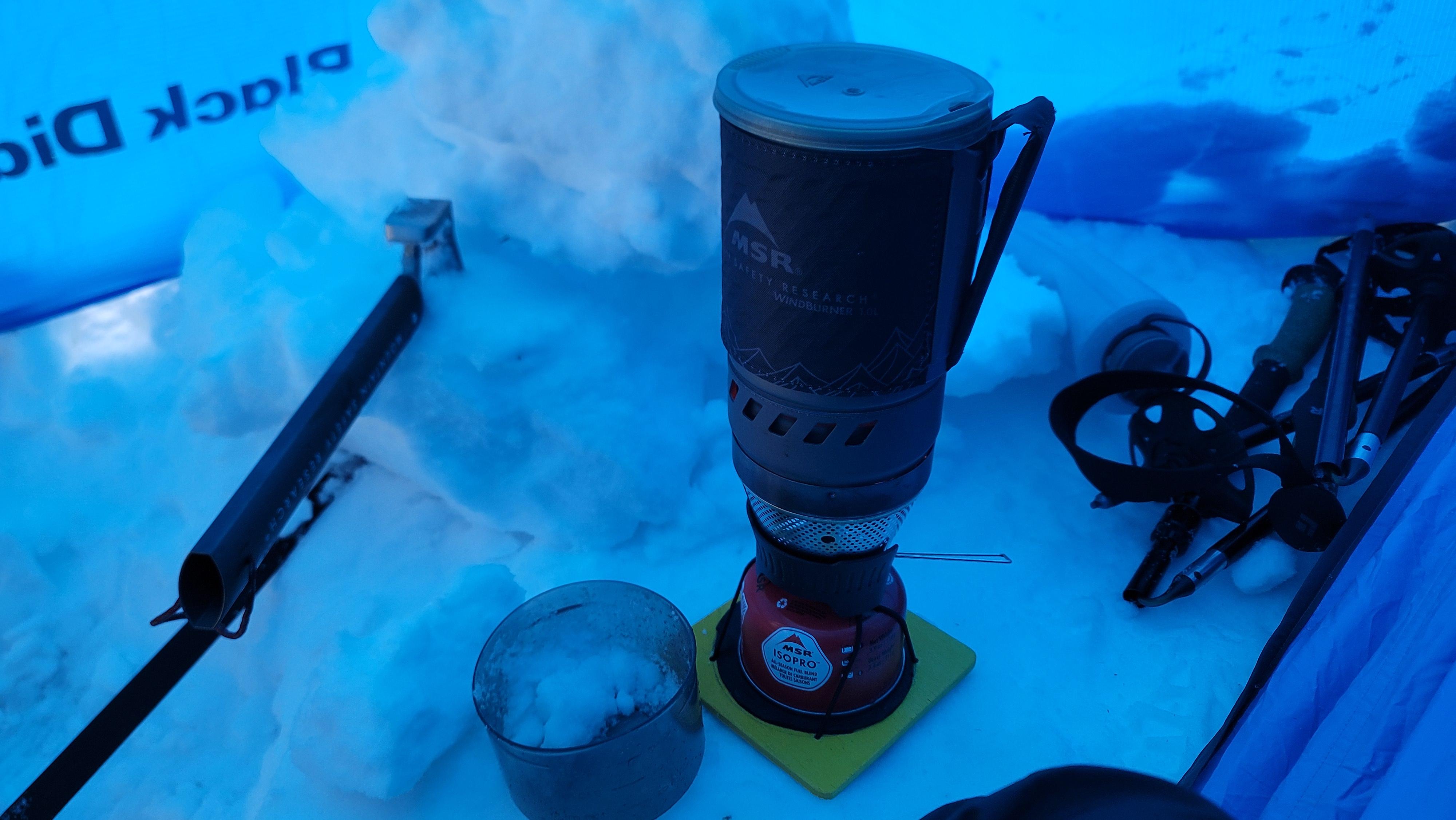 plenty of options. At those temperatures my MSR Windburner has performed flawlessly and I use it for melting snow as well. No need to carry water when there is snow all around.
Relaible yes. Simple yes. Less expensive maybe not.
However, if you dont plan on melting snow and looking to keep it cheaper then look elsewhere. Esbit tabs will boil water no problem at those temperatures, as will a good ol’ fasion wood fire.
I have an inexpensive fuel canister that must be regular butane mix. It quit working in the upper 20’s with my upright stove. I picked up a fms-118 and tried it out inverted this weekend at around 30 degrees and it worked great. I was able to control the heat really well and cooked pancakes. It is also nice and stable which was a complaint with my upright stove. I think I paid about $29 shipped.
I’ve operated upright canister stoves down to -25F by using a Moulder Strip™ and wrote it up on BPL. The shorter 4-ounce canisters and a short stove like a $19 BRS-3000T enable the Moulder Strip® to keep the canister warm down to stupid-cold temperatures. https://backpackinglight.com/forums/topic/moulder-strip-put-to-the-test-butane-canister-use-at-21f-29c/
Warning: I tend to geek out in such posts and use lots of words.
Here’s some testing of many variations I did in Fairbanks: https://backpackinglight.com/forums/topic/testing-moulder-strips-at-15f-26c/
There’s also the approach of, “Screw the UL stoves, I’m just carrying a 1-pound propane cylinder (green, Coleman, thick steel) and matching stove head and not fretting about it. Then the fuel is very cheap (if you refill from BBQ tanks) and if you’re going in with a sled*, especially if over a frozen lake (which tend to be very flat), maybe the weight doesn’t matter so much.
*always put a glide wax on the bottom of the sled. Trust me on that.
A heat-exchanger pot is called for at those colder temps. You need to accommodate the Moulder Strip© within the HX pot, but it can be done. Esbit and alcohol put out less heat than a canister stove and that’s a problem in winter. You’ve got warm and then hot water losing heat for the 10-15 minutes instead of getting it all done in 1 minute with butane or propane and a HX pot.
“The shorter 4-ounce canisters and a short stove like a $19 BRS-3000T enable the Moulder Strip® to keep the canister warm down to stupid-cold temperatures.”
When I used a moulder strip on a tall stove, a Soto, it didn’t work very well, takes too long for the heat to travel down the longer Moulder strip
Works great on a BRS3000 stove because it’s shorter
The BRS transfers a lot of heat energy down the stove body. At normal temperatures it can be a problem when burn times are long. My 2 cents

I wonder at what point a PRD or Soto’s wind performance outweighs the strip on a BRS?
Above 2 mph. My 2 cents
wind is a separate issue – you need a windscreen if its windy
the moulder strip helps to counteract evaporative cooling – as you run the stove, butane evaporates in the canister before going to the stove. This causes the butane in the canister to gradually cool by as much as 6F.
Basic upright stove functionality – the butane has a boiling temp of, for example, 11F (isobutane like MSR isopro). The butane has to be about 3F warmer than this in order to supply enough pressure for the stove to operate well – 14F.
If the air temp was 20F, and while you were boiling the butane dropped 6F due to evaporative cooling, that would be 14F which would still be enough for the stove to operate well.
If the air temp was 17F, half way through boiling your water the temp would drop 3F – the butane would be 14F so it would slow way down. You may still get your water to boil after quite a few extra minutes.
In this case, if you had a moulder strip, heat would be conducted down the strip to the canister and warm it up, cancelling out the evaporative cooling. You could operate down to 14F air temp, maybe a little less.
With an inverted canister stove, liquid butane exits the canister so there’s almost no evaporative cooling. The butane needs to be a little warmer than the boiling point, I think a little less than for an upright – maybe 12F is the minimum air temp.
Maybe moulder strip and inverted canister stove have the same minimum air temp.
The classic way to deal with this is have a tray of water and put the canister in it. This will warm up the canister as needed. When you boil water, pour a bit of it into the tray which will keep it warm enough to counter evaporative cooling.
Another technique is to use a bic lighter to heat up the canister. (David’s idea)
There are many previous threads that discuss all this.
Jon, as temp decreases, the strip+BRS advantage increases. For 2mph, what max temp do you think the strip would hold the advantage? I can operate my PRD “fine” at 25F in slightly higher winds (5mph?) but haven’t pushed it to lower temps (use an inverted stove for that).
Without actual testing this is all wet finger guesswork but experience here could help estimate at what min temp its even worth starting consider a strip if you already have a stove that performs well in lighter wind.
I’m not a fan of carrying a windscreen but I spend my time in forests and not high alpine
As Jerry says, wind and cold temperature are two different animals. If the Moulder strip is down wind in the cold, it will generate probably more pressure than normal and the flames may still miss the pot. If the Moulder strip is upwind, it probably wont transfer any heat down to the canister. If it is windy, you need a windscreen. With a BRS, you will need it at lower winds that the PRD/Soto. My 2 cents.
I don’t think my question is coming through, but there’s probably no easy answer.
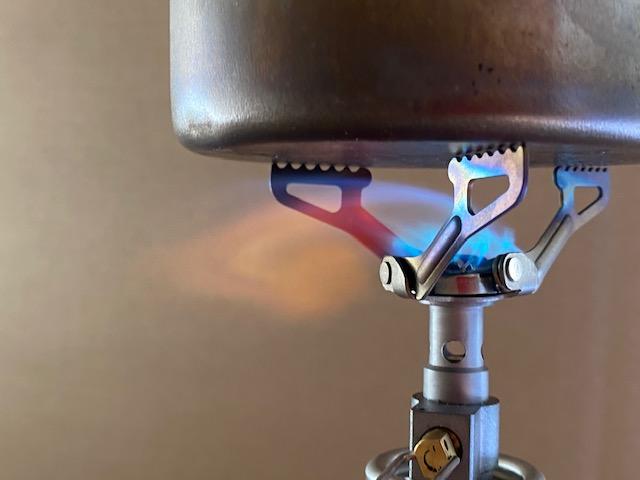
Above 2 mph, a BRS needs a windscreen: regardless of the temperature. With a windscreen, it will improve the flame profile and the Moulder strip will work as expected. My 2 cents.
Perfect, thanks.
@Jerry Adams Is this all predicated on having a reasonably warm fuel can to start with?
In this scenario-sleeping with the can, then exposing it to 10F temps to boil 8oz of water-would a moulder strip be needed? I am not sure how quickly the ambient temps will impact the stove.
Become a member to post in the forums.
 XL Stuff PackLightweight stuff pack designed to secure to the top of your backpack for carrying wet gear, extra food, rainwear, or layers.
 © Beartooth Media Group Inc.
 Loading...