Topic

BRS Failure (photo)

Viewing 25 posts - 1 through 25 (of 32 total)
PostedAug 13, 2025 at 6:00 pm

I saw this on Reddit/Ultralight and thought that I would repost it here. Zergcheese posted a thread where his BRS failed due to deformation: https://www.reddit.com/r/Ultralight/comments/1mpbbcz/brs_3000_quality_issue/

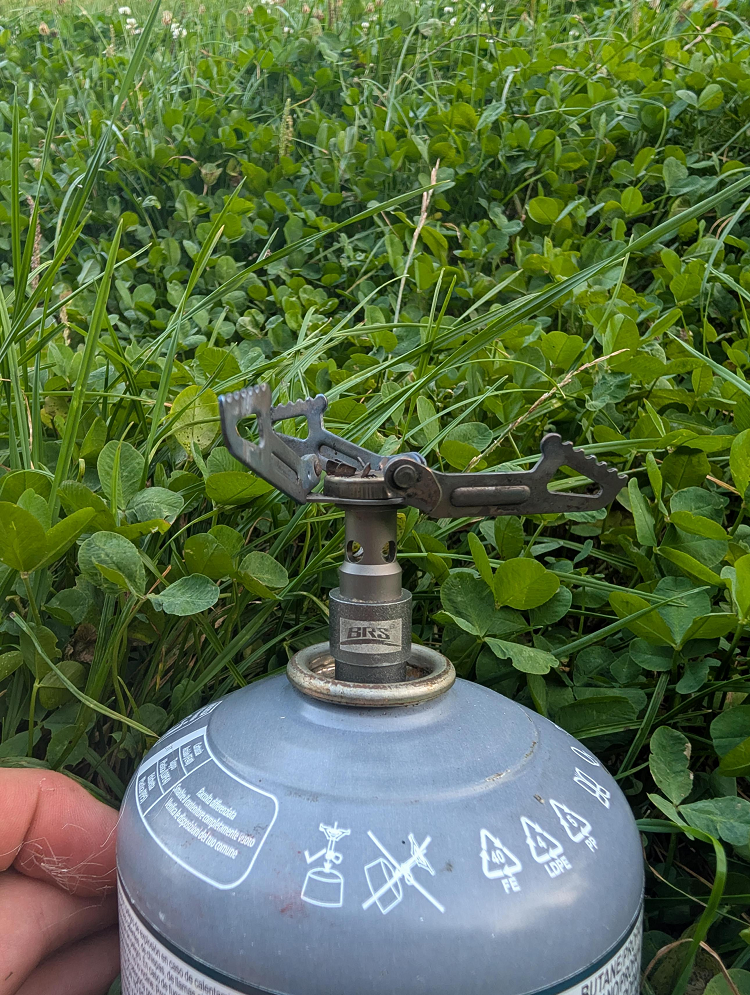
Apperently this has happened again on a seperate BRS Stove.  It looks like the support plate that holds the pot support arms twisted.  This is one of the better photos of the failure that I have seen.  My 2 cents.

PostedAug 13, 2025 at 6:48 pm

BRS = Broke Rotten Stove :)

Kidding aside, it is a pretty janky unit. It has its place undoubtedly, but I’ll happily move on to something that performs at least as well, and is better made, even if it’s 0.75 oz’s heavier.

Roger Caffin BPL Member
PostedAug 13, 2025 at 7:12 pm

Fascinating photo.
Yes, I agree with Jon that the pot support arm has NOT bent or failed. Rather, it is the ring supporting the arm which has twisted, and a fair bit at that.

Now, I work with (machine) titanium a fair bit, and I know how strong it is. The support ring is 1.0 mm thick and the bend itself is 6.0 mm wide by a few (<5) mm. The support ring does not get very hot. The pot support arm would get much hotter, and it shows no damage.

Regardless of the alloy used, to put that sort of twist in that tiny bit of metal requires a LOT of force. Obviously it can be done, but with force. My own humble opinion is that the user has directly 100% caused this bend, either by putting a huge pot (really huge) on the stove or, far more likely, by sheer negligence. Perhaps he sat on it accidentally?

Funny how this stove engenders so much passion. It is so much lighter and so much less expensive than most of the competition, and yet it gives out the same amount of power. Is there an element of sour grapes or perhaps some deliberate propaganda involved?

Cheers

Jerry Adams BPL Member
PostedAug 13, 2025 at 7:14 pm

so, the piece that goes sideways from the stove is what must have failed

you can see it below his thumb

PostedAug 13, 2025 at 7:26 pm

I asked the poster to publish a few more pictures: one showing the inside of the arm/plate and the other with the stove lit with a pot on it.  The only thing that I can imagine is that somehow the flame is coming out between the cap on the burner and the base plate of the pot support arms.  That could apply direct flame to that section.  We’ll see.

Jerry Adams BPL Member
PostedAug 13, 2025 at 7:30 pm

Right where the red arrow points

Yeah, that isn’t where the flame is the hottest, doesn’t make sense

Maybe that metal isn’t good for some reason, low melting point or something

Although, where the metal bends to the vertical, it is in the flame.  Maybe the heat conducts down to the horizontal piece.  That is a weak mechanical structure – horizontal flat piece, easily bends.  Where the metal bends vertical, and it’s in the flame, that mechanical structure is much stonger.

Like floor joists are strong.  If you rotated them horizontal they bend easily.

Roger Caffin BPL Member
PostedAug 13, 2025 at 10:10 pm


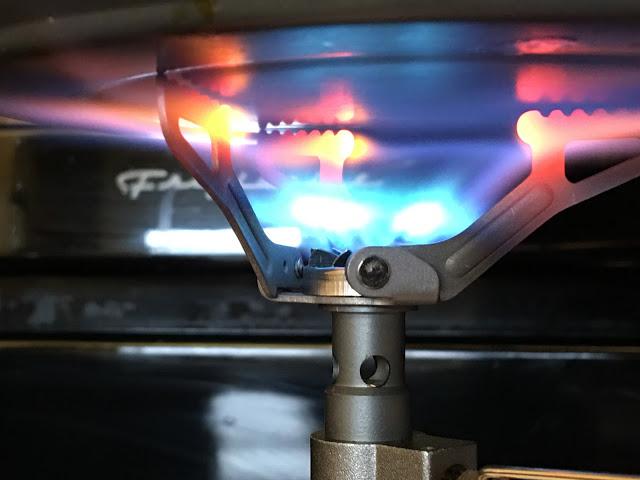
This is a photo of a BRS-3000T stove running at medium power. Can you see how the flames hit the support ring where the bends are?

No, I can’t either.
To be sure, the inside tips of the pot supports are glowing red hot. But not the outside bits which do the real support.

Could there be a leak (and a flame) at the base of the cap? Not easily, and I would think such a leak would be very obvious. The cap is actually a tight fit over the bottom of the burner head – actually the top of the burner column. If it was a loose fit I would expect it to fall off.

That bend in 1 mm titanium took a LOT of force.

Cheers

Dan BPL Member
PostedAug 14, 2025 at 5:23 am

I agree with Roger that it is likely caused by the user, either through rough treatment or deliberately. I know nothing about that person on reddit, but people on the internet have all kinds of motivations. If this were a common failure mode of this stove, we would know it, and that user claimed it happened to him twice.

I normally use an alcohol stove/caldera cone combo, but recently broke out my BRS because we are now in stage 2 fire restrictions. I used it for a four-night trip, boiling 1.5 cups of water twice a day in a titanium mug at 12,000 feet and it was totally fit-for-purpose.

Roger Caffin BPL Member
PostedAug 14, 2025 at 5:27 am

I did see one complaint from ‘someone’ (elsewhere) that his BRS-3000T collapsed when all he had on it was a 5lb cast iron cooking pot, full of dinner for a large group.

Sigh.

Cheers


JCH BPL Member
PostedAug 14, 2025 at 5:38 am

I did see one complaint from ‘someone’ (elsewhere) that his BRS-3000T collapsed when all he had on it was a 5lb cast iron cooking pot, full of dinner for a large group.

Hahahaha.  The phrase “fit for purpose” comes to mind.

Jerry Adams BPL Member
PostedAug 14, 2025 at 7:39 am

That could be it, heavy weight

But, you can see the flame hitting the piece with the rivet through it.  Where I pointed to with the red arrow.  Right at the spot where it bends up.  The metal just below that bend is what failed.

It doesn’t have to be red hot, like the corner of the arm above.  To weaken that metal.  (Like the beams in the World Trade Center)

I agree it’s a lot to expect from that stove to put a heavy cast iron pan on it

Bonzo BPL Member
PostedAug 18, 2025 at 9:41 pm

It could also be something like a simple defect: a piece of material that didn’t pass inspection and slipped through, for example.  I’m not sure if this is a common failure on this stove or not, but the causative factors are impossible to determine without knowing more of the situation that led to the deformation.  As it stands, almost anything could have been the culprit: weight, heat, force, corrosion, material fatigue, gremlins, witchcraft, etc.  Hard to tell without a lot more situational info.

Jerry Adams BPL Member
PostedAug 19, 2025 at 7:32 am

It would be helpful to have a photo from below so you can see the part that failed – twisted

You can see the piece with the rivet through it that rotated, but not the part below that failed

Bonzo BPL Member
PostedAug 19, 2025 at 10:43 am

It would be helpful to have a photo from below so you can see the part that failed – twisted

You can see the piece with the rivet through it that rotated, but not the part below that failed

The part with the rivet through it is the part that failed/rotated/twisted, is it not?  There are only seven parts in that entire support assembly: the base flange, three pot support arms, and three rivets.  The support flange failed where it projects and turns 90° upwards, and it did so on at least two of the arms; the left-most support area may be starting to fail as well, but it’s hard to tell from the angle.  Either way, out of all of the different areas in the pot-support assembly, the ones that failed are exactly what I’d expect to fail: each are the effective fulcrums of a lever arm, located in the weakest areas of the part.

Jerry Adams BPL Member
PostedAug 19, 2025 at 12:16 pm

I’d like to see the part just below that 90 degree bend

Where it goes horizontal

The part with the rivet is vertical

Those two parts are part of the same piece

Okay, maybe the word “part” is confusing.  The part of the piece…

Bonzo BPL Member
PostedAug 19, 2025 at 12:26 pm

That was a lot of parting, yes… 🤣

I get what you’re saying, now; you want a look at the underside of the support flange.  I’d like to see the upper surface, myself.

Jerry Adams BPL Member
PostedAug 19, 2025 at 1:14 pm

The underside of the support flange is where it will be damaged.  Bent or wrinkled or whatever.

And from rogers photo you can see where the flame hits it pretty good.  Not as much as the red hot support arm.  Maybe enough to weaken it so it buckles.

I bet if you didn’t put too much weight on it, and only ran the stove at slow speed you’d be fine

I seem to remember that advice elsewhere

Bonzo BPL Member
PostedAug 19, 2025 at 1:35 pm

The underside of the support flange is where it will be damaged. Bent or wrinkled or whatever.

Possibly; depends on what happened.

And from rogers photo you can see where the flame hits it pretty good. Not as much as the red hot support arm. Maybe enough to weaken it so it buckles.

That’s why I want to look at the upper surface.

I have a BRS laying around somewhere; I don’t really use it – at all – so I guess I could always just see what kind of force is required to break it. 🤔

Or – even easier – has anyone already measured this?

Roger Caffin BPL Member
PostedAug 19, 2025 at 4:53 pm

Picture of BRS-3000T going flat out. (Author unknown.)

To be sure, the tops of the pot support arms are glowing, but with a reasonable 2-man dinner sitting on them I doubt there would be any problem. Tens of thousands of customers have cooked dinners happily on one.

The more important thing to note is that there is no flame going down near the rivets. To weaken the support ring you would need to have a lot of flame going right downwards. Instead the flame goes upwards from the kinky top cap – by design of course.

Yes, it would be interesting to measure the force needed to put that sort of bend in the ring, but I don’t feel the need myself. (It would be quite high: 1 mm thick Ti metal.)

Cheers

Jerry Adams BPL Member
PostedAug 19, 2025 at 7:14 pm

yeah, that doesn’t look like a lot of flame hitting the riveted piece, good picture

we need a picture showing that 90 degree bend to see what failed

Roger Caffin BPL Member
PostedAug 19, 2025 at 7:30 pm

Forgive me for repeating myself N times.
I don’t think it ‘failed’; I think it was bent by force, probably when cold and most likely by the owner or someone he lent it to. Brute force, but maybe a user-driven accident.
Occam’s Razor.

Cheers

Bonzo BPL Member
PostedAug 19, 2025 at 8:30 pm

Occam’s Razor.

Any and all speculation being a violation thereof.  That being said: I think you’re as likely to be correct on this as anyone.  There’s just no conclusive way to tell without looking at it…but the pattern of deformation certainly makes it an interesting case.

Also, I did some quick estimates via a materials analysis GPT.  Result: you could bend that piece of Ti with a 2.5kg load, and not have to work hard at it…and that was a surprisingly small number.  Hmmm. 🤔

Roger Caffin BPL Member
PostedAug 19, 2025 at 8:47 pm

Hi Bonzo

Questions:

What does ‘bend’ mean? A simple bend of say 10 degrees at that load maybe, but the damage shown is a twist of at least a 45 degree in material 1 mm thick and 5+ mm wide over a distance of about 6 mm. I strongly suspect that would take a lot more force. Can you try that?

What alloy was used? Grade 2 Ti or CP is a bit soft, but I suspect that the support ring is made from something like 6Al-4V, which is a lot harder.

Cheers

Viewing 25 posts - 1 through 25 (of 32 total)
Loading...