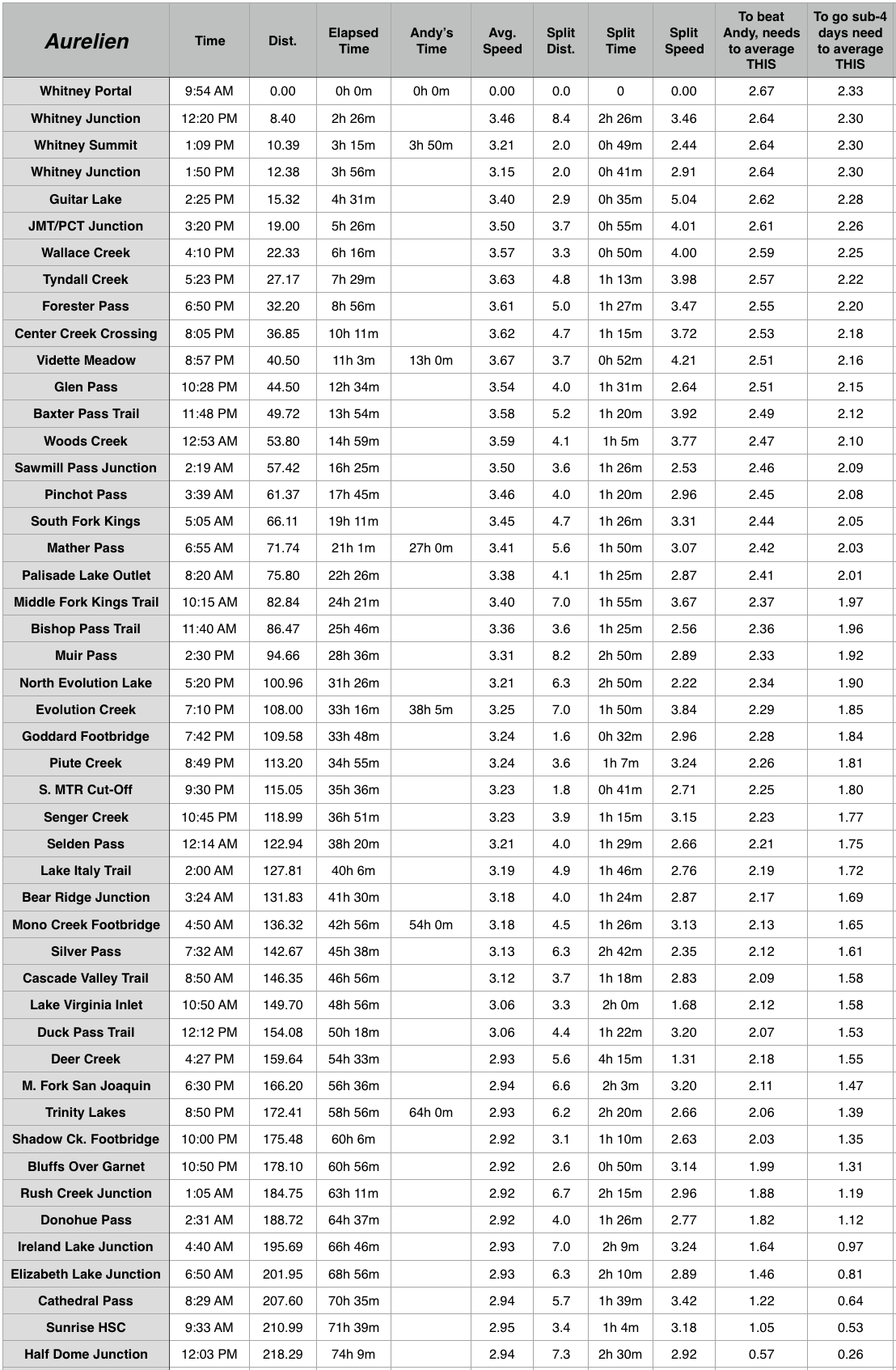
Aurelien: A fabulous effort, improving your times considerably and getting further than last time!
It seems like your 10 am start worked well and I suspect the solid night’s sleep beforehand is part of what enabled you to go so long on so little rest. And it sounds like your food and hydration worked great until you stopped doing so around Donahue Pass. Would setting an hourly alarm on your watch help? Every hour on the hour, start another 200-300 calories? Drink another pint of water (or more if thirsty).
I hesitate to give suggestions because you’re already at a much higher level event than I’ve ever done, but a few missteps resonated with ones I’ve made and remedied:
A few very small items are worth having redundancy in. For me on a usual backpacking trip, that includes a second mini-Bic (or sparker). And an extra bottle cap (gatorade bottle cap for me, since that’s what I use with my SteriPen. Enough extra shoelace to replace one if it broke. Short lengths of Luekotape. A few safety pins. 4 to 6 each of Tylenol, Advil, and Imodium. Big needle and strong thread. 2 water-proof bandaids. With those 20 grams, I can deal with a lot of little mishaps.
Regarding “I tried to have a nap next to the (King’s Fork) creek since I started to feel very exhausted after almost 20 hours of hiking, but it was still freezing cold”: It’s a lot colder next to creek than just 5m to 10m higher in elevation. Partly, the more humid air carries more heat away from you. More so, cold air often spills down a creek drainage from upper, colder elevations and that slight breeze of noticeably colder air makes a big difference. Just getting on a little rise and/or some protection in a grove of trees can make a 5C to 8C difference, which is huge.
I hear you about how mentally and emotionally exhausting it is to think you’re at the pass but you’re not (like those 3 lakes at Muir Pass) and when you thought Donahue Pass was less of a climb than it is). That’s going to get better with every attempt, but an altimeter is another trick to manage that. It helped me a lot, before going UL in the early 1980’s, to KNOW how many more vertical feet I had to go with a heavy pack on. If the pass is 9,600 but I’m at 8,100, then that next rise IS NOT the pass itself, however much I wish it was. I just adjust my expectations, and settle in for another 1500 feet of climb. An altimeter, combined with the simplest of paper trail profiles (or a table of elevations / distances) could eliminate those emotionally-draining disappointments. Or just keep hiking / running it. On trails I know really, really well (Half Dome, Whitney, Bright Angel, South Kaibab), sometimes the time flies by and the miles seem effortless compared to the first time I hiked the exact same trail, but didn’t know what to expect.
Again, great job on a really tough event. Congratulations on how much you improved!