Revisiting this thread got me thinking:
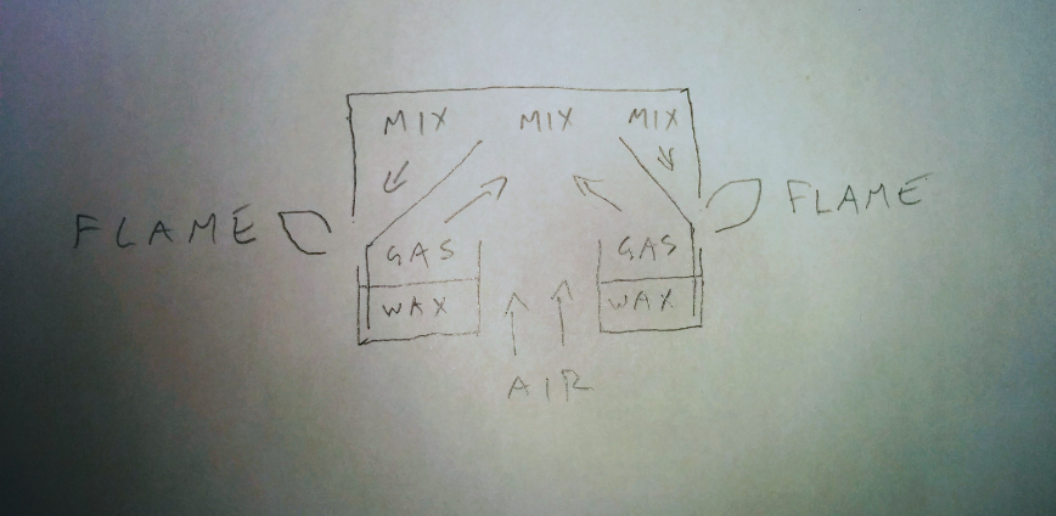
If you went with a toroidal reservoir, you could move the air intake to the bottom and use the cooking flame to heat the fuel, eliminating the need for a permanent priming flame.

The conical insert has axial creases in the parallel/vertical walls, like a groove stove, that serve as a priming wick to draw wax up to the flame ports. The all metal construction will conduct heat down in to the fuel reservoir faster than a carbon wick so this should prime faster. Once the fuel vaporizes, it will self ignite and bloom from the priming flame. Since the air intake is so far from the flames, you don’t need any wire mesh to prevent combustion inside the stove.
I notice most of the soot in Jon’s experiments was in the middle of the pot, where it seals against the stove body. Given that the pot is always below stove temp., it makes sense that vapor is condensing on it there. I’ve closed the top of this stove to prevent that. If contact between the pot and stove is minimized, the stove top will remain hot, eliminating internal vapor condensation. A bit of carbon felt can take care of that letting you use the stove as a pot stand. Then you just have to ensure the reservoir remains above the ground for the air intake – also easy. In cold weather, this insulates the reservoir from the ground.
I think this can be built entirely from beverage cans with a little JB Weld, Tektoba style.
As an option, separate priming ports could be placed below the cook flame ports and a rotating snuffer sleeve added. And I suppose a snuffer sleeve for the cook ports is in order. Might also need to close the air intake once the flame is out to contain the vapor while the wax cools. You’ll probably get vapor condensation all over the inside of the stove at this point, but it should boil right back off next time you fire it up.
Unfortunately I don’t have time to tinker with this – just thought I’d put it out there if anyone is interested.
Anyone have any progress to report?