


+1 What Dan said !
Topic
Become a member to post in the forums.
+1 What Dan said !

"Sidewinder Cone without extras – $40, 1oz…..
….1) Trail Designs includes a lot of stuff you don't need in that Sidewinder price (12-10 stove, fuel bottle, esbits, esbit holder). Sometimes you can contact them and ask to buy just the cone for around 1/2 that."
A agree with the comment, but disagree with the opportunity to buy just the cone. It is either not there when one needs it, or TD is inconsistent about it.
A year or two ago I asked Rand @ TD this same thing, and he politely refused to sell me just the sidewinder cone as "we only offer this option to already existing customers, and for the new ones we prefer that they buy our entire 'system'".
Which was a nice way to turn me down, as I see no value in their 'system'.
I am actually quite happy with this outcome though, as I was forced to build two "clones" of the sidewinder cones from Ti foil – for my 0.9 L wide Evernew, and for my 0.75 L narrow/tall Toaks.
And I am confident that my cones (fitting into the pots for storage of course) perform no worse that the TD ones! And the closure system of my cones is smarter, more reliable, and definitely lighter from the TD one.
"And the closure system of my cones is smarter, more reliable, and definitely lighter from the TD one."
Picture?
Link?
Thanks

It does seem like TD only offers standalone cones to existing customers. If enough demand exists they might change this. Not that many people want to buy a 12-10 and a Starlyte stove when they only desire the latter.
The functionality of a cone is what's important, so building it yourself is great too. I've built several titanium cones that work well, but I've never seen anyone do a closure system as nice as TD's dovetail closure. If it's a choice between $80 and building your own I see the appeal of MYOG, but if TD will sell a professional cone for $40 and ti by itself is $25 then I'd rather buy from TD.
I'd like to see a picture of your system.
"what distance the bottom of the pot should be set above an Esbit burner."
Roughly, 1.25" to 2.25". Once you get more than 2.5", you will see a loss of performance. This varies a little depending on several things: the actual shape of the Esbit burner, the orientation of the Esbit fuel tablets, and the amount of air intake. There are several ways to foul this up, and there are several ways to get it right. There is always controversy about exactly where to measure this distance. Is it from the top of the unlit Esbit tablet, or from some spot inside the flame, and the top of the Esbit tablet depends on its orientation?
In general, the closer to the pot the Esbit flame is, the more residue it will leave on the pot surface. This is especially true when the water in the pot is cold.
–B.G.–
Pictures as requested.
And I have to retract my previous statement that my cone closure is more reliable than the TD one.
It is not.
It is just equally reliable.
But it is still lighter. I have not inspected a TD cone up close and personal, but I have seen numerous photos, and it seems that the dovetail is riveted to the foil. I believe it is unnecessary. It is as well unnecessary to use a dovetail interface since the spring action of the foil (with its tendency to "uncoil") automatically removes one degree of freedom (the "shrinking frustum" one), and that leaves only one DoF to be dealt with – namely the "uncoiling" one.
This is why my closures (2 different types as seen below) use the Ti foil itself with no extra parts and/or interfaces.
On to the photos.
My early edition with the Evernew pot, as simple as it gets:
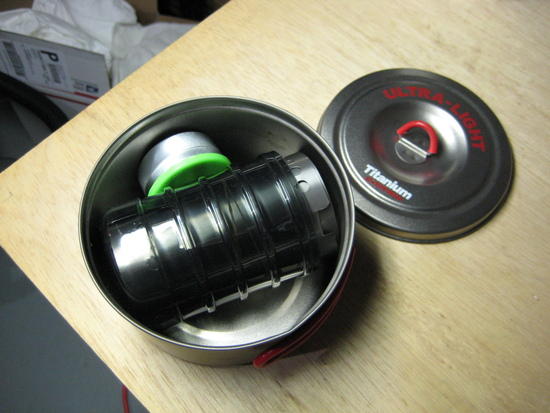
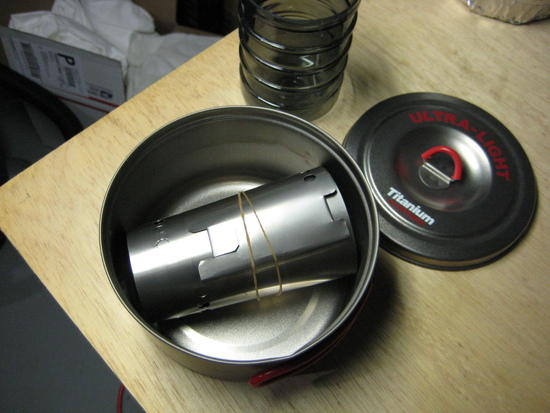
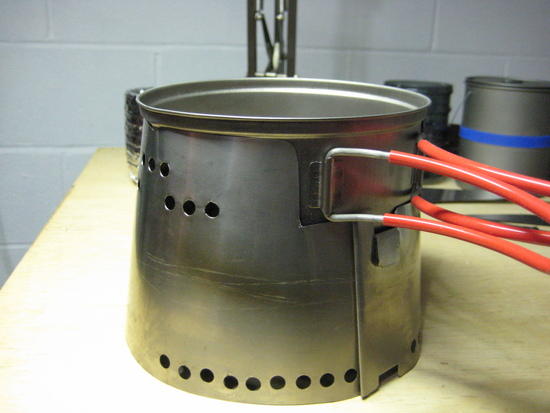
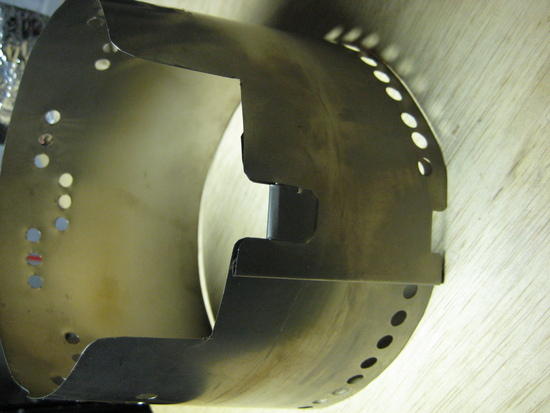
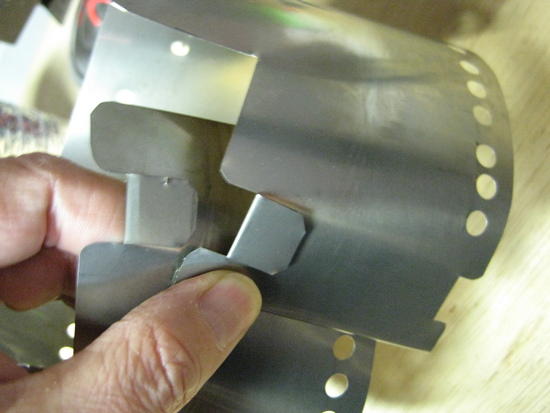
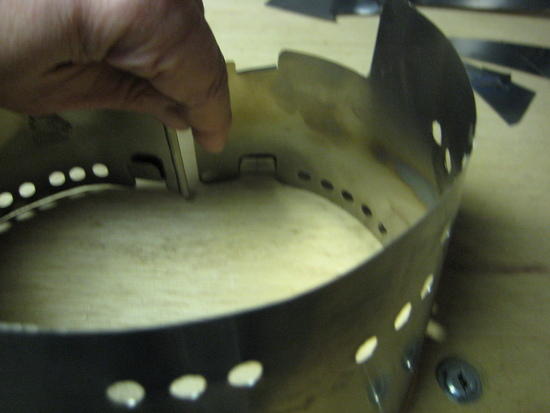
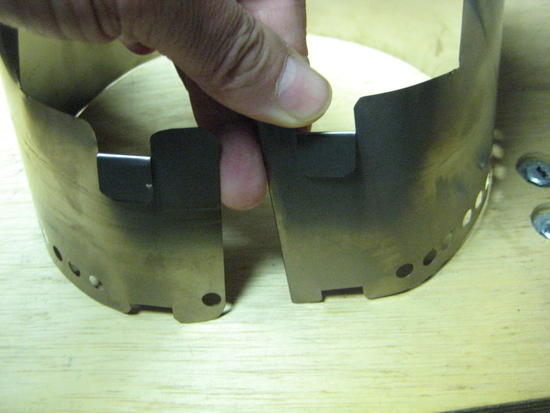
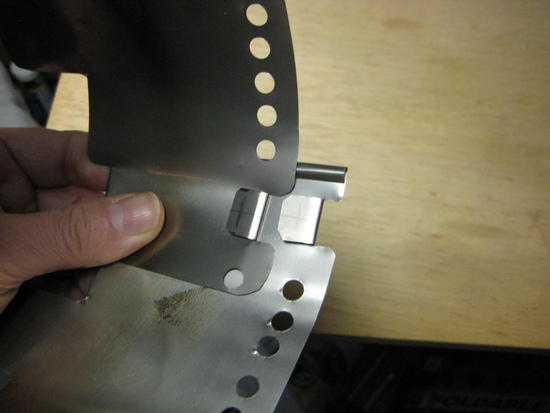
Crude, I know, but works very well.
My next post will show the newer, improved, version with the 750 mL Toaks pot.
MYOG cone for Toaks 750 mL, improved version:
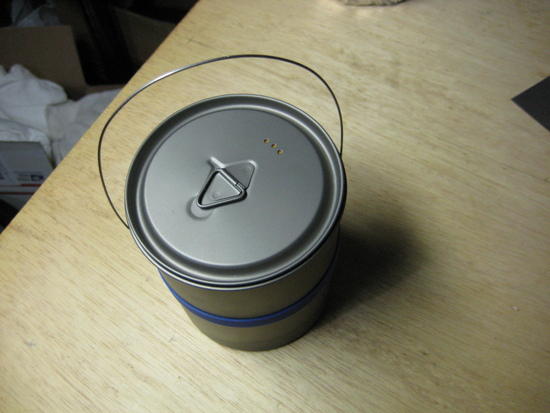
Pot cozy not shown
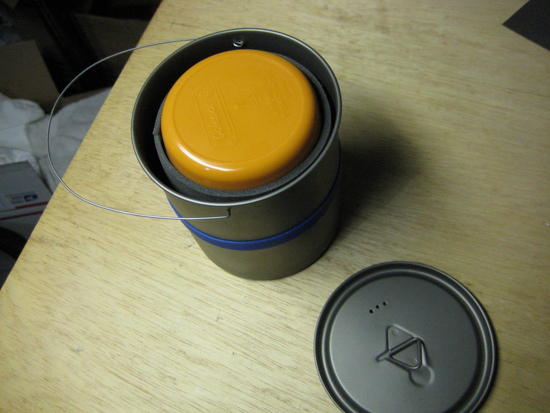
Orange cup with a CCF insulating band, containing the windscreen
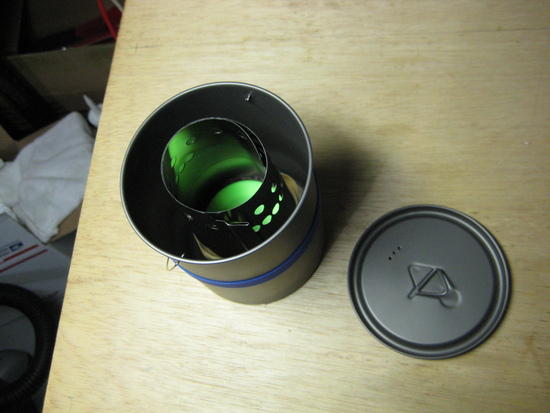
Screen and Starlyte Mod
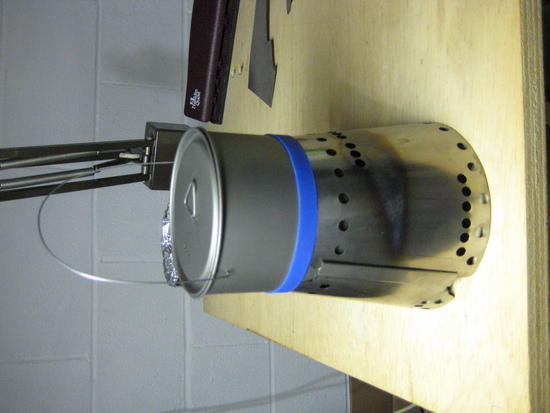
Ready to cook
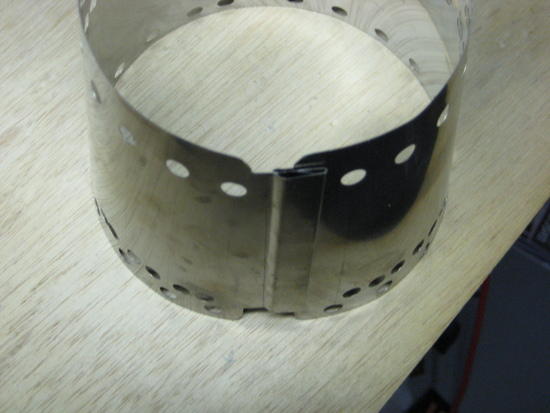
Simple and effective
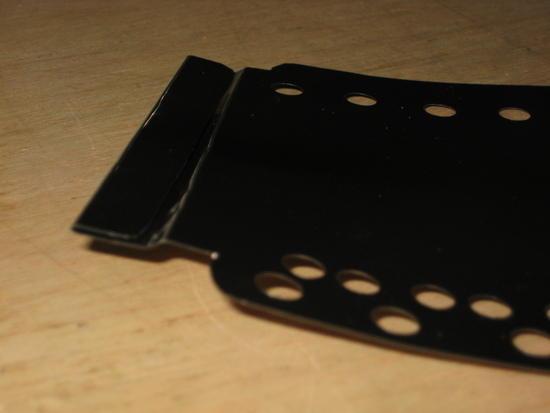
some guts…
Not bad at all @ 4.2 oz for a cone, pot, and stove….
Oh, and the efficiency of this setup hovers around 0.54 as per Dan D's evaluaiton.
Nive workmanship,good work on the pics.
Thanks for posting pictures Ivo. Your work is Interesting. I'll try to comment but it's tough to imagine the full functionality without trying them in person.
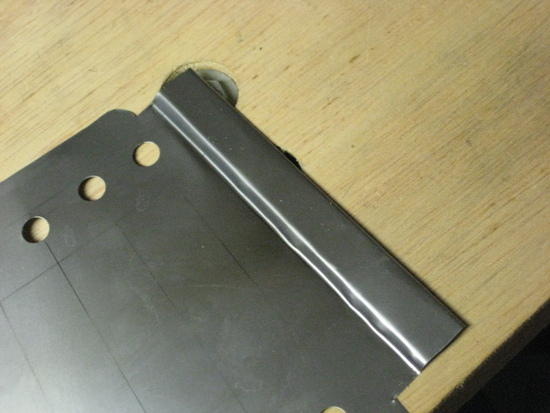
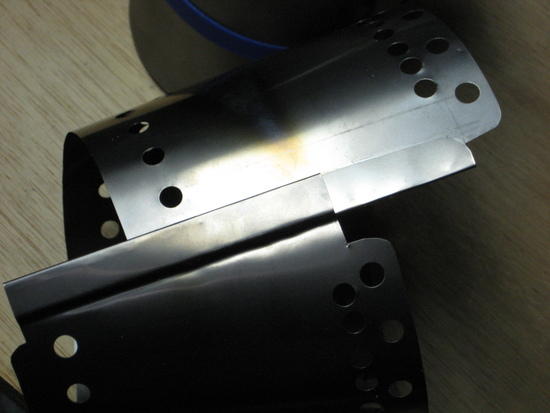
The ideal closure should prevent the joint from moving horizontally and vertically, while also being easy to use. On a flat surface only horizontal control seems needed, but in the field there's often uneven terrain where it's nice to have vertical control as well. It might also seem that only horizontal expansion control is needed, but a design that also prevents horizontal contraction is nice because uneven surfaces can torque the cone and cause the bottom of the cone to contract. With that said, it's difficult to design a closure that is controlled in all 4 directions (up, down, left, right) while being easy to assemble although snaps can do this.
The TD Dovetail design prevents the joint from expanding or contracting horizontally (10/10), it's relatively easy to use (8/10) and it provides some vertical control (6/10) because it's a snug fitting joint with a lot of surface area so it doesn't slide easily. It also avoids 180 degree bends in the titanium, so it's less likely to fatigue and crack over time. Obviously it costs money and adds probably 2 grams over a non-reinforced design.
Your first design appears very easy to use and provides full horizontal control (expansion and contraction) but seemingly very close to no vertical control in one direction. I like this design quite a bit.
I've made a few cones similar to your second design. It's tough making a long flap with a highly consistent gap, so these joints usually need to be joined vertically, rather than horizontally. Assembly is easy depending on build quality, but typically I find the TD design to be a bit easier. It's also difficult to have tight tolerances with a design like this, so usually vertical control is absent in both directions (up, down). This design also lacks horizontal control in one direction (contraction). Overall, this design only controls the cone in one direction (expansion) so I've come to prefer paying more for the TD closure.
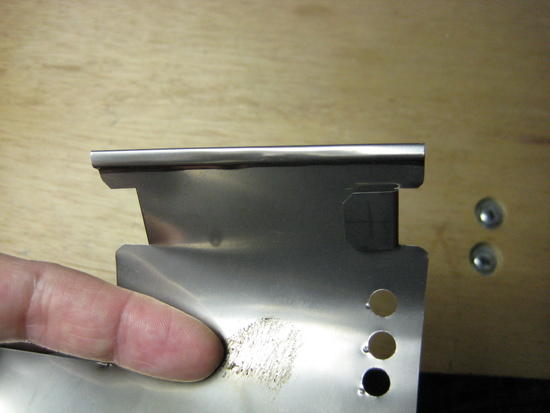
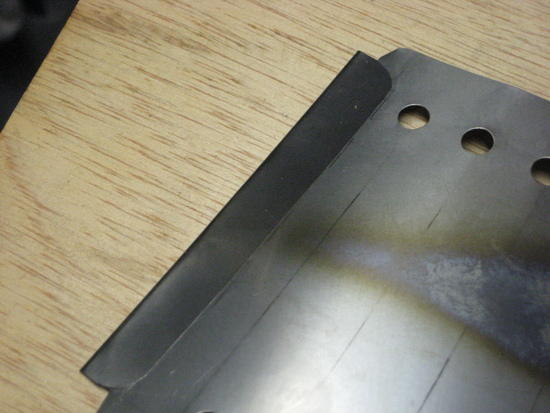
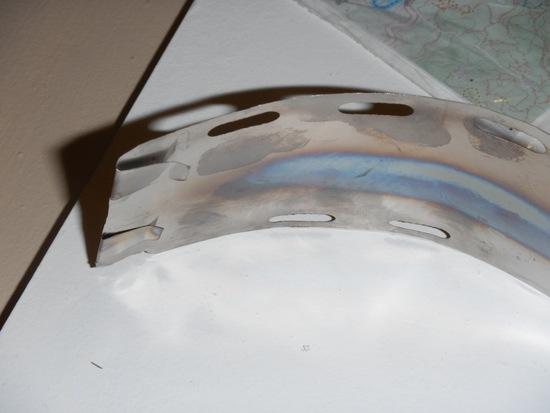
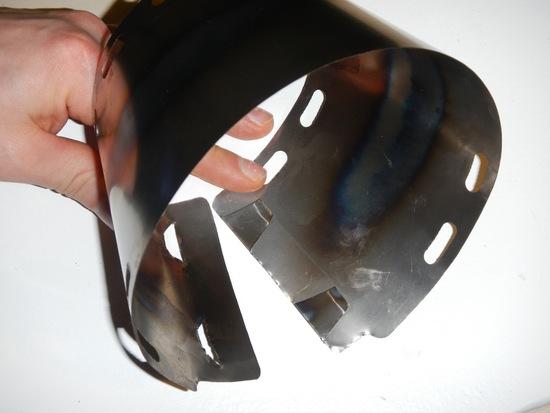
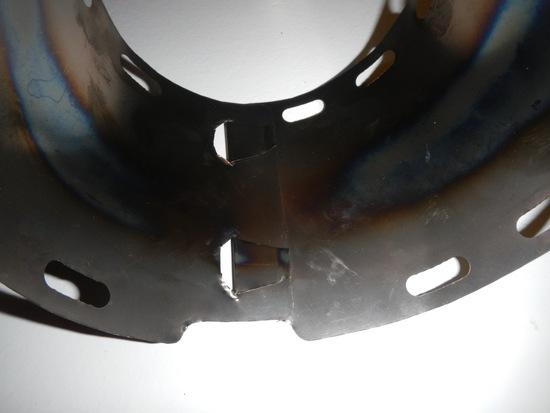
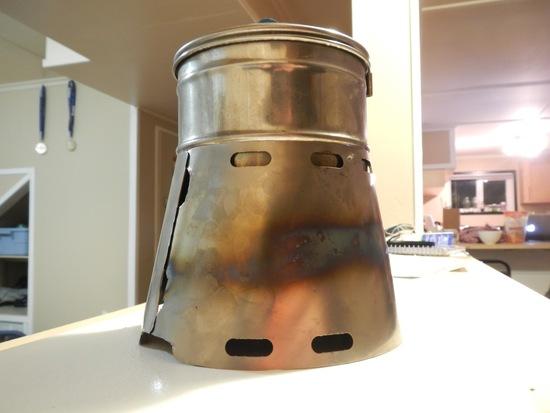
My most recent closure design is shown below. This design is very easy to operate (similar to TD) and it provides full vertical control in both directions, in addition to expansion control. It provides no contraction control other than a slight bit of friction. Overall I find the appeal very close to the TD design.
+1
Simple.
Effective.
Nice Job!
Didn't Trail Designs use a similar multi tab system in their early Calders Cones before they made the dovetail?
Could be. I'm not familiar.
zI think their early tap system was similar only the tabs went out sgraight and slupped under the opposing side of the cone.
And I would like to comment about your statements about Titanium's properties through repeated thermal cycles.
Titanium is just about THE LEAST fracture prone metal made regarding expansion/ contraction cycles. That is why it was chosen as the outer skin of aircraft like the SR-71 Blackbird.
It also does not change its hardness/ temper like steel and Alumnium over repeated heat cycles at stove temps.
Titanium's achilles heel is it's tendency to work harden and crack when cold formed. With thinner gauges ,it's not much of an issue if the cutting and forming is done correctly. If Titanium gets through the forming process without any damage, its good to go down the road.
As proof of this, look at all the Ti cookpots out there. Look at the tight curly Q bends made around the rims on the pots and lids and handle mountings. They go through reaoted high heat cycles just fine without cracking.
My experience is that if you put a sharp bend in titanium foil it can crack if it's close to 180 degrees and semi-creased. I've had that happen once or twice. Aluminum does it much easier, but if you're really creasing titanium it can happen. I'm not worried about thermal stress. I'm just hesitant to have a design with tight 180 degree bends in case there's hairline cracking that's tough to see.
When I do bend close to 180, I put something in the fold as a spacer so it's not creasing as much. On bends like below I was quite careful not to crease sharper than I had to. If you hammered this fold flat it would probably crack.
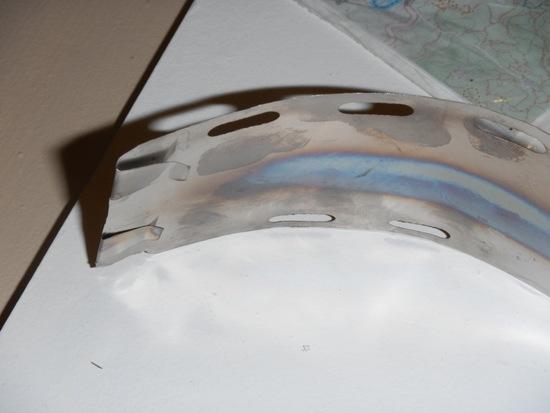
Forming can cause internal stresses which show up when heated as well,
I have always thought it would be intersting to observe the forming opetations at the various Asian Ti cookware making plants and talk with.the metalurgists more about the methods they use to form Titanium in production.
The forming dies must cost a fortune.
This assumes that they have actual metallurgists.
–B.G.–
In Japan, likely. In China and Thailand,maybe not.
It would be intetsting to see how they make the stuff, though.
Too bad we didn't get on the tour of the Lockheed Skunk Works in Burbank when they were figuring out how to build the SR-71. That would have been quite a titanium class. I've seen the video tour, and I was impressed.
–B.G.–
Dan D,
Thanks for sharing your design. I agree it is simple and reliable.
However, I find your concern about the vertical direction a bit excessive.
If the frustum was closer to a cylinder in shape, and there was no friction between the 2 sides at the closure, then I'd agree. In our cases though, we deal with pronounced cone, and plenty of friction, which does not necessitate too much of a restriction vertically. Even my early edition of the closure provides sufficient friction to prevent both slides from sliding vertically and becoming disengaged.
Besides, I made these for myself, and happen to know the end user personally (me), and he is quite gentle on his equipment unlike the common gorilla…
As to the concerns about fatigue and fractures in metals – this is precisely my area of expertise, on which I have spent a significant chunk of my career between 1985 and now. This is why I have zero concerns about the Ti foil cracking. There are many Ti alloys, and the one that I used merely needs a small radius in the bends, and a proper relief of the material around the bends – that's all.
Of course, I fully understand why the TD design of the closure is what it is (overdesigned). It is because – unlike you and I – they offer a commercial version, which may (and in many case does) end up in inept hands, and thus they need to cover their ar$es about liability, warranty, and brand reputation.

Best Combo: Evernew 0.9L pot (ECA252) + Sidewinder Caldera Cone + Starlyte Stove
I agree with this being the best combo. There may be cheaper MYOG alternatives, but I don't have time to do that.
I like the size, I wouldn't go any smaller. Reason being, I only use it to boil water for hydrating meals. Once I empty the water into the meal bag, I throw the bag back into the pot, cover it with the lid, and put it into my quilt or stack the quilt on top. It'll stay hot for at least 30 minutes. Having the meal bag in the pot allows me to not have to worry about the bag leaking onto the sleeping bag and turning it into a bear attractant. A smaller pot would not be able to accommodate the meal bag.
Also, with this combo, I found the furnished sack doesn't really work that well as it's a loose fit and allows the lid to come off and then the cone, fuel bottle and stove start to come out a little. Zpack makes a cuben fiber sack that specifically fits the 0.9L pot. It fits perfectly and keeps the lid in place.
Best Combo: Evernew 0.9L pot (ECA252) + Sidewinder Caldera Cone + Starlyte Stove
+1
I have had several alcohol stoves through the house via the gear swap to test them all out. Foster can setups, aluminum standard caldera cones, snow peak 700ML tri-tri fusion, supercat stoves, 12-10s, starlytes, etc. Finally ended up with the above combo. Most efficient, easiest setup, windproof, etc.
I really like it. I do believe that a low/wide pot like the evernew .9L pot with a titanium sidewinder and starlyte is the "best". The sidewinder is 1 piece, and since you are using the starlyte, you do not need to fiddle with stakes. So it has by far the easiest setup (in comparison to the fusion, fissure, etc). The starlyte stove is an awesome stove too for the various reasons already mentioned.
Now…is it best for me? I'm….not sure. I almost never hike solo, but many times will take a caldera if its just me and one of my kids. For breakfast…its not an issue. I can usually fit enough water for two mountain house breakfasts in the 900 ML pot. But for dinner….I can't get 1 L of boiled water.
So, the big question in my mind is if I would rather get a 1.3L evernew/sidewinder combo to boil 1 L of water at a time. That way, both of the meals would be done at the same time and there is less fiddle factor with 1 boil vs two separate boils. It should also be more efficient, but not by that much.
Downside….it is more packed volume and slightly more weight.
It might not matter in the end….if one never comes up on the swap, then I probably won't get it. (I've had a WTB several times for a 1.3L).
Just got back from a nice weekend using the Evernew 1.3L + Sidewinder + Starlyte. Indeed it's a wonderful thing. Just as good as the 0.9L setup but for two.
Ah! You just had to rub it in that you have the exact setup I'm looking for. Glad to hear that you enjoy it.
Could you let me know how much your pot (without lid) and cone weigh? For comparison, ->
My evernew .9L, without lid, is 81g, 2.85oz. The titanium sidewinder cone weighs 35g, 1.25 oz.
Also…I trust your opinion highly. How much more efficient is it to boil 1L in the 1.3L once, vs 2 burns of 500ml in the .9L?
While your here…question about the starlyte.
So, I can get a rolling boil with 10.5g of kleen strip green in my kitchen with my cold tap water…which is about 7/16th of a fl. oz.
However…that is only with a full starlyte (which, the starlyte holds about 1 1/8oz of fuel). If I take an empty starlyte, and only put in 10.5 grams, then I only get a soft boil, no rolling boil, since the flame gets weak quicker so at the end, its not quite strong enough to get it to a rolling boil. I also notice that its harder to light when its not full.
Would you say that's normal operation for a starlyte? That for the best efficiency you want a full starlyte, or at least, more than what you'll need?
Do you have some tips for lighting a nonfull starlyte with a bic lighter? (maybe, hold it upside down and light or ?)
"Do you have some tips for lighting a nonfull starlyte with a bic lighter? (maybe, hold it upside down and light or ?)"
Use a small coleman jet lighter or hold the starlyte upside down with a bic under it.
1.3L Evernew Sidewinder Cone: 44g
My Evernew 1.3L pot (no lid) is the non-stick version which is heavier and undesirable because the coating doesn't really do much. It is also a version without handles which offsets this weight, so it ends up being 100g for just the pot (no lid). I just pick it up by the rim and that works fine.
With my 1.3L pot, when I boil 1L instead of 500mL it takes 175% as much fuel. So overall fuel usage when boiling in one batch instead of two is about 88% (175%/2). It's also possible there's efficiency differences between the .9 and 1.3L pots (wide = slightly more efficiency) but this would be minor.
Regarding the Starlyte, it seems that the solution to your issues is to always start with a full stove. Since the lid can store fuel there's not much harm in just filling it up. I have noticed that it's harder to start when the stove is far from full. I typically hold the stove vertically so the flame penetrates a bit more and hold it there a bit longer if need be. I've had quite a few Starlytes and some seemed to light easier when 1/4" full that others. It could be differences in the wicking material, or just differences in temperatures or nothing at all.
With regards to the efficiency, when you add only 10.5g perhaps the last bit doesn't get burned because as it gets low on fuel there's not enough vapor coming off to sustain combustion? Have you tried weighing it after to see if all 10.5g indeed got burnt? It's also possible there's small differences in how complete the combustion is? Or perhaps because the last bit of fuel burns slowly and flickers it's not quite as efficient? There's probably a number of possible explanations that would require some testing to investigate.
Become a member to post in the forums.
 Magic 100 Sleeping BagMinimalist 900-fill-power down sleeping bag with a 55°F | 13°C comfort rating. Weighs 8.46oz | 240g
 © Beartooth Media Group Inc.
 Loading...