


Title says it all. Going to attempt to they-hike the pct this May. Is the jetboil really worth it? Or would you just make a cheap can stove?
Topic
Become a member to post in the forums.
Title says it all. Going to attempt to they-hike the pct this May. Is the jetboil really worth it? Or would you just make a cheap can stove?
worth what?
any restrictions? won't know till next spring. decide then.

Its going to be different for everyone, but after using a JetBol on the JMT I came to the conclusion that for me, the JetBoil makes sense if more than one person is using it. The speed and convenience is significant, and all 3 of us were eating while the alky stove people were still cooking. I like the alky stove when I'm alone for the reduced weight and bulk.

I loved my Jetboil on the PCT. It's fast and efficient, if you are making the most of daylight by hiking it's so much faster and easier to use. I tried my alcohol stove when we got out of the restricted areas (which they have changed the laws to yes you can use esbit and alcohol, but who knows what the laws will be next year), BUT a week into using the alcohol stove I shipped it back home. It was so dry everywhere it was scary and the alcohol stove so darn fussy to use I went back to the JetBoil, I missed it. And there were a few times I needed to cook in my tent, the JetBoil was perfect for a fast cup of tea or a quick meal. Just my personal experience.

I used both a canister stove and an alcohol stove on the PCT this past summer.
Canister stoves are nice and simple, but finding canisters can be a pain. Some people had no issues but I ran into a few. In Big Bear I had to buy a whopping 16oz canister because it was all they had, and then in Mojave no one had canisters at all. I was going to carry the canister stove until Kennedy Meadows, but without fuel in Mojave I just shipped it home and went cold food until I could pick up my alcohol stove (Starlyte + Cone) in KM.
I really like alcohol stoves. You can always find it and it's cheap. Even when it's a ripoff (Shelter Cove) it's still cheaper than a canister. Alcohol is slower, but I only cooked breakfast and dinner and at those times I had other tasks to do anyways.
Is the jetboil really worth it? Or would you just make a cheap can stove?
Well alcohol is always lighter in the end, but that assumes you have an efficient set up — which is anything but a given. If you want to do a DIY stove, start experimenting now. To my mind, a reasonably efficient alcohol set up should be able to boil 2 cups of water with about 20 to 25 ml of alcohol. If your stove is using over 25 ml in alcohol, then I would think you’d want to keep experimenting. Of course really efficient set ups can do it with less than 20 ml of alcohol for 2 cups boiled. Personally, I gave up trying to beat the pros to save a few bucks. I got some commercially available alcohol set ups, and have found those to be far better than anything I could come up with.
On the other hand, there are plenty of people I’ve talked to who just wanted to flop down in camp at the end of the day and have dinner quickly with a minimum of set up and hassle. I personally don’t see that alcohol set ups are that much hassle, but I understand that integrated canister stoves like a Jetboil are quick to set up and quick to boil. Note that Jetboil isn’t the only player anymore; Primus and MSR have entries as well. I can’t comment about the Primus entry because I haven’t used it, but the new MSR Windboiler is pretty nice. The lower end Jetboils are the more economical though at $80 for the Zip and $100 for the Flash.
So, think about your style, experiment with alcohol while you’re still in the planning phases, and then see what the restrictions are in the spring. I can pretty much guarantee that alcohol stoves are not allowed in Southern California, drought or no drought. A lot of people ignore the rules and make a decision based on their personal perception of fire danger. I won’t urge you one way or the other there.
In 2010 I started with a canister stove. In Big Bear I couldn't find a canister to save my life and set out with barely enough fuel for the next leg. The first night on the trail there was still phone reception so I ordered a Caldera system to be delivered to Idyllwild and have been using them ever since. I find them easy to light and not fussy and the windscreen/pot holder design works very well. With the Caldera, and any other alcohol stove, there are choices in size and shape of cooking pot, which is important if your resupply plan includes food you have to cook and not just pour boiling water over. And you can find fuel anywhere.
As for convenience and cook time, I developed a routine where I started my stove and then did the evening camp chores like sorting out the next days food bags or getting my sleeping bag fluffed and laid out. The stove was slower than a canister but that never seemed to leave me waiting for it, usually I would look over to see it boiling was I was still doing something else. Also the Caldera was efficient enough that I was actually cooking, boiling pasta, with the same amount of fuel that DIY packers were using just to get a boil.
To each there own, I saw a number of jetboils on the trail and their owners loved them. And I will even admit to being jealous when they pulled them out just for a quick hot drink. But you can see where my loyalties lie and think they are worth a look.

On my section hike last spring (Idyllwild to Walker Pass) I used a Trangia mini inside a Caldera cone. The snuff cap on the Trangia put it in conformance with the fire regs (stoves must be able to be turned off), and the Caldera windscreen increased efficiency considerably for very little weight.
The other thing to consider on long hikes is the probability of gear breaking down. I'm sure the JetBoils are very well-made, but it's just a fact that increasing the complexity of a piece of gear also means increasing the number of failure modes. I switched from white gas stoves (Svea, MSR) to alcohol not only to save weight, but because I found myself doing field repairs – or cooking over a fire – more often than I thought reasonable.
I used a Whitebox alcohol stove on the PCT because I wanted something that was simple, wouldn't fail, and was easy to get the right amount of fuel for. I would do so again. One caveat is that IF a lot of your resupply comes from stores along the way, make sure you know how to cook with a stove that only has one setting — full blast! I brought a cozy and it worked great.
The year before I did the JMT and I used a canister stove because reliability wasn't a huge concern on a shorter trip and I just mailed myself fuel part way through the trip. As a nice bonus, I found that a canister stove is lighter than an alcohol stove over a long period of time when you have 8+ days of fuel (rare on the PCT).
I found that a canister stove is lighter than an alcohol stove over a long period of time when you have 8+ days of fuel (rare on the PCT).
Jeff, I wonder if you could share your numbers on the canister vs. alcohol issue. When I ran the numbers, my finding was that alcohol is always lighter in the end (although canister could certainly be lighter at the start of a trip). Assumptions are everything in numbers like these, so I won’t claim my numbers are “gospel” by any means — which is why I’d be curious to see yours.
>"Assumptions are everything in numbers like these"
And a big potential difference in methodology is if you counting base weight without fuel (alcohol always wins), total weight at the start (canisters might come out ahead on longer stretches), or totalizing pound-miles in which the greater alcohol fuel weight is consumed day by day, while the greater canister-stove metal weight is carried for the whole segment.
"totalizing pound-miles"
What kind of units do you calculate with, furlongs per fortnight?
–B.G.–

The real issue is are you doing any cooking or is it just rehydrating your food? The answer to that will answer your question.
I used an caldera cone alcohol stove setup for my hike in 2009. I went with the cone as I thought it would contain the flame better and thus be less of a fire hazard in SoCal. Alcohol was very easy to find along the trail. I even found it in some of the tiny Oregon resorts that you have to mail a box to inorder to resupply. I was doing freezer bag cooking so all I needed was some hot (no need for a full boil) water. I also was only cooking for dinner so I only needed 0.6 to 0.7 fl.oz. of alcohol a day. The weight of a Jetboil was an automatic no way its happening after working to get my pack weight down for the trip. I also don't get the big deal over fast boil times. As long as my water heats up, why do I care if it takes a few more minutes? Is an extra 3-5 minutes really going to make a difference in how many miles I hiked that day?
The only time I was envious of the guy with a Jetboil was in the Sierra Nevada as he was boiling fresh trout he caught inside of it. But even then, I didn't need a jetboil as I was able to trade chocolate for some of his fish.
And a big potential difference in methodology is if you counting base weight without fuel (alcohol always wins), total weight at the start (canisters might come out ahead on longer stretches), or totalizing pound-miles in which the greater alcohol fuel weight is consumed day by day, while the greater canister-stove metal weight is carried for the whole segment.
I looked at stove + container + fuel to get starting weight, and then adjusted the weight by how much fuel was consumed each day.
I created a table showing the start of trip, end of trip, and average weights for trips of X days. I found that alcohol was always lightest in the end, that average weight was almost always lighter with alcohol except in a couple of cases on longer trips and even then the difference was fairly small.
Starting weight on the other hand was lighter in a number of cases using a canister stove. Inasmuch as one’s pack is heaviest on day one, saving weight in the beginning of a trip might actually make sense whereas a few extra ounces at the end of a trip might be fine since I’ve consumed the majority of my food and fuel, and my pack will be significantly lighter overall.
I’ll try to paste in the table below, but given BPL’s (ahem) high tech interface, I’m not sure how well that will work. The table is also on my blog which may be better in terms of readability.
HJ
Adventures in Stoving
Hikin Jim’s Blog
| ALCOHOL | ||||||||||||||
| Number of days on trail | 1 | 2 | 3 | 4 | 5 | 6 | 7 | 8 | 9 | 10 | 11 | 12 | 13 | 14 |
| ml of alcohol per day |
50 | 50 | 50 | 50 | 50 | 50 | 50 | 50 | 50 | 50 | 50 | 50 | 50 | 50 |
| Total ml of alcohol |
50 | 100 | 150 | 200 | 250 | 300 | 350 | 400 | 450 | 500 | 550 | 600 | 650 | 700 |
| Specific gravity |
0.8 | 0.8 | 0.8 | 0.8 | 0.8 | 0.8 | 0.8 | 0.8 | 0.8 | 0.8 | 0.8 | 0.8 | 0.8 | 0.8 |
| Total grams of alcohol |
40 | 80 | 120 | 160 | 200 | 240 | 280 | 320 | 360 | 400 | 440 | 480 | 520 | 560 |
| Fuel bottle weight (grams) |
18 | 18 | 32 | 32 | 32 | 45 | 45 | 45 | 45 | 45 | 45 | 63 | 63 | 63 |
| Stove system weight |
60 | 60 | 60 | 60 | 60 | 60 | 60 | 60 | 60 | 60 | 60 | 60 | 60 | 60 |
| Total grams (bottle + fuel + stove) |
118 | 158 | 212 | 252 | 292 | 345 | 385 | 425 | 465 | 505 | 545 | 603 | 643 | 683 |
| Weight carried end of trip (grams) |
78 | 78 | 92 | 92 | 92 | 105 | 105 | 105 | 105 | 105 | 105 | 123 | 123 | 123 |
| CANISTER GAS | ||||||||||||||
| Number of days on trail | 1 | 2 | 3 | 4 | 5 | 6 | 7 | 8 | 9 | 10 | 11 | 12 | 13 | 14 |
| Grams of gas per day |
20 | 20 | 20 | 20 | 20 | 20 | 20 | 20 | 20 | 20 | 20 | 20 | 20 | 20 |
| Total grams of gas needed |
20 | 40 | 60 | 80 | 100 | 120 | 140 | 160 | 180 | 200 | 220 | 240 | 260 | 280 |
| Actual grams of gas carried |
110 | 110 | 110 | 110 | 110 | 220 | 220 | 220 | 220 | 220 | 220 | 330 | 330 | 330 |
| Canister weight (grams) |
100 | 100 | 100 | 100 | 100 | 140 | 140 | 140 | 140 | 140 | 140 | 240 | 240 | 240 |
| Stove system weight |
60 | 60 | 60 | 60 | 60 | 60 | 60 | 60 | 60 | 60 | 60 | 60 | 60 | 60 |
| Total grams (can + fuel + stove) |
270 | 270 | 270 | 270 | 270 | 420 | 420 | 420 | 420 | 420 | 420 | 630 | 630 | 630 |
| Weight carried end of trip (grams) |
250 | 230 | 210 | 190 | 170 | 300 | 280 | 260 | 240 | 220 | 200 | 390 | 370 | 350 |
| Number of days on trail | 1 | 2 | 3 | 4 | 5 | 6 | 7 | 8 | 9 | 10 | 11 | 12 | 13 | 14 |
| Start of Trip Difference (grams) | 152 | 112 | 58 | 18 | -22 | 75 | 35 | -5 | -45 | -85 | -125 | 27 | -13 | -53 |
| Start of Trip Difference (ounces) | 5.4 | 4.0 | 2.0 | 0.6 | -0.8 | 2.6 | 1.2 | -0.2 | -1.6 | -3.0 | -4.4 | 1.0 | -0.5 | -1.9 |
| End of Trip Difference (grams) | 172 | 152 | 118 | 98 | 78 | 195 | 175 | 155 | 135 | 115 | 95 | 267 | 247 | 227 |
| End of Trip Difference (ounces) | 6.1 | 5.4 | 4.2 | 3.5 | 2.8 | 6.9 | 6.2 | 5.5 | 4.8 | 4.1 | 3.4 | 9.4 | 8.7 | 8.0 |
| Average Difference (grams) | 162 | 132 | 88 | 58 | 28 | 135 | 105 | 75 | 45 | 15 | -15 | 147 | 117 | 87 |
| Average Difference (ounces) | 5.7 | 4.7 | 3.1 | 2.0 | 1.0 | 4.8 | 3.7 | 2.6 | 1.6 | 0.5 | -0.5 | 5.2 | 4.1 | 3.1 |
A couple more things to consider.
A canister stove works fine for cooking inside the tent. This is important for me, especially in the morning: I want to be able to cook w/o getting out of the sleeping bag. The alcohol stove I have used ("fancy feast stove") has too much open flame to cook inside comfortably.
The alcohol stove usually is assumed to be used to just cook food, 2 cups per day or so. I like a cup of hot fluids in the morning and a cup of tea after dinner at night. This makes alcohol stove less competitive.
Try them both out, on a shorter trip, and see which one you like. The weight difference will be small. The one you find easier to live with is the one to take.
It costs you nothing to make a cat stove
Give it a try and if it works for you then youll have saved $$$$
If not then a jetboil works great
Im a fan of jetboils but why spend money when something cheaper works fine for you
;)
"The alcohol stove usually is assumed to be used to just cook food, 2 cups per day or so. I like a cup of hot fluids in the morning and a cup of tea after dinner at night. This makes alcohol stove less competitive."
I have tea w/my hot cereal. When the 2 cups of water in my 3 cup pot boils some goes in the mug the rest is for the meal.
But maybe thru hikers need larger servings.

First criteria – what are the rules and regulations covering your trip. If it is another drought year, you may have limitations on what type of stove you can use (sorry, but the Trangia probably won't meet the drought restrictions).
Second – re-fueling supply. Are you picking up locally or cashing supplies (mailing or drop off) for yourself.
Third – Safety. What cooking systems are you comfortable using? Alcohol stove need some skills and practice and are not for the newbies
Forth – Fuel usage. A canister holds a lot of fuel. A good alcohol stove can boil 2 cups of water using 1/2 ounce of alcohol and HEET comes in a 12 ounce bottle. If you use a lot of fuel per day, a canister may be a better choice.
my 2 cents,
Jon
I saw hikers, with both alcohol and canister stoves, without windscreens wondering why it was taking so long to get their water to a boil. With a Jetboil this is already taken care of, but if you go alcohol incorporating a windscreen will be almost as important as which burner you chose to use.
I had the original jetboil… I found it annoying compared to my snowpeak TI minimalist setup, which is also much more compact.
First, the bulk. – the jetboil is big, no way around that.
Second, the "stack" arrangement. It's nice how everything attaches as one unit while testing in the kitchen. I find the burner and pot can be stuck together, which is awkward in the back country while you're holding food in one hand, and nowhere to put it down to fuss with the jetboil. Also if you have ever knocked one over. Lets just say I would rather knock the pot off the burner than invert a fuel cannister AND knocking the pot over.
Third, the mug – if you use it as a coffee vessel, or anything besides water, the flavor remains. So I don't use my boiling vessel as my mug anymore. Considering this is kind of the point, or at least a big "feature" of the jetboil, if you don't plan on doing that, why bother with the jetboil at all?
My cannister system:
Built around the snowpeak piezo-start cannister stove with Ti 600ml mug & spork set. Nests two mini cannisters and scrubber perfectly inside a sea-to-summit mesh sack.
For fast & light pursuits I will bring only the factory setup, and deal with coffee tainted flavor. Backpackers pantry/mtn house style cooking. I keep one full mini cannister nested as "reserve fuel" and use the same partial cannister from trip-to-trip without worries of having no fuel.
For extended duration, cooler weather where warm food is key, I stop using the mug to cook in, and boil in a GSI halulite kettle. The stove, seasonings, scrubber, and coffee making kit all fit nicely inside, plus a couple esbit's and I also usually opt for a large MSR cannister instead of the mini's that nest with my mug. My partner and I then each bring our own mugs for coffee and or oatmeal- the GSI halulite mug is great here! (You could each nest a mini cannister inside for extra/reserve fuel)
In short – forget the fancy form factor of a jetboil and assemble your own cannister stove based kitchen, get more for less.
I saw hikers, with both alcohol and canister stoves, without windscreens wondering why it was taking so long to get their water to a boil. With a Jetboil this is already taken care of, but if you go alcohol incorporating a windscreen will be almost as important as which burner you chose to use.
Well, Jetboils are better than a regular canister stove, but they’re still vulnerable to wind, particularly to strong gusts which can blow a Jetboil out. See the two videos in Jetboil Sol vs. MSR Windboiler Even with a Jetboil, you still need to shelter the stove and perhaps use a partial windscreen — carefully (there are a lot of plastic parts).
First off, I am new to the forum and was so genuinely surprised with all the helpful feedback I received. Thank you to everyone who replied! :)
Yes, first concern is that practically all stoves of any kind are not allowed in the first 700 miles of the PCT. So I will just be soaking the majority of my meals.
But for the rest of the hike, I am now really leaning towards a caldera cone system. I am a SUPER newbie and would feel way more comfortable with a more specialized manufactured product.
The jetboil seems to be all luxery and though a lot of it's features appeal to me, the problem with finding canisters and the weight just isn't worth it to me.
Thanks again!!!
"To my mind, a reasonably efficient alcohol set up should be able to boil 2 cups of water with about 20 to 25 ml of alcohol."
I don't understand the logic of comparing the most expensive and engineered canister stove, the jetboil, to any old alcohol stove. That's like comparing a tarptent notch or zpacks soloplex to a shower curtain.
It's like people think/act as if alcohol stoves are one thing, and a jetboil is another thing.
When I started looking at alcohol stoves, I got first to the least efficient ones, the ones you are most likely to come across googling, because they were among the first designs out there, that are not easy to light and get a full bloom on, like the penny stove or the fancy feast. Those get between 20 and 25 ml boils, ie, they are basically the worst you can do re efficiency. I've read people getting worse efficiency, like 1 ounce, but I honestly don't know how they do that, you'd have to actually try to get that bad given the engery content of alcohol.
I haven't tested most of the commercial ones, but my guess is the starlight type stoves by zelph as a name brand get close to 15ml boils, but I don't know that. Assuming slx, of course.
I can fully understand why someone would dump alcohol stoves if they stopped at the finicky, hard to light, hard to refill, slow to ignite to full bloom, inefficient, and or slow, stoves out there, I would have given up on them too if I had to use a penny or fancy feast, but you don't have to use those.
Starlight Stove:
Boils 2 cups of 69 degree water in 6 1/2 min.Used 1/2 ounce of denatured alcohol to boil 2 cups of water.(always use windscreen for best fuel efficiency) results may vary according to conditions and pot used.
http://www.woodgaz-stove.com/starlyte-stove.php
I'm giving a named stove here to make this more fair, since we are talking about a named canister system. The CHS is the best I've seen so far, but it's not commercially available and is hard to make, relative to simple alcohol stoves anyway.
The major drawback of this stove is it doesn't come with the custom fitted heat shield, which is not an optional part of the package. Those are not hard to make out of aluminum flashing, diameter of screen about 1/2" greater than diameter of pot, I think, and top of screen about 1" above bottom of pot. Air slots cut out of bottom, easiest is to have about 1/4" to 3/8" cutouts on bottom, leaving 6 nubs to hold up screen. With the starlight no stand is needed, if you use a stove that needs a stand, you can use either a pot stand or rods stuck in heat screen.
15ml is standard for a good alcohol setup, if yours does not get that, it's not that good. Ok, maybe, but not great. 20ml is the worst I'd consider and then only if it's really fast, like 5 minutes.
A 16 ounce fuel bottle filled weighs about 14 ounces, and will last you 16 days if you are careful, 4 cups a day.
I think most stove users have issues because they don't use a decent setup, once the setup is solid all the negatives vanish for alcohol, at least that is what I've found. Fire danger of course is real, and also should be heeded.
Don't get lost in the ml/gm issue, 1 ml of alcohol weighs 0.8gm roughly.
However, there is definitely a real problem with how alcohol stoves/screens are marketed, in general, the pot, screen, and stove, should all matched, and sold as such, with that explanation. Since that usually doesn't happen, except I think with caldera cone (which is why I believe people like their caldera cone setups), and that's a real mistake, but it's not a flaw of the technology, just of the marketing / knowledge base out there. But cones are bolky, I prefer a setup where everything fits in the cooking pot, stove, screen, cups, even 2 days fuel.
Re fire danger, also, in no case should a stove where the base sits directly on the ground be used in dry areas, it gets HOT under that, I've charred wood in tests that way. This issue can be totally resolved by using an insulating base, like the top of a can. A piece of round foil big enough to more or less fit inside the screen edges gives you further fire proofing. Nothing is more dangerous than a fancy feast in my opinion, it's a side burner, and has no base, and the pot rests directly on it, which is risky for spills/fire. I wish these were explicitly banned to be honest, but the forest service can't be expected to do such granular bans, so it would be nice if users would stop promoting them and using them by themselves.
The proper comparison should be between a jetboil and a very good stove/screen/pot setup, then it makes sense.
I use a pocket rocket with a Caldera cone–just the outer wall– (that I bought used) for a windscreen. Push comes to shove, I could use the caldera with twigs to get a boil. Most importantly, the addition of a windscreen improves the efficiency of the pocket rocket by quite a bit. Just keep touching the canister to make sure that it's not getting too hot. This has never happened to me; although I only boil water for one person.
Become a member to post in the forums.
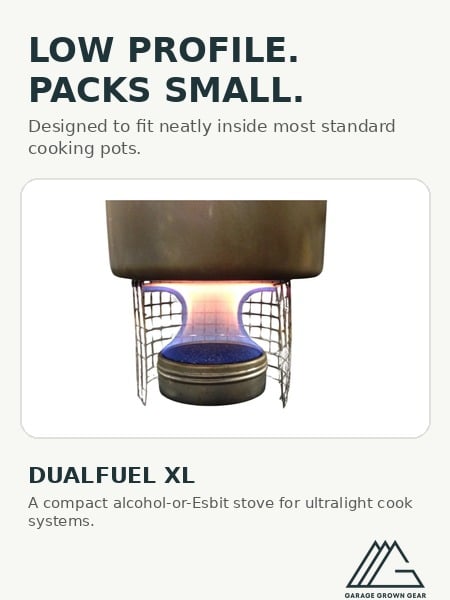 DualFuel XLCompact alcohol-or-Esbit stove with a low-profile design that fits inside most standard cooking pots.
 © Beartooth Media Group Inc.
 Loading...