Topic

Tent vestibules and TENT VESTIBULES

  • This topic is empty.
Viewing 25 posts - 1 through 25 (of 89 total)
PostedAug 20, 2014 at 8:56 pm

To me a good tent vestibule serves several purposes.
Namely:

1. Shelter the inner tent entrance from rain and snow (This implies a CLOSED vestibule, not just a "porch".)
2. Provide a space for a pack and boots
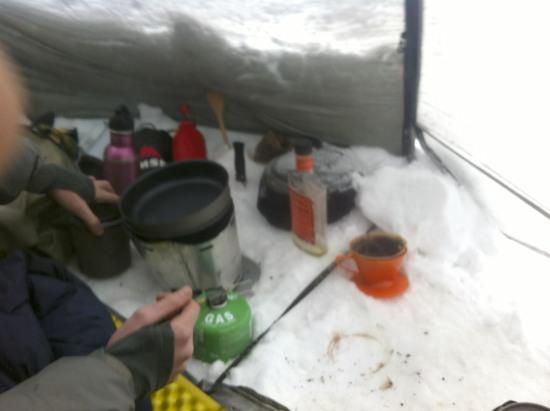
3. Provide a sheltered cooking area if absolutely necessary.

If a vestibule does all this it is a TENT VESTIBULE in every sense of the word.

Some newer tents have cleverly supported vestibules with partial poles from a hub, etc. That's good design.

So tell us about the vestibules you love and/or hate.

(Most of you know I love Tarptent Moment and Scarp vestibules but I'll say it anyway for illustrative purposes.)

HkNewman BPL Member
PostedAug 20, 2014 at 9:08 pm

I am rethinking vestibules after an incident 1 week ago. Had a furry critter try to get into my vestibule in the middle of the night, right above an area where a bear was raiding crowded camps and there I was solo. Soon in the moonlight I could make out it wasn't a paw but a body. Then I saw what appeared to be stripes on its tail as I shooed it away. Probably a marmot with a bad dye job (after the salt on my cap) but imagine frightening a skunk in an enclosed vestibule?

Most of my gear is highly water resistant anyways, so why worry too much about vestibule space? Thinking about using my moment's vestibule for winter cooking though.

PostedAug 20, 2014 at 9:27 pm

Eric,
I got so tired of tiny vestibules, on the tents you mention and others, that for several years I used a fly covered bug dome that was open at the front and back.
The inner was remodeled to provide more protection against rain blowing in at an angle.
BDnetBDguy

Despite trying many tents with vestibules, this was the first time I could actually cook and eat a meal comfortably under cover. The camp chair was place inside the tent so that the feet did not project out from under the awning into the rain.
Surpisingly, wind blown rain was never a problem despite the large openings. Granted, no camping was done above timber/tree line in completely exposed areas.

There is also the problem of the pack and boots obstructing the entrance on some smaller vestibules. This does not happen on the One Planet tent used now, but doubt that there would be enough room to cook comfortably.
GoondieFlyFrontOpen

So despite the slightly added weight, the next tent will have a rear vestibule for storage, and a sizable front vestibule with an elevated roof (propped up by a trekking pole) for having dinner. Now that silnylon can be found around 1.1 oz including coating, the weight penalty from the added space is not so much.
If a tent doesn't enable living comfortably in severe weather, a super light version of the bug dome limited to more sheltered sites would serve just as well, I think.

Roger Caffin BPL Member
PostedAug 20, 2014 at 11:51 pm

> Most of my gear is highly water resistant anyways, so why worry too much about vestibule space?

My quilt is not.
My spare clothing is not.
Me is not.

Cheers

PostedAug 21, 2014 at 6:04 am

>> "Then I saw what appeared to be stripes on its tail"

Raccoon?

Ken Thompson BPL Member
PostedAug 21, 2014 at 6:14 am

Will be a thing of the past like pack lids if Sierra Designs has their way.

My hammock, no vestibule

My Solomid XL, no vestibule

My Hilleberg Unna, no vestibule.

But they all have room for and have worked doing 1,2 and 3. Well maybe not so much for #1. But I think that is an overblown problem anyway. Here, everything will get wet eventually. No matter what.

Haven't had a vestibule on a tent since my Walrus Arch Rival back in '99

PostedAug 21, 2014 at 6:29 am

I use a floorless shelter or tarp now, so no need to keep the inside of the tent clean. My groundsheet is smaller than the shelter so I just put dirty stuff on the ground. For cooking, I can use my umbrella since it takes 5 minutes to boil water, then everything can be done inside the shelter or if I'm an open tarp it can be done under the tarp.

I like to keep it simple!

For winter in exposed sites I think vestibules still serve important functions, but I'm avoiding the cost of a 4 season tent and sticking to forest service huts and shelters this year.

James Marco BPL Member
PostedAug 21, 2014 at 6:39 am

Yeah, one of the secondary criteria for buying a new tent is a vestubule over the door. Too many tents in the past ignore this, I get wet trying to get into and out of the tent. 'Corse, it seems to rain most nights in the ADK's. I seldom use it for cooking or gear storage. Most tents are 7' long and I have a foot+ above me or below me for gear.

Under my tarp? Well, the whole thing is a vestibule. Once or twice per year I cook under it.

Jesse Anderson BPL Member
PostedAug 21, 2014 at 7:35 am

I have to say after falling for Sierra Designs' marketing and buying a new Flashlight 2, I have an entirely new opinion of vestibules. I can from an old Kelty-made Flashlight clone. It had a substantial vestibule that I thought worked great, until I found something better. With the gear closets next to the doors of my new tent I can store muddy boots out of the rain, I can cook when needed. I prefer to keep my backpack in the tent with me. What I don't miss is reaching more than an arm's length into the vestibule trying to reach the zipper to get out. And in a rain storm I got just as wet getting in an out of the tent with the vestibule as without.

My 4 season bomb-shelter tent still has vestibules and I like them there where I might need extra protected space for cooking, and getting on my boots and snow-shoes. The vestibule works there and unless I move to a tee-pee style hot tent, I'll probably continue to use a 4-season tent with vestibules.

As far was what I really hate are vestibules so poorly designed that when you open the door, the inside of the tent is completely exposed. If the vestibule extends into the main body of the tent, it is beyond worthless in my opinion.

PostedAug 21, 2014 at 8:23 am

1. Shelter the inner tent entrance from rain and snow-yes
2. Provide a space for a pack and boots-no, everything goes inside tent because critters eat anything that I wear for the salt
3. Provide a sheltered cooking area if absolutely necessary-no

For warmth I do like a full coverage fly, however.

Matt Dirksen BPL Member
PostedAug 21, 2014 at 9:17 am

add a Tent Wing!

It says it's lightweight, too! (In 1992 standards, perhaps.)

tent wing

PostedAug 21, 2014 at 7:38 pm

Sam,
Did you make that fly yourself? If so most excellent job Dude.

Daryl,
My Moment DW and Scarp fly/vestibules extend to the ground if I dig shallow holes for the main arch pole and the end or corner CF rods. I'd only do this if expecting a full gale or in winter for high winds to stop spindrift.

PostedAug 22, 2014 at 5:09 pm

Eric,
No, the fly was from a Bug Dome from Australia's Wilderness Equipment. It is 30D nylon. The inner was taken from an REI Bug Hut of about the same size as the WE, as it was much lighter than the WE inner to start. Then the floor was replaced with silnylon from Thru-Hiker, and the alloy poles were replaced with carbon poles. The lower pole sleeves were removed and replaced with one clip above each corner so that only two short upper pole sleeves need to be used for the pitch. Then the front and back net panels were redone to add the fabric that is closer to the ground, a zip was added for a rear entry, and all #5 door zips were replaced with #3.

After all that, the weight came down to around three pounds, which is more than I want to carry now, and the 52" by 87" floor is not needed for just one person and two smaller dogs (30# shelties).

So the praise is undeserved. If the choice is to build a lighter version of a similar tent, I have an old fly for a Terra Nova (Wild Things) Solar 2 that could be cut up and used for a pattern. It is so heavy that it's not worth preserving intact. The result would be less deep, more like a 34" by 90" floor, and 15D sil or PU coated nylon would be used for the outer, all to cut weight. The challenge would be to eliminate an inner that is pitched first, by attaching the poles to the outer, attaching the floor to the outer, and just using clip-in net panels under the roof to keep condensation off. Also, as much as I loved the Bug Dome awnings for cooking in rainy weather, I want to be able to camp above timberline, so would need to design some end covers that would fully protect the front and back of the tent from wind-blown rain, hail and snow, as may occur at high altitudes in any season. It would probably end up looking like one of the tents formerly made by Steve Noall, which were bomber tents, but on the heavy side with the vestibules.

A problem with the above design is the high total weight of the two longer poles, together with the transverse arch pole, as you probably know from your experiments adding poles to TarpTents. Even carbon isn't so light with that much pole footage. One approach would be to keep the transverse pole, as on a Moment and Scarp, but instead of two long poles, use one long pole with hubbed spreaders on each end, as with a Hubba. Thought about converting a Hubba, but the space would be coffin-like unless the floor were extended under the rear vestibule, and most of the outer would have to be redesigned. Seemed like too much work, especially since hubs are relatively heavy, and are a weak spot on a carbon pole frame.

So, I'm probably going to stick with a 15D mostly silnylon version of my XX design, posted here in 2011, which requires much less seams and sewing, and uses less pole footage. The challenges are figuring the best way to install the poles under the outer, and designing end covers that are open and provide great ventilation in most weather, but can be buttoned up in severe weather. I appreciate others' decisions to just go with a tarp and something underneath; but hiking on the Divide and other remote aeries, there are no shelters, the routes are often well above timberline, and it's great to be able to spend nights comfortably no matter what mother nature throws. I think that's what Roger C has been able to do with his tunnel tents, and its my goal as well. Sorry about the long answer.

PostedAug 22, 2014 at 5:17 pm

Sam, you are a gear "modded" after my own heart. That's a lot of mods for one tent and the results are very good, Weight for a two person tent is quite reasonable.

We are always searching for "that perfect tent" or pack or stove, etc. And usually people who mod gear get the closest thing available and mod it to their own specs.

Bob Moulder BPL Member
PostedAug 22, 2014 at 7:20 pm

Two very useful vestibules, two doors so one tentmate doesn't have to climb over the other to get out, super quick pitch/strike, total 21.8 oz including stakes and stuff sack. However, I use it only solo with my dog as tentmate, and for us it is a palace.

I've experienced only one 'real' thunderstorm in mine thus far (just got it this past Spring) with rain duration of about 5 hrs with thunder/lightning/wind/heavy downpour for about and hour of that, and experienced no problems. Minimal condensation in the very top of the ridgeline in the morning despite high humidity.

K C BPL Member
PostedAug 22, 2014 at 10:00 pm

For me, vestibules serve a good purpose. They add little added weight, they provide good protection against weather for gear if you don't want to bring it inside the tent with you. I unzip half of it to provide ventilation (can't do this in most mids). It's a nice place to make coffee and breakfast in the morning, good to put on shoes and sock in the middle of the night and morning. With some shaped tents they add aerodynamics for better wind protection.

Jeffs Eleven BPL Member
PostedAug 22, 2014 at 11:33 pm

I like the vestibules that have tow stake out points on the front edge, with zippers going vertically from each stake out. Marmot Swallow did this.

I liked it because you could zip up both zippers and make a big rectangular awning. Awnings in the rainy areas are awesome.

Of course, this makes it heavy. That two man, the Swallow, was like 9lbs+

Mike W BPL Member
PostedAug 23, 2014 at 12:11 am

I'm surprised that so many light weight/ultra light backpackers like vestibules.

I never have anything to put in mine. My shoes go beside my sleeping pad to support my arms (back sleeper… but that's another thread). My rain gear and extra clothes are my pillow and my pack (frameless) is under my legs or in a corner. If my shoes, pack and rain gear are wet, I stow them in dry bags to minimize interior condensation but they still get used as mentioned. The vestibule on my shelter(s) just seems like wasted space.

Jerry Adams BPL Member
PostedAug 23, 2014 at 8:51 am

pyramid tent – the 1/4 of floor area where the door opens gets rain on it. Just put your boots or whatever there.

1/2 the floor area is where my sleeping bag is.

The remaining 1/4 of the floor area is like a vestibule – covered so no rain, place to put gear that I want to keep dry.

Jeffs Eleven BPL Member
PostedAug 23, 2014 at 9:50 am

vestible

They're handy for cooking in crappy weather!

Plus, when we get to the campsite we get in the tent and hang out. We really like those UVX windows! We get to look at all that nature through the window in the woods! ;)

Doug Smith BPL Member
PostedAug 23, 2014 at 5:46 pm

I've never been stuck in a tent for days. Camped for days, sure, but not "stuck" in a tent for days. I think that is when a vestibule (not to mention more interior space) would make the difference. Solo shelters like the Unna, BA Copper Spur, Hubba, etc. are great if you can get up and out of them during the day and basically use them as a sleep shelter. But if I was fairly certain I was going to be stuck in a shelter due to heavy rain, acclimating to altitude, or snow for more than a day or two, I'd want a nice big tunnel tent with a "GT" style vestibule, for cooking, drying off, lounging, etc.

In other words, if I was one of the folks who literally live in a tent for the better part of 10 years, like Simon and Lisa Thomas, I'd buy a big Keron 4 GT just like they did. :) Having had both a Hilleberg Saitaris and a Nammatj3 GT, I can tell you that the huge GT vestibules are like living in a palace compared to tents without one. Then again I wouldn't want to carry one in a backpack.

Derrick Whit.e BPL Member
PostedAug 23, 2014 at 6:53 pm

After trying freestanding, nothing beats a cuben 2 man pyramid for solo use. Ultrlight spacious sleep area and spacious vestibule.

Derrick

PostedAug 26, 2014 at 8:33 pm

Derrick,
Given your locations, I had to take your experience to heart.
It would be nice to know more about your tent, though.

Also am not sure if pyramid vs freestanding is the issue here. Hybrids could incorporate the best of both. What if a pyramid were slightly bowed outward with exterior poles in a triangular shape coming down to two opposite corners, and the other two corners guyed in the conventional pyramid way. This would eliminate the upright pole inside and the bowing would add a little interior space around head height when sitting. The weight penalty, assuming one uses two trekking poles (which I don't – two would drive me nuts), would be about 3 oz with better quality carbon tube, and the one trekking pole could be used to guy out … a vestibule for rain protection while cooking.

MontBel made something like this called a Crescent 1, but it was way too small and made of PU coated nylon that sagged to the max. There is a photo in an older BPL tent article that made me feel drenched just looking at it.

One worry about tents that are stake supported is the possibility of total collapse if heavy rain loosens the stakes. You might have some comments about that as well.

PostedAug 27, 2014 at 11:03 am

I have used several tents as shelter from afternoon thundershowers.

I prefer the side vestibule. The front, single vestiblue versions typically let in rain when entering/ exiting. You can still cook in them though. You can also store your gear in them as well, though they are typically smaller.

My kids and I were caught in a 3 hr storm from mid-afternoon till it was dark. we were fine with the dual, side vestibules. I could cook and keep shoes in one, while our 3 packs and such were in the other.

Derrick Whit.e BPL Member
PostedAug 28, 2014 at 9:23 am

@Ray – I use an HMG Ultamid2. Unlike most other mids (MLD)it door is in the short side which is convenient for 2 people, one does not have to climb over the other to exit, but less functional for 1 in that you can only open 1 door at most in rain and even then there is risk of getting gear wet. I prefer the HMG mids for their additional height for snow shedding.

I just received the gear I need from Zpacks and I am about to mod my mid to have 2 doors. The original in the short side and the new one will be installed in the long side so when using it solo I can use it like an MLD mid and sleep behind the centre line with a a large protected area (vestibule) between myself and the door.

Like you, I am not a two pole hiker, and use a single pole only when fording rivers, and otherwise nothing when on dry land. I had Josh at Rotalocura construct me a single strong pole which is multpurpose: Hiking staff, Tent Pole and Tenakara rod. Please see this link for details: http://www.backpackinglight.com/cgi-bin/backpackinglight/forums/thread_display.html?forum_thread_id=85049

I can't comment on how well 2 arched poles would work with wind and snow load but would be less preferable for me than my 1 pole setup based on weight increase if nothing else.

The reason I reference freestanding is prior to moving to the mid, I used a Big Sky Evolution, with 2 reasonably sized vestibules, but it of course required the extra weight of single use poles. By moving to a mid I reduced weight by only needing a single multi-use pole and gained more space and the convenient and large 1/4 vestibule.

Interestingly, I rarely use my pole to set up my mid. I normally camp in forested areas and have taken to suspending my mid from a line tied between two trees, which can be very far apart in necessary. It works great as you can tension the line to reach the desired height.

As for pegs, I camp on sand, dirt, moss and snow. For sand I use large rocks or MSR Cyclone stakes. Both work effectively. On dirt I use 6" carbon core stakes (sheppard hooks don't work in our rocky soil). And on moss spongy ground I usually cut my stakes from dead branches or use the cyclones. For snow it depends on the type and depth of snow or ice.

I hope this is helpful.

Derrick

Viewing 25 posts - 1 through 25 (of 89 total)
Loading...