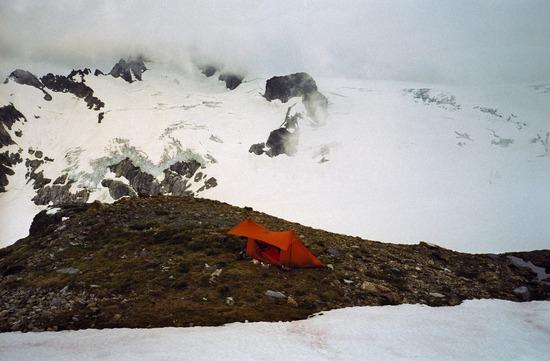
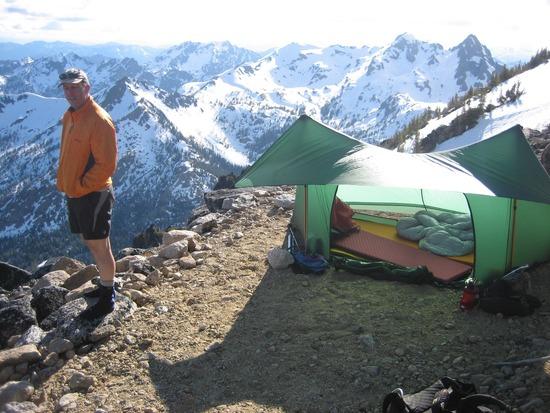
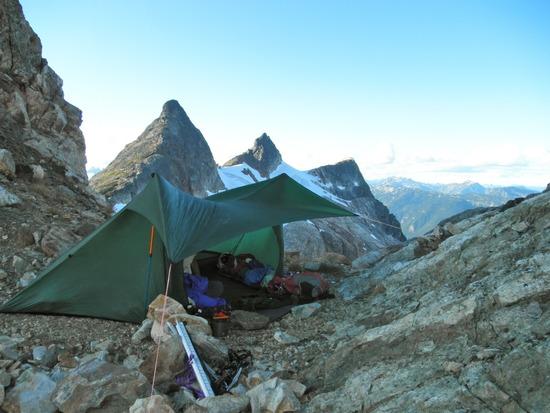
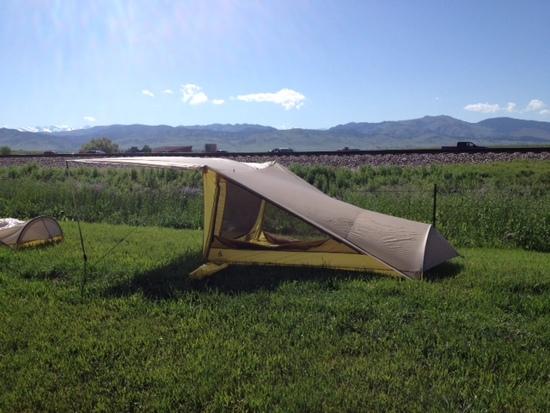
There is no doubt that awnings make shelters stronger in the wind. Yes, the tent blows "up" vs. down, and thus rather than collapsing and bending the poles to reduce the volume of shelter (where it will ultimately break or collapse completely), it remains upright and transfers the tension to what is, by far, the strongest part of the tent: the stake out loop. So, I guess these shelters WILL transfer more force to the stake out loop than a collapsed tent will, but no more than that same shelter (assuming equal surface area) when upright. Yes, an awning forces all of the force to the stake out loop, which is exactly where you want it since it is relatively easy to make any stake out loop completely bomber vs. experiencing failure of the structure itself (which can only be realistically addressed in the field with guy lines).
It is also counter-intuitive that many "tarp-style" shelters are actually stronger than many dome structures. It seems crazy that I would carry an MSR Missing Link into the world of the mountaineering dome, but a Missing Link is actually much stronger in wind (tested to 70MPH in the UW wind tunnel, if memory serves) than most dome tents (most 4 season tents fail at under 50MPH believe it or not).
There are two reasons. Every tent that I have seen fail in wind tunnel testing has failed for two reasons. By far the most common reason is that a pole breaks. The second, far less common failure is fabric tearing due to being "snapped" back and forth repeatedly due to low tension. The pole is actually the weak link, not the fabric. And the poles in dome tents carry the load under "bend" which is their achilles heel.
But a missing link has no bent poles. Think about it, if you wanted to break a section of tent pole, would you push straight on it along it's length (like a trekking pole) or try to bend it to break it (like a dome tent). Of course, you would bend it and it would fail way easier. Poles are MUCH stinger under direct compression than when under pre-bend. Trekking poles structures have much much much stronger frames than dome style shelters, especially since the trekking poles are WAY overbuilt for most tent use, since you use them to support your body weight.
A dome tent "feels" all nice and strong with its tensioned panels and apparent lack of floppiness, but again the truth is hidden. Pre-bent poles tend to reverse themselves under wind (in other works flip around so that they are facing inward rather than outward. In this case, the fabric completely de-tensions, creating a pocket that can hold the wind and force the poles to invert even more. This lack of tension can break the poles, but can also de-tension the fabric enough so that it can begin to flap. Flapping allows acceleration of the fabric to a hard stop, which can make the fabric tear. (check out the Kelty Gunnison, a dome tent, in the video. It immediately collapses the poles at just over 20MPH, and shortly thereafter the poles will break.)
Compare this to the Missing Link, which has no convex shapes to invert into concave shapes. Yes, you lose volume almost immediately in lighter wind compared to a dome which use the poles to create initial tension, but on a Missing Link (or MegaMid, or any similar structure) the seams create guy lines that form a STRAIGHT LINE between the top of the pole and the stake out loop. VERY strong. So while you will lose volume in a tent like this due to the generally larger un-supported panels, the design is way stronger at ultimate failure. It avoids flapping fabric because all the seams are tensioned guy lines, and it loads the poles where they are strongest.
The reason that "pyramid" style shelters are stronger than domes has to do with why we don't generally love the space: most of it is at the bottom and only a minimal amount up high. Not great for livability, but way better in the wind.
Finally, check out the Hercules vestibule in the wind tunnel test and compare it to the awning on the Lightning. The vestibule is the weakest part of the Hercules because it pulls those poles and tries to invert them. It is much stronger from the side where the awnings can hold it up. The Hercules fails because of the vestibule, and would be stronger with an awning on the end like it has on the side.
I know it all seems ass-backwards, I really do. But the testing does not lie…….
Hope folks find this interesting…..