


"…wondering if there isn't a drying effect that down has which 1) helps to eliminate the moisture instead of accumulating it, and 2) has a drying effect at skin level which has a beneficial effect with regard to heat loss?"
1) Nope.
2) Nope.
Topic
Become a member to post in the forums.
"…wondering if there isn't a drying effect that down has which 1) helps to eliminate the moisture instead of accumulating it, and 2) has a drying effect at skin level which has a beneficial effect with regard to heat loss?"
1) Nope.
2) Nope.
Um… ok, so in my quest to get more info on the subject, this isn't the only place I've looked or asked questions. I'm not finding much direct evidence one way or the other regarding moisture and heat loss, but what I am hearing is that moisture amplifies the effect – and of course, that we give off moisture that does settle in the bag as it can be measured afterwards. Except for clothes, what other types of insulation accommodate this moving of moisture? (other than down and similar syns)
I'm just making sort of a hypothesis with the "wondering". Are you saying, Greg, that you have conducted experiments directly related to such a hypothesis, or are you saying you have information regarding others who've done the research whereby the hypothesis did not hold water? (pun intended)
Can you understand why "nope" doesn't do me much good?
Your "wondering" is ambiguous –
"…what I am hearing is that moisture amplifies the effect – "
You mention moisture and heat loss, but specifically what effect are you asking about?
"Except for clothes, what other types of insulation accommodate this moving of moisture? (other than down and similar syns)"
Well, after "clothes", down, and synthetics, what else is left?
Down is neither hydrophobic or hydrophilic. It will not "pull" or "push" moisture. Moving air will move moisture, but not down.
Specifically, I'm learning that moistures increases conduction, speeds it up. Therefore, we lose heat faster and get colder when moisture is involved (our clothes are wet, for instance).
Well, since we started off talking about down and pads, I'd say the other insulation I'm talking about is CCF or closed cell pads, and I guess you have to include air pads, including insulated pads which obviously don't move moisture either.
I realize I'm being somewhat ambiguous, or perhaps it might be put decidedly unspecific. Not looking for a specific answer to whether or not moisture has an effect, but rather, a more generalized opinion on what might be happening with moisture – since we know its there and is obviously being dealt with, mostly, by the elements at work. If anyone is absolutely clear on what is happening, I'd love to get a good explanation.
And, of course, I'm not saying the down is moving anything, I'm saying that moisture is obviously being pulled though through the bag, not all of which escapes, but it would seem most of it does.
"…a more generalized opinion on what might be happening with moisture … by the elements at work.
I have mentioned before that , like some others, I have slept down to about -7c (20f) inside a 32f rated Summerlite.
How ?
With Merino top and bottom, a wool hat,wool gloves and a WM puffy down top and bottom.
(as for weight efficiency, the puffy top and bottom, hat and gloves are my camp clothes in winter…)
Now there is no way I could sleep at 20f inside a Summerlite naked.
My guess of why some feel that less clothing equals more warmth is that the clothing are either too tight and or dirty and dump from sweat.
Simple test, put on a few layers of DRY and CLEAN puffy clothing at home and then get into your sleeping bag.
Wait for half an hour.
Now get out strip off cool down and get inside the sleeping bag naked.
Still warmer when naked ?
BTW, socks inside a bag.
Ever noticed the sock pattern sculpted on your skin ?
Well that is a good indication that the are too tight (at night at least) and possibly, rather than warming you up, they slow blood circulation to your foot making them colder.
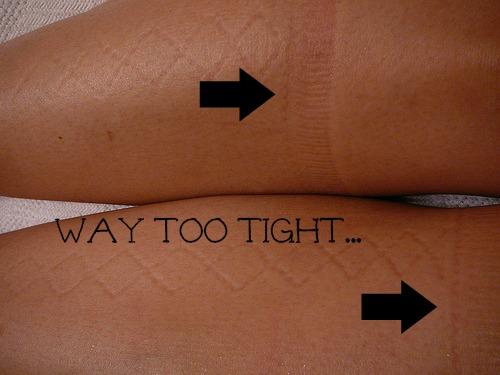
The sock marks may also just be a sign of edema.
I think it's a myth that you are warmer naked inside your sleeping bag. If it were true, I wouldn't feel warmer draping a jacket over me inside my sleeping bag. And on warm nights if it were true, I could put on some clothes to cool off inside my hot sleeping bag.
Again, "sleeping naked" is a misnomer, and you're actually doing what I'm talking about by being just in your merino baselayer. I doubt the r-value of this whole system adds up to the ability of the cumulative insulation to take you to 20 degrees. This is one of the scenarios that I hear a lot of that makes me wonder what else is going on here?
I surmise that the form-fitting nature of the jacket and pants assure no gaps in insulation, even if it might be getting compressed some. The pants work like a pseudo hot water bottle, warming your blood in the key areas of your thighs. The 32 degree bag insulates your WM down so that it can more efficiently do this while still being compressed some. You still would need foot, hand and head insulation to make it all work, and of course, sufficient insulation underneath.
Gosh, I hear the sock argument a lot. I'm beginning to wonder if this isn't just about cold feet, but more about the elimination of weak points (head and hands also) where the body can relax more completely in a comfortable state. Again, I contend that if the body is not restricting blood flow while trying to stay warm, then that increased blood flow assists the overall system of staying warm within the insulation. Down insulation, to the degree that you feel cozy warmth from it, is unique in helping the body to reach this state.
Just a hypothesis.
Let's keep in mind that the immediate effect of putting more insulation on you is to make you feel warmer immediately. The key is, what is the effect on the overall system that is responsible for keeping you warm through the night. And one of the reasons I'm a hanger now, is that I can recall nights in a sleeping bag where I did put on clothing to feel more comfortable in a warm bag. I don't think that was about insulation and much as absorption of body moisture.
Clothes do insulate, and in fact, they are more efficient at warmer temperatures where there can be more body moisture. It doesn't make sense that you would put more insulation on to be cooler – it really doesn't go that direction. Its only an argument I make that with regard to the usage of down insulation, that its not always additive that more insulation – in the form of clothes or pads – makes a better overall system of staying warm. Not that there can't be examples where it is additive, but just speaking of the typical scenario of staying warm in a down sleeping bag.
" I doubt the r-value of this whole system adds up to the ability of the cumulative insulation to take you to 20 degrees. This is one of the scenarios that I hear a lot of that makes me wonder what else is going on here?"
well I don't know but looks to me that you are trying to complicate something that is very simple.
Sleeping bag temps are given assuming that you are wearing increased insulation as the temperature gets lower.
So say underpants only at 50 f but a full top and bottom underlayer at 32f.
(so you see even the EN ratings tell you that clothing works…)
Anyway when I add the WM Down jacket and down pants to my Summerlite I have almost exactly the same amount of down as I do in my 20F rated Ultralite (used with only the Merino bits), so not all that surprising (to me) that the two perform about the same.
Note that I use the same mat with either system (DM7)
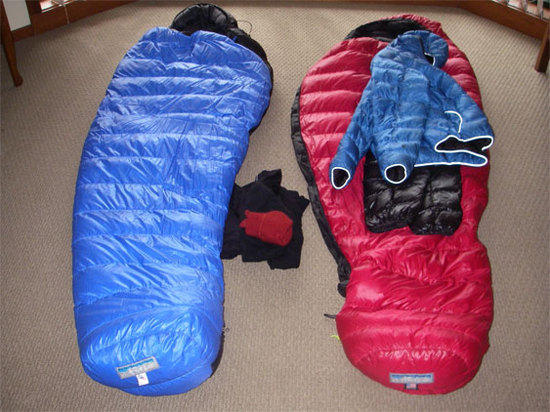
I forgot the socks but they are a pair of fluffy loose socks.
BTW, I will not attempt to address the insulation in a hammock bit given that the last time i pointed out "bridge like heat losses" inside a hammock(all around convective loss compared to a road like environment for ground sleepers) I was called ignorant and convective loss described as "pseudo science" so I will leave that alone.
Hi Court Jester
Sorry to have to say this, but some of your ideas are just plain wrong.
> The pants work like a pseudo hot water bottle, warming your blood in the key areas of your thighs.
Wrong. Clothing can not WARM anything. The only things which can warm your blood are muscle exertion (not likely while trying to sleep) or digestion in your stomach.
Insulation of any sort simply slows heat loss.
> You still would need foot, hand and head insulation to make it all work, and of
> course, sufficient insulation underneath.
This is correct, although I would place far more emphasis on head and underneath. Insulating feet and hands will not keep them warm if the blood going to them is cold.
> I hear the sock argument a lot. I'm beginning to wonder if this isn't just about cold
> feet, but more about the elimination of weak points (head and hands also) where the
> body can relax more completely in a comfortable state.
I am not sure what you are tryiing to say here, but Franco's picture of the effect of socks which are too tight is spot on.
> I contend that if the body is not restricting blood flow while trying to stay warm,
Some understanding of basic physiology would help here. The body will restrict blood flow to extremities in order to keep internal organs and especially your head warm. Under those conditions, insulating the extremities is of little use.
> Down insulation, … is unique in helping the body to reach this state.
Wrong. Any sort of insulation will have the same effect. Down is simply the lightest and most compressible insulation we have. It is not unique in any other way.
> Let's keep in mind that the immediate effect of putting more insulation on you is to
> make you feel warmer immediately.
Arguably wrong. When you are seriously cold, down to the bones in your arms and legs, you won't start feeling 'warm' for quite some time. Yes, I am talking about near-hypothermia states here, but I suspect many of us have flirted with this in winter. But we only do this when we know what we are doing and have the reserves to handle it – and know in advance that we have a safe exit strategy.
> Clothes do insulate, and in fact, they are more efficient at warmer temperatures
> where there can be more body moisture.
Wrong, pure and simple. In fact, increased moisture in the insulation layer almost alays leads to reduced efficiency.
> its not always additive that more insulation – in the form of clothes or pads – makes
> a better overall system of staying warm.
By and large, wrong. More effective insulation is good – although there are other very significant factors such as wind speed and the size of your dinner.
> wondering if there isn't a drying effect that down has which 1) helps to eliminate
> the moisture instead of accumulating it, and 2) has a drying effect at skin level
> which has a beneficial effect with regard to heat loss?
Basically, no.
> the air is warmed inside the mitt, which means more blood flow in our digits, which
> means air is further warmed in the mitt.
Wrong to some degree. What controls blood flow to our digits is a combination of two factors: how much blood is being diverted away from extremities to our head and internal organs, and what is called vaso-constriction: the narrowing of the blood vessels resulting from contraction of the muscular wall of the vessels. This latter will happen when the fingers get too cold: the body sacrifices the fingers (it's called frostbite) to stop really cold blood from returning to the core of the body.
> moistures increases conduction, speeds it up
Sort of wrong.
What moisture normally does to down is to degrade the structure so the down structure collapses and doesn't trap nearly as much air – which is the insulator. If you had an fibrous insulator whose structure was totally unaffected by water, it would not change a huge amount in insulation. This is why we won't wear down while active in damp conditions, but will wear good fleece. The latter withstands moisture much better.
> moisture is obviously being pulled though through the bag, not all of which escapes,
Very poor wording. Moisture diffuses through a bag due to a vapour pressure gradient. There is no 'pulling' per se.
Cheers
My experiences lead me to believe that if the sleeping bag is warm enough for the temps, I will be more comfortable naked or in a light layer.
a. My feet and hands will be warmer because the warm air from my torso will reach them more easily.
b. I will be less likely to wake up in a chilled swear as venting will be easier.
c. I can toss and turn more freely and as such sleep better.
d. I won't be going to sleep in damp clothes from the day.
If the sleeping bag is not up to the task however, extra clothes or liner or hot water bottle can make up the difference.

If I have marginally enough insulation, my feet will get cold. The body automatically restricts blood flow to feet to keep torso at temperature, but then the feet are cold.
Problem I have with sleeping naked is:
1) when I roll it sucks in cold air from outside which chills
2) when I get up to pee I never quite get warm again after that…
So… in cold weather I sometimes sleep in a light down jacket and down pants… makes getting up to pee quite nice :)
Billy
Geez, where do I go with this? Some of what you're saying is wrong, but most of it is a failure to understand what I'm saying. For instance, clothing and insulation do not actively warm you in terms of heat energy, which is something produced – that was never my argument. Rather, in terms of heat loss, if its effectively reduced by a certain amount, then that heat energy CAN be radiated back to you. Often, this is in the form of too much insulation where we get too warm. Theoretically, this shouldn't happen at equilibrium, but I'm saying maybe it does, in particular with regard to down insulation and the way it retards heat loss. I contend there is more at work than simple r-value heat transfer.
And in terms of body physiology, does it not make sense that our extremities get colder first and that this sends a signal to the body that it needs to protect the torso? In theory, its the torso getting cold that makes the body react. I'm saying that perhaps the body is a little too anxious to act by going into that mode when it senses cold from the extremities – maybe more so for some than for others. Do you know for a fact that is incorrect? Perhaps keeping the extremities well insulated means your bodies systems are less anxious. As someone with Asthma, I know all too well about the body reacting when technically it should not have to.
Other points could be addressed, but these are the main ones. Again, I'm not trying to tell anyone anything, except that I have these ideas that are mostly hypothesis, not necessarily fact. Its my way of trying to reconcile experience with theory of insulation.
> moistures increases conduction, speeds it up
Sort of wrong.
What moisture normally does to down is to degrade the structure so the down structure collapses and doesn't trap nearly as much air – which is the insulator. If you had an fibrous insulator whose structure was totally unaffected by water, it would not change a huge amount in insulation. This is why we won't wear down while active in damp conditions, but will wear good fleece. The latter withstands moisture much better.
Well, regarding bags and water vapour, this is correct. Air is a pretty good conductor when coupled with convection. Breaking the chain means air becomes a good insulator. That's why large areas, like in a tent, are usually still too cold at 0C to sleep in. Down creates "dead" air space mostly. The smaller these packets are, the better insulator you have for the same volume. 900fp down is better at this than 600fp down. It has more barbules on each plume meaning smaller air packets. Water actually conducts heat pretty fast. It is much denser than water vapour. And, as Roger says, it will collapse the structure causing less air to be trapped leaving you with a cold sleep.
Again, water vapour and liquid water do not respond the same. The major problem is that it will transfer back and forth depending on the local conditions. Or, you can think of water vapour as diffusing out of a bag, IFF the bag is warmer than the outside air. When the condensation line moves into the down, this will build up water in a bag causing it to fail. In more extreme conditions ice will form inside the down fill. This happens often enough in the ADK's to make me very aware of it. I often open my bag up and let it air out for 30 minutes or so in the morning, even at 40F. Relitive humidity in the mountains is usually 100% at ground level. Note that this condensation will cause a cascading effect because it cools as it evaporates, moving the condensation line further in the down. It makes me colder at around 3-4AM. I often get up and slip on a sweater.
Extra cothing in a bag is fine, up to a point. They will keep you warmer. But after that they are actually constricting whatever loft is in the bag, making you colder.
Jester –
" Some of what you're saying is wrong …"
Please cite the example.
"… clothing and insulation do not actively warm you in terms of heat energy, which is something produced – that was never my argument." [emphasis added]
In your 08/15/2014 08:16:55 post you said – "The pants work like a pseudo hot water bottle, warming your blood in the key areas of your thighs."
"Rather, in terms of heat loss, if its effectively reduced by a certain amount, then that heat energy CAN be radiated back to you. Often, this is in the form of too much insulation where we get too warm."
Net energy does not flow from low to high. Until the bag becomes warmer than you, it will continue to absorb energy. You feel "too warm" because your heat loss is reduced by the insulation, the "micro climate" of your bag is approaching, 98.6°, and your body begins to compensate by sweating.
"Theoretically, this shouldn't happen at equilibrium, but I'm saying maybe it does, in particular with regard to down insulation and the way it retards heat loss. I contend there is more at work than simple r-value heat transfer."
Refuting the laws of thermodynamics will be a tough go.
Down or synthetic, the principles are the same.
" … these ideas that are mostly hypothesis [ed. – conjecture], not necessarily fact."
Agreed. A hypothesis usually contains propositions to support the assertions.
If the insulation just gets damp, it won't collapse the insulation. If you measure the loft, it's unaffected. Either down or synthetic.
That dampness will evaporate, and that takes a lot of heat. The water vapor will go out of the insulation into the air. That is a major effect. It can reduce the effective insulation by a factor of two.
After a few hours, the dampness will all be evaporated and the effective insulation will be restored to normal.
This is when the temperature inside the insulation stays above freezing.
This is, of course, highly dependent upon the humidity differential and the external temperature.
If the ambient humidity is high, that could take a long, long, long time… that is, until you can make your way to a laundromat. ;-)
It is at these times the critical value of VBL is most appreciated.
Roger and Greg,
Blood is never cold. Based on what I was able to look up, moisture vapor speeds up the rate of conduction, and therefore heat loss.
Before the body gets cold and goes into vascular constriction mode, it has to sense being cold – it has to sense the threat. My example of insulating the extremities was always under the given of sufficient insulation for the torso as well. SO, insulate the extremities and you reduce at least that area where cold would be sensed first. That doesn't mean that I believe that's the end of the story – I mean, for all I know the body is going to sense cold with breathing, so maybe it goes into that mode anyway, right? Just saying its an element which can be controlled. There's plenty of anecdotal evidence backing me there.
And for Christ's sake, I never ever said that anything produced heat energy other than the body. Let me ask… If you're "warmed" by a hot water bottle between your thighs and it promotes you being warm throughout because it warms your blood because your femoral artery runs along the inside of your thighs, then what the heck do you call that? I call it being "warmed" by the hot water bottle. Now, follow me here, if you're wearing down pants, you've got down in an area right there, too. Its keeping you warm there – warmer than you otherwise would be. How many of you have actually worn down pants? I love'm when I'm outside. Hate'm in a sleeping bag, but then I'm not trying to stay warm in temps well below freezing in a 32 degree bag. So, tell me again how wrong I am about the down pants "warming" you like a hot water bottle? Please don't tell me its reduced heat loss. If so, you need to take that argument all the way through the system (body).
I don't know enough about the laws of thermodynamics to refute them. I know enough about enough obviously to get me in trouble with some technical guys who seem bent on the idea that variables just don't exist. I'm just saying I think variables exist, that they are not constant over environmental conditions and over materials used for insulation. This plays into how we use insulation IF in fact there are other variables in play. Again, just suggesting that anecdotal evidence seems to suggest something other than a strict adherance to heat loss and an accompanying linear relationship with comfort.
Ya'll might look at this article I found that comes close to describing some aspects that I've been trying to get at. Perhaps they say it much better than I and you can tell me either how wrong they are, too, or perhaps how right they are and how different that is from what I've been trying to say…
http://www.easternslopes.com/2013/05/02/gear-snapshot-dridown-technology-is-it-a-game-changer/
Jester –
Best of Luck.
I'm done.
"call it being "warmed" by the hot water bottle. Now, follow me here, if you're wearing down pants, you've got down in an area right there, too. Its keeping you warm there – warmer than you otherwise would be."
If you can't see the flaw in this 'reasoning', further discussion is futile.
Just read the article guys. Never should have gone with the rest of my "retort", sorry.
> Blood is never cold.
Ever handled a dead body?
> I call it being "warmed" by the hot water bottle.
> Please don't tell me its reduced heat loss.
Your priviledge, your choice.
Cheers
Roger Caffin, BSc, MSc, PhD, Physics
Um, no, I've never handled a dead body so I appreciate you setting me straight on that one. Really?!?
I truly don't like that I'm obviously pissing some folks off – I'm not getting any joy out of that. Did anyone read the article yet? It seems to me that what I'm hearing is contradictory to what is espoused in the article about down keeping us dry, and therefore more comfortable…
"When we got the bags home, we weighed them…and then dried them, and weighed them again. Both of them lost weight, but the Zissou lost about 4 ounces; the other bag, 6. In other words, the other bag, while appearing to be dry, had retained MORE water weight. The DriDown bag, on the other hand, had either had less moisture from the sleeper in it to begin with…or, based on being able to flick some ice off the outside, we think that it simply transported MORE moisture from the warm side to the cold."
"That brought us back to the jacket, and its exceptional temperature range. If the DriDown was moving moisture from the source (the body) to the surface of the jacket more efficiently than regular down, that would mean a less humid environment inside the jacket. The more humid the air, the more efficiently it transports heat, in BOTH directions. So, more moisture in the down would mean that the jacket would feel colder when outdoors, and hotter indoors. Beyond that, more moisture in non-hydrophobic down would subtly decrease loft, further compromising the insulating value, increasing how obvious the effect feels; with a really dry jacket, you’re comfortable outside when it’s cold, and comfortable inside when it’s hot."
How about we focus on this article and either take it apart or support it. Will make it less personal for me.
Become a member to post in the forums.
 New Ultralight GearSee the latest releases in ultralight cottage-brand gear from small makers.
 © Beartooth Media Group Inc.
 Loading...