Topic

Tiny dense calorie brick

  • This topic is empty.
Viewing 25 posts - 1 through 25 (of 41 total)
chris smead BPL Member
PostedAug 8, 2014 at 10:46 am

I used to bring these energy bars called belly timber for breakfast. Over 300 calories, but about half the size of a candy bar.
Downside is they didn't taste that great, were hard to chew, and now discontinued.

With those and other carefully picked items I was able to cram 9 days of food into a bearikade weekender.

Anyone else know of a replacement? Just needs to be tiny and calorie dense. I can deal with bad flavor/consistency.

I've read about homemade alternatives like Logan bread….but I'm a horrible cook. I even mess up mountain house half the time.

PostedAug 8, 2014 at 2:49 pm

"I used to bring these energy bars called belly timber for breakfast. Over 300 calories…"

Unless we also know the weight, to calculate calories per ounce, it will be hard to know if something is better or not.

After that is the question of carb/protein/fat ratio.

It's hard to hit a target if you can't see it.

Bob Gross BPL Member
PostedAug 8, 2014 at 2:54 pm

It is possible to come up with a food item that is extremely calorie-dense. However, it might be indigestible.

I stick with items that I know will work in my system. I can go a long way on dilute Gatorade, Logan Bread, and Swiss Cheese.

–B.G.–

Gary Dunckel BPL Member
PostedAug 8, 2014 at 3:07 pm

I agree, Greg. I checked out the above-mentioned Datrex line, and I couldn't find any nutritional info. But it's apparently just oil and carbs, and no protein at all. Some food that would be…OK for quick energy, but not for balanced nutrition.

I'll stick with Pro Bars, and maybe some dehydrated Spam for dinner. Tomorrow night I'll test the dehydrated Bush's beans and beef sausage I packaged up today–4 oz. yields a whopping 565 calories (141 cal/oz.), with those being 33% fat, 51% carbs, and 16% protein–not bad.

Rex Sanders BPL Member
PostedAug 8, 2014 at 3:55 pm

If you eat one 2400 calorie/17 ounce Datrex package per day, you would get roughly 36 grams of protein, with 141 calories per ounce.

Datrex 2400 calorie package label

You could supplement with a high-protein food and a multivitamin.

But I wouldn’t want to eat that diet!

You can always explore the dizzying variety of so-called food bars, most of which are processed beyond recognition.

On the less processed end of the scale, I like Bear Valley bars for breakfast when backpacking and sometimes at home. Better balanced, but only 106 calories per ounce.

And I eat Larabar Jocalat bars daily, roughly 119 calories per ounce. Be careful, since General Mills bought Larabar, they’ve been sneaking sugar into some flavors.

You could try making your own. Dozens of recipes online and in books. Then you control the ingredients, flavor, and nutrition. Some involve no more cooking than blending raw ingredients and shaping into bars. That’s how Larabars got started.

— Rex

PostedAug 8, 2014 at 4:34 pm

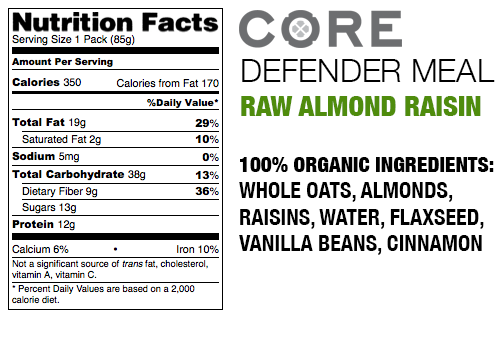
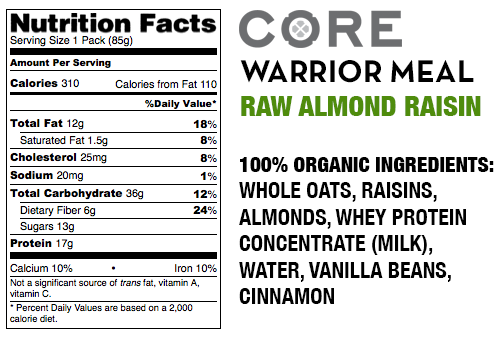
My local market started carrying Core bars (http://www.corefoods.com). I decided to pick a couple up. Pretty tasty – they call it a bowl of oatmeal in a bar. There are a few 'regular' flavors, and a few protein-added flavors. I just ate the Warrior Meal (the protein added line), almond raisin, and it's the best bar I've ever had. Quite tasty. 85 grams, 310 calories, 12g fat, 20 mg sodium, 36g carb, 17g protein.

They only last a week unrefrigerated (or so says the package – as well as 1 month chilled and 9 months frozen).

chris smead BPL Member
PostedAug 9, 2014 at 12:55 am

I think it was 2.4 oz for 300 calories….so not the best ratio…but I liked them because they were really small.
1 belly timber and 2 stinger waffles scored me a 650 calorie breakfast.

I've been reading about Logan bread for years here….so I'm finally giving up and begging my wife to help bake some using a recipe I found on BPL.

Will check out the other options like corebar too.

Roger Smith BPL Member
PostedAug 10, 2014 at 11:36 am

If someone has an old BT wrapper, maybe we can can make something close. Understanding that industrial kitchens have abilities gustatory tinkerers do not possess.

Ken Larson BPL Member
PostedAug 10, 2014 at 12:40 pm

Take a look at these bars!!

Not just a “bar” to fill in the hungry cracks of the day, rather an entire meal that would supply about 1/3 of an individual’s daily nutritional needs. It would be healthy, with all natural ingredients and no artificial preservatives.

GO HERE

GREENBELLY

PostedAug 10, 2014 at 12:55 pm

These certainly look interesting, but I'm not finding any nutrition information, or ingredient list, on their website. Where did you find your nutrition info?

Ralph Burgess BPL Member
PostedAug 10, 2014 at 12:58 pm

Ken – I think you need to check your arithmetic there
I think you may have missed serving size = 2 bars
640 kCal is for 160g
320 kCal per 80g (2.8oz) bar
113 kCal per oz, unremarkable

PostedAug 10, 2014 at 1:13 pm

GreenBellyBars

I see 2 bars per serving for 640 calories, or 320 calories per 2.8 oz bar, at~ $2/bar.

Similar in calories, weight, and cost to ProBar Meal bar.

[Edit: Damn! What a bunch of fact checkers!}

Aaron Sorensen BPL Member
PostedAug 10, 2014 at 9:42 pm

I'm not sure just how caloric they are, but they are up there.
They are also raw, so won't go bad on the trail.

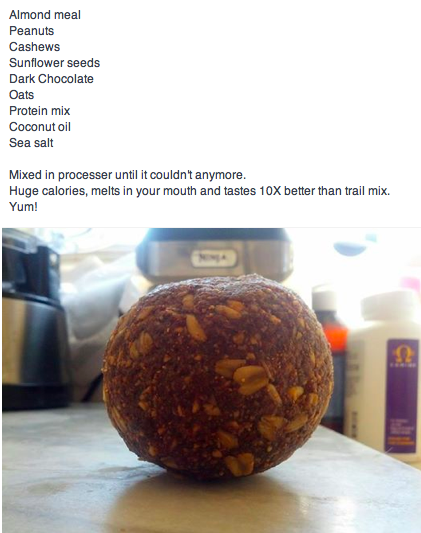
.gf

todd BPL Member
PostedAug 11, 2014 at 5:38 am

Aaron:

No cook? Just process, roll, and that's it?

Man I want some. How do you pack them for the trail?

PostedAug 11, 2014 at 5:59 am

" 113 kCal per oz, unremarkable "

exactly 100% correct.

am i way off base when i look at food specs and notice that if one takes out water and oil, that real food is pretty much 100 cal/ oz. of course, you can eat grass, and it won't pay the full 100, but it's not under the heading of real food either.
because that's what i start with. 100/oz.
if something is more than that, well then it's got oils in it. oil is not a bad thing, and in fact it seem the only way to bust pass the 100/oz barrier.
at any rate, when considering the sacred ration of 100 to 1, we can see that the bars under discussion are not big hoot calorie wise.
lacking big numbers may not be a curse. take Spam for example … the 3oz packet fails to deliver even our hoped for 100/1 minimum (water, i suspect), but still pays it's way as a core component of a trekking food matrix.
i suspect the trick in food packing is how to best keep the oils stable. cashews for now seem my best (cheap too) option, but overage of cashews makes for looseness down low. so one can't quite live on them exclusively.

just my op.

cheers, (and more nets soon)
v.

Jonathon Self BPL Member
PostedAug 11, 2014 at 6:18 am

I'm a fan of Kind bars.

http://www.kindsnacks.com/

They hover around 140 calories/ounce, and they are among some of the best tasting bars I've ever eaten. Sure, they aren't going to be cheap if you want to do a lengthy hike eating a bunch of them, but it's about the best I've found short of specific trail mixes or straight nuts.

The dark chocolate chili almond is a favorite of mine. Yum.

Ralph Burgess BPL Member
PostedAug 11, 2014 at 7:01 am

Peter, you're completely right.
Carbs & Protein have about 4 kcal/g (~115 kcal/oz), fats about 9 kcal/g (~250 kcal/oz)
Energy density is pushed up only by higher fat content; it's reduced mainly by water content.
Usable energy is also reduced if a lot of the carbs are the form of indigestible fiber, and this is not usually reflected on the nutritional label, which reflects the theoretical energy if everything were completely digested.

A typical energy bar has a little moisture and a little fat, and comes out in the 100-110 kcal/oz range.

Increasing energy density above about 110 kcal/oz means increasing fat content. The problem with this is that fat is more difficult to digest, especially when exercising. That's why most energy bars don't have too much fat. Nuts are high in fat, and the "energy bars" that have much higher energy density, like the "Kind" bars, are basically nuts shaped into a bar. You can get the same energy density by taking a bag of nuts or a jar of peanut butter. The question is, can you digest it?

I take a diet with a much higher fat content when I'm hiking at a moderate pace, taking breaks to stop and eat, and cooking a proper dinner that has time to digest. But moving fast, you just can't digest too much fat.

For me, the ideal bar would be something like:
70% carbs (with minimal fiber)
15% protein
15% fat

I've yet to find anything like this. Most have less fat than this – I think I can digest a little more, and I'd rather have it mixed in with my carbs in the bar than carry a separate high-fat item. Most bars have WAY more fiber than I want. You need some fiber to keep your digestive system healthy, but when you're eating a lot of food on the trail, I don't think most people need the amount of indigestible fiber that's in most energy bars. Power bars are the only low-fiber bar that I've found, they just don't taste so great.

Viewing 25 posts - 1 through 25 (of 41 total)
Loading...