Topic

Welding Blanket Under Alcohol Stove for Winter Conditions

  • This topic is empty.
Viewing 25 posts - 26 through 50 (of 63 total)
PostedMar 26, 2014 at 7:50 pm

> I have absolutely no idea how to decipher any usable formula from Ben's postings, or I'd put up the efficiency quotient too.

Ditto. I bet Ben has an Excel spreadsheet that makes fast work of calculating that efficiency percentage.

Or not, maybe he uses a slide rule or abacus.

PostedMar 27, 2014 at 9:22 am

> Delmar, your chart doesn't make good sense, because there is no continuous scale along the bottom axis. A bar chart would have been better. –B.G.–

Bob, using line-type graphics for categorical data is standard practice when you are trying to spot interactions. Bar graphs tend to hide interactions, visually. If you're going to disqualify my graphic, you're also going to have to disqualify many thousands of graphs in academic journals, where lines-over-discrete data are commonplace. I admit my graph should be criticized for omitting the zero point on the scale. But by omitting it, interactions become more apparent, so I did it.

Ben H. BPL Member
PostedMar 27, 2014 at 9:35 am

David,

That is really interesting. You boiled much faster on the other thread than any of your tests here. I am surprised that changing the lid could have such a profound effect on burn time.

Glenn,

Many assumptions went in to my calculation. If you, or anyone, would like my excel spreadsheet, just PM me your email and I will send it to you. Since I am calculating overall system efficiency I am coming up with one number for the whole process. The efficiency at the beginning could be different than the efficiency just as it starts to boil. This doesn't really matter since David repeated the same conditions (or nearly) for all tests. I think my biggest assumption is that the stove burns fuel at a constant rate. That is how I am able to calculate fuel to boil ( = fuel x time to boil / burn time). This is clearly not true. Thermal feedback would suggest the stove is burning through fuel much faster at the end of the test than the beginning. That means I am over-estimating how much fuel was used to bring the water to boil.

Next assumption is that all of the water starts at 70°F (21°C) and ends up at 100°C. David stops his clock when the water just starts to boil, so not much energy is being used to convert water to steam. Also, since the bubbles act to mix the water, I believe all of the water is close to the boiling point. I think this is a pretty good assumption.

I think the last big assumption is the lower heating value. Most alcohols are a combination of ethanol (26.8 kJ/g), methanol (20 kJ/g), and water (does not combust). I assumed the stuff David used is mostly ethanol.

PostedMar 27, 2014 at 10:22 am

Thanks for the SS, Ben. To calculate efficiency with your SS, it appears the data we need to enter is:

1. time to boil in minutes:seconds (or better yet, an average of same)
2. total burn time in minutes:seconds (or better yet, average of same)
3. amount of fuel we put into the stove in GRAMS.
… I need to cup-measure rather than weigh ethanol. So for the Fuel (g) line, I could calculate that as: ml * .789 = g of ethanol (yes?)
4. the initial temperature of our water in C.
5. the amount of water in the pot in CC (which is the Mass H2O (g) line).

All other cells looks like they're calculated, or are constants. Correct?

PostedMar 27, 2014 at 11:32 am

Ben > I think it is clear that the felt must be catching residual combustion heat. Your system 1 appears that the lid is too large to allow the felt to do its thing.

Still thinking about this. If the felt is catching and retaining heat, is it acting as a heat sink, or as a heat trap? If it's acting as a sink, we need to ask what else could be put on top of a pot that would act as an efficient heat sink? It would have to be something relatively conductive, that wouldn't add to the inertia of a cold pot of water. A cold rock on top, for instance, would have to get warmed up, so might make a lousy heat sink until warm. But isn't it more likely that the felt is acting as a trap, like a down jacket?

Still wonder about the aluminum mushroom hat idea. Notice how adding the oversize aluminum hats speeds boil times, relative to the oversize felt alone. And based on Ben's efficiency calculations, the oversize felt + aluminum (narrowly) beats the oversize felt alone. So the aluminum hat does a little for efficiency, and a lot for speeding up the boil time.

If the felt is a decent heat sink OR trap, then you'd think order should be: pot, then sized lid, then oversize felt hat, then oversize aluminum hat on top. That should serve to channel heat to the felt, no? (I think in David's tests, the felt hat was on top of the aluminum hat.) Felt nearer the heat source and aluminum further away would be something like wearing a windshirt over a fleece sweater.

Ben H. BPL Member
PostedMar 27, 2014 at 12:12 pm

"…To calculate efficiency with your SS, it appears the data we need to enter is: …"

Yup, you've got it

PostedMar 27, 2014 at 1:44 pm

Awesome. Well that's easy enough. Maybe I'll play with the SS a little so that I can enter ml of fuel directly and let excel calculate the weight. Also, so it will better display better on my phone, where I keep my gear SS at too ;)

Due to the many assumptions made with this formula, I'm sure there's a degree of error involved, but as long as we're all following the same model it should work quite well for relative comparison testing. As long as nobody does anything extreme, like letting it boil on for 2 minutes *ahem*. Also I noticed I have 17.75 g listed for 20ml of fuel. Clearly an error on my part, since 20*.789=15.78. Which puts the efficiency at 53.5. Unless I'm getting something else wrong?

On the plus side, With my new fuel measuring device and a real thermometer, I look to be hovering around the 60% efficiency mark. However… I recycle my boiled water, and it's been filtered. Both aeration and particulates will effect boil times as well, so it made me wonder if we shouldn't have a gallon of distilled water just for running tests. It would eliminate regional water quality differences. Any thoughts?

Edit: Well, I just did a run with tap water. I let sit out and warm up. 65 degrees and a 58% efficiency, so not sure water quality has much impact after all. Back to work for me, but maybe next week I can run some lengthier tests comparing unfiltered tap to distilled to see if it's worth it, unless David is feeling ambitious lol

Kevin Beeden BPL Member
PostedMar 28, 2014 at 6:19 am

I take pretty much the same approach as Ben H, and also have a spreadsheet to calculate efficiency.

Like Ben, I assume a constant burn rate, and agree with him that this gives a pessimistic figure.

I calculated the lower heating value from bond enthalpies for ethanol and methanol, since published figures vary. As do those for bond enthalpies… I used LHV, since, although some water of combustion does condense on the pan at the start of heating, by the time the water has boiled, this condensation has evaporated again, and is lost to the system; it's not a condensing system…

I allow the volume and temperature of the water to be entered, and the weight and type of the pan, and the fuel type, volume and temperature. So I account for heating and evaporation of the fuel, and the heating of the pan and water. I don't account for the heat of vaporisation of any steam given off during the boiling phase, but this is generally small.

I measure the time to boil, and the total burn time. These two figures, along with the water and fuel volume, are the fundamental ones to determine efficiency.

I always test with a lid in place, and determine boiling point as when steam is emitted as a decent stream (under some pressure), rather than mere wisps.

I'm at about 70m ASL, so altitude and pressure isn't an issue.

David Gardner BPL Member
PostedMar 28, 2014 at 11:28 am

OK, here's the latest:
efficient

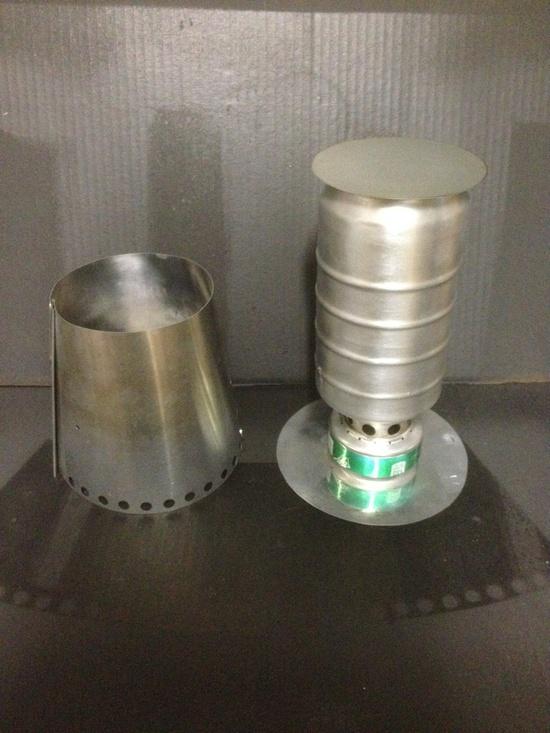
The setup as tested

Parameters:
500.0 g/ml of 70.0* F water
11.84 g (15.00 ml) fuel
Air, fuel & surface = 59.8* F
Relative humidity = 90%
BAR = 30.15
No wind
Same stove
Same brushed & ridged can
4" diameter Al pot lid
Polished windscreen & base sheet

Results:

5:44 min boil, 5:45 min burn time
5:47 min boil, 5:49 min burn time
5:52 min boil, 5:52 min burn time
5:48 min boil, 5:51 min burn time
5:50 min boil, 5:52 min burn time

Average boil time = 5:48.2 min (max deviation = 8 sec = 2.3%)
Average burn time = 5:49.8 (max deviation = 7 = 2.0%)

How does this calculate for efficiency?

PostedMar 28, 2014 at 1:10 pm

With 11.84 ml of fuel, and Ben's SS, we have a new winner with the oversize aluminum hat alone: 56.3% efficiency. That edges out the previous best of 55.6%, with oversize felt + oversize aluminum hat.

It would appear that the "impede/reflect the flow of hot gas from the top" hypothesis survives the latest round of testing–the oversize hat must be keeping hot air in the vicinity a bit longer. Now the efficacy of felt hat on top is in question.

Maybe we'll have to resurrect the idea of the "Devo" hat.

.devo

(But I'm getting a flaw, changing the inital water temp makes no difference in columns to the right… stay tuned. EDIT: Yeah, I think you want to take cell B28 (the one with the energy absorbed formula) and just copy that formula to the cells to the right. No change to the calcs of David's latest test as his water temp is the same as before.)

PostedMar 28, 2014 at 1:28 pm

Depends on which cell you enter the info into. Every column after the first references back to the first column

I hacked up the SS and made it a bit more layman-friendly lol

Cut it down to 7 lines and 1 column of formulas, with entries in ml of fuel and temp in farenheit. Made it to fit and run on my phone too.
Hope you don't mind Ben, it's still your formula wizardry ;)

This old Samsung device came with "ThinkFree Office" on it, and it does pretty well editing xls sheets.

PostedMar 28, 2014 at 1:30 pm

First column works fine. I think the problem was using the "=cell" command for a *formula* rather than a constant–at least, it didn't copy the formula to the right in my Mac version of Excel. I just copied the formula in B28 with the "fill right" command and all works.

Hey I like the Samsung version! Can a dedicated app be far behind?

David Gardner BPL Member
PostedMar 28, 2014 at 2:05 pm

Sorry, I just amended the post to include the amount of fuel.

11.84 g/15.00 ml

PostedMar 28, 2014 at 2:18 pm

I think you're still getting a temperature flaw or something Delmar. At 70 degrees, I get your 56.3 rating, but with 61 degrees it's more like 59.9.

(59.8 if using 16.1 C. I think F is more accurate though.)

But anyway, now yer cookin' David :D
That's about the range I seem to be falling in to as well.

Now for the BIG question….

What's our target? When do we say we've achieved "optimal efficiency"? Do we shoot for 75%?
Or are we already about as good as we're going to get?

PostedMar 28, 2014 at 2:21 pm

I don't understand? David writes:

> 500.0 g/ml of 70.0* F water

Doesn't 70F translate to 21C for the spreadsheet's "initial temp" row?

Where does 61F degrees come from?

PostedMar 28, 2014 at 2:24 pm

Ooo, my bad, it was the fuel and air temps I was recalling. N/M

I got all wrapped up in the SS column fiasco ordeal and got mixed up. Carry on! :)

I actually just ran into the column carry-over issue just as I was calculating Davids ratings. I did a cross check from my new SS with Bens original, and was getting conflicting readings. That's how I came across the column carry over thing. So. I was a little flustered with all the numbers. That, and it's still my first cup of coffee this morning/evening lol

PostedMar 28, 2014 at 2:27 pm

Understood. I suppose with a more complex formula there'd be a place to enter ambient temperatures too… But you're right, David is making steady improvement on efficiency. Strong work, man.

And…yeah, what is the goal? How good can this get?

PostedMar 28, 2014 at 2:32 pm

With such quick boil times, I think Davids stove is losing a little efficiency to speed. But it sure is fast! A full 2 minutes faster than my rig, and almost the same efficiency. I wish it was more packable. Seems a little bulky.

David, is that center "stand" part of the stove removable? Would sure help it pack down if it was.

Bob Gross BPL Member
PostedMar 28, 2014 at 2:35 pm

"That, and it's still my first cup of coffee this morning/evening"

What was the starting temperature of the liquid?

Nevermind.

–B.G.–

David Gardner BPL Member
PostedMar 28, 2014 at 3:20 pm

Glenn,

Yes the center pot support is removable. However, I am trying to solder it to the cans, but not having much luck so far. Tricky.

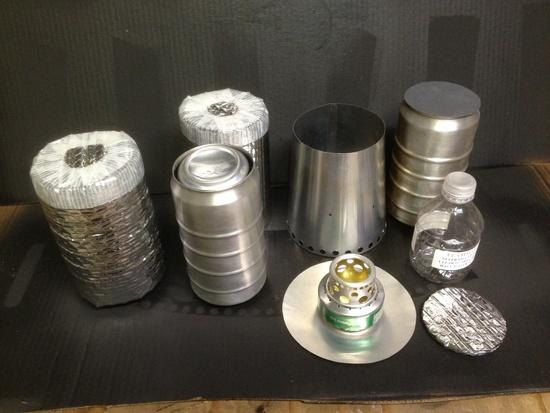
Packability depends on what you're trying to pack it into. Here is my full rig, packed with cozy on to hold it all together (left), packed with the cozy removed (center) so you can see the base of the stove (it goes in upside down), and unpacked to see the contents (right):
all

Weight = with aluminum windscreen, base sheet, and pot lid. Don't have any Stainless Steel or Titanium foil at the moment to compare the weights.

PostedMar 28, 2014 at 3:35 pm

It certainly nests together quite nicely. Makes for a stable pot platform too by the looks of things.

Have you tried that JB Weld stuff, instead of solder?

David Gardner BPL Member
PostedMar 28, 2014 at 4:56 pm

Glenn, thanks for the suggestion. Regrettably, I have tried JB weld many times on stoves, as well as Permatex 81422 High-Temp RTV silicone and Resbond 907GF. None of them have stood up to the heat generated by alcohol stoves, even at the bottom of the base below the flames. I would love to find a glue, epoxy, or anything else that will work instead of soldering. It's easy to glue stuff, but I haven't mastered aluminum soldering yet.

I am completely open to any suggestions that anyone might have. A friend said he could TIG weld the stoves' thin-walled soda cans (!!!) but I don't have a TIG set up or anything like that kind of skill.

Viewing 25 posts - 26 through 50 (of 63 total)
Loading...