Topic

Welding Blanket Under Alcohol Stove for Winter Conditions

  • This topic is empty.
Viewing 25 posts - 1 through 25 (of 63 total)
David Gardner BPL Member
PostedMar 22, 2014 at 11:42 pm

Much has been written about the poor performance of alcohol at low temperatures.

To see if it would make an alcohol stove work better in winter, decided to try putting insulation under the stove to insulate it from cold ground temperatures/snow. Obtained from Cyberweld.com some 3/16" thick Tillman Welding Blanket Thermofelt 615 because it won't melt or burn, and doesn't give off little particles that cause itching like fiberglass (http://store.cyberweld.com/panfelwelbla.html#pdItemDataTabs). Cut a 3" diameter piece with regular scissors. Weight = 2.84 g.

As basis of comparison, first did 5 boil tests with pad and 5 without pad, on a non-cold surface (64.1* F). Could not quite get a full boil using 11.84 g (15.00 ml) of fuel, so increased the fuel quantity to 12.64 g (16.00 ml). Assuming a camper boils 500 g of water for breakfast and 500 g of water for dinner, that's an extra 2 ml per day. So if you went for a 7-day trek that's an extra 14 ml of fuel, which weighs 11.05 g; on a 30-day trek, that's an extra 60 ml of fuel, which weighs 47.34 g/1.7 oz.(Water weighs 1 g per ml, alcohol weighs .789 g per ml).

Test parameters:
500.0 g/ml (= 2.19 cups)
70.0* F water
12.64 grams (16.00 ml) of 70* F Klean Strip alcohol
64.1* F air, fuel and test surface temperature
52% relative humidity
29.97 inHg barometric pressure
Boil measured with digital thermometer as 212.0* F
Same stove
Same beer can pot
Polished windscreen (& base sheet)

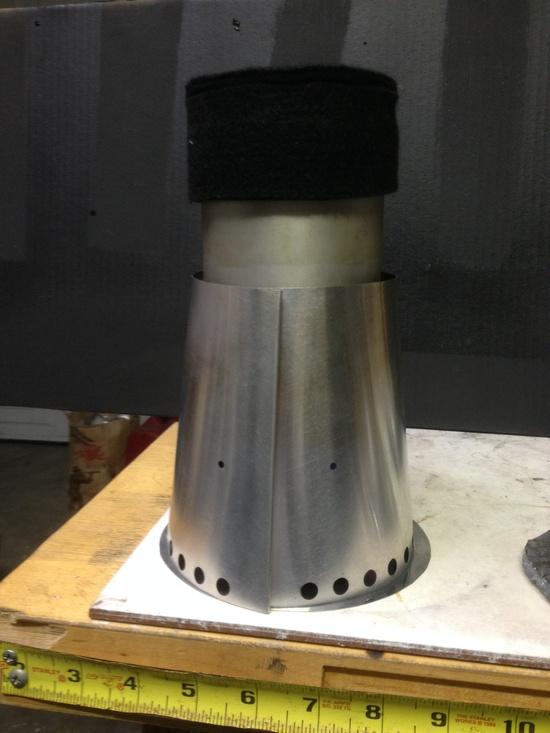
Set up as tested:

pad

Results:

With pad under stove:
5:00 min (300 sec)
4:59 min (299 sec)
4:51 min (291 sec)
4:58 min (298 sec)
4:48 min (288 sec)

Average boil time = 4:55.2 min
Maximum deviation = 12 sec = 4.1%

No pad under stove:
5:36 min (336 sec)
5:34 min (334 sec)
5:43 min (343 sec)
5:43 min (343 sec)
5:32 min (332 sec)

Average boil time = 5:37.6 min
Maximum deviation = 11 sec = 3.3%

Difference in average boil times pad vs. no pad = 42.4 sec = 14.4%

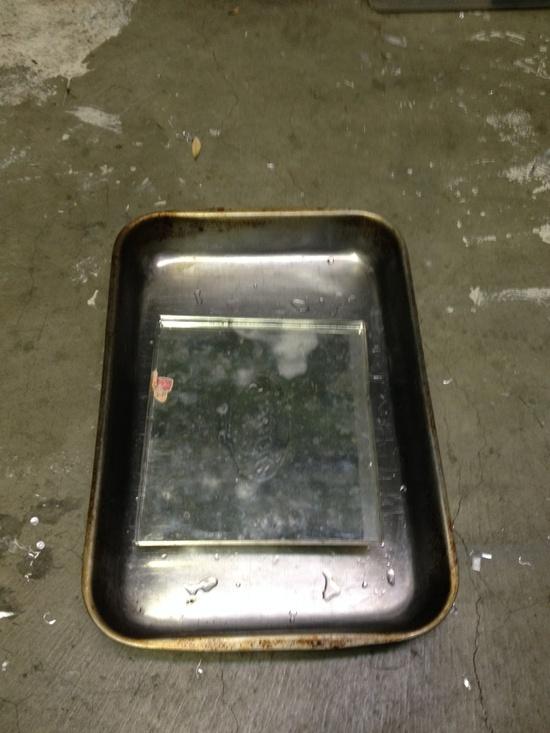
Then tried to simulate winter conditions by putting a thin steel tray on top of ice cubes in an aluminum broiling pan. Measured surface as 34* F. Put the fuel bottle in the freezer for awhile, measured fuel temperature as 29.8* F. In order to get the stove to light had to slosh the fuel around inside until it wetted the inside surface of the pot support, and hold the lighter to the holes in the pot support for about 5 seconds instead of just touching it. Using the pad, could not get a boil with 16, 17 or 18 ml of fuel, so increased the fuel to 19 ml and obtained boils. Without the pad, had to increase fuel 23 ml. All other test parameters were the same as listed above.

Set up as tested:
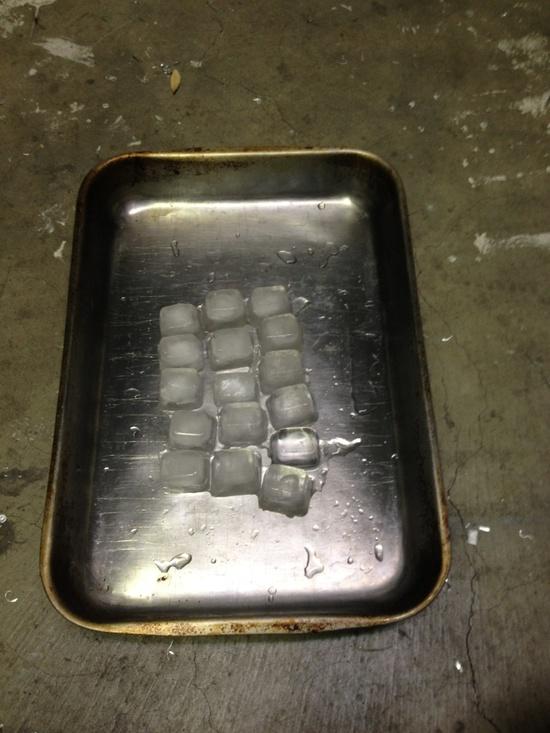
icetrayset

Results:

With pad under stove:
5:14 min (314 sec)
5:21 min (321 sec)
5:26 min (326 sec)
5:19 min (319 sec)
5:17 min (317 sec)

Average time = 5:19.4
Maximum deviation = 12 sec = 3.8%

Without pad under stove:
6:03 min (363 sec)
6:10 min (370 sec)
6:17 min (377 sec)
6:08 min (368 sec)
6:12 min (372 sec)

Average time = 6:10
Maximum deviation = 14 sec = 3.8%

Difference in average boil times pad vs. no pad = 50.6 sec = 15.8%

Will carry that little piece of welding blanket from now on, in all seasons.

PostedMar 23, 2014 at 8:33 am

Wow, another great David experiment! Thanks for doing this! Really appreciate the attention to detail, the control group, and the multiple tests. Everything, right down to the deviation. Empiricism rules!

So riddle me this:

I have been carrying a round piece of flashing (that fits in the bottom of my pot) and a round piece of reflectix (ditto). I pull them out and put them on the ground (reflectix, then flashing on top) and then the alcohol stove on top of that. Without going through the experiments like you did, do you think my setup has a similar effect? Ie, is there something special about the welding blanket?

David Gardner BPL Member
PostedMar 23, 2014 at 9:09 am

The main advantage of welding blanket vs. reflectix is that the welding blanket won't melt or burn. If you happen to spill some alcohol while filling the stove or accidentally knock the stove over while it's operating the reflectix will likely melt.

Otherwise, I think your setup has a very similar effect. I just went and did a test burn with your system using 3" diameter reflectix and aluminum flashing, and got a boil time of 5:02 min. Weight is 5.66 g vs. 2.84 for the welding blanket.

Actually, the main reason I got the welding blanket is to make little pot lid "hats" to see how that affects boil times. Tried it with reflectix awhile ago and it melted within seconds of the stove reaching full operating temperature. Pot lid hats are my next experiment.

PostedMar 23, 2014 at 2:57 pm

I think it's important to consider this as subjective to stove design. Maybe build the stove with internal insulators if it's not running quite hot enough for optimal efficiency? Bonus of spill resistant too. Just a thought.

PostedMar 23, 2014 at 4:03 pm

Wow, thanks for testing the reflectix! I assume that's the "no ice" test, meaning that the reflectix is in the same range as your welding blanket, but not quite as efficient and heavier.

> Actually, the main reason I got the welding blanket is to make little pot lid "hats" to see how that affects boil times. Tried it with reflectix awhile ago and it melted within seconds of the stove reaching full operating temperature. Pot lid hats are my next experiment.

Looking forward to it. My reflectix disc is supposed to do double duty as a minimalist-cozy (ie, just for the lid–since I've read that most heat loss is via the lid). But if a pot lid hat like you describe can reduce boil times (either on the lid or beneath the stove) AND do cozy duty, I'll have to rethink this. Actually, sounds like your pot hat would add a third function, too: pot lifter.

The welding blanket is a new concept to me. Previously I'd investigated carbon felt, such as the Oatey Heat Shield, such as available in the big box home stores. Sounds like your welding blanket is a much more reasonably priced option. What is it made of? What is "thermofelt?"

David Gardner BPL Member
PostedMar 23, 2014 at 6:20 pm

Glenn,
You're surely right that the pad's effect on performance will vary between different kinds of stoves, but in general hotter. This stove and two others of different design all ran a little hotter when insulated from the cooling effect of the ground/ice. Hotter = less efficient, and I had to use slightly more fuel with the pad than without it.

Interesting idea about internal insulators to increase the heat of a stove that runs too cold. Any ideas how it might be accomplished? It seems you might be thinking of something like a wick material inside the stove?

David Gardner BPL Member
PostedMar 23, 2014 at 6:44 pm

Delmar,
You're right, it was a "no ice" test. The reflectix seems to work very well. Only did one burn, but it was very close to the range of results for the welding blanket. Just a few percentage points different.

Underneath a metal base sheet, which I always use anyway, reflectix would be lighter than welding blanket. And you could put it directly on snow without any melt being being absorbed. I'll have to test this concept further. It may be that the only place where welding blanket has a significant advantage over reflectix is above the stove, where temperatures are high.

Hadn't thought of the pot lifter multiple use for the "hats," good idea. Would need to make sides for the hat, though the original concept was just a flat round piece that sits on the pot lid. For a mini cozy the relectix is lighter (1.22 g) than the welding blanket (3.32 g).

From the info available on the web site I couldn't figure out exactly what the welding blanket is made of. "Thermofelt" appears to be the trade name of the product. The web site does distinguish thermofelt from fiberglass but they don't call it carbon fiber.

PostedMar 24, 2014 at 3:16 pm

I was just kind of thinking out loud, but yes, something along the lines of some kind of the wick material they use was the path my brain went down. Seemed like some kind of connection between the two could be melded with dual purpose, but I've never played with that kind of stuff yet.

David Gardner BPL Member
PostedMar 24, 2014 at 5:13 pm

Delmar,
Performed some boil test on pot "hats" made from Thermofelt vs. bare aluminum pot lit vs. Thermofelt disc the size of the pot lid vs. no pot lid.
hatHat
discDisc of Thermofelt on aluminum pot lid

Parameters:
5 boils for each setup
500.0 ml of 70.o* F water
Surface, fuel, air at 65.7* F
Barometric pressure 30.16 inHg
No wind
Same stove
Same pot
Same polished windscreen and base sheet
Reflectix disc under base sheet

Results:

With Thermofelt "hat" on aluminum pot lid:
5:38 min
5:29 min
5:31 min
5:36 min
5:33 min

Average = 5:33.4 min
Maximum deviaton = 9 sec = 2.7%

With disc of Thermofelt on aluminum pot lid:
5:09 min
5:07 min
5:12 min
5:07 min
5:16 min

Average = 5:10.2
Maximum deviation = 11 sec = 3.5%

With bare aluminum pot lid:
5:18 min
5:16 min
5:19 min
5:24 min
5:26 min
Average = 5:20.6
Maximum deviation = 10 sec = 3.1%

No pot lid:
5:36 min
5:39 min
5:41 min
5:35 min
5:45 min

Average 5:39.2 min
Maximum deviation = 9 sec = 2.6%

Surprising that the Thermofelt "hat" was so slow compared to the little disc of it. It would appear that the insulated top of the can keeps more outside heat from getting in than inside heat from getting out.

Also surprising to me is that the aluminum pot lid with Thermofelt disc was so close to the bare aluminum pot lid, only about 3% different. Perhaps because the pot lid is such a small surface area on a Foster's pot. With wider, lower pots and bigger pot lids insulation would expect it to make more of a difference.

PostedMar 24, 2014 at 6:32 pm

A bit off the scientific discovery trail…

I made a 2 gram aluminum lid for my Fosters pot, but I waffle back and forth between that, and the grossly overweight, 8 gram Fosters lid cut from a second can, which is what I usually throw in when I'm showing my cook kit to friends and family, none of which know anything about weight.

Nor do they understand how I can spend hours and hours watching water boil. They could care less about how many dozens of stoves I've built, or how many rolls of aluminum flashing I've gone through. They laugh at reflectix and think a nesting kit is possibly useful. But without fail, the one thing that every single one of them pick up, turn over, play with, stare at, question and admire… Is that stupid lid.

So just for the "cool factor", I think I'll take the 6 gram penalty, and have a nice conversation starter if nothing else. :)

David Gardner BPL Member
PostedMar 24, 2014 at 6:56 pm

Have you tried comparing boil times for the cool pot lid vs. the light one? The cool lid seems to seal pretty well so it might actually work better.

David Gardner BPL Member
PostedMar 24, 2014 at 9:25 pm

A full size cozy is a beautiful thing for water-boil stovers vs. simmer stovers. I'm a boiler because I seem to incapable of making a simmer mechanism that I like, whereas a cozy is easy to make.

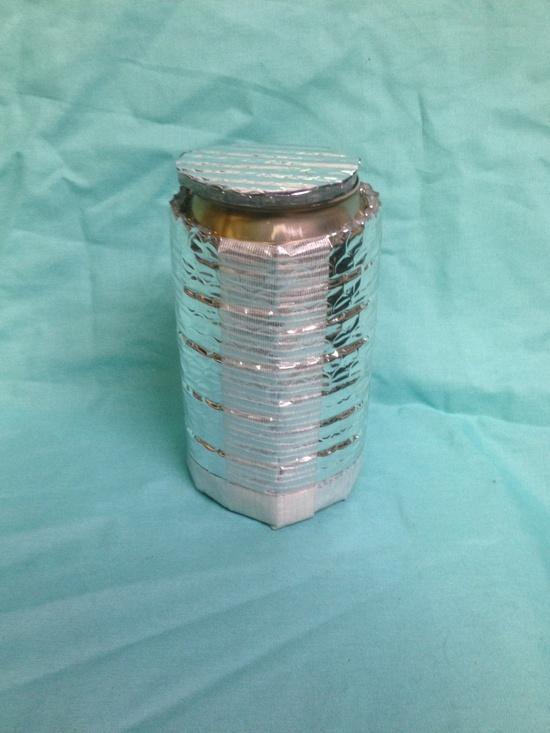
Cozy cooking, freezer bag or in the pot, is a well known concept. I use a cozy, but wondered how effective it really is. So of course I had to measure it.

This cozy weighs 19 grams. It could be lighter with a more minimalist taping system. It probably weighs more than a good simmer system would though.

212* F @ start
165* F @ 50 minutes
142* F @ 90 minutes

cozy

PostedMar 24, 2014 at 10:14 pm

Well, my "testing" is quite primative. I don't even have a thermometer. With that being said, I've tried to produce some meaningful results along the same vein as your methodology. Room temp water, fuel and materials. 500 grams of water, 20ml fuel. 15ml can sometimes result in a non-boil, so to be sure I achieved complete and equal boils, I went with 20ml. My only measuring device also only has graduations of 5ml. I let the fuel run out and clocked the burn out time as well, just for curiosity's sake, but didn't see much point posting them. They ran about 2 minutes of a hard roll on average.

Obviously my smaller stove takes longer time to boil with the smaller flame pattern, but runs longer, so comparable I'd imagine. I think the longer burn times might be what factors in to the wider variations I experience as well. Even though no priming is necessary, I set the pot, then waited for the bloom before starting the timer, since bloom time seems a bit more susceptible to variation and contributes very little heat, at least in my setup. I also alternated lids with each test. That may have been unwarranted, but seemed like a good idea anyway.

The BattlefieldLidtest

With 20ml (15.78g) fuel and 70 degree water (edited for correct fuel weight)

Foster's Lid Ave boil time = 7:46 / Burn time = 9:53
7:23
7:54
7:54
7:37
8:03

Aluminum Lid boil times – Ave boil time = 7:43 / Burn time = 9:50
7:48
7:32
7:45
7:45
7:46

Looks like a tie. Something interesting though, was the consistency of the times with the aluminum lid vs. that of the Foster's. The aluminum lid mounts externally, whereas the Foster's seats internally. Not sure it matters, but a point of note anyway. I also have those 2 holes in the side for the bail handle which lets a minute amount of heat escape, but it's all relative I guess, since it was the same for all the tests.

PostedMar 25, 2014 at 8:43 am

> Surprising that the Thermofelt "hat" was so slow compared to the little disc of it. It would appear that the insulated top of the can keeps more outside heat from getting in than inside heat from getting out.

Interesting! So the hat with flap is apparently insulating the top part of the can from heat.

David, if you are feeling charitable, will you try something for your ol’ pal Delmar? Try a flat disc of thermofelt on top, but one that extends somewhat over the sides of the can/pot. Like a mushroom cap. Perhaps it will thicken the column of hot air going up the sides of the can, as the heated air is retarded in its upward flight, and spills out around the oversize disc.

If that increases efficiency, then it's a question of how big and trap-like to make the heat retarding device at the top of the can…perhaps more hot air being slowed/trapped/retarded at the top of the pot will further increase efficiency (up to the point that it interferes with necessary exhausting).

> Hadn't thought of the pot lifter multiple use for the "hats," good idea. Would need to make sides for the hat…

An oversize flat disc should work fine, simply use the hat like you would an old-style quilted kitchen hot pad.

> Also surprising to me is that the aluminum pot lid with Thermofelt disc was so close to the bare aluminum pot lid, only about 3% different.

Perhaps the amount of heat escaping through the lid, vs the heat running up the sides, is negligible. The disc on top might make a significant difference again when the fire is out and the disc turns into a semi-cozy?

Loving the experiments. Nothing clears away misunderstanding and conjecture like a good experiment or three.

David Gardner BPL Member
PostedMar 26, 2014 at 10:18 am

“David, if you are feeling charitable, will you try something for your ol’ pal Delmar? Try a flat disc of thermofelt on top, but one that extends somewhat over the sides of the can/pot. Like a mushroom cap. Perhaps it will thicken the column of hot air going up the sides of the can, as the heated air is retarded in its upward flight, and spills out around the oversize disc.

If that increases efficiency, then it's a question of how big and trap-like to make the heat retarding device at the top of the can…perhaps more hot air being slowed/trapped/retarded at the top of the pot will further increase efficiency (up to the point that it interferes with necessary exhausting).”

For my ol' pal Delmar:

Here are three "mushroom cap" lids tested and compared to a standard size beer can pot lid.:
pots

First is a very oversize pot lid so that the aluminum extends far out into the exhaust gases, with an oversize Thermofelt pad on top.

Second is just oversize Thermofelt, with no pot lid under it.

Third is oversize aluminum pot lid with matching disc of Thermofelt.

Fourth is the standard size pot lid with the same size disc of Thermofelt.

The idea with all the oversize lids is twofold: (1) the aluminum will catch some of the heat that is otherwise lost at the top of the can and conduct some of that heat into the top of the can and down into the water; and, (2) obstruction of the flow of gases past the top of the can will make some of the hot gases "linger" near the top of the can and transfer more heat into the can, again to conduct heat into the top of the can.

Test parameters:
500.0 ml of 70.0* F water
14.20 g (18 ml) of fuel
Air, surface and fuel temperature 55.2* F
Relative humidity 100% (it’s raining today)
Barometric pressure: 29.86 inHg
No wind
Same stove
Same can
Same polished windscreen and base sheet
No Thermofelt or Reflectix under base sheet or stove

Results:

Largest aluminum pot lid with oversize Thermofelt disc:
5:54 min to boil, 6:49 min total burn time
5:53 min to boil, 6:36 min total burn time
5:43 min to boil, 6:38 min total burn time
5:56 min to boil, 6:47 min total burn time
5:51 min to boil, 6:42 min total burn time

Average boil time = 5:51.4 min (maximum deviation = 13 = 3.7%)
Average burn time = 6:42.4 min (maximum deviation = 11 = 2.7%)

Oversize Thermofelt disc alone:
5:58 min to boil, 7:04 min total burn time
6:02 min to boil, 7:07 min total burn time
6:14 min to boil, 7:21 min total burn time
6:10 min to boil, 7:16 min total burn time
6:06 min to boil, 7:13 min total burn time

Average boil time = 6:06 min (maximum deviation = 16 = 4.4%)
Average burn time = (maximum deviation = 17 = 3.9%)

Large aluminum pot lid with oversize Thermofelt disc:
5:52 min to boil, 7:00 min total burn time
6:00 min to boil, 6:57 min total burn time
6:01 min to boil, 7:04 min total burn time
5:44 min to boil, 6:58 min total burn time
5:47 min to boil, 6:59 min total burn time

Average boil time = 5:52.8 min (maximum deviation = 14 sec = 2.0%)
Average burn time = 6:42.4 min (maximum deviation = 11 = 2.7%)

Regular size aluminum pot lid with oversize Thermofelt disc:
5:35 min to boil, 6:34 min total burn time
5:37 min to boil, 6:37 min total burn time
5:42 min to boil, 6:42 min total burn time
5:37 min to boil, 6:29 min total burn time
5:36 min to boil, 6:37 min total burn time

Average boil time = 5:39.4 min (maximum deviation = 7 = 2.1%)
Average burn time = 6:35.8 min (maximum deviation = 13 = 3.3%)

Had anticipated that the oversize aluminum discs with thermofelt on top would capture more “waste” heat and conduct it back to the top of the can than the small “regular” size pot lid with thermofelt, but these results would indicate the opposite. Perhaps the unobstructed path of the hot gases all the way up and over the can convects the most heat?

Totally do not understand the different total burn times. There appears to be a correlation between long boil time and long burn time, but that makes no sense to me. I figured burn times for all systems would be about the same, since the stove is so far below the lid and every burn started with the same amount of fuel. Somehow the obstruction of the large lids seems to feed back all the way down to the stove, like partially closing a flue. Anyone with knowledge of thermodynamics want to chime in?

Using the oversize disc of Thermofelt as a pot lifter was a bust. The Thermofelt doesn't have much friction and I had to grasp it hard to keep the can from slipping, hard enough to flex the can, though not permanently deform it. Darn.

PostedMar 26, 2014 at 10:49 am

My take, is that you're realizing the thermal feedback I've been constantly getting on about. The hotter the water gets, the hotter the stove burns. The larger aluminum lids don't trap heat, they sink it off the can, actually cooling it down. The thermofelt does basically nothing and the only reason it works under the stove is by eliminating convective loss to the cold ground via an inert spacer. Vapor passes right through it and might even cool things down from latent absorbsion through condensation as it does.

So to summarize, yes, the lids do feed back to the stove via the water/can medium, either over temping the stove and making it run above peak efficiency, or cooling it down and "taming the flame" as I eluded to in my Fosters thread regarding base plate reflectivity.

Despite the way I made all that sound, I'm just kinda theorizing here. I know none of it for fact, but stating it as so, makes it read a lot better than constantly saying "I think, I guess, I suppose, I wonder if….etc."

PostedMar 26, 2014 at 11:12 am

Oh No! My precious theories! [EDIT. It appears Ben exonerates the mushroom hat theory in following posts–the oversize felt with oversize hat being the most efficient.]

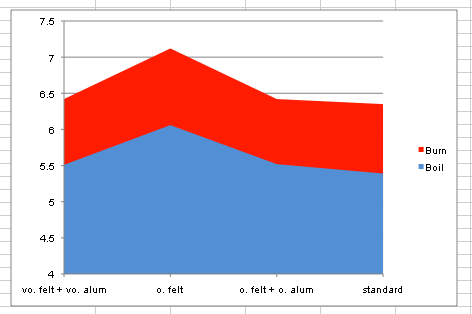
.burnvboil2

"vo" alum = "very oversize" aluminum. (The graph should not read vo. felt, it is just o. felt)

Fastest boil (and shortest burn) with the standard felt hat, but slowest boil (and longest burn) with the oversized felt hat.

We want the blue area as low as possible (for faster boils) and the red area as high as possible (for longer boils). What we want to do is spread those lines apart. But the two appear to be in lock step. So much for the comment in another thread that burn time and boil speed may be orthogonal. They appear to be highly (inversely, for what we desire) correlated–faster boils with shorter burns and vice versa.

So the oversized felt hat alone is slowing everything down…and then you add the oversized aluminum to the oversized felt and it speeds back up, similar to the standard hat. Hmmm.

Also interesting that the vo aluminum hat vs. the o aluminum hat is negligible. If we are messing with the heat column around the pot, more overhang doesn't make much difference from a little overhang. The "obstructing heat escape" hypothesis melts.

Wonder what is happening to fuel consumption-to-boil. Is it possible the o. felt is the most efficient, fuel-wise? You have to wait another half minute for your boil, and are rewarded with a little over a half minute more boil time. Looks like the two lines spread apart a little bit there.

Are the data hinting that an oversize aluminum hat without the felt would speed the boil and shorten the burn? Because adding oversize aluminum hats to oversize felt hats brings times down, relative to o. felt hats alone. (This would be the opposite of Glenn's theory, that aluminum hats radiate rather than trap heat.) Is the felt primarily responsible for slowing? Should we consider slower as more efficient? Don't know.

PostedMar 26, 2014 at 2:49 pm

"adding oversize aluminum hats to oversize felt hats brings times down, relative to o. felt hats alone. (This would be the opposite of Glenn's theory, that aluminum hats radiate rather than trap heat.)"

It's all relative. Yes, adding Oversize al brings times down to felt, but only compared to felt alone, and only because felt is so transparent as to basically not exit. I'm not saying an oversized lid will run cooler than no lid at all, which is basically what the felt has already proven to be comparable to. But compared to an exact fitting lid, the oversized al DID slow down times, possibly from sinking out heat. So Not opposite, but actually directly in line with what I was getting at, or at least trying to…

Bob Gross BPL Member
PostedMar 26, 2014 at 3:00 pm

Delmar, your chart doesn't make good sense, because there is no continuous scale along the bottom axis. A bar chart would have been better.

–B.G.–

Ben H. BPL Member
PostedMar 26, 2014 at 3:25 pm

Wow David you are a testing mad man!

I took your info (made a few assumptions) and made a stab at estimating the efficiency for each system. 2 and 3 had the highest efficiency. #3 seems to be the winner system.

VL Combo Felt L Combo Combo
Average time to boil 5:51 6:06 5:52 5:37
St Dev 0.003 0.004 0.005 0.002

Average burn time 6:42 7:12 6:59 6:35
St Dev 0.004 0.005 0.002 0.003

Fuel (g) 14.2 14.2 14.2 14.2
Fuel to boil (g) 12.40 12.02 11.94 12.10
Lower Heating Value (kJ/g) 25 25 25 25
Energy released (kJ) 310.0 300.6 298.5 302.6

initial Temp (°C) 21 21 21 21
Final Temp (°C) 100 100 100 100
Mass H2O (g) 500 500 500 500
Specific Heat H20 (kJ/g-C) 0.0042 0.0042 0.0042 0.0042
Energy absorbed (kJ) 165.9 165.9 165.9 165.9

Efficiency 53.5% 55.2% 55.6% 54.8%

David Gardner BPL Member
PostedMar 26, 2014 at 3:31 pm

I’m a stove addict, what can I say. Although I’m getting a little “burned out” on testing for awhile.

But…just did some efficiency testing on another thread . Would be interested in seeing a similar analysis of those results.

Anyone feel like starting a thread on stove addiction, and 12-step recovery? Would be interested in seeing the collections of other people’s stoves that they have built or acquired.

Ben H. BPL Member
PostedMar 26, 2014 at 3:35 pm

I've been thinking about the physics a bit. I am still trying to nail down the burn time results.

I think it is clear that the felt must be catching residual combustion heat. Your system 1 appears that the lid is too large to allow the felt to do its thing.

We know from previous testing people have reported here on bpl, that a significant source of heat loss from these types of set-ups is escaping vapor. It seems the aluminum lid would be a better seal than the felt, but system 2 performs better than 1 or 4 and equal in terms of efficiency to 3. I'm stumped.

Ben H. BPL Member
PostedMar 26, 2014 at 3:46 pm

I posted my analysis over that the other thread for those results. Came out to be 48.8% efficient. Fast but inefficient.

I am assuming the results in this thread are with an unpolished interior? If so it seems that the thermal feedback from polishing speeds up your burn rate but reduces your efficiency.

David Gardner BPL Member
PostedMar 26, 2014 at 4:13 pm

Actually, the parameters in the OP of this thread include polished windscreen. For the present, all my tests are run with the polished windscreen. Combination of the cool factor and my preference for increases in speed vs. slightly better efficiency.

PostedMar 26, 2014 at 4:27 pm

Well, I dug my notes out of the garbage for that Fosters vs Aluminum lid test I tried, and put up the final burn out times on my earlier post. Since they both fared almost identically, it's kind of a moot point, but all for the interest of science and all that jazz.

I have absolutely no idea how to decipher any usable formula from Ben's postings, or I'd put up the efficiency quotient too.

Oh well, it's probably pretty anemic anyway lol. As long as it boils water in around 15ml I'm as happy as can be. It's all up for grabs out in the real world anyway. Packability was a primary objective of mine, so I'm willing to sacrifice a bit of efficiency.

Something worth considering about using a straight line formula though, is that efficiency is actually operating on a curve, diminishing as it gets hotter. Not being one who understands the formula, I don't know if that's taken into account, but can only assume it's a static equation. And if no more energy is absorbed once the water reaches a boil, then how does that factor in? Maybe I'm asking too much of the math?

Viewing 25 posts - 1 through 25 (of 63 total)
Loading...