Topic

Best Headlamp

  • This topic is empty.
Viewing 25 posts - 76 through 100 (of 116 total)
PostedOct 19, 2013 at 4:00 pm

> What i find interesting is that petzl probably sells more tikkas alone, and likely even more of a single model say the tikka 2 … Than all sparks, zebras, etc combined

Well…yeah…Petzl is mass market, so they sell a ton of mass-market 3AAA lights. Zebra and Spark are not mass market, don't have anywhere near the distribution channels, manufacturing capacity, or marketing muscle. They are boutique / niche products, emphasizing build, tint, lumens, burn time, etc.

The reason 3AAA is the typical mass market headlamp, is that 3 x 1.5v cells gives enough voltage to fire an LED without any additional electronics to increase the voltage. It costs more to make an LED that burns on two or one 1.5v cell; these require boost circuits. Downside is, AAAs are relatively inefficient for their size, which is why many flashlight enthusiasts shun 3xAAA lights in favor of 1xAA lights.

Petzls can generally be purchased for less, and purchased in brick and mortar stores. Inexpensive, widely available, and durable…that's why Petzl has such a strong following. If you love Petzl, go for it. I'll not try to change your mind.

Regards the title of the thread:

BEST HEADLAMP

…there is no such thing. There are only headlamps that match your needs to greater or lesser degre. If your need is to buy it from REI, well there are good headlamps that fit that need. If you need ultralightweight and don't care if it takes exotic batteries, a different one. Maybe you need to spend a lot of money so you can brag about how much you spent. Or the opposite, maybe you need to spend $30 or less. Want excellent tint? A different one yet. Me, I need a waterproof, single cell, high CRI light that can double as a handheld and has a floody beam. You may not need or even want those things.

No such thing as a "best headlamp."

There is only "best fit for your personal requirements."

Mark BPL Member
PostedOct 19, 2013 at 4:23 pm

"Hey Mark.

Thanks for the descriptions of the various zebralights. I've been really looking into getting one for my primary headlamp. Zebralights naming system and product descriptions leave my head spinning a bit. If you have a chance, can you give some more specifics about the functional differences between the H600 MKII and the H602? Also, any of you insiders know when they might be releasing cool white versions of all the new lamps? Thanks!"

Hi,

Not sure if you mean me as the forums software is extremely clunky with quotes here.

It doesn't seem as though anyone has answered your question though so….

For the H600 you have 2 version, one standard and one flood.
The standard one (the one i have in the pics) has a 80° spill.
That means if you were to place the torch on a desk and measure the angle of the beam it would come to around 80°.

In practice this gives and extremely useful beam pattern, it's helped by the fact that it has a 12° spot that's slightly brighter in the centre of the beam.
So you get a nice flood that would illuminate say the width of a 2 lane road 2 meters in front of you, but the spot also gives you enough throw that i felt confident riding my MTB at 45mph at night on one pretty rocky downhill section.

The H600Fw has a slightly wider beam at 90° but also has a frosted lens so the beam has less of a hot spot in the centre.

With regards to the H602, this is really just a flood monster (for it's size)
It has a 120° beam with no reflector so it's just a wall of light.
To give you some idea what this relates to in real world use.
I've found that with the torch mounted on my head, the beam is pretty much as wide as i am physically able to move my eyeballs.
With eyeballs at their left or right limit there is a few degrees that is not illuminated, but it really is a few degrees.
For all intense and purposes it's a wall of light in front of your eyes.

The disadvantage is more lumens are spread out so you don't get anywhere near the distance you do with the H600.

It's really down to what you prefer and what serves it's purpose.

For me night hiking and running i prefer a slightly narrower beam, i don't really care if the torch illuminates the path and 3 meters either side, all i really care about is that i can see the path good enough to pick my route around tree stumps, rocks and potholes.

I tend to have the torch on it's highest setting as well, as i like to be able to see what i'm approaching 50m or 100m away.
I don't care about night vision as if it's dark enough to warrant using a torch i'll use it for the entire walk.

I do have a mate that runs off-road at night with a light that i don't think is bright enough to read by, so different horses for different courses.

Marc Kokosky BPL Member
PostedOct 21, 2013 at 11:35 am

I looked long and hard at the H51, and new H52 but in the end still like my Vizz for the points below:

1. Not all that much heavier with batteries (3.7 oz) than the H51 (3.0 oz). Of course, you can use just the H51 for 1.2 oz or make a super lightweight headband for it, but I'm lazy lol.

2. The burn time. On High-High (200l) you get .9 hrs. A better comparison to the Vizz's max output (150 lumens) would be the H51 H3 setting (140 lumens) which nets you 1.7hrs. With the Vizz on the highest 150 lumen setting with 3 AAA lithiums you get 110 hrs. On low you get 150 hrs

3. A red light – Vizz has one. H51 doesn't. Enough said. I prefer one at night so the Vizz wins out

4. The on/off settings. The Vizz from the first touch starts on red so that it doesn't blind anyone when it's first turned on. A quick second button gets you max brightness if that's what you want.

5. Also, if you hold the button on, it starts at the lowest light setting and then slowly brightens until you want the desired light output at which point you just stop pressing. No need to remember how many presses you made to get it on which of the correct 9+ settings you want. I get a headache just watching people on some of the You Tube clips "reviewing" and not being able to get it to the right settings.

6. It has a button lock setting so it can't accidentally be activated. On the H51 you need to back out the end screw cap a bit so that you can't accidentally activate it; which in my mind COULD affect its waterproofness.

7. Price – With a 20% off REI (or other goods) coupon you can get them for $40, $9 – $30 cheaper than the H51 or H52 at their cheapest

I'll caveat this with saying that most of my 3-season hiking is done with a Petzl E+ since its about all the light I need when it gets dark at 7:30 or later. But in the early sping, late fall and winter when it's darker sooner and may require more time hiking at night or needing light for camp chores in the dark, the Vizz goes with me.

Phillip Asby BPL Member
PostedOct 21, 2013 at 1:23 pm

Just a note – unless PT has a technological advance of mammoth proportions that 110 hours on the main LED is not regulated light – it suggests that it may still be producing some light but certainly not 150 lumens (i.e. unregulated).

Current production pretty efficient lights depending on the cells used (2xAA or 1xCR123) can get around 5-7 hours at 85 lumens regulated. A good bit less at higher levels…

The ZL are pretty efficient – maybe not the best but my H31W is spot on to spec- in terms of runtmie – but that is measured as fully regulated runtime not a significantly diminished moonlight mode…

Now there is some value to a diminishing out of regulation moon mode – particularly backpacking – one thing many lights do the ZL included is once they go out of regulation they shutoff entirely. There are some who much prefer to have some light rather than total darkness and it's a fair point. The current models of ZL if I recall have a battery life indicator built into the UI but mine does not.

Mike W BPL Member
PostedOct 21, 2013 at 1:25 pm

>> With the Vizz on the highest 150 lumen setting with 3 AAA lithiums you get 110 hrs. <<

The Vizz would certainly be the market leader if it could output a 150 lm for 110 hours! I suggest you turn your Vizz on at 150 lm and see how long your 3 AAA batteries last at that light output. If you get more than a few hours of regulated (150 lm) output I'd be amazed.

Don't let the marketing spin fool you with these lights. What they actually mean is that the light is regulated "while the voltage is at a certain level" and then they drop down to the next lowest level and the cycle repeats, dropping you to a lower level until you can barely see the light. That entire process "may" take 110 hours but you certainly won't be seeing 150 lm for very many of those 110 hours.

I'm not condemning the Vizz, I don't know that headlight but I just wanted to point out that marketing spin can be misleading (wow, great surprise!). At the lowest setting my Zebralight will last 3 months!! I can't even tell if the light is on at that setting (0.01 lm) even in a dark room, so what's the point. Looks good in the specs I guess (they could advertise that it has a 3 month run time on a single AA).

Bob Gross BPL Member
PostedOct 21, 2013 at 1:46 pm

Low Voltage Disconnect (LVD) is the battery voltage when the load manager decides to cut off the light. With some battery types, this is done to protect the battery. With other battery types, this is done to improve the light regulation up to a point.

If you are using a disposable alkaline battery, then you might as well use up every last electron in the battery. You will be throwing it away soon. So, you may not want or need LVD.

If you are using a rechargeable battery, often you want this LVD to happen before the battery voltage gets too low. If you continue draining it, then the battery may be damaged and difficult or impossible to recharge again.

If you are using a disposable lithium battery, then things get tricky. Lithium batteries hold three to four times the power of an alkaline battery (plus they operate better in cold weather, they can generate much higher peak currents, they typically have a slightly higher open circuit voltage, they are typically lighter in weight, etc.) Lithium batteries have a sharper "knee" of the voltage/time curve for most current ratings. That means that they work really good up to a point, and then they die in a hurry. There is little gray area as it starts to fail, and this can cause some interesting symptoms in some headlamps.

–B.G.–

Phillip Asby BPL Member
PostedOct 21, 2013 at 2:17 pm

Agreed on the low voltage disconnect – I do run my H31 on protected RCR123s so while the cell has protection I appreciate the light shutting down before I risk cell damage (or worse)…

The ZL is supposed to not engage the LVD when using a primary – however the runtime charts show that even with a primary you won't get the same long "tail" of an alkaline in a AA or AAA light. Some of that is the lithium cell nature but I suspect that like some other lights when not capable of staying in regulation it shuts down – but I am not certain in the ZL…

Anywho – it's important to make sure we understand what the advertised runtime really means to compare apples to apples.

PostedOct 21, 2013 at 3:28 pm

"I looked long and hard at the H51, and new H52 but in the end still like my Vizz for the points below:"

Marc,

I find myself in agreement with all your points about the VIZZ, with one minor correction: With lithium batteries, the VIZZ weighs 3.0 oz on my scale. It's possible my scale could be off by a bit, but probably not by .7 oz on a small 3.7 oz object. I tried the H51 a couple years ago and set it aside for all the reasons you mention. Also, I have found the Soft Brite 5 mm Led's on the VIZZ perfectly adequate for trail hiking. If you were really booking or off trail, you might want to use the Max Brite LED, but it is overkill for ordinary trail hiking.

PT makes another really nice, much lighter light, the Remix but unfortunately it doesn't have regulated circuity. I talked with a PT rep about using lithium batteries anyway, and she told me the risk was that it would burn out the LED's. Too bad, as it only weighed ~1.6 oz with lithium. :0(

PostedOct 21, 2013 at 5:16 pm

I didn't realize Princeton Tec moved production back to the U.S., impressive that their price point is lower than Zebralight (China).

Bob Gross BPL Member
PostedOct 21, 2013 at 5:29 pm

"I talked with a PT rep about using lithium batteries anyway, and she told me the risk was that it would burn out the LED's."

The open circuit voltage on a new lithium battery (maybe 1.75 volts) is slightly higher than for a new alkaline battery (maybe 1.55 volts). Also, there is less internal resistance, so when the lamp starts drawing current, the battery voltage might stay pretty high (maybe 1.7 volts).

A few headlamps were designed so closely that anything over 1.6 or so might possibly damage the LED or the regulator, if any. After so many complaints from users trying to use lithium batteries, many designs have shifted slightly to allow lithiums. The problem is that if the LED is designed to tolerate lithiums and if you give it only alkalines, then there is some potential lost brightness. Regulated headlamps typically don't have so many problems in this regard since the power to the actual LED is controlled at the output of the regulator, not at the output of the battery.

–B.G.–

PostedOct 21, 2013 at 5:46 pm

"I didn't realize Princeton Tec moved production back to the U.S., impressive that their price point is lower than Zebralight (China)."

Both make headlamps, but it'd apples to oranges when you look a machined aluminum versus plastic, throw, lumens, and duration at a particular weight.

Depending on needs, PT is fine. (I just bought a Byte for a specific upcoming hike.)

But, Zebralight is a significant step up, all around, including the cost.

PostedOct 21, 2013 at 6:18 pm

"After so many complaints from users trying to use lithium batteries, many designs have shifted slightly to allow lithiums."

But PT didn't. Go figure. They're usually out front on that kind of thing, and the Remix, with a 100 lumen Max Brite LED and 3 5 mm LED's with burn times of 28 and 61 hours respectively on high, would have been a sweet little package if it had regulated circuitry. Can't win 'em all, I guess.

PostedOct 21, 2013 at 6:39 pm

""After so many complaints from users trying to use lithium batteries, many designs have shifted slightly to allow lithiums."

But PT didn't. "

Hi Tom, my EOS will take lithium batteries, as will the Vizz.

Or am I misunderstanding you?

PostedOct 21, 2013 at 6:47 pm

"But, Zebralight is a significant step up, all around, including the cost."

I'm missing something here, Greg.

Zebralight H52w specs

LED: Cree XM-L2 Neutral White (Norminal CCT 4400K)
User Selectable Levels: 3 main levels (High, Medium and Low). Each main level can be programmed to one of its two sub-levels. The second sub-level of the each main levels can be further programmed to different brightness levels.
Light Output (runtimes)
High: H1 280 Lm (0.9 hrs) or H2 172 Lm (1.7 hrs) / 108 Lm (3 hrs)
Medium: M1 50 Lm (7.5 hrs) or M2 25 Lm (12 hrs) / 12 Lm (27 hrs)
Low: L1 2.7 Lm (4 days) or L2 0.34 Lm (3 weeks) / 0.06 Lm (2 months) / 0.01 Lm (3 months)
Beacon Strobe Mode: 4Hz Strobe at H1 / 19Hz Strobe at H1

Light output are ANSI out the front (OTF) values. Runtimes tested (and parasitic drain estimated) using Sanyo 2000mAh Eneloop AA batteries. Light output with 14500 batteries are the same except that the H1 is 500Lm for the first minute and then step down to 280Lm.
Operating Voltage Range: 0.7V – 4.2V
Battery: One 1.5V AA (NiMH, lithium or alkaline) or 3.7V 14500 li-ion rechargeable. Batteries are not included in the package.
Parasitic Drain: Negligible (much less than the self discharging of a battery)
Beam Type
80 degree spill
12 degree hot spot
Dimensions
Head Diameter: 0.86 inch (21.8 mm)
Length: 3 inch (76.5 mm)
Weight
1.1 oz (32 gram)
2.9 oz (80 gram) with an Eneloop AA and headband

Features
Battery capacity indicator (LED flashes 1-4 times, 4 short clicks to start)
All levels are current regulated
Low battery alert when the light is switched Off (LED flashes if the battery voltage is below 1.06V)
Automatic stepping down to lower output when battery (AA and 14500) capacity is low
Builtin over-discharging protection for 14500 batteries at 2.8V cutoff
Durable electronic soft-touch switch
Smart user interface provides fast and easy access to all brightness levels and beacon-strobes.
Precision machined unibody casing from premium grade aluminum bar stocks
Proprietary heat sinking design bonds the LED board directly to the unibody aluminum casing
Durable natural hard anodized finish (Type III Class I)
Sealed and potted LED driver circuitry
Tempered optical grade glass
Battery power can be disconnected by slightly unscrewing the tailcap to prevent unwanted activations or parasitic drain
Waterproof to IPX7 (2 meters, 30 minutes)

PT VIZZ specs

POWER

165 Lumens

LAMP

Maxbright LED, Ultrabright White LED, Ultrabright Red LED

BURN TIME

150 Hours

My comment, as the specs don't seem to copy well, at least for me.

Burn time with the 165 lumen LED is 110 hours, 120 with the Ultrabright LED's, and 150 hours with the red LED's.

BATTERIES

3 AAA Alkaline or Lithium

WEIGHT

92 Grams

My comment: With lithium batteries my VIZZ weighs in at 3.0 oz.

VIZZ

The Vizz is feature-loaded with three distinct beam profiles easily accessed via a simple press, hold, or double press of the button. One Maxbright LED creates a powerful 165 lumen spot beam for long-throw illumination, a pair of white Ultrabright LEDs deliver a dimmable flood beam, and two red Ultrabright LEDs handle close-range lighting while preserving night adjusted vision. When not in use the Vizz can be locked to prevent accidental turn on, and the translucent switch acts as a low battery indicator. As with all of PTEC Professional Series headlamps, the Vizz is waterproof (IPX7) and is equipped with regulated circuitry making the Vizz lithium battery compatible.

•Single 165-lumen Maxbright LED throws a bright white beam up to 90m on high; 2 white 5mm LEDs? output 30 lumens? and reach up to 23m on high
•Also includes 2 red LEDs? that output 15 lumens? and reach up to 20m.; red LEDs? minimize the impact on your night vision
•White 5mm LEDs? are dimmable so you can balance light output and battery life to meet your needs
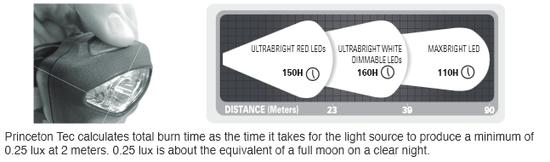
•3 AAA batteries (included) provide 110 hrs. of burn time for the Maxbright LED; using the 5mm white LEDs?, the batteries provide 160 hrs. of operation
•Switch to the red LEDs? and the batteries will last for 150 hrs.
•Regulated circuitry ensures consistent power output over the lifespan of the batteries
•Large push-button switch is easy to operate with gloves on
•The Princeton Tec Vizz headlamp has an IPX7? rating (protected against water immersion down to 1m for 30 min.)

Price: Zebralight H52w $64

PT VIZZ $49.50

Edited: My comment

The VIZZ also has a locking facility to prevent accidental turn on of light without partially unscrewing the battery chamber cap. Which brings up the nightmare scenario of
taking a dunking with the H52w cap partially unscrewed.

So, I guess my question is: How is the Zebralight H52w a significant step up all around?
Seriously, I suspect you know a lot more about the technology, and I am very much aware that I amy be missing something. But, I just can't figure it out. Maybe I just chose the wrong Zebralight model for comparison?

PostedOct 21, 2013 at 6:49 pm

So this non-Flashaholic seeks perspective from the cognoscenti…

1) IF Zebralights were unobtainable, and you must advise your Boy Scout Troop, mother-in-law, or some other non-cognoscenti what to walk into REI and purchase for their upcoming overnight backpacking trip, what would you recommend?
2) IF you had never heard of CFP, and if you were not a gear geek like me, what Petzl/Black_Diamond/Princeton_Tec headlamp would be GOOD ENOUGH for your usage?

p.s.,
This thread delivers. :-)

PostedOct 21, 2013 at 6:56 pm

A misunderstanding, Dave. The EOS has regulated circuitry and takes lithium batteris. It was my goto headlamp from when it first came out. When the Remix came along, I assumed it had regulated circuitry, too. But about halfway thru the 2012 season, an REI salesperson told me that was not true and when I called PT and they also said not true, I came crashing down to earth. Big disappointment, but now that the VIZZ has come along, I am once again a happy camper. Luv my VIZZ. :)

Edited for clarity.

PostedOct 21, 2013 at 8:02 pm

Tom,

The PT Vizz uses 3 AAAs
The Zebralight H52 uses 1 AA
So those two don't compare well.

My comment was directed towards the generalization about PT and ZL. I needed a lamp for a specific purpose and was looking at the H52 as an option. When looking at form factor, regulation, parasitic drain, lumens, beam characteristics and weight for a single or double battery headlamp the Zebra seems, To Me, to be ahead of the game.

I ding PT for lack of regulation, parasitic drain (one some models), and switch failures at low battery levels. And the fact that they ignore these things until people complain, and then they fix them. I don't like dealing with a company that overlooks stuff or is inconsistent. I like to buy with confidence, versus having to sleuth out shortcomings.

Edit: got my A's mixed up.

Ken Thompson BPL Member
PostedOct 21, 2013 at 8:39 pm

PT does not make all their lights in the USA. Only some models. Places like REI let you select "made in USA" models.

Their POS Byte is made in China.

PostedOct 21, 2013 at 8:47 pm

>1) IF Zebralights were unobtainable, and you must advise your Boy Scout Troop, mother-in-law, or some other non-cognoscenti what to walk into REI and purchase for their upcoming overnight backpacking trip, what would you recommend?
2) IF you had never heard of CFP, and if you were not a gear geek like me, what Petzl/Black_Diamond/Princeton_Tec headlamp would be GOOD ENOUGH for your usage?

I'll play. (1) If Zebra wasn't available, and Spark was unavailable, and SureFire was too expensive, I'd reluctantly go with a Petzl or a Black Diamond or PT (reluctance primarily due to not wanting to use 3 or 4 AAAs). I would avoid Energizer. (2) As has been mentioned in this thread, the Tikka 2 / XP2 is a known entity with many users.

> Which brings up the nightmare scenario of taking a dunking with the H52w cap partially unscrewed.

Drama! The o-ring is still secure against water ingress even when backed off a quarter turn. Also the power button is recessed, making the cap-turn optional.

> [VIZZ] Burn time with the 165 lumen LED is 110 hours

I find this hard to believe. Are we sure that's 165 lumen for the whole 110 hours? Not ramped down to a minimal setting? Without dropping into a lower level of regulation? On 3xAAA? That would be magical. If it can do that, I'm buying one and will power my house and car with this amazing new technology.

More discussion of the VIZZ here:

http://www.candlepowerforums.com/vb/showthread.php?356402

Bob Gross BPL Member
PostedOct 21, 2013 at 8:50 pm

Greg, there is a similar number of watt-hours between three AAA batteries and one AA battery.

For most headlamp designers, it can be much cheaper to make a headlamp that uses three AAA batteries, because then they can drive the LED directly and they need no expensive switcher/boost circuitry. They don't get any light regulation that way, but the whole product is much cheaper to build and much simpler to operate, so there could be an improvement in overall reliability. On the other hand, the expensive regulated headlamps are not all that impossibly complex, so reliability may not be an issue.

If anybody needs a really cheap flashlight, run down to Harbor Freight Tools. They sell the little ones with three AAA batteries and nine LEDs, I think two for $3.19. With the right strap, those can be made into headlamps.

–B.G.–

Marc Kokosky BPL Member
PostedOct 21, 2013 at 9:38 pm

Obviously I don't expect it to run on 150 lumens the entire burn time stated,but my point is that I get a hell of a lot more time out of my Vizz, ounce for ounce than the H51. YMMV

I think a lot of it has to do with how much you are into lights too. Just from reading this thread I had no idea how much there is to analyze… nor do I really care. It's obviously exciting for some people, and that's fine. For me it just isn't. I love to geek out on a lot of different things, but, for me, flashlights just ain't one of them. My main criteria is does it turn on and do what I want it to do… easily. And do I get a decent amount of output for the extra weight justification. The Vizz hits all of those for me.

PostedOct 21, 2013 at 9:46 pm

Well, now…I see this statistic of 165 lumens for 110 hours for the VIZZ, everywhere I look online. Reviewers on Amazon seem to believe it's true. It gets mentioned on CPF without comment, and usually those guys tear apart inflated claims. PT strongly implies it on their own website, if not saying it outright.

I did see ONE comment where a youtube reviewer said that at top lumens, the light would last about 6 hours (didn't mention regulated or not). Which, if true, is still an eye-popping good runtime, but is a far cry from 110 hours, which would be an 18-times exaggeration.

My suspicion is that what PT is really saying, is that the VIZZ can do a max of 165 lumens on its Maxbright LED (for how long I can't find), and that the various LEDs can also run for 110-120-150 hours at lowest settings.

For it to do both would be as amazing as cold fusion, and if it could do that, the VIZZ would beat the Zebralight and every other headlamp out there into the cold, cold ground as far as runtime is concerned.

Which would be amazing, as the Zebralight is consistently one of the most efficient headlamps sold.

I'm not calling YOU out, Marc. I see the 165 for 110 claim everywhere. You like the light, and that's great–I can see it has a number of innovative features.

But I smell a fish regarding the (implied?) marketing claims of this light. Time to do a runtime test. If the claim is true, or even close to it, you can bet I'm buying one.

PostedOct 21, 2013 at 10:18 pm

OK, clarity after continued research. This review says the VIZZ will do 110 hours on high, UNregulated. In which case, these extended runtimes make sense — you'd soon have very low output levels, as you do with any unregulated light.

http://www.flashlightuniversity.com/princeton-tec-vizz-headlamp-review/

Confusion is understandable, as PT advertises the VIZZ as a REGULATED light, quoting: "…equipped with regulated circuitry…"

And REI says "…regulated circuitry ensures consistent power output over the lifespan of the batteries…"

Whew; for a few minutes there, the marketers had me thinking PT had somehow harnessed the sun.

Regards absolute runtime, it's still hard to beat a zebralight, with regulated output measured in days, weeks, and months, depending on level chosen.

James holden BPL Member
PostedOct 21, 2013 at 11:28 pm

Id buy a petzl

Or if i wanted something cheaper but still pretty solid … A rayovac indestructable headlamp from home depot, i know a few people with those and its pretty solid for 13$ … Good for scouts, moms, etc … And id u get a "better" lamp then itll go in yr car for everyday use

Honestly all this yaking about how this lamp or that is "better" misses the point for most people

You dont need a fancy specialty headlamp to do what 99% of the people here do … What you do need is something that works and is reliable … And most importantly go out and do it

Its that simple

Remember that BPLers luuuv to argue about gear minutia like its the most important thing evah

;)

Mike W BPL Member
PostedOct 21, 2013 at 11:48 pm

What concerns me about this thread (and claimed by Princeton Tec) is that some poor soul is going to think he can take off for a week into the back-country with his VIZZ and only take one set of batteries because he can get 110 hours of burn time on a set of batteries!

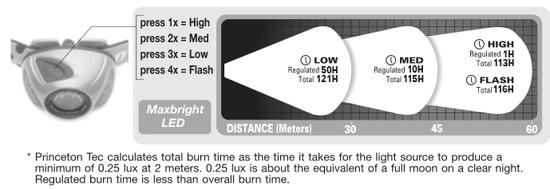
Princeton Tec has obviously started playing games which is unfortunate for the consumer. Here's what their old charts used to look like (Notice that they list the total regulated time which would be the max lumens):

burn time (old spec)

The Specs for the Vizz no longer list the regulated time in their new table which gives the false impression of a long "bright" burn time.

burn time (new spec)

In both cases they do state that the minimum light output will be .25 lux at 2 metres. That would be at most, 3 lumens. Good luck night hiking with that!

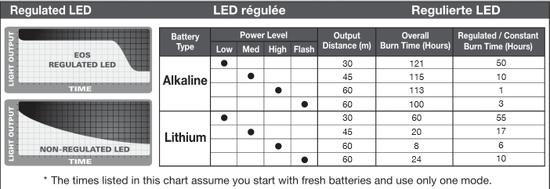
This old table (from my EOS) was very helpful but has been removed from their new manuals (no doubt it wouldn't be good for sales).

burn times for battery types

Viewing 25 posts - 76 through 100 (of 116 total)
Loading...