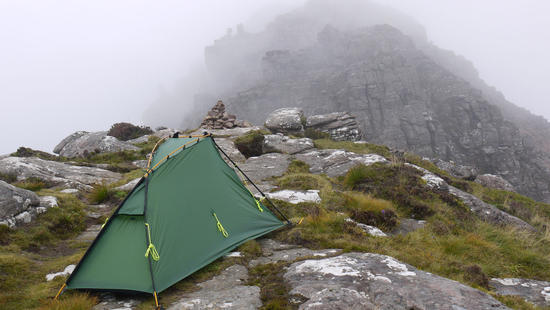
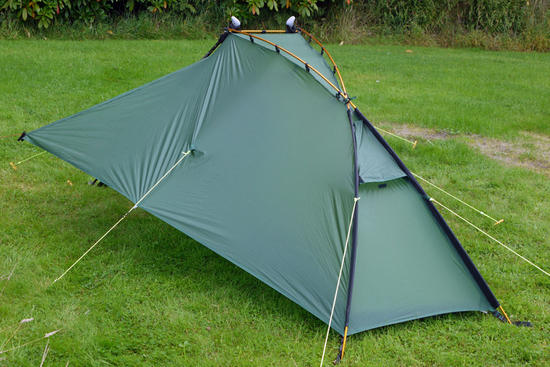
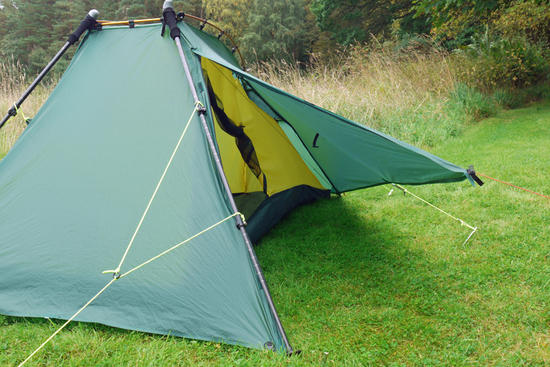
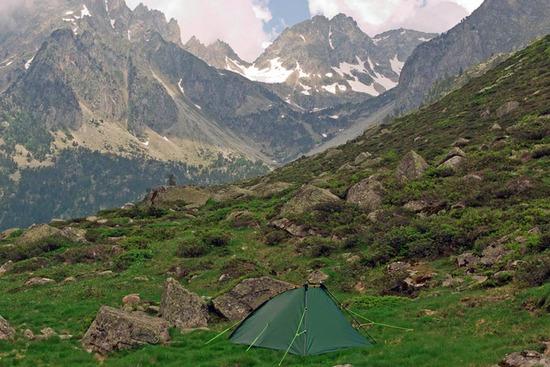
> When the tent has enough inherent (freestanding) structure, then there is a greater
> potential of lateral forces (wind) to be resisted by compressive forces of the
> structure, and not just by the tension of the guy lines…
Forgive me if I disagree for rather basic technical reasons, but the problem lies initially in just one word. That word is however vital. It's 'compressive'.
The only things in a tent which has any compressive strength are the poles (CF or Al). They have way more than enough compressive strength, so that is not an issue.
The poles also have flexure (bending) strength. In general this is not enough to keep the tent up in any decent wind. Why? Because the large sail-like areas of the fly pull on the poles and bend them, to the point where the poles can bend and collapse.
So what keeps the poles in their right shape? Well, with some tents, not very much. Those are the tents which I tend to dismiss as being useless in a wind: I am sure you all know what general classes I mean. Any tent with a throw-over fly falls into this class. Any tent with l-o-n-g unsupported poles does so too.
However, there are tents where the poles are held in shape by two forces. When the pole is short and bent it tends to be a bit stiffer against further deflection than the long ones arching over a pop-up. This is pole strength, albeit not enough in itself. When the pole is sleeved into the fly and the fly is properly guyed, the tensile strength of the fabric of the fly restrains the pole from bending in 'unfortunate' directions. You have to prevent the fly from distorting too much of course, and that is the main purpose of the guy ropes. When the fly is tight and guyed, the poles find it very hard to deflect. So the poles stay up, and so the fly stays up, and so the occupant has a good night.
I apologise if this sounds pedantic. But reread it at 2 am in a howling gale and see what you think.
Cheers