


Thanks Marc that's exactly what I was looking for. What minor improvements are you thinking of incorporating? The tents already look as good as anything that's on the market.
Topic
Become a member to post in the forums.
Thanks Marc that's exactly what I was looking for. What minor improvements are you thinking of incorporating? The tents already look as good as anything that's on the market.
Chris
Venting mainly. The single pole tent has a 60mm gap all round the bottom edges, and a high level vent, which seems ok. The 2 pole tent has the hem of the flysheet right down to the ground, as this one is intended for winter use. I think the front vent should be lower and larger, then a high level vent added, to make it breathe better.
Also, I have put in too many inner tent hangers, adding to the weight and time to assemble.
I have a trip to the Outer Hebrides coming up, and I will be camped mainly on remote beaches, in amongst the sand dunes if possible. Those storms that roll in from the Atlantic will probably reveal other improvements that can be made as well.
Could you describe how you set up the hangers for the inner tent? Does the inner tent hang from grosgrain loops on the flysheet?
I also noticed that you use a pole sleeve for the bottom half of the poles, but switch to clips on the top half of the poles. Was this for extra strength? How do you think the tent would perform if using only the clips?
Thanks for all the information!

The inner tent has elastic loops that are sewn into the top seams, the elastic loops go through bullet shaped toggles (cant remember the exact name for them).
The flysheet has grosgrain loops sewed into the flat felled seams, 1/2" stuff is fine, there is not a lot of stress on them. The grosgrain goes through 15mm 'O' rings. To attach the inner tent, feed the toggles through the O rings.
I changed to clips for the top half of the poles as the sleeves were catching the wind and appeared to be putting a strain on the poles up top. My knowledge of aerodynamics is extremely limited, but I suspect the wind hits the side of the tent then accelerates upwards. Either that, or the wind is just stronger at that height, or just catches on the lip formed by the sleeve.
The clips definitely work better, and the fabric is still plenty taut. Whether this would work the full length, I don't know. I prefer to have the poles in continuous sleeves built into the flysheet wherever possible, preferably flat pole sleeves, like in the single pole tent.
Bear in mind that if it is all clips, it is going to take longer to set up. Not what you want with cold hands and dodgy mountain weather. I can feed the poles through the clips at the top, rather than clip them on, as the poles are already pretty much held in place from the sleeves lower down. Clips are also heavier than sleeves.
Daryl.
That is impressive, thanks for the link.
I need to start reading me up on cuben fibre I think!
"Either that, or the wind is just stronger at that height"
Yes it is.
Next time you are out in the wind lay down flat on the ground and that will become very obvious.
> a length of fabric 100mm wide, fold it in half, and run a line of stitches 5mm in
> from the cut edges. This edge of the sleeve is then inserted 10mm into the top fold
> of the flat felled seam
IF I understand this correctly, which is not guaranteed, that gives you a 40 mm wide sleeve? If correct, then I would guess it is far too much. Even my winter tent has only a 25 mm wide sleeve, and that handles getting frozen solid. It also is much less susceptible to the wind.
Cheers
"IF I understand this correctly, which is not guaranteed, that gives you a 40 mm wide sleeve? "
Yes, 40mm is correct. I used a 30mm wide sleeve on the single pole tent and the pole doesn't run as smoothly as I would like.
Hope you don't mind me asking, but have you got any Easton poles available that I could have for my own shelter project? Happy to pay to cover the cost of the poles plus postage from Scotland to Wales.
Anthony
Just enough Easton to fulfil orders at the moment, should have more in about a week. PM me and I will see what I can do.
I hope you had these tents pitched during the recent storms!
I hadn't checked the forecast and wasn't able to get out in the hills anyway, but I had left this tent out on the timber deck in my garden, not staked down.
I had tied one side panel guyrope around a heavy hardwood bench. In the morning, both the tent and bench had travelled about 30 yards, stopping against a fence. The tent is Ok but the bench is a bit smashed up. Even concrete paving slabs were airborne, wild!
That is a seriously impressive tent! I got halfway to building something like this (before other projects took precedence), but yours looks to have a better design, (by finishing the alu poles at the beak of the tent and putting the hiking poles out front).
Although the concept of 'freestanding' could be misleading in extreme environments, man it is useful in many moderate ones. I recently came back from a 5 day hike through Tenerife where the soil is often very hard but also very brittle (like super compacted sand) and having a tent like this would have saved me 30 minutes of searching around for suitable rock anchors!
Thankyou.
I never hiked in Tenerife, but sounds like a great trip! I do recall there being a lot of dark, hard soil there, probably remnants of lava deposits from its volcanic past.
I like to do the occasional overnight summit camp, where the ground is often rocky. Although no tent is truly 'freestanding', I would not like to risk attempting this in a tent that is not self-supporting.
Become a member to post in the forums.
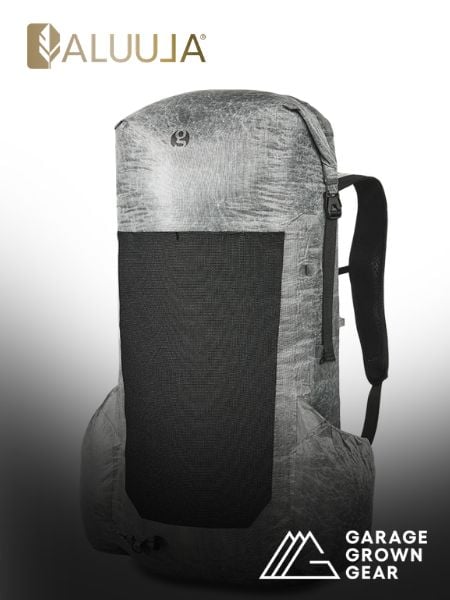 New Gear with Aluula FabricsLighter, stronger, more abrasion-resistant, and highly water-resistant - explore ultralight backpacking gear made with ALUULA Graflyte fabrics. Engineered for exceptional strength, durability, and lightweight performance, ALUULA Graflyte helps reduce pack weight without sacrificing reliability, making it ideal for demanding backcountry adventures.
 © Beartooth Media Group Inc.
 Loading...