Topic

New Down Quilt from Sierra Designs with built in hood and hand pockets

  • This topic is empty.
Viewing 25 posts - 76 through 100 (of 120 total)
PostedSep 30, 2013 at 9:29 am

Rarely add to the quality of a product. Usually they help sell a inferior product at a high price. I am automatically sceptical of salesmen. Does the fake plastic cheese trigger on a victor mouse trap look like cheese to a mouse? Does a mouse know what cheese is? Will future generations of mouse traps put a plastic peanut on the trigger? Now that's a great idea. If the SD make over doesn't pan out Michael you can have that idea. But actually I see some backpacker editor choice awards coming your way. If not I think there is a discussion forum called building a better mouse trap that you can sell your plastic nuts on. :-) 8-0 I'm in a weird mood this morning. Awnings blow up I love it. "Help me help you"

Jason Johnson BPL Member
PostedSep 30, 2013 at 2:46 pm

Could you send a pic of your EE quilt..I was thinking about getting the royal blue and would love to see what how it looks.

THANKS

PostedSep 30, 2013 at 8:15 pm

Michael G. you are to be applauded for the new direction of SD. I presently have a Tarptent Scarp 1 which I am relegating to my winter tent using the cross poles. I was about to get a Moment DW for my 3 season tent but am intrigued with the new Flashlight 1. Watched the video and downloaded the workbook. A question, why the yellow floor in the UL? Why not grey, black or the SD blue. All would contrast nicely with the yellow walls. Worst case I would have to go with the regular fabric model.

PostedSep 30, 2013 at 8:31 pm

Several larger US companies are using well under 30 denier PU coated nylon: MH and GL to name two. Yah, I know – it costs more.

Re the vestibules:

"1. Vestibules place gear in the doorway, where you have to crawl open it to get in and out of the tent"
A straw man. Well designed vestibules are large enough to hold the gear under the covered and closed side, leaving plenty of space for entry and exit on the side that opens. Another vestibule at the rear of the tent can also be used. My modified One Planet Goondie holds enough under the fixed side of the cover up front, that the vestibule under the rear cover was replaced with more floor space. BTW, the fly is 15 denier PU coated nylon, trail weight & guys < 2.5 lbs, floor area > 23.5 sf.
GNDY-flyFrontOpen

"2. You have to open two doors every time you want to get in or out"
If the tent has a canopy or fly, it must be opened to get in or out. If you also want bug protection, a netting door must also be opened. That's par for the course.

"3. Generally, they inhibit ventilation when deployed for poor weather. It is true that some vestibules do allow you to keep them open in the rain, with an otherwise positive drip line, but this is almost never the case."
It may be almost never the case among the larger US companies. But among the better tentmakers, it is almost always the case. Vestibules are not the issue. Competent tentmaking is the issue. Have you looked at the TarpTents?

"4. When closed for weather protection, ventilation is USUALLY reduced dramatically, and I can't think of a single design that allows you to continue to look outside and enjoy the views, regardless of weather. I have hiked a LOT in the rain, and being cooped up in a steamy tent without air or a window is not fun, especially when you can have all this while going even lighter."
If this is an argument for tarps, please say so. They definitely have their place. As for tents, you must button up in high winds else the canopy or fly will balloon, be subjected to great stress, and place the anchoring at risk. So the answer to steamy is good vent design, or in the alternative, awnings that allow the wind to pass right through, which is problematic because rain may be coming right along with it, and gusts can be totally unpredictable. I camped in a modified two-awning WE Bug Dome for several years, and greatly enjoyed the full view out the front and cooking and eating under the front awning in the pouring rain. But wouldn't dream of taking it well above timberline in exposed locations.
BDfly
The tent weighs 3 lbs complete, in the bags, and the floor area is 30 sf.

"5. You can absolutely use the doorway of a awning/door combo to transition from wet hiking to dry camping. In fact it is one of the main benefits. … . The drop door is used to sit down inside the tent, while sitting on the OUTSIDE of the tent wall. Then, out of the rain, you can make your transition. Of course, there are other ways to accomplish this, but we at SD believe the awning/drop door/separate gear storage is the lightest and most elegant."
Yes, there are other ways. Like unzipping the vestibule and net doors, stepping into the tent, and rezipping the outer door after you. You have to stoop, but if you have to crawl, it is more of that poor tent design at work again. The one thing I do agree with is the value of awnings that can be locked down to create a closed vestibule in extreme weather, and opened up for ventilation in unblown rain and good weather. Hope we see much more development along those lines. Still, a zipper in the awning is needed for easy entry and exit sans the low crawl.

Will look in January to see what's up at SD when the new tents are posted. But as already noted by some others, lighter materials will be needed to attract light packers, and more functional designs as well.

Scott, please accept my apology for going off-thread.

Ken Thompson BPL Member
PostedSep 30, 2013 at 9:19 pm

Thanks for the Flashlight video. I await others comments on a few things.

PostedSep 30, 2013 at 9:39 pm

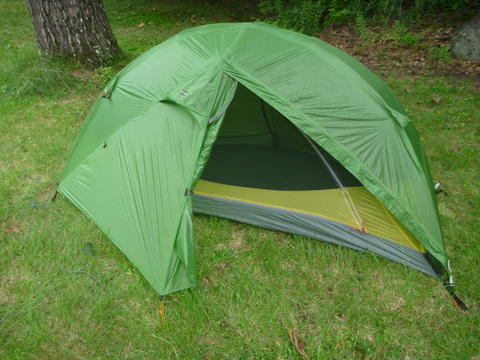
Tent color: yellow was chosen simply because we liked the color and due to its historical significance with Sierra Designs. Most of the energy went into the fly color, since we wanted something "natural" that would blend in to many environments, but has a flesh tone element to avoid the green depressing interior. It needed to shade in the hot, but not be too dark. The final color "aluminum" met all the objectives, and was a nice update of classic SD beige. Note that the yellow has a lot of green in it that is not coming through on the video. It looks much richer in person, and the inside of the tent is very cheerful.

Wind testing: this is an area of personal interest for me, since I learn something new in nearly every test. There is so much that is counter intuitive. If you look at some of the photos in my blog, you will see my sil/nylon missing link in some sites where most would not think to take such a shelter. Trekking pole tents are very strong in the wind for a variety of reasons; awnings are another wild card. Designs where a pole extends to a corner to make a tent freestanding are a weak point. The other factor is that people generally dramatically over-estimate how hard the wind is blowing. 30mph sustained wind at sea level is a very hard wind. Most people who felt this wind would guess it at about 50mph. Plus, the higher the elevation, the more speed is required to generate the same force due to the lower density of the air.

We could have a whole thread on wind and tents what would be very interesting. It's one of those funky mysteries with very few real experts, myself included. Until recently, you had to rely on big fans (like Hilleburg) or very small wind tunnels (like U of WA). I have seen many wind tests for tents (including the flatbed truck I-5 system that MSR started in the early 70's) I can tell you that every tent I have seen fail in the wind is from three causes: 1. It just blows down flat; some would not call this failure since nothing breaks, though poles can bend. 2. A pole breaks; mostly this is what I have seen, and why trekking pole tents, which operate under direct compression with a stout pole, are so good. 3. The tent flaps to a point where the fabric can rip.

The final point relates to the discussion regarding lighter weight PU coated fabrics/CPIA-84 comments from earlier. Because the PU locks down the fibers on a woven fabric it significantly reduces tear strength, and lightweight fabrics can suffer durability issues as a result. Not just abrasion, but tear. Sil/PU fabrics, which not only allow the yarns to float but lubricate them with water shedding silicone goodness, are both light and strong, and resistant to abrasion. These are really good tent fabrics for tents, so long as you accept that they currently cannot be effectively factory seam taped, and do not currently pass fire standards. So, yes SD could have made some expensive lighter versions of our tents with one of these fabrics, and we still may, but instead we are looking for a better and different solution that is strong in both abrasion and tear, and is light. Or, we could just ignore CPAI-84 and build the best tents we can make, then sell them only in non CPAI-84 states. What do you folks think we should do?

What tents are strongest? Pyramid tents, similar to the design suggested above, are super strong. Volume is focused lower (wind is slower at the ground) Solid pole or poles under compression=good thing. Plus, the seams create built in guy lines directly to the stake outs. The other tents that are really good are tunnels. The bent poles generally do not go to a corner, so they are supported by fabric to keep them from inverting, and the ends are protected by seam guy lines and focus the force in equally all around the circumference of the pole. The weakest designs involve poles that go to a corner to make tents freestanding. It's one big reason why I am NOT a big fan of freestanding tents personally.

PostedSep 30, 2013 at 10:00 pm

Samuel:

Like I said, every time I think I can guess which tents will be strong in the wind, I prove myself wrong in testing. That said, I would guess that that fish pole (moss) structure and dual awning tent you showed would be a VERY strong. I am surprised that tent weighs three pounds with all those poles…

To your point #2, note that the rain door and the bug door on the flashlight are the same door, so there is indeed only one door to open to exit and enter, same with all the new SD tents.

I am very familiar with Tarptent, and REALLY like some of their design elements and am a fan of their shelters in general. Smart, fresh thinking. Love it.

I'm not arguing for tarps or for tents. In fact I separating them prevents design evolution of either. If you look at the new SD tents, you will see that they really are just tarps with built in bug netting and floors. There is not body and fly. That's what inspired me in 2001 with the Missing Link (and why I named it that), and it's what I love about Tarptent, Six Moon Designs, and others. I do think that the new SD tents nail ventilation and livability like nothing that has come before, simply because most others still protect the inner tent with an external fly, and the SD tents combine these crucial elements.

Your comments in #5 are very interesting. Though the tent was never produced, you should look at the Malcontent that I made in 2002. Your request for further development just gave me a great idea that I struggled to achieve all those years ago. Thanks!

K C BPL Member
PostedSep 30, 2013 at 10:04 pm

Marketing Sierra Designs to BPL members is like marketing Scion vehicles to Lamborghini owners. We're a bunch of gear snobs, 5 pound base weights- cuben, carbon fiber and titanium everything.

You have a great place in the middle, anything to help the general public lighten up will help.

Jerry Adams BPL Member
PostedOct 1, 2013 at 7:02 am

"30mph sustained wind at sea level is a very hard wind. Most people who felt this wind would guess it at about 50mph"

When I've measured wind speed with my wind meter, it's just like you say, 30 MPH is very strong.

If you're on the side of a mountain then you get higher wind speeds, but most people don't need that.

If a tent is designed for higher wind speeds than you'll ever need, it will probably be heavier than necesary.

PostedOct 1, 2013 at 1:01 pm

Michael; Thank you for the yellow floor reasoning. As you indicate seeing the yellow in person may change my mind. A couple of more questions and then no more till I actually see one. In the workbook (I realize it may not be totally accurate) it seems there is a back window and the fly appears to be to the ground from the overhead view. Ia there an outside upper vent cover in the fly so air can flow through the window, or could the fly be cut higher in an arc shape to encourage air flow. Having used many one person tents over 40 years, they can get pretty stuffy more so than 2 person models and the new line is all aboout air flow.. Also the gear closet is listed as 7.5. The 2 man version lists 2 closets at 3.3 each. What is the actual size of the one man closet? Thanks again for where you are taking this company.

PostedOct 1, 2013 at 1:30 pm

Sorry all, I should have mentioned that the Flashlight 1 design has changed significantly from what is depicted in the workbook. The depicted design utilized a full coverage awning with a gear port to access the gear storage. And, just like the full coverage vestibules I have been arguing against in this thread, this one ventilated poorly on one side of the tent, where the configuration mimicked a traditional vestibule. We conduct ventilation tests with humidifiers that simulate the vapor produced by a person, then measure interior humidity of the tent over time. The current design failed both the lab test and concurrent field tests with regards to ventilation.

So, even though we had already introduced the item, we canned it and went back to the drawing board.

The updated version is being prototyped and tested as we speak. Only testing can tell for sure, but I am feeling confident in the ventilation of the new design, since it allows full cross ventilation in the rain, just like all the other SD tents. Plus, I think it may get even lighter.

So stand by for revisions to this item…..

PostedOct 1, 2013 at 1:33 pm

For a sneak preview of the updates to the Flashlight 1, you can see a screen capture I used to share an idea for the update with the team in Boulder. It is the shot used on my profile. Since we work remotely from one another, there is a lot of video and photography going back and forth…..

PostedOct 1, 2013 at 3:45 pm

Thank you Michael. I'm not going senile after all. I just couldn't see the new innovative and functional features of the 2 man were being applied to the 1 man based on the current workbook diagrams. Will follow your updates on this. As I said earlier, my buget for next year is for a new 1 man tent and this one really has my attention.

Derek M. BPL Member
PostedOct 1, 2013 at 7:03 pm

+1 on basically everything Samuel Farrington said above, especially the part about the utility of tent vestibules that can be turned into breezy awnings at a moment's notice (the TarpTent Double Rainbow's "porch mode" is an excellent example of this).

Also, I think KC is right that the BPL forum crowd is not exactly the target market for Sierra Designs. Still, I think it's an encouraging sign that Michael Glavin is soliciting us all for feedback and interacting with the BPL community in the first place.

How many other non-cottage industry Senior VPs have done this?

Obviously, just because we aren't the target audience for Sierra Designs doesn't mean our ideas and experience can't make the products better. Clearly Michael Glavin sees that, or else he wouldn't be spending his time discussing his upcoming products with us.

And lastly, my apologies to the OP, Scott. We have totally jacked up your thread. Hope you don't mind ;)

PostedOct 1, 2013 at 9:10 pm

Michael,
Thank you for your comments. Very gracious of you.

I appreciate that my comments were not gracious, though. So will attempt some helpful, if not positive comments.

The wall under the awning goes back to the original Eureka Crescent, if not well before that. First thing I did with the Crescent was to remove the fabric portion of the door/wall entirely, leaving just the netting, and put 'beaks' on the awning that zipped shut to make a closed vestibule with the front slightly open at the bottom for ventilation:
Crescent
In its prime, before the PU coat degraded, this tent handled some serious gales in unprotected areas. And all the benefits of the awning were kept when the beaks were rolled up out of the way.

The beaks, from 1.6 oz (with coat)PU coated nylon from Warmlite, were lighter than the 2.7 oz coated door that was removed from the tent. The elevation of the vestibule bottom did not create a serious wind problem, because as Franco points out, the wind is usually quite less just above ground level, and as always, we at least try to keep the entrance facing away from the prevailing wind.

Why not just leave the vertical wall under the awning as is? Well, in addition to the usefulness of the vestibule, there is nothing wind hates more than a vertical wall, especially if there is an awning around it to catch the wind. You may think that the guylines will resist the wind. Yes, but the tent will shake like the dickens. So why fight the wind if you can channel it around a pointy vestibule. So long story short, you may need to add some yardgoods to those awnings to make the tent windworthy. Then you won't need the weight of the coated nylon on the doors, just the netting, or a light DWR fabric. And the improved air circulation will help with condensation under the roof.

Although I think you are going to have a problem with condensation on the single wall at the head end, where it will be annoying. A way must be found to shield the head from the wet wall. Maybe a pullout vent that will place netting next to the head, and ventilate at the point of exhalation, where we most need it.

Adding fabric, even if weight neutral, raises the flame retardency standards issue.
There is the implication that the lighter nylon is not sturdy enough, especially with the required PU coat. That's why I am trying out the 15 denier Goondie, to see if it's so. My feeling is that if Snow Peak can market a PU coated 20 denier Lago tent, using polyester that is weaker than Dupont 6.6 nylon, and market it as a winter tent, then the real issue is not the inherent strength of the material; rather it is the quality of the material and the coating. If SD cannot profitably market tents of these lighter materials, then that, alas, seems to end the discussion right there. But Mountain Hardwear and GoLite are doing it, and I'd think they'd have just as much interest in a profitable product.

Also, a few companies are using fabric coated with silicone on one side, and PU on the other. That could yield a lighter floor, and meet the CPAI standards. I've found that silcoated nylon with a high HH makes great floors because the elasticity of the material improves the resistance to abrasion and pointy objects. The catch is that the floor has to be well tensioned at the corners to keep it from sliding about.

That rear wicket could also use lighter carbon, albeit with elbows of Easton 7075-T9.

With lighter materials, hence lighter weight, and some windworthiness, I think you might have a winner for the many who hike with two trekking poles these days.

Good luck to you!

P.S. Your IT guys should make the videos viewable by those of us who live in the boonies without broadband.

PostedOct 2, 2013 at 12:53 am

Sorry, Samuel. There is no IT guy, this is just me in my basement. Sorry, I do like the high def videos. I think if you view them directly at my vimeo site (all of this is my personal site and vimeo site, not part of SD) you can view in lower definition. http://www.vimeo.com/michaelglavin

For all the tent geeks, I just made a movie showing some testing done in the DAC wind tunnel which shows what I am talking about regarding wind, awnings and what not. The final video shows the new Lightning and how the awning supports the tent in the wind, even with that nearly vertical wall/door right behind it. I made that clip pretty long, so you could kinda get a feel of the difference between a 25 and 35mph wind. In one of the videos I stood in a 25mph wind (some of the tests show the wind in M/S, so I converted). Sustained 25mph wind is HARD. I was worried about slipping on that metal floor.

Note also that there are two kinds of wind tunnel (I forget the name). In one kind, the wind is consistent throughout the entire width of the tunnel. These need to be much narrower, like the one in Seattle at the UW. Jake built this one that does not have the consistency of wind across the whole tunnel, but has a much wider wind path and for the first time is allowing us to test larger shelters AND facing multiple configurations in the wind.

Sorry if I broke the thread. I think that was my fault. I have never posted on any forum like this before, and am clearly addicted. My wife thinks I am crazy, and thinks I should stop working on backpacking, stop talking about backpacking, and just go backpacking. I like that idea.

The video is on the SD page at my personal site (not affiliated with Sierra Designs) at http://www.zenbivy.com

PostedOct 2, 2013 at 1:37 am

Samuel:

I am curious about your opinions on nylons vs. polyesters on the rainflys, specifically your comment about polyester and nylon 66.

Also, noted your idea about the "head vent" on the flashlight. We prototyped that exact thing, then killed it; like I said before: "a dollar and an ounce" (though in this case it was more than one of each). Instead, focused on trying to keep air moving through there. Ironically, in my own testing (I personally have about half a dozen nights in this particular model), I never had really bad condensation conditions, and never experienced any condensation inside. Other testers who tested 1p and 2p on the same trip ripped the 1p for condensation (as detailed earlier), but reported good results with the 2p. We are getting more test results all the time so we will see what develops there.

Note: we are using Sil/PU IN 30d for our 2014 UL versions. Note this is a bit tricky because the silicone migrates and if the PU is not cured properly, you get nasty sticky over time. I just really personally hate the PU, since it just seems to cause all kinds of issues, including delam and degradation as you noted. Would love to figure out a way around it altogether. Am working on it……

PostedOct 2, 2013 at 7:25 am

Michael,
Wilderness Equipment of Australia has been using a sil/PU coat on its tents for some time now. Their site has a "fabric mojo" that goes into some detail.

Sea to Summit has a couple 'Specialist' tents that share some design approaches with the new Flashlight. The fabric is Pertex Endurance. I have a nice letter several years old from a designer at SD explaining quite well why they were not partial to waterproof/breathable fabrics such as Endurance for tents.

The person most knowledgeable about outdoor fabrics that I know of is Roger Caffin, an editor right here at BPL, who lives in Australia, but can be reached through BPL.

Polyesters are nice because they usually sag much less than nylon, which is great, particularly on a partially single wall tent. But not all polyesters are equal, which may explain why Snow Peak uses fabric manufactured locally in Japan for the Lago. I've noted that the higher HH silnylons out of the Far East sag a bit less. Have looked at the low denier PU coated nylon tents form Mountain Hardwear and GoLite, but haven't had them out backpacking to see how they sag. Did not like the inside space limitations of the designs even without sagging. But there was very little sag in the 15 denier PU coated nylon Goondie that I took out this past summer. Time will tell how durable it is. Have already noted that the netting they use is not particularly durable compared to the .8 oz polyester netting sold by Bear Paw Wilderness Designs here in the USA.

Porcher Sport of France treats Dupont 6.6 nylon to make several weights of paragliding fabric. Some of the fabrics in the 45-50 gram range are dubbed 'aquatic' and are specially treated for water as well as sag resistance, but I've not been able to get ahold of enough to test for HH and make a tent. I did obtain some of the 27 gram, but tests by Roger showed a low HH. I'm planning on experimenting with some PU sprays from 3M, Johnson Kiwi and others to see if they raise the HH on the 27 gram. It wouldn't be so bad to have to spray your tent before each trek if it were made out of a tough nylon that weighed only around .9 oz per square yard total and didn't sag much.

Single wall tents that do reasonably well with limiting condensation when pitched on the back lot, can be a disaster in mountain weather. SD had one called the 'Baku' which may have suffered this fate. Last I saw, they were selling them dirt cheap at the outlets. The North Face suffered a similar fate a few years ago with a knock-off of TarpTent's Scarp, but with one of the PU waterproof/breathable treatments. They should have read that letter I got from that SD design associate.

PostedOct 2, 2013 at 9:01 am

Good clip. Could use a few tweaks, some as suggested. Why not make the i identical to the 2 only narrower. Excellent ventilation, 2 gear closets, eliminate one door zipper or even leave it in. My personal preference for a one man tent is 2 doors. Have even added an extra door to single door versions in the past. Also why not a 1 person version of the newly designed Lightening tent. Great design based on the wind tunnel testing shown on 'zenbivy.com'.

PostedOct 2, 2013 at 11:09 am

Hey Jim:

We have lots of stuff in the product pipleine. Both lots of new ideas, and versions of existing as you suggested. I agree a 1P version of the lightning is very interesting.

Big question: Why 2 doors on a one person tent? Seems an odd suggestion given this forum with the obvious weight implications….

PostedOct 2, 2013 at 11:54 am

I've had a few items of SD gear in my day, including 15+ year old Meteor Light I finally had to retire after years of use (and occasional abuse). And a SD sleeping bag that still gets used when car camping (slept in it a couple days ago).

Props to you for being here and soliciting input. God knows you'll hear it from the BPLers. And best of luck with innovation and products going forward.

PostedOct 2, 2013 at 11:56 am

Big question, small answer 'personal quirks'. we all have them. Big answer, wind,snow ,rain,sleet etc.,etc., as you well know is dynamic always changing direction, swirling etc. My personal experiences re sheltered ingress/egress, sheltered cooking conditions in inclement weather, limitations of site (slope, rocks, bush, etc.) led me down the road to the flexibility of 2 doors and to the calmer (leeward) side of the tent in most cases, not all. I am willing to pay the weight penalty, most are not. I understand that and will make my own changes if needed. Back in the 70's,80's,90's,I was dealing with 4 1/2 to 5 lb.+ tents and now it's 2 1/2 to 3 and change with 2 doors, I'm happy. My pack weights are now 20lbs +/-, back then 35lbs+/-. You are well aware most hikers (yourself included)) like to tinker with gear, it's part of the experience. This site is about light hiking, not uber or ultralight. They have their own sites and mfrs. Functional, light gear is where SD is headed, good for them. l

PostedOct 2, 2013 at 6:12 pm

Michael,

I sense that you get the impression that everyone on BPL is a "gram weenie" (not that there's anything wrong with that), which is by far not the case necessarily. Most of us take other things such as comfort and safety into consideration as well. The one thing we all have in common though, is the desire to "lighten our load" and shave down pack weight. I first joined BPL with just that goal, back when my 'Kit' (if you could call it that) included 2 Blue Walmart Tarps, an Osprey Atmos 65 Pack, 100 yards of ParaCord, a "lightweight" synthetic 20* bag that was comfy down to about 45* before freezing my nether regions, and a cheap parachute hammock. Needless to say, my "lightweight" strategy at the time ended up just being me coaxing my way into someone's tent when the temp dropped below 40 (which could have it's advantages from time to time). Nowadays my pack weighs a lot less, AND can get me down to the 20s comfortably. But I'm getting a bit off track here.

Point being, most of us started as brand name dayhikers or campers and slowly transitioned our way into ultralight backpackers. Usually there were many stops along the way, small gear tweaks, lots of ditched gear, "Big 3" Upgrades, lots more ditched gear. I think at one point or another during out backpacking lives we would have been drooling over this quilt to replace our REI clearance sale sleeping bag. A friend in advertising once told me this: "You can sell anything, absolutely anything, but first you have to find your market and show it to them…you could discover the cure for cancer and not sell a single dose if you didn't get out there and find the people with cancer." (His actual explanation was a bit more explicit, but I've paraphrased and changed some verbage to protect the innocent).

As a side note, I'm not sure how keen you are on hammock camping, but I will tell you that there are few (if any) hammockers that are buying sleeping bags over quilts.

It's cool to see you down here "talking shop" with all us BPLers, you're in good company, a lot of us have learned to make our own gear here mostly because commercial companies were not offering what we were envisioning. There is no doubt we have some common roots here.

Good to have you here.

-Dave

Viewing 25 posts - 76 through 100 (of 120 total)
Loading...