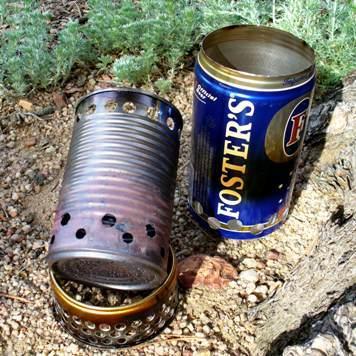
Something to consider. In my experiments with tincanium stoves, I've concluded that it is important to restrict your primary air (fewer/ smaller lower holes)–otherwise you produce more smoke than the oxygen coming through the secondary (higher) air holes can provide. I've examined my Bushbuddy, and concluded that Fritz has done his calculations very precisely, and that's what makes it such a smokeless stove.
The serious stovers (see their discussion ongoing @ http://www.repp.org/discussiongroups/resources/stoves/) suggest a 5:1 ratio. That is, have five times more air going through your _secondary_ (upper) holes than through your lower holes. I might suggest more like 3/1 for natural draft (fanless) stoves. Following this ratio, more or less, should result in the kind of "candle" flame put out by the Bushbuddy.
BTW, if, sans pot, you see the flames climbing very high, this is proof that there is not enough secondary air–flames climb in search of oxygen, so to speak.
Hapy stoving,
Muskrat the pyro